
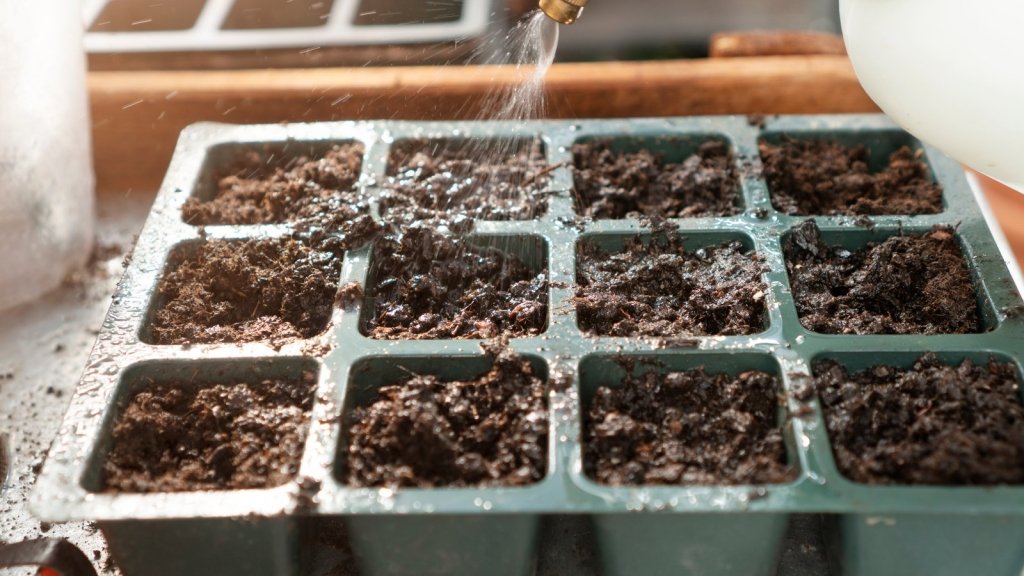
The short version: Seeds need a mix that stays damp all the way through germination without ever being sodden, and the water has to arrive gently enough to leave them where you sowed them. Wet the mix before you sow, water with a fine spray or from below, cover fine seed with vermiculite, keep the surface damp until the seedlings are up, and then water in the morning when the surface starts to dry rather than on a fixed schedule. Get the moisture steady and the air moving, and most of the classic seedling failures, from washed-out seed to damping off, become far less likely.
Watering is one of the easiest ways to lose a tray of seed, and one of the easiest to get right. A tray sown with care gets a good drenching from a hose, the fine seed floats to one corner, the mix slumps, and a week later a clump of seedlings comes up in a heap while the rest of the tray stays bare. The other failure is quieter: a tray kept so wet that the seed rots before it sprouts, or the seedlings keel over at the soil line. Both come down to how the water arrives and how much of it stays.

What a seed actually needs
A seed has to take up water to wake up, and then it needs oxygen as much as moisture to keep going. A seed-raising mix that stays evenly damp and drains freely gives it both. A mix that dries out at the wrong moment stops germination dead, and a mix that sits saturated drives the air out of the pore spaces and rots the seed or invites disease. Moist but never wet is the whole art, and a good seed-raising mix, one that holds water yet still drains, does half the work for you. Our guide to seed-raising mix covers what to look for.
Start wet, then water lightly
Water the mix before the seed goes in. Fill the tray or punnet, water it gently until water runs from the base, and let it drain. Then sow into a mix that is already damp, cover the seed, and give it only a light misting to settle it. That first soaking is the only heavy watering the tray needs until the seedlings are up, and it is the step that stops seed being flushed around later.
One safety note before you start. Seed-raising mix, potting mix and compost can carry the bacterium Legionella longbeachae, so open the bag outdoors and away from your face, wear a mask and gloves, wet the mix down to keep the dust out of the air, and wash your hands with soap afterwards. The risk is higher if you are older, a smoker, or have a weakened immune system.
Sow at the right depth, roughly two to three times the seed's own width, and dust very fine seed such as lettuce, celery and snapdragon over the surface rather than burying it, checking the packet first because some flower seed germinates better covered. Carrot is a different case: sow it direct in the ground at about 5 mm rather than in a punnet, since it transplants badly. A thin layer of vermiculite over the top holds moisture around the seed, lets light through to the seeds that need it, and stops the surface crusting. It also cushions the water as it lands, which is exactly what fine seed wants. Our guide to how deep to sow seeds has the details by crop.

Watering from above without washing seed away
- Use a watering can with a fine rose, held low and moved steadily across the tray, or a hose nozzle set to its finest mist. Droplet size and pressure matter more than the tool.
- A spray bottle or pressure sprayer is the safest option for fine seed and small punnets.
- Keep watering with a fine spray until seedlings are a centimetre or two tall and have some grip on the mix, then move to a gentler rose or a slow pour at the base.
- Before the seed is up, keep the surface continuously damp. Once seedlings have emerged, water when the top of the mix looks and feels dry rather than by the calendar. That may be twice a day on a hot balcony and every third day in a cool shed.
Watering from below
Bottom watering sidesteps the problem, because no water lands on the surface at all. Stand the punnet in a shallow tray of water, with the level a little below the top of the mix, and let the water wick up until the surface darkens, then lift it out and drain it. Ten minutes is usually plenty. The trap is leaving trays sitting in water, which keeps the mix saturated and rots seed and seedlings, so treat it as a soak, not a home.
Capillary matting takes the idea a step further: a strip of absorbent fabric with one end in a reservoir and the trays sitting on the rest, so the mix draws up what it needs. Growers report seedlings raised this way develop strong root systems, and it is a good answer for a shelf of trays you cannot check twice a day. Wicking beds do the same for a whole bed, although even a wicking bed is watered from above for the first week or two while roots find the moisture.

Covers, heat and shade
A cover over the tray, whether a clear lid, a sheet of glass, a board or a scrap of shade cloth, holds moisture around the seed until it germinates. Vent it every day and remove it the moment the seedlings show, because a sealed, humid cover in a warm Australian spring is the ideal setup for damping off.
In hot weather seedlings dry out from the top faster than their roots can keep up. Water in the cool of the morning so the mix is charged for the day, and if a tray is wilting by afternoon, water it anyway, gently, at the base. On a hot day run the hose off to one side until the water feels cool before it touches a tray. Water that has been standing in a hose or a shallow pipe can come out hot enough to scald a child or a pet, as well as shock a seedling, so do this before anyone plays with the hose too. Shade cloth of around 30 to 50 percent over the trays takes the sting out of the sun, and lifting trays off hot concrete onto a bench or a pallet keeps roots from cooking from underneath.

Damping off, and how watering causes it
Damping off is the seedling disease where healthy-looking sprouts collapse at the soil line, or seed simply never comes up. It is caused by a group of soil-borne organisms, Pythium and Rhizoctonia among them, that are common in soils everywhere and thrive in wet conditions. Overwatering, poor airflow, crowded trays and cold, saturated mix are the triggers, and the controls are the ones in this article: water in the morning, let the surface dry between waterings, thin crowded seedlings so air moves, and use a fresh seed-raising mix rather than garden soil. Our guide to damping off goes into the detail, and the Queensland Government's page on damping off names the culprits.

Which water, and when you are allowed to use it
Tap water is fine for raising seed. The chlorine and fluoride in Australian supplies are tiny amounts, and chlorine is a plant micronutrient, though a few sensitive plants can build up leaf damage over years. Rainwater is a nice-to-have rather than a necessity, and letting tap water stand for a day lets some of the chlorine evaporate, although fluoride stays put and chloraminated supplies do not clear the same way. Warm the water a little in cold weather; a cold drench on a warm tray is a shock the seed does not need.
Water restrictions vary by state and by utility, and they change. Perth's rules allow hand watering with a can or a single-outlet hand-held hose on any day, ideally before 9am, which is precisely what seed trays need under a sprinkler roster. Sydney's set both the hours and the tools: drinking water goes on the garden before 10am and after 4pm, a hand-held hose needs a trigger nozzle or another instant on-off fitting, and hoses must never be left running unattended. Check your own water authority rather than assuming.
Raising seed across Australia's climate zones
- Tropical (Cairns and far north Queensland, Darwin and the Top End of the Northern Territory, the Kimberley in Western Australia): the risk is too much water, not too little. Raise trays off the ground, sow under a rain shelter in the wet, and prize drainage and airflow above everything.
- Subtropical (Brisbane and coastal Queensland, Coffs Harbour and northern New South Wales): humid nights breed damping off. Water in the morning, thin early, and never leave a sealed lid on in warm weather.
- Arid and semi-arid (inland Queensland, Broken Hill and Dubbo in New South Wales, Mildura in Victoria, inland South Australia and Western Australia, Alice Springs in the Northern Territory): evaporation empties a tray by lunchtime. Bottom watering, capillary mats and 50 percent shade cloth, plus a windbreak, because wind dries punnets faster than sun.
- Temperate (Sydney and New South Wales, Melbourne and Victoria): cold, wet mix in late winter kills more seed than dry mix does, so warmth and restraint beat extra water. By summer the balance flips to shade and morning watering.
- Mediterranean (Perth and southern Western Australia, and Adelaide and the Adelaide Plains in South Australia): drainage and airflow in the wet winter, shade and wicking in the dry summer. Perth's rules let you hand water any day, ideally before 9am, which suits seed trays well.
- Cool and alpine (Hobart and Tasmania, Canberra and the ACT, Ballarat in Victoria, Orange and Armidale on the New South Wales tablelands): warm the mix before sowing, sow a little later than the packet suggests, water only in the morning, and keep trays off cold concrete. Bottom watering can leave the mix wet for days here.
Frequently asked questions
How often should I water seed trays?
There is no fixed answer. Before germination the surface should never dry out. After the seedlings are up, water when the top of the mix looks and feels dry, which can mean twice a day in a hot spell and every few days in cool weather.
Is bottom watering better than watering from above?
It is gentler on fine seed and a good option, provided you lift the trays out once the surface darkens. Trays left standing in water stay saturated and rot. In a dry, windy climate such as Alice Springs it may be the only way to keep up, while in a cool, damp Hobart spring it can leave the mix wet for days, so match it to your weather.
Why do my seedlings fall over at the base?
That is damping off, a soil-borne disease driven by wet mix, still air and crowding. The first sign is a pinched, water-soaked stem at the soil line rather than a dry, bent one. There is no cure for the affected seedlings, so lift them out, let the tray dry a little, and start the next sowing in fresh mix and a clean tray.
Should I cover seed trays?
A cover helps hold moisture until germination, but vent it daily and take it off as soon as seedlings appear. A sealed lid in warm weather invites disease. In a cold spell a cover also holds a little warmth, which matters more than the moisture for slow, warmth-loving germinators such as capsicum and eggplant.
Can I use tap water on seedlings?
Yes. Rainwater is nice if you have it, and standing tap water for a day lets some chlorine evaporate, though not fluoride, but ordinary tap water raises seed perfectly well. Whatever you use, let it come to air temperature first, since a cold drench slows germination.
A wet start, a light touch and a morning habit cover almost everything a seed asks of you. If your seedlings live in pots through summer, our guide to watering potted plants in summer picks up where this one ends.
Related growing guides
- A step-by-step guide to starting seeds indoors
- Damping off: what it is and how to prevent it
- How deep seeds really want to go
Ready to sow? Browse our vegetable seeds, herb seeds and flower seeds.