
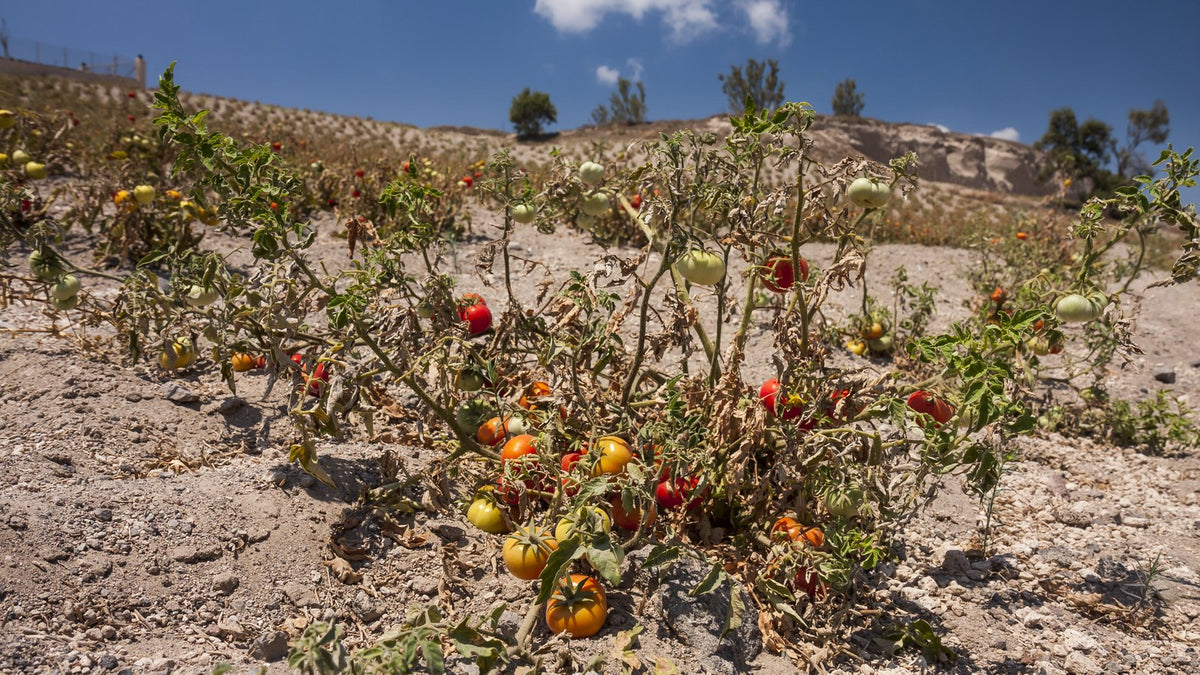

The short version: Dry farming grows tomatoes and melons on the water your soil stored over winter: one deep soak at planting, then little or nothing from the hose. It needs deep, moisture-holding soil filled by a wet winter, a dry summer, early planting, about double the usual spacing, mulch and no weeds. Sand and shallow soil give much less, and pots and wet-season summers rule it out. Expect a smaller crop of smaller fruit, more blossom end rot, and far less time on the hose.
Somewhere around the third hot week of a dry summer, most tomato growers have the same thought while holding the hose: surely these plants could do some of this themselves. Up to a point they can: growers near Naples have raised tomatoes without irrigation for centuries, and California market gardeners sell dry-farmed tomatoes at a premium for flavour.
Oregon State University's Dry Farming Program has turned that folk method into a written one, with tomato trials from 2018 to 2023 and melon trials in 2022 and 2023. Its definition is a summer crop grown with no irrigation where more than about 500 mm of rain falls a year, most of it in winter. Watering a bed a few times early and then stopping is a different thing. The trials are Oregon's, so what follows is their method set against the Australian figures that decide whether it can work for you.
Will it work in your garden? Three conditions
- Deep soil that holds water, filled by winter rain. Oregon asks for about 1.2 m of moisture-holding soil, and more is better. Agriculture Victoria's figures from the Murray Mallee and the Barossa show why texture decides it: between field capacity and wilting point a clay loam holds about 1.5 mm of plant-available water per centimetre of depth and sand about 0.6 mm, so a metre of clay loam stores about 150 mm and a metre of sand about 60. A dry winter puts the season behind before a seedling goes in.
- A dry summer, but not a furnace. Some sites are too hot and dry even for the Oregon trials, losing stored water faster than the plants can use it. The guide prefers summer tops under about 32 degrees, with wind shelter and some late afternoon shade.
- No competition, and no pots. Trees and shrubs with roots under the bed take the stored water first, raised beds dry faster than level ground, and a pot holds nowhere near enough.
The test is an auger or a deep hole in late winter, down at least a metre and ideally the full 1.2 m: loam or clay loam the whole way, still moist at the bottom, no rock or hard pan. Check where your own pipes and cables run before you dig that deep.
The method, step by step
- Feed the soil in autumn or winter, and do not dig deep in spring. Compost and any nutrient a soil test asks for go on well ahead, so rain carries them down and fresh amendments do not burn unwatered roots: on one nutrient-poor Oregon trial site a pre-plant dressing of composted poultry manure tripled the total yield. Oregon asks for lime at least three or four months before planting. End a winter cover crop early, because it is using the water you are saving, and in spring loosen the top few centimetres to kill weeds and break the crust, no more, because moisture is lost to the depth you cultivate.
- Plant early, after your last frost, into moist soil. Oregon plants tomatoes once the soil reaches about 16 degrees Celsius, and its earlier plantings outyielded later ones; melons are sown at 18 degrees or more, watermelon above 21. Our kitchen thermometer test for soil temperature tells you when that is.
- Plant deep. For a tomato transplant, water the root ball well first and pass over anything rootbound. Strip the lower leaves, keep the top three or four, and dig a hole deep enough that just those sit above ground. Fill it with water, let it drain, set the plant and firm moist soil around it. For melons, scrape the dry surface aside, sow 1 to 4 cm deep into moist soil or set transplants with about a litre of water each, and pull the dry soil back over.
- Space wide. Give each plant about double the ground you normally would. The trial figures are that wider spacing already, not numbers to double again: Oregon's unstaked tomatoes had about 1.4 square metres each (rows 1.5 m apart, plants 90 cm apart), staked crops in California sit closer at about 1.1, and closer planting cut late-season blossom end rot in an Oregon trial; the melon trials ran 2.1 m between rows and 1.2 m between plants.
- One soak, then stop. Water in enough to settle the plant, and if you can soak the whole bed to depth on planting day, do: the guide notes it can lift the final yield where no rain follows.
- Mulch and weed. A thick organic mulch suits a home bed, mostly because it stops weeds: evaporation from bare soil is minor next to what plants and weeds transpire, and the weeded trial plots gave over seven times the marketable yield of the unweeded ones. Use 5 to 8 cm of straw, lucerne or sugarcane, kept clear of the stems, as our guide to choosing a mulch sets out. Keep the mulch back from direct-sown melons until the seedlings are up, because the soil under it stays cooler.
- Skip the summer feeds, and sprawl or stake. Oregon ties blossom end rot in dry-farmed tomatoes to wind and excess nitrogen, so the pre-plant feed is the feed. Traditional dry farmers let plants sprawl on the dry ground, where fruit rots less; staking and pruning give bigger fruit and may cut cracking and sunscald, but do not prune a determinate bush, because Queensland's tomato guide says that drastically reduces its yield.
A dry-farmed bed carries less foliage and gives smaller fruit late in the season, and that is not a fault.

What to expect from the crop
Oregon puts dry-farmed yields at 25 to 50 per cent below irrigated ones in some cases, and in its 2022 side-by-side trial the dry-farmed rows gave about half to three fifths as much blemish-free fruit, because fewer fruit set under stress and more had blossom end rot or splitting. California's dry-farmed tomatoes are famous for intensity, and that comes with small fruit and roughly 15 per cent blossom end rot; in Oregon's taste trials of the same varieties grown with and without water, people rated them similarly flavourful. The magic is in the stress, and the stress has a cost. Oregon's melon tasting is preliminary but encouraging: in a 2018 blind comparison of two watermelon varieties, 67 to 100 per cent of 60 tasters ranked the dry-farmed fruit higher for colour, texture and sweetness.
Blossom end rot, and when to break the rule
The sunken, leathery patch where the flower was is the disorder dry-farmed tomatoes are most prone to. The Northern Territory's plant pathology note explains that the fruit is not getting enough calcium while it swells, and that a shortage of calcium in the soil is "possibly the least likely reason". The usual causes are water that is short or inconsistent, hot dry windy weather pulling water to the leaves instead of the fruit, and too much nitrogen. Eggshells do not fix that. Small round-fruited varieties, less nitrogen and shelter do: a windbreak protects for about 13 times its height, so set it back far enough that its roots stay out of the bed.
Dry farming is a decision, not a vow. Dry soil at 30 cm is normal, because the crop empties that layer first and then lives off the subsoil, and an afternoon wilt that recovers overnight is the plant coping. Act when it does not recover by morning, or when growth stalls before a crop sets, though heat, a hard subsoil or weeds can each do that too. Give one long soak at the base, under the mulch, and accept that you have moved to deep, infrequent watering. Do not sprinkle: a wetted surface crusts and dries faster, and swings in water supply are what split the fruit.
Which varieties suit it
Fruit size and shape matter more than the name on the packet: small round fruit resist blossom end rot, every cherry Oregon trialled did, and large or elongated fruit are the most susceptible, which rules out most pear and paste types. Early varieties set a crop before the stored water runs low. From the store's listings, Gold Nugget is a compact determinate cherry bred at Oregon State University and one of the first to ripen, and Oregon Spring is an Oregon State determinate that sets in cool weather and crops early, though its 170 to 200 g fruit will need watching for blossom end rot. For melons, Hales Jumbo is an early rockmelon whose listing says it performs well in droughty conditions, and the piel de sapo and honeydew types did well in the Oregon melon trials.

Dry farming across Australia's climate zones
These notes pair the Oregon method with Bureau of Meteorology rainfall averages and the soil each region tends to have, not with Australian trial results.
- Mediterranean (Perth and the south-west of Western Australia, Adelaide and South Australia): the textbook rain pattern. Perth Airport averages about 150 mm in June and 10 mm in January, Adelaide's Kent Town 78 mm in June and 16 mm in February. The catches are heat and soil. Perth Airport's tops average about 32 degrees in January and February, the Oregon ceiling, with nine January days and eight February days at 35 or above, so shelter and afternoon shade matter most here. A Western Australian agriculture department report puts Perth's metropolitan sands at 15 to 22 mm of stored water to 60 cm, a quarter or less of what clay loam holds at that depth, so look for loam or clay below. Plant tomatoes from late September once the soil holds 16 degrees, and melons when it reaches 18.
- Temperate (Sydney and the New South Wales coast, Melbourne and Victoria): Melbourne Airport's 35 to 62 mm a month fills the profile slowly, but clay is common and a deep bed planted out from late October suits. Sydney's Observatory Hill averages 100 to 130 mm a month from January to March, which is summer rain rather than stored winter rain, so a Sydney bed is rain fed rather than dry farmed, and the deep soil, wide spacing and mulch are what earn their keep in a dry summer.
- Cool and alpine (Tasmania, the ACT and Canberra, Ballarat in Victoria's uplands, the tablelands of New South Wales at Orange and Armidale, Stanthorpe on Queensland's Granite Belt): the calendar is the main problem, and a winter-filled profile is not a given: Canberra and Hobart average fairly even rain through the year and Armidale and Stanthorpe see theirs peak in summer, so here deep soil, wide spacing and mulch cut the watering rather than replace it. Plant after the last frost, often November, and choose early, cool-setting varieties such as Oregon Spring, because cooler sites can fail to ripen a dry-farmed crop.
- Arid and semi-arid (Alice Springs and central Northern Territory, Broken Hill in far western New South Wales, Mildura in the Victorian Mallee, Kalgoorlie in Western Australia's goldfields): too hot and dry for the method: the Northern Territory's growing note for lettuce around Alice Springs budgets about 11 mm of water a day in summer, which is the scale of demand a stored profile would have to meet. Keep the parts that cut watering: deep clay loam, wide spacing, thick mulch, shelter and afternoon shade.
- Subtropical (Brisbane and south-east Queensland, the northern rivers of New South Wales): summer is the wet half of the year, Brisbane averaging 140 to 170 mm a month from January to March against about 30 mm from July to September, so a summer tomato usually fights wet leaves rather than thirst, though a median January of 96 mm against that 140 mm mean says dry runs happen. Plant in late winter and spring and again in late summer, as our guide to tomato fruit problems sets out.
- Tropical (Darwin and the Northern Territory's Top End, Cairns and Townsville in north Queensland): the wet season runs October to April, and the Northern Territory Government's home garden page has tomatoes as a dry season annual, planted late April to July into moist, well drained soil about 70 cm deep, which means watering through the dry months. Dry farming as defined does not apply.
These zones are broad groupings. A gardener between two of them should lean on local cues, the last frost, the soil thermometer and the state of the subsoil in August, rather than the label.
A word on mulch and compost
Potting mix and garden soil commonly carry Legionella longbeachae, a cause of Legionnaires disease in Australia, and the same care is sensible with bagged compost and mulch. NSW Health's advice is to wet the material down, wear gloves and a mask (a P2 if you have one), and wash your hands afterwards and before eating or drinking.
Frequently asked questions
Can I dry farm tomatoes in a raised bed or a pot?
Not in a pot, and rarely in a raised bed: a pot holds a tiny fraction of what a metre of clay loam stores.
Do I really not water at all after planting?
You water the plant in once, properly, although Oregon's trial seedlings that went into moist soil without being watered in still established and cropped. After that the plan is nothing, and if the plants stall anyway, the rescue soak above is the right call.
Why are my dry-farmed tomatoes getting blossom end rot?
Usually water, wind and nitrogen starving the swelling fruit of calcium, not a shortage in the soil. Pick small round varieties, shelter the plants, skip the nitrogen feeds, and water deeply if it starts early and runs hard.
Can I dry farm pumpkins and zucchini the same way?
Yes. Winter squash and zucchini are on Oregon's list of commonly dry-farmed crops, on the same terms and with generous room: Oregon groups squash with tomato as vining crops whose roots need more space than beans or potatoes.
Try it on one plant in your deepest soil, let the subsoil tell you the rest, and if you want the full tomato method, Oregon State University Extension's dry farm tomato guide is free to read.
Related growing guides
- Diagnosing blossom end rot, cracking and the other tomato fruit faults
- Deep, infrequent watering for the beds you do water
- Working out whether your soil is sand, clay or loam
- Getting a vegetable patch through a Perth or Adelaide summer
Browse the tomato seed range for early and cherry types, and the rockmelon and melon seeds for the long-keeping types that suit a short dry-farmed harvest.