
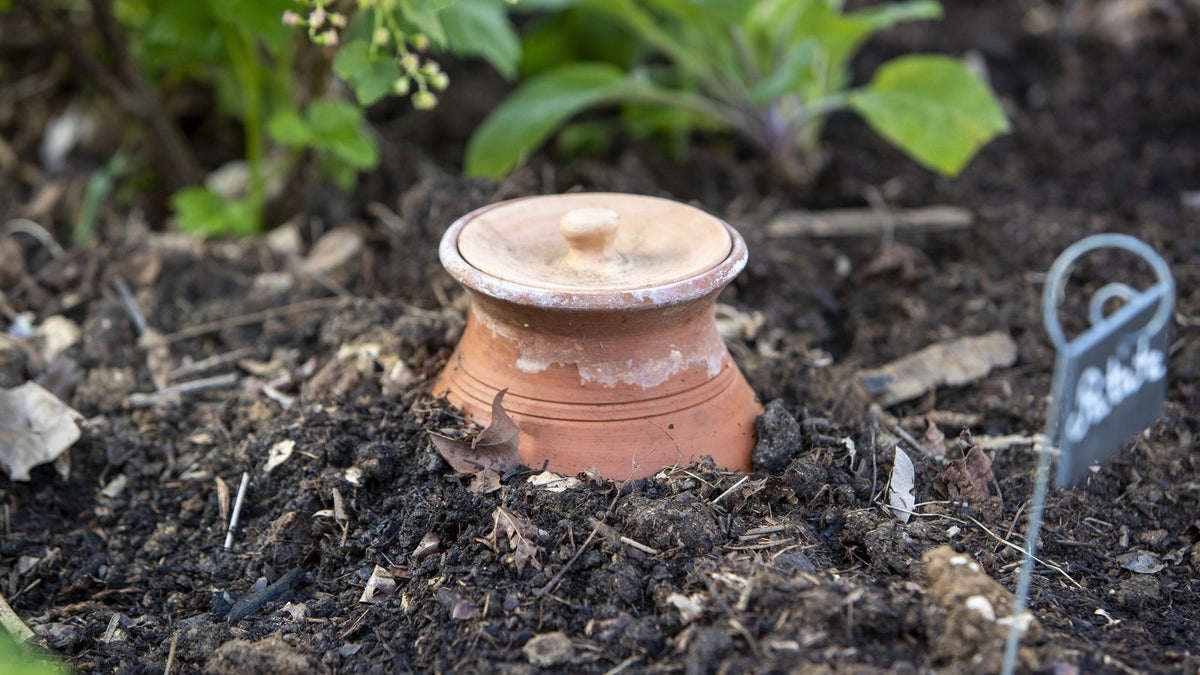

The short version: An olla is an unglazed clay pot buried to its neck beside your plants and kept full of water. The water seeps out through the clay into the soil, faster when that soil is dry and slower when it is wet, so roots drink from below while the surface stays dry. You can make one from two terracotta pots and food-safe silicone. Expect to refill it every few days to a week, keep a lid on it against mosquitoes, and plant right beside it.
Summer watering has a familiar rhythm. You soak the bed in the evening, the surface looks dark and promising, and by the next afternoon the tomatoes are sulking again while much of the water has gone back into the air. An olla puts the water below the surface, beside the roots, and hands it out a little at a time.
It will not replace the hose for a whole patch, but for a few thirsty plants, a big tub or a bed that bakes, it turns daily watering into a refill every few days.
How an olla works, and where it comes from
Unglazed terracotta is porous. Water in a buried pot moves out through the clay wall, drawn by the soil itself: dry soil pulls it out quickly, damp soil slows it to a trickle. ABC Gardening Australia describes exactly this, and it makes an olla close to self-regulating. Roots follow the moisture, and dug-up ollas have been found with roots wrapped around them.
The idea is more than 2,000 years old. A Chinese farming manual from the first century BC, the Fan Sheng-chih Shu, describes burying a clay jar in a planting pit, sowing four melon seeds around it, covering it with a tile and topping it up as the level falls. David Bainbridge, a researcher who has written widely on buried clay pots, records its use in Iran, India, Pakistan, Mexico and Brazil. "Olla" is Spanish for a clay pot, said "oy-ya". A University of Arizona extension bulletin reports that it may save 60 to 70 per cent of water compared with a watering can, a figure from one overseas comparison rather than an Australian trial.
Choosing a pot
The pot must be unglazed and unsealed, because the water has to pass through the wall. Some garden centre terracotta is glazed, painted or sealed inside, and that kind holds water like a jug. Bainbridge's test: spray the pot and the surface should darken straight away. If the water beads or runs off, put it back. Pots of two to five litres suit vegetables, and every olla needs a lid that covers the opening completely: a saucer, a flat stone or a tile.
Making a two-pot olla
Potter-made ollas are not cheap, but two terracotta pots of the same size do the job. Gardening Australia used 13 centimetre pots, holding about three litres joined.
- Seal the drainage hole of one pot, inside and out. Gardening Australia glues a disc cut from a plastic milk bottle over the hole with silicone; a rubber cork or a wooden plug also works.
- Run a bead of silicone around the rim of the sealed pot, set the second pot upside down on top so the rims meet, and smooth more silicone over the join. The hole in the top pot is your filling hole.
- Let it cure before any water goes in. Gardening Australia allows about 24 hours and Bainbridge leaves a silicone plug two days. Check the tube for its cure time and go with the longest.
- Fill it and check the join and the plug for leaks before you bury it.
For the sealant, Gardening Australia advises a food-safe grade of silicone made for water tanks and indoor plumbing.
Burying it and planting around it
Bainbridge digs a hole about three times as wide and twice as deep as the pot, and mixes compost through the soil that came out. Firm enough of that mix back into the bottom so the olla's neck sits a couple of centimetres above the surrounding soil, then fill around it and firm gently: water will not cross an air gap, and roots will not grow into one. Fill it, put the lid on and mulch around it, keeping the mulch clear of the opening.
Plant close. Bainbridge sets seeds or seedlings within one to two centimetres of the pot in most soils, leaving one side clear so the lid is easy to reach. Seeds and new seedlings still need watering from the top until their roots find the pot, which the Arizona bulletin puts at up to a month or more.
How far the water spreads
Not far, and that is the point. In good soil, Gardening Australia expects the wet zone to reach at least the width of the olla in every direction. The Arizona bulletin calls the evidence on spacing limited and gives, as a rule of thumb, a watered circle about twice the diameter of the pot. Between them, start from a wet circle two to three times the pot's width and check your own bed.
Soil changes the shape. Drip irrigation guides show water running down faster in sand and spreading further sideways in clay, so on sandy soil set ollas closer together and plant tighter around each one. One pot will not water a whole bed.

How often to fill it
Gardening Australia expects a refill every few days to a week, varying with the weather, the soil and the size of the pot. Bainbridge finds small pots need it every two or three days and large ones about once a week, and tries not to let a pot run completely dry. In a heatwave, lift the lid every day; a thin bamboo stake dipped in shows the level.
A pot that empties faster than usual is mostly the system working, because the soil around it was dry and pulled hard. If it keeps happening in mild weather, look for a crack, which tree roots can cause over time.
Which crops suit an olla
Gardening Australia rates ollas most efficient for crops with fibrous roots, such as tomatoes, chillies, squash and melons. Bainbridge's list of plants that did well with buried pots in his trial gardens adds beans, peas, cucumbers, corn, onions, garlic, potatoes, basil and coriander.
His two cautions: big, sprawling melon and squash vines sometimes could not draw enough from one pot. Constant moisture brought disease to sensitive plants in some gardens when heavy rain added to it, so let the pot run low in a wet spell. Keep trees and shrubs away, because woody roots can crack the clay.
In a large planter, bury a small olla in the middle and ring it with seedlings. One bonus Bainbridge noticed: snails and slugs gather at the seam where pot meets soil, which makes the evening hunt a short one.
Looking after it, and what goes wrong
- It empties more slowly each season: salts and grime are clogging the pores. Lift it, scrub it and soak it in clean water.
- It hardly empties at all: in damp soil that is normal. If the soil is dry, the pot is glazed or sealed, or there is an air gap: do the spray test and refirm the soil.
- The plants still wilt: feel the soil beside the pot first. Dry means the olla is too small or the roots have not reached it yet, so add a second olla or keep watering from the top. Damp means heat or drainage, not thirst.
- It cracked over winter: terracotta is prone to cracking in freezing weather. In frosty districts, lift the olla before winter and store it dry.
Ollas across Australia's climate zones
No source sets out an olla season for each zone, so take these as a guide.
- Tropical (Darwin in the Northern Territory, Cairns and Townsville in Queensland): the Bureau of Meteorology gives the wet season as October to April. The olla works in the dry season, when the Northern Territory Government recommends planting tomatoes from late April to July, and can sit empty under its lid through the wet.
- Subtropical (Brisbane and south-east Queensland, northern New South Wales): Brisbane averages around 30 mm a month from July to September against 140 mm or more from January to March. Lean on the olla through the dry late winter and spring, and let it run low in a wet summer.
- Arid and semi-arid (Alice Springs in the Northern Territory, Kalgoorlie in Western Australia, Mildura in Victoria, Broken Hill in New South Wales): Bainbridge sees buried pots as most valuable in dry country, and an olla earns its place through every warm month. Alice Springs averages about 13 nights a year at or below 0°C, so lift the pots for the coldest weeks.
- Temperate (Sydney and the New South Wales coast, Melbourne in Victoria): Sydney averages more than 100 mm a month from January to March, so ollas help most in the dry runs between storms. Melbourne's rain is spread more evenly, and an olla carries summer crops through the hot, dry weeks.
- Mediterranean (Adelaide in South Australia, Perth and southern Western Australia): Perth Airport averages about 10 mm of rain in January and Adelaide about 16 mm in February, so summer is where an olla does the most work. On sandy soils, set the pots closer together.
- Cool and alpine (Tasmania, Canberra in the ACT, Ballarat in Victoria, the tablelands towns of Orange and Armidale in New South Wales, Stanthorpe in Queensland): Bureau records show nights at or below 2°C, a sign of ground frost, into October and November in Canberra, Orange, Armidale and Stanthorpe, and in every month at Ballarat. Bury the olla after your last frost and lift it before winter: a full pot cracks when it freezes.
These zones are broad groupings. If you sit between two of them, your own first and last frosts and summer rainfall are the better guide.
A few cautions
Mosquitoes. An olla is a container of standing water, and mosquitoes lay their eggs in containers that hold water. Keep the opening covered at all times with a lid that fits closely, or with mosquito-proof mesh. The WA Department of Health sets out the household steps in its guide to stopping mosquitoes breeding around the home.
Silicone. Acetic-cure silicones, the kind that smell of vinegar, release small amounts of acetic acid as they cure, and the Australian safety data sheet for one of them asks for adequate ventilation. Join the pots outdoors or in an open shed, follow the safety directions on the tube, and do not fill the olla until the sealant has fully cured.
It is not a wicking bed. One fill waters a small circle for days, not weeks, and seedlings still need hand watering at first.
Frequently asked questions
Can I use an ordinary terracotta pot as an olla?
Yes, if it is unglazed and unsealed and the drainage hole is plugged. Spray it first: the surface should darken straight away.
How many ollas does a vegetable bed need?
More than one, unless the bed is tiny. Space them closer in sand than in clay.
Will an olla keep my garden alive while I am away?
For a long weekend, a full olla helps the plants beside it. For longer trips it needs a neighbour to refill it, or a drip line.
Can I leave an olla in the ground over winter?
Where frosts are rare, it can stay, empty and covered. In frosty districts, lift it before winter and store it dry.
A clay pot, a lid and a watering can every few days: a quiet way to grow a lot of summer from very little water.
Related growing guides
- Building a bed with its own water reservoir underneath
- Soaking vegetables deeply so the roots grow down
- Getting the garden through a summer trip away
- Telling sand, clay and loam apart in your own beds
Tomatoes and chillies are two of the crops that take most happily to an olla: browse our tomato seeds and chilli seeds.