
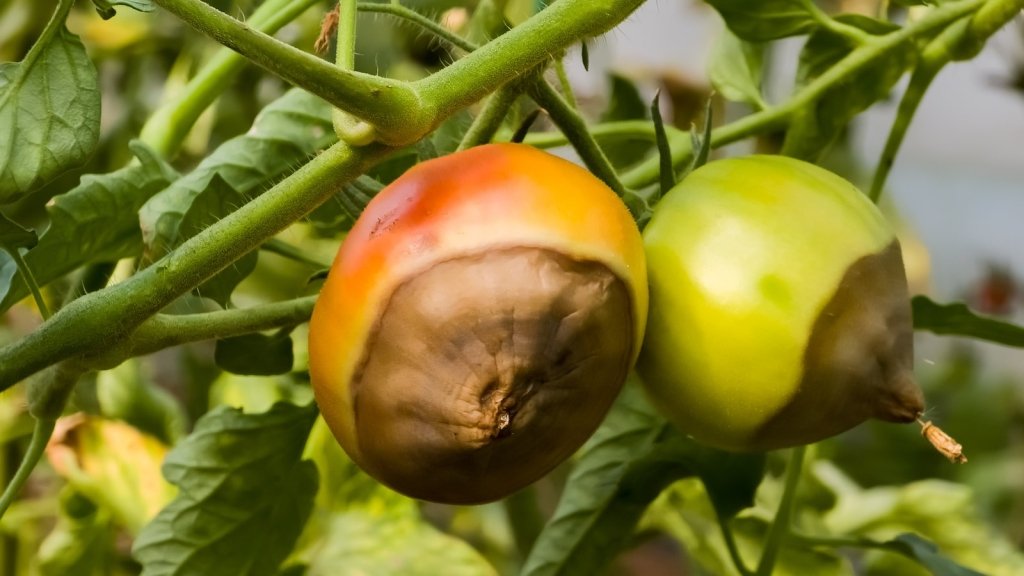
The short version: Most tomato fruit problems are the plant reporting on the weather and the watering. Blossom end rot, cracking and catfacing come from uneven water, cold or excess nitrogen; flowers that drop without setting are usually heat, cold or humidity at flowering; sunscald and slow ripening are about leaf cover and temperature; and holes, tunnels and collapsing fruit are fruit fly or budworm. Even watering, mulch, a stake, some leaf cover and fine insect mesh fix or prevent nearly all of it. Nothing on this list makes the rest of the crop unsafe, and a plant with damaged fruit will usually set a clean truss once conditions settle.
Leaf problems get most of the attention, but it is the fruit that decides whether the season was worth it. This guide is about the fruit only: what each fault looks like, what caused it and what to do. For spots, curls and yellowing on the foliage, see our separate guide to tomato leaf problems.

A quick key
- Sunken, leathery black patch on the bottom of the fruit: blossom end rot.
- Rings or lines of split skin around the shoulders: cracking after a soak or storm.
- Puckered, scarred, misshapen blossom end: catfacing from cold at flowering.
- Flowers yellow and drop, no fruit: blossom drop from heat, cold or humidity.
- Fruit hollow inside: poor pollination, usually heat.
- Pale, papery, blistered patch on the sunny side: sunscald.
- Hard green or yellow shoulders on ripe fruit: variety, cold or low light.
- Fruit stays green for weeks: cool weather and short days.
- Pinprick stings, soft patches, maggots inside: Queensland fruit fly.
- A neat hole with a caterpillar inside: tomato budworm.
- Rot where fruit touches the ground: soil contact and splash.
Blossom end rot
A flat, sunken, brown to black leathery patch at the base of the fruit, opposite the stem, is blossom end rot. It is a calcium problem, but rarely because the soil lacks calcium. The fruit simply did not receive enough of it while it was swelling, and that is driven by water. Overwatering, underwatering and swinging between the two all disrupt the flow of calcium into the fruit; strongly acidic or alkaline soil and heavy nitrogen feeding can lock it up as well. Affected fruit will not recover, so pick it off, then fix the watering: deep, even water on a regular rhythm, a thick mulch to stop the soil drying out between, and no more high-nitrogen feeds. Work lime or gypsum into the bed before planting next time if a test shows the soil is acidic or low in calcium. Diluted milk sprays are popular folklore, but calcium reaches the fruit through the roots, not the skin, and no reliable source supports the spray.

Cracking and splitting
Concentric rings around the stem end, or cracks running down the sides, appear when a dry spell is followed by a downpour or a heavy watering. The inside of the fruit swells faster than the skin can stretch. Ripe and nearly ripe fruit split first, so pick anything close to ready before a storm, keep the soil evenly moist through dry weather, and mulch. Split fruit is fine to eat the same day; after that it moulds quickly.
Catfacing and misshapen fruit
Catfacing is a puckered, scarred, sometimes deeply creased blossom end. It is set weeks before you see it, when cold nights at or below about 10 degrees hit the plant around transplanting or flowering, and heavy feeding is often blamed for making it worse. Large-fruited varieties, beefsteaks among them, are the most prone. Plant out a week or two after the last frost rather than at the first warm weekend, and go easy on manure. The fruit is edible once the scarred tissue is trimmed, provided no rot is hiding in the creases.
Flowers but no fruit
Blossom drop is the plant aborting flowers because pollination failed. The commonest cause in Australia is heat: Diggers puts the danger at days above about 29 degrees with nights above 21, and overseas extension sources put daytime pollen failure a little higher, around 32 to 35 degrees, and warn that warm nights above about 27 degrees cause failure on their own. Humid weather from the mid twenties up makes pollen clump, and cold nights in spring, below roughly 10 to 13 degrees, stop fruit set at the other end. There is little to do about the weather itself except shade cloth in a heatwave, steady water so the plant is not stressed as well, and patience: flowering resumes and fruit sets again as soon as conditions ease. In a sheltered spot with little wind, tapping the stakes or flowers at midday helps shake pollen loose. Hollow fruit, with air gaps between the walls and the seed jelly, is the same problem in a fruit that half set, and it is harmless to eat.
Sunscald and green shoulders
Sunscald is a pale, papery, sometimes blistered patch on the side of the fruit facing the sun. It happens when fruit that grew in shade is suddenly exposed, most often after heavy pruning, a leaf disease or caterpillars stripping the plant. Prune lightly in hot weather, keep the plant healthy so it keeps its leaves, and drape shade cloth over exposed trusses during a heatwave. Scalded fruit does not recover. If the flesh under and around the patch is still firm and smells clean, cut the patch away and use the rest; scald often lets rot in, so discard any fruit that has softened. Hard green or yellow shoulders on otherwise ripe fruit are mostly a varietal trait, commonest on large-fruited types; if your favourite variety does it every year, try one bred for even ripening.

Fruit that will not ripen
Full-sized fruit that sits green for weeks in autumn or in a cool, cloudy spring is not diseased. Ripening slows sharply once temperatures drop and days shorten. Pick fruit at the first blush of colour and finish it on the bench indoors, where it ripens just as well. A plant loaded with green fruit at the end of the season can be pulled whole and hung under cover, or the fruit picked and ripened in a paper bag with a banana. Heavy nitrogen and crowding also delay ripening.
Holes, tunnels and collapsing fruit
Queensland fruit fly is the serious one in the eastern states and increasingly elsewhere. The female stings ripening fruit to lay eggs under the skin; the maggots tunnel through the flesh and the fruit rots from inside and often drops early. Look for tiny puncture marks and soft, weeping patches. The fix is exclusion and hygiene. Cover plants or individual trusses with fine insect mesh of about 2 mm as soon as fruit sets, since bird netting is far too coarse, or use exclusion bags on trusses. Pick up every dropped or stung fruit straight away and kill the larvae by sealing the fruit in a bag in full sun for at least two weeks, freezing it for two days or submerging it in water for several days, then bin it. Never compost or green-bin stung fruit. Bait and pheromone traps are useful for telling you when the flies have arrived, less so for control. Our guide to fruit fly in the home garden covers the whole routine.
Tomato budworm (Helicoverpa caterpillars) hatches on the leaves, feeds briefly, then bores into green fruit, leaving a neat round hole and a rotting interior. A single moth can lay up to about a thousand eggs, with several generations a year in warm areas. Hand-pick caterpillars, use insect mesh before egg-laying starts, and from the first flower buds spray leaves and flowers weekly with Dipel, a caterpillar-specific bacterial spray that is not known to harm bees when used as directed.

Fruit rotting on the ground
Fruit that rests on wet soil rots at the contact point and picks up whatever fungi are splashed up from the bed. Stake or trellis every plant, tie trusses up off the ground, and mulch thickly so rain does not splash soil onto the fruit. Water at the base, not over the plant.
Small fruit and heavy loads
A plant carrying far more trusses than its roots and leaves can feed tends to size each fruit down, and dry spells make it worse. It is common gardener's knowledge rather than a documented disorder, but thinning a few trusses on an overloaded plant, feeding with a balanced tomato fertiliser once fruit sets, and keeping the water even all help fruit reach full size. Whether a plant needs pruning at all depends on its type, which our guide to determinate and indeterminate tomatoes explains: bush types set most of their crop over two or three weeks and need no pruning, while vine types keep going until the cold stops them.
Tomato seasons across Australia's climate zones
- Tropical (Cairns and far north Queensland, Darwin and the Top End of the Northern Territory, the Kimberley in Western Australia): grow through the dry season, planting from about April to July. Wet-season heat and humidity cause blossom drop and disease; cherry types cope best.
- Subtropical (Brisbane and coastal Queensland, Coffs Harbour and northern New South Wales): plant from about August to October and again in late summer for an autumn crop. Fruit fly pressure is highest here, so mesh from fruit set.
- Arid and semi-arid (inland Queensland, Broken Hill and Dubbo in New South Wales, Mildura in Victoria, inland South Australia and Western Australia, Alice Springs in the Northern Territory): plant after the last frost, September to October, and expect a mid-summer pause in fruit set during extreme heat. Mulch and shade cloth matter most here.
- Temperate (Sydney and New South Wales, Melbourne and Victoria): plant out from October, once nights stay above about 10 degrees. Blossom end rot and cracking track the erratic spring weather.
- Mediterranean (Perth and southern Western Australia, Adelaide and the Adelaide Plains in South Australia): plant from October, and plan for heatwave blossom drop in January with a second flush of fruit in autumn.
- Cool and alpine (Hobart and Tasmania, Canberra and the ACT, Ballarat in Victoria, Orange and Armidale on the New South Wales tablelands, and the alpine country of the Snowy Mountains and the Victorian high country): plant out in November or December, choose early varieties, and expect to ripen the last of the crop indoors.
Wherever you are, the fruit faults in this guide arrive with the weather, so a garden diary that notes the heatwaves and storms explains most of them.
Frequently asked questions
Is a tomato with blossom end rot safe to eat?
Yes. Cut away the leathery patch and use the rest, as long as the fruit has not started to mould.
Will my plant recover after blossom end rot or catfacing?
Usually. Both affect the fruit that was forming when the stress hit. Fix the watering and later trusses are commonly clean.
Does one net protect against birds and fruit fly?
Not necessarily. Victoria's wildlife protection rules require garden netting with a mesh no larger than 5 mm at full stretch so birds and bats do not tangle, and New South Wales recommends the same, but fruit fly needs about 2 mm. A fine 2 mm insect mesh does both jobs.
Why do my flowers keep dropping in January?
Heat. Days near or above 30 degrees with warm nights stop pollination. Shade the plant, keep watering, and fruit set returns when the weather breaks.
Read the fruit and the weather together and most tomato mysteries solve themselves. Sustainable Gardening Australia's Queensland fruit fly notes are the best next read if you are in fruit fly country.
Related growing guides
- Tomato Leaf Problems: A Visual Guide to Diagnosing Your Tomatoes
- Fruit Fly in the Home Garden: Netting, Hygiene and Safe Disposal
- Determinate vs Indeterminate Tomatoes: Which Should You Actually Grow?
Choose a variety suited to your season and your patience: browse our tomato seeds, bush tomato seeds and vine tomato seeds.