
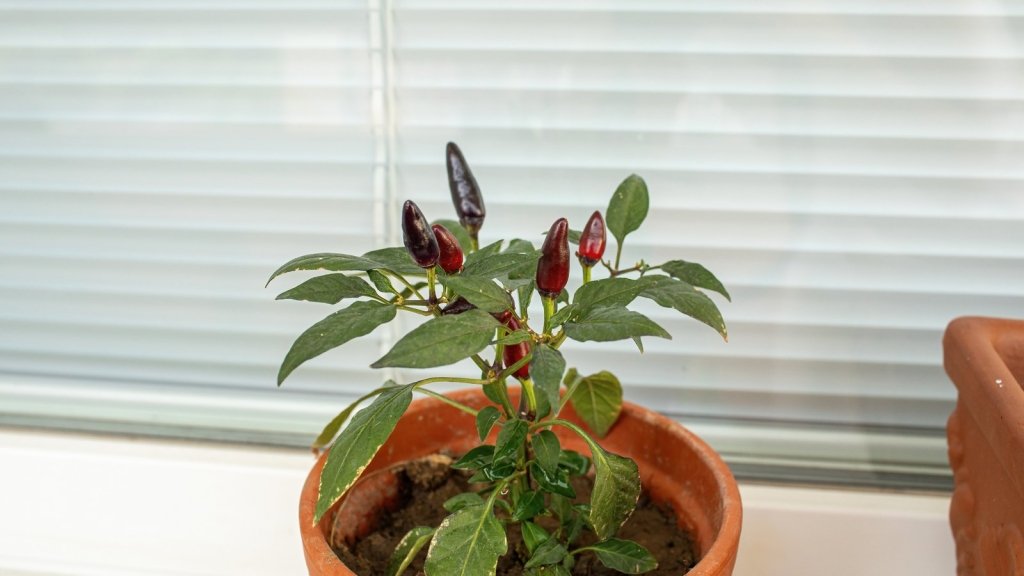
The short version: Chillies and capsicums are perennials that most Australian gardeners treat as annuals. Keep a plant alive through winter and it starts spring with an established root system, fruits weeks earlier than a new seedling and gives the long-season super-hot varieties the time they need. In frost-free districts, leave it in the ground and prune lightly. Where frosts are light, mulch, fleece and a hard prune usually see it through. Where frosts are hard, pot it up, cut it back to a short frame, and keep it barely watered and frost-free under cover until nights stay above about 12 degrees again. Check it for aphids before it comes inside, stop feeding until spring growth begins, and expect to lose a plant or two along the way.
Every autumn, thousands of perfectly good chilli plants go into the compost because the leaves dropped and the plant looked dead. Most of them were only going dormant. Overwintering is the practice of helping a chilli through the cold months so it comes back bigger, and it is easier than it sounds.

Why bother
A chilli grown from seed in spring spends its first two or three months building roots and a frame before it flowers. An overwintered plant already has both, so it flowers and fruits about a month earlier, which in a short or cool season can be the difference between a ripe crop and a green one. That head start matters most for the slow, fiercely hot types such as habanero, scotch bonnet and the superhots, which need the longest possible season to ripen. Some retailers claim a second-year plant gives double the yield; treat that as marketing, but an earlier and heavier crop is a fair expectation. It also saves buying seed or seedlings of a variety you already love.
Know your climate, and your chilli
Chillies and capsicums (Capsicum species) are tropical perennials. In the frost-free north they simply keep growing as short-lived shrubs. In light-frost districts they drop leaves and go dormant but usually survive with a little protection. In hard-frost districts, frost kills the top and, if the soil freezes, the roots, so the plant must come under cover. The species matters too: the quick annual types such as jalapeno, cayenne and most capsicums (Capsicum annuum) are the toughest and easiest to overwinter, while the tropical Capsicum chinense group, habanero and scotch bonnet among them, resents cold and needs the warmest spot you can offer. Rocoto (Capsicum pubescens) is reputedly the most cold tolerant of all, though reliable Australian figures are scarce. The practical trigger is night temperature: once nights sit consistently below about 12 degrees, growth stops and it is time to act. Brief dips to around 5 degrees are usually survived; frost generally is not.

Method one: overwintering in the ground (frost-free and light-frost gardens)
As autumn cools, stop feeding and gradually reduce watering. Pick every remaining fruit and pinch out flowers, so the plant stops spending on a crop it cannot ripen. Once the leaves begin to yellow and drop, prune the plant back by about a half, or harder, to a frame of main stems 15 to 30 cm high, cutting cleanly above a node. Pull the mulch back from the stem, then lay a thick organic mulch over the root zone, and on nights when frost is forecast throw horticultural fleece, an old sheet or an upturned pot over the frame. Water sparingly through winter, only when the soil is dry a few centimetres down. In spring, new shoots appear at the nodes; resume watering as they grow and start feeding once flower buds show.
Method two: overwintering in pots (hard-frost gardens)
Choose the healthiest and most productive plants, and overwinter a couple more than you need, because not all will make it. Plants already in pots are the easiest. Plants in the ground can be lifted with as much root as possible and potted into a container just big enough, but transplant shock is real and some will not recover. Cut the plant back hard, to a frame about 10 to 15 cm high if it will sit somewhere cool and dim, or by half to three-quarters if it will sit somewhere bright and heated where it may keep some leaves. Before it comes inside, inspect it closely for aphids, whitefly and mites, wipe or hose them off, and repeat the check a week later; stressed indoor plants spread pests to houseplants.
Put the pot somewhere frost-free with some light: a greenhouse, a sunny enclosed veranda, a cool spare room by a window or a bright garage. It does not need direct sun while dormant, but darkness is not right either. Water very sparingly, letting the mix go almost dry between drinks, and do not feed at all; extra water and fertiliser in winter push soft growth or rot the roots. Check the pot every week or two.

Waking it up in spring
As days lengthen, buds swell at the nodes and new shoots appear. Increase watering gradually to match the new leaf area. Scrape a few centimetres of old mix from the top of the rootball and replace it with fresh potting mix, or move the plant up a pot size, and begin feeding once flower buds form. Harden the plant off over a week or so before it goes back outside, and wait until nights are reliably above about 12 degrees, because a plant that has spent winter under cover is as soft as a new seedling. Pinching out the first few flowers on a weak plant lets it rebuild its frame before it carries fruit.
What can go wrong
Overwatering is the commonest killer: a dormant plant in wet mix rots at the roots and is found dead in August. Aphids brought indoors on the plant breed through winter in the warmth. Plants kept somewhere too warm and dim grow long, pale, weak shoots that should be pinched off. And pests and diseases that were on the plant in autumn are still there in spring, so a plant that struggled with disease is better composted and replaced from seed. Wear gloves when pruning and handling very hot varieties, keep your hands away from your eyes, and wash your hands with soap and water afterwards, because the capsaicin that burns does not rinse off in water alone. Keep picked hot fruit and prunings away from children and pets.

Overwintering chillies across Australia's climate zones
- Tropical (Cairns and far north Queensland, Darwin and the Top End of the Northern Territory, the Kimberley in Western Australia): no overwintering needed. Chillies grow and fruit year round as short-lived shrubs; prune lightly after each flush and replace plants every two or three years.
- Subtropical (Brisbane and coastal Queensland, Coffs Harbour and northern New South Wales): plants usually survive in the ground with a moderate prune, about half, and a thick mulch. In the occasional frosty hollow, use fleece on cold nights.
- Arid and semi-arid (inland Queensland, Broken Hill and Dubbo in New South Wales, Mildura in Victoria, inland South Australia and Western Australia, Alice Springs in the Northern Territory): winter frosts are common and hard, so pot up and move under cover, or grow chillies in pots from the start.
- Temperate (Sydney and New South Wales, Melbourne and Victoria): Sydney and coastal gardens can overwinter in the ground with mulch and fleece; Melbourne needs the pot method under cover.
- Mediterranean (Perth and southern Western Australia, Adelaide and the Adelaide Plains in South Australia): light frosts in most suburbs, so in-ground overwintering with protection works well, and pots against a sunny wall are a safe bet.
- Cool and alpine (Hobart and Tasmania, Canberra and the ACT, Ballarat in Victoria, Orange and Armidale on the New South Wales tablelands, and the alpine country of the Snowy Mountains and the Victorian high country): pots, hard pruning and a frost-free room or greenhouse are the only option, and it is well worth it, because the season is otherwise too short for many varieties.
Our guide to frost protection covers fleece, cloches and the other tools that keep an in-ground plant alive.
Frequently asked questions
My chilli dropped all its leaves in autumn. Is it dead?
Probably not. Scratch the bark on a main stem: green underneath means it is alive and dormant. Prune, protect and wait for spring.
How hard should I prune?
For a cool, dim winter spot, to a 10 to 15 cm frame. For a bright, heated spot, by half to three-quarters. For a plant staying in the ground, by about half, and harder in a mild climate is fine.
Can I overwinter capsicums the same way?
Yes. Capsicum is Capsicum annuum, the same species as jalapeno, cayenne and most mild to medium chillies, and it overwinters the same way. The hotter habanero and scotch bonnet types are a different species, Capsicum chinense, and need the extra warmth described above.
How many years can a chilli plant live?
In a frost-free climate a chilli can live for several years, though most gardeners replace plants every two or three years as vigour and yield fall away and pests build up. In a cold climate with overwintering, a couple of good seasons is a fair expectation before it is worth starting again from seed.
Overwintering turns a chilli from a one-summer plant into a small shrub that gets better each year, and the only real costs are a pot, a corner out of the frost and the discipline not to water it. GrowVeg Australia's overwintering guide is a good second opinion.
Related growing guides
- The Chilli Grower's Starter Guide: Heat Levels, Varieties, and What to Grow
- Growing Capsicum in Australia: From Seed to Harvest
- Beating the cold: frost protection and stretching your growing season
Start the plants worth keeping: browse our chilli seeds, capsicum seeds and the full range of vegetable seeds.