
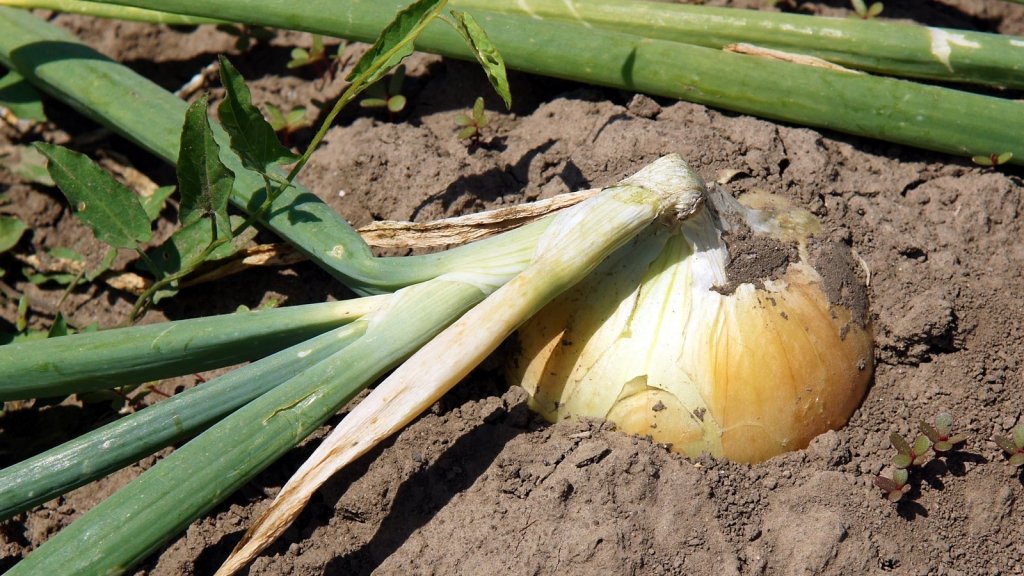
The short version: Onions bulb in response to day length, not age, so the two things that matter most are choosing a variety bred for your latitude and sowing it early enough to grow a big leafy plant before the days lengthen in spring. Sow in autumn or winter, thin or transplant to 10 to 20 cm apart before the seedlings are thicker than a pencil, keep the shallow roots evenly moist, feed while the leaves are growing and stop feeding once the necks start to swell. If you sowed a bunching variety, or sowed in spring in a warm district, the plant was never going to bulb, and spring onions are the honest alternative.
An onion that stays as a thick green stalk all season is one of the most common questions we get, and it is almost always a calendar problem rather than a soil problem. Once you understand what makes an onion decide to swell, the fix is usually a change of variety, a change of sowing date, or both.

First, is it a bulbing onion at all?
Spring onions, bunching onions and Welsh onions are grown for their leaves and white shanks and are not bred to form a single round bulb, however long you leave them. If the packet said bunching, spring or salad onion, the plant did exactly what it was meant to do. For a storing bulb you need a variety of Allium cepa sold as a brown, white or red bulbing onion, and the packet will usually describe it as early, mid-season or late, which is the clue to the next section.
Day length decides when an onion bulbs
Onions bulb when the days reach a certain length, and different varieties have different triggers. The names are borrowed from the northern hemisphere and can be confusing, so think of them as early, mid and late.
- Short-day (early) varieties start bulbing once days reach very roughly 10 to 12 hours. Varieties in this group, such as Gladalan Brown, suit Brisbane, Sydney and everywhere north of them, and are the only type that reliably bulbs in the tropics.
- Intermediate (mid-season) varieties need roughly 12 to 14 hours of daylight. Pukekohe Long Keeper is the best-known example and it is the workhorse of Melbourne, Adelaide and Perth gardens.
- Long-day (late) varieties need roughly 14 hours or more and are for southern gardens only: Melbourne, Hobart, Canberra and the cooler tablelands, where they make the biggest bulbs and keep the longest.
As a rule of thumb, southern Australia can grow any type, the central band, reaching roughly as far north as southern Queensland, suits short and intermediate types, and tropical gardens need short-day varieties only. Sow a long-day variety in Brisbane and the days never get long enough; it will grow leaves, thicken at the neck and eventually flower. Sow a short-day variety in Hobart in spring and it bulbs almost immediately, while the plant is tiny, and you harvest marbles.

Sowing too late, or too early
The size of the bulb is set by the size of the plant when bulbing begins, because each leaf feeds one ring of the bulb. That is why onions are sown in autumn and winter across most of Australia: the plant spends the short days building leaves, then swells when the days lengthen. Sow too late and a small plant with a few leaves bulbs early and stays small. Sustainable Gardening Australia's windows are a good guide: February to May in warm northern areas, March to May for early varieties and June to July for mid-season ones around Sydney, and April to September with successive sowings in the cool south.
Sowing too early has its own problem. A plant that goes through winter already thick in the neck can be pushed by the cold to flower in spring instead of bulbing. The usual advice is to have plants no thicker than a pencil when the coldest weeks arrive, which is another reason to match the sowing date to the variety rather than sowing everything in March.
Crowding, transplant size and depth
Onions do not push their neighbours aside; a crowded row simply produces small bulbs or none. Thin direct-sown rows, or transplant seedlings, to a final spacing of about 10 to 15 cm apart in rows 20 to 30 cm apart, or a little wider for the biggest keepers. Transplant while the seedlings are slimmer than a pencil, because bigger seedlings sulk after moving and are more likely to bolt. Set them shallow, with the base of the plant just below the surface: an onion likes to sit on the soil and swell above it, and a deeply buried seedling makes a long white neck rather than a round bulb. If the bed has been crowded all season, thinning now to give each plant room can still rescue the crop while the days are lengthening. Our guide to thinning root crops covers the technique.

Water and feeding
Onions have a shallow, sparse root system with little ability to recover from a dry spell once bulbing starts, so the bed should never dry out at depth. Water deeply and regularly through spring, mulch lightly between the rows, and taper off in the last few weeks before harvest so the necks dry down. Feeding is about timing. The plant needs nitrogen while it is building leaves in winter, so a bed enriched with compost and a fortnightly liquid feed through the leafy stage gives the frame that makes a big bulb. Once the necks begin to swell, stop the nitrogen. Sources disagree on how strictly, but late feeding tends to give thick, soft necks and leafy plants that store badly, and it is the most common reason a well-grown bed produces leeks instead of onions.
Disease can stop bulbing too
Downy mildew shows as pale, then purplish-grey, furry patches along the leaves in cool, damp weather and can shut down leaf growth before the bulb fills; wider spacing, morning watering at the base and removing infected leaves help. White rot is the serious one: leaves yellow and collapse, the base shows white fluffy fungus with tiny black dots, and the bulb rots. There is no treatment, the fungus persists in soil for more than a decade, and the only answer is to grow onions and garlic somewhere else for many years and never move soil from the infected bed. Onion thrips rasp silvery streaks into the leaves in hot dry weather and weaken the plant; a hard spray of water and encouraging predatory insects help keep them in check.

Harvest, curing and storage
Bulbs are ready when the tops yellow, soften and fall over, typically 14 to 32 weeks after sowing depending on variety and season. Lift them gently with a fork on a dry day, lay them out in a warm, airy spot, in the sun for the first few days if the weather is dry and then under cover, for two to three weeks until the skins are papery and the necks are dry, then trim the tops or plait them and store in a cool, dark, ventilated place. Early short-day varieties are the poorest keepers and are best eaten within a couple of months; mid and late types can keep for six months or more. Any bulb with a thick, soft neck should be eaten first. Onions, like all alliums, are toxic to dogs and cats, so keep thinnings, bulbs and trimmings out of their reach.
When to sow onions across Australia's climate zones
- Tropical (Cairns and far north Queensland, Darwin and the Top End of the Northern Territory, the Kimberley in Western Australia): short-day varieties only, sown in the early dry season from about April to June. Bulbs are modest and do not keep long; spring onions are the reliable year-round crop.
- Subtropical (Brisbane and coastal Queensland, Coffs Harbour and northern New South Wales): short-day varieties sown from about February to May, so the plants are well grown before the days lengthen. Long-day types will not bulb here.
- Arid and semi-arid (inland Queensland, Broken Hill and Dubbo in New South Wales, Mildura in Victoria, inland South Australia and Western Australia, Alice Springs in the Northern Territory): short and intermediate varieties sown in autumn, roughly March to May, with steady irrigation through the dry spring.
- Temperate (Sydney and New South Wales, Melbourne and Victoria): around Sydney, early varieties March to May and mid-season June to July. In Melbourne, intermediate and late varieties from April through winter, with the latest keepers sown last.
- Mediterranean (Perth and southern Western Australia, Adelaide and the Adelaide Plains in South Australia): intermediate varieties such as Pukekohe Long Keeper sown from about April to July, grown on winter rain and finished with spring watering.
- Cool and alpine (Hobart and Tasmania, Canberra and the ACT, Ballarat in Victoria, Orange and Armidale on the New South Wales tablelands, and the alpine country of the Snowy Mountains and the Victorian high country): intermediate and long-day varieties sown from late winter into spring, about August to October, or in autumn under cover in milder spots. The long summer days give the biggest bulbs and the best keepers.
Treat these as starting points: the Sydney and subtropical windows follow Sustainable Gardening Australia's calendar, and the rest are general guidance to check against a local sowing chart. A garden on a warm north-facing slope and one in a frosty hollow a few streets apart can sit a fortnight apart in their best sowing date.
Frequently asked questions
Can I still get bulbs from onions that have not swelled by spring?
Sometimes. If the variety suits your latitude and the plants are healthy, thin them, keep watering and wait for the longer days. If the plants are flowering or the variety is wrong for your zone, harvest them as green onions and resow at the right time.
Why did my onions flower instead of bulbing?
Usually they were too big going into winter, so the cold pushed them to flower in spring. A dry spell or transplant shock can do the same. Snap off the flower stalk and use those bulbs first, because they will not store.
Does it matter how deep I plant onion seedlings?
Yes. Set them shallow, with the base just below the surface. Deep planting gives long necks and small bulbs.
Can I grow onions in pots?
Yes, in a wide, reasonably deep container, spaced about 10 cm apart and watered evenly. Bulbs will be smaller than in a bed, and spring onions are the more productive choice for small pots.
Match the variety to your latitude, sow it in the cool months, and give each plant a hand-width of room, and onions become one of the easiest storage crops in the garden. Sustainable Gardening Australia's onion growing notes give a useful regional calendar.
Related growing guides
- What to grow in winter: cool-season vegetables across Australia
- The Australian Sowing Almanac
- Why thinning is the step everyone skips
Choose an early, mid or late variety for your zone: browse our onion seeds, spring onion seeds and the full range of vegetable seeds.