
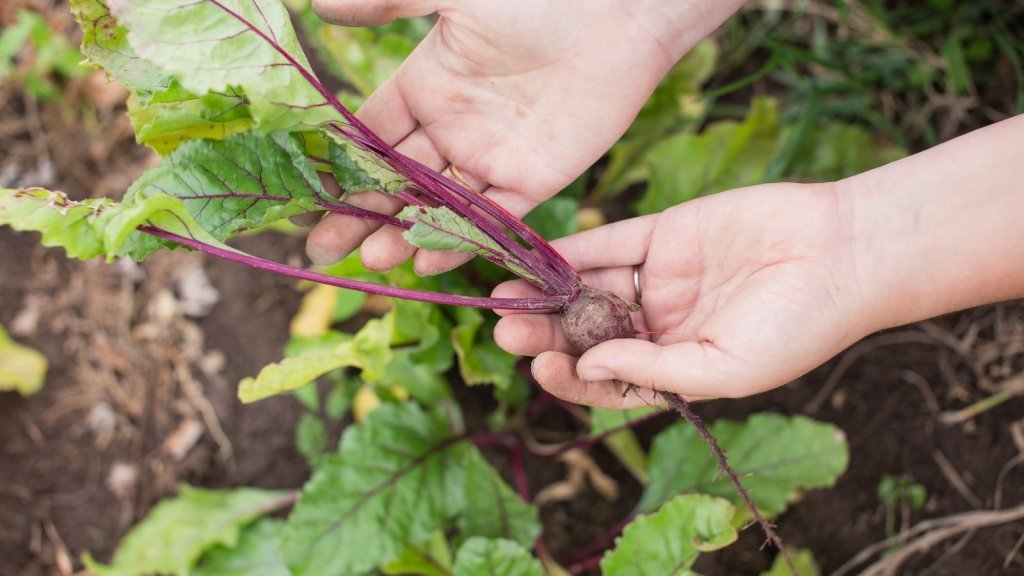
The short version: Radish, beetroot, carrot and turnip that grow lush tops and no root have almost always been crowded, overfed with nitrogen, grown in heat or shade, or sown into soil their roots cannot push through. Sow direct into loose, stone-free soil, thin hard and early so each plant has its own space, go easy on manure and high-nitrogen feeds, keep the water even, and sow in the cool months for your zone. Do those five things and the roots follow. Fresh manure, forgotten thinning and a hot spring are among the commonest mistakes behind a bare-rooted harvest.
There is a particular kind of gardener's grief in pulling a beautiful, leafy beetroot plant to find a pencil of a root underneath, or a bed of carrots that turned out to be all fern. The plant was healthy. It simply put its energy into the wrong end. This guide covers why that happens and how to make the root, not the leaf, the plant's priority.

What a root crop needs to swell
A radish, beetroot, carrot or turnip stores sugar made in the leaves into a swollen root. For that to happen the plant needs enough light to make the sugar, a reason to store it rather than spend it on more leaves, room to expand, soil loose enough to expand into, and steady water so the sugars can move down. Take away any one of those and you get top and no bottom. The causes below map straight onto that list.
The seven usual suspects
1. Crowding
This is the big one. Seed goes in thickly, the seedlings come up in a green carpet, and nobody thins them. Every plant in that carpet is competing for the same light and water, and none of them gets enough to swell. Thin early, when the seedlings are a few centimetres tall, and be brutal about it. Final spacings of about 3 to 5 cm for radish and carrot, around 5 cm for beetroot and about 10 cm for turnips give each root room to size up. Beetroot needs an extra pass because each "seed" is a cluster that produces several seedlings; keep the strongest one. Snip the extras at soil level with scissors rather than pulling, so the neighbours' roots stay undisturbed. Our guide to thinning root crops walks through it.
2. Too much nitrogen
Nitrogen tells a plant to grow leaves. Fresh manure dug in just before sowing, a high-nitrogen liquid feed every week, or a bed that just grew peas or beans all push root crops into producing foliage at the root's expense. Carrots respond with a hairy, woody root or a tangle of small roots instead of one taproot. Prepare root beds with compost rather than manure, ideally manure that fed the previous crop, use a low-nitrogen or balanced fertiliser sparingly if the soil is poor, and put root crops after hungry leaf crops in your rotation rather than after legumes. Fresh or half-rotted manure also carries a food-safety risk on crops that are often eaten raw and grow in direct contact with the soil, so only ever use manure that is fully composted.

3. Heat and the wrong season
These are cool-weather crops. Radish sown into warm soil and lengthening days will often bolt to flower before it makes a usable root, and crowding makes that worse. Carrot roots lose colour and sweetness once the soil sits above about 25 degrees, and beetroot and turnip turn woody and bolt in the same conditions. In most of Australia the reliable sowings are autumn, winter and early spring, with summer sowings limited to the cool zones or to a shaded bed with shade cloth over it. Gardenate gives radish an ideal germination range of about 8 to 30 degrees, but it is the weeks after germination that decide whether the root forms.
4. Shade
Root crops tolerate a little shade, but a bed with less than about six hours of sun grows slowly and leafily. In a shady garden, give the sunniest spot to the root crops and grow leafy greens in the shade instead. A bed shaded by a taller crop planted on its northern side is a common and easily missed cause.
5. Transplanting and disturbed taproots
Radish, carrot and turnip make a single taproot that forks or stalls if it is bent or damaged when young, so they should always be sown direct. Beetroot tolerates careful transplanting while the seedlings are tiny, but it too does better sown in place. Punnets of carrot seedlings from a nursery are a poor bet; a packet of seed is cheaper and works.

6. Uneven water
Root crops are thirsty, and water shortage limits both the sugar the leaves can make and its movement into the root. Dry spells followed by a heavy soak give split radish and carrot, cracked beetroot and woody cores. Water deeply and regularly, mulch lightly once the seedlings are up, and never let the bed dry out in the fortnight either side of thinning.
7. Hard, stony or heavy soil
A root tip that meets a stone, a clod of clay or a lump of undecomposed manure goes around it, and you get forks, twists and stumps. Compacted or crusted soil can stop a root swelling at all. Work the bed to a fine, loose tilth at least 20 to 30 cm deep, remove stones, and let any organic matter rot right down before sowing. In heavy clay, grow the shorter, stump-rooted carrot varieties and round beetroot, or build a raised bed of lighter soil. Soil pH matters too: root crops do best between about 6 and 7, and a strongly acid or alkaline bed slows them. Lumpy, galled roots with tiny knots are a different problem, root-knot nematode, which our guide to root-knot nematode explains.
Crop by crop
- Radish is the fastest and least forgiving. Sow 6 mm deep, thin to 3 to 5 cm, keep it moist and pull at 4 to 8 weeks. A radish left in the ground past its prime turns pithy and hot within days, so sow a short row every two weeks rather than a long row once. Radish is a brassica, so it shares pests and diseases with cabbage.
- Beetroot is the most tolerant of alkaline soil and of a little shade. Sow about 10 mm deep, thin the clusters to single plants at 5 cm, and harvest at about 30 to 50 mm across, golf ball size, two to three months from sowing, when it is sweetest. Big old beetroot is woody, not a triumph.
- Carrot is the slowest to germinate, up to three weeks, and the seed bed must not dry out or crust in that time. Sow 6 mm deep in loose, deep soil, thin to 3 to 5 cm, and hill soil or mulch over any shoulders that push into the light so they do not turn green.
- Turnip is a brassica like radish, so do not sow it where cabbage or broccoli grew last season. Sow direct, thin to about 10 cm, and harvest at about 10 cm across, 6 to 12 weeks after sowing, before it flowers and turns fibrous.

Rescuing a bed that has already gone leafy
If the plants are still young and the weather is still cool, thin them now, stop feeding, water evenly and wait; many beds recover and put on roots over the following month. If the plants have bolted or the season has turned hot, harvest what you can and treat the bed as a leaf crop: beetroot and turnip tops are excellent cooked greens, radish leaves go into soup, and carrot foliage can go to the compost. Then resow at the right time with the spacing fixed from the start.
Sowing root crops across Australia's climate zones
- Tropical (Cairns and far north Queensland, Darwin and the Top End of the Northern Territory, the Kimberley in Western Australia): sow radish and carrot in the dry season, roughly April to September, and use quick varieties; beetroot tolerates a longer window with shade and steady water. Turnip is marginal.
- Subtropical (Brisbane and coastal Queensland, Coffs Harbour and northern New South Wales): March to August is the reliable window, with radish extending into early spring. Summer sowings bolt and go woody.
- Arid and semi-arid (inland Queensland, Broken Hill and Dubbo in New South Wales, Mildura in Victoria, inland South Australia and Western Australia, Alice Springs in the Northern Territory): autumn and late winter sowings, roughly March to May and August to September, with mulch and steady irrigation.
- Temperate (Sydney and New South Wales, Melbourne and Victoria): most of the year for radish, and roughly February to May and August to December for beetroot, carrot and turnip, with the best roots from the autumn and early spring sowings. Midsummer sowings need shade cloth and daily attention to water.
- Mediterranean (Perth and southern Western Australia, Adelaide and the Adelaide Plains in South Australia): autumn to early spring, about March to September, growing on winter rain. Sandy soils suit carrots well but need compost to hold water.
- Cool and alpine (Hobart and Tasmania, Canberra and the ACT, Ballarat in Victoria, Orange and Armidale on the New South Wales tablelands, and the alpine country of the Snowy Mountains and the Victorian high country): September to March, with successive sowings through the mild summer, and carrots and beetroot left in the ground into autumn.
Soil temperature matters more than the calendar. A bed in full sun in early spring may be ready weeks before a shaded one across the path.
Frequently asked questions
Why are my carrots hairy with a woody core?
Too much nitrogen, usually from fresh manure or frequent feeding. Cut the feed, and prepare the next bed with compost only.
Can I eat root crops that never swelled?
Yes. The tops of beetroot, turnip and radish are good cooked greens, and thin roots are still edible, just small. Nothing about a leafy plant makes it unsafe.
Should I add lime for root crops?
Only if a test shows your soil is acidic. Root crops prefer a pH between about 6 and 7; beetroot is happy a little higher, radish and carrot a little lower. Liming an already neutral bed can lock up other nutrients and hold growth back.
Why did my radishes split?
A heavy watering or downpour after a dry spell. Keep the bed evenly moist and pull radishes as soon as they reach size.
Thin hard, feed lightly, sow cool and keep the water even, and the same beds that grew fern and foliage this year will grow roots next year. For a crop-by-crop sowing reference, Yates' beetroot growing guide and its carrot and radish guides give depths, spacings and harvest times.
Related growing guides
- Why thinning is the step everyone skips
- Root-Knot Nematode: The Hidden Cause of Wilting and Forked Roots
- How deep seeds really want to go
Sow a short row every fortnight: browse our radish seeds, beetroot seeds, carrot seeds and turnip seeds.