Description
Garlic - Tasmanian Purple (2 Bulbs, 200g, 400g, 1kg)
Allium sativum
NOT to WA & TAS
Contains approximately 16-20 bulbs per kg. As garlic bulbs are a natural product with inherent size variation, the exact number of bulbs may vary. All packs are weighed to ensure you receive the full stated weight, with loose cloves included where necessary to achieve precise weight.
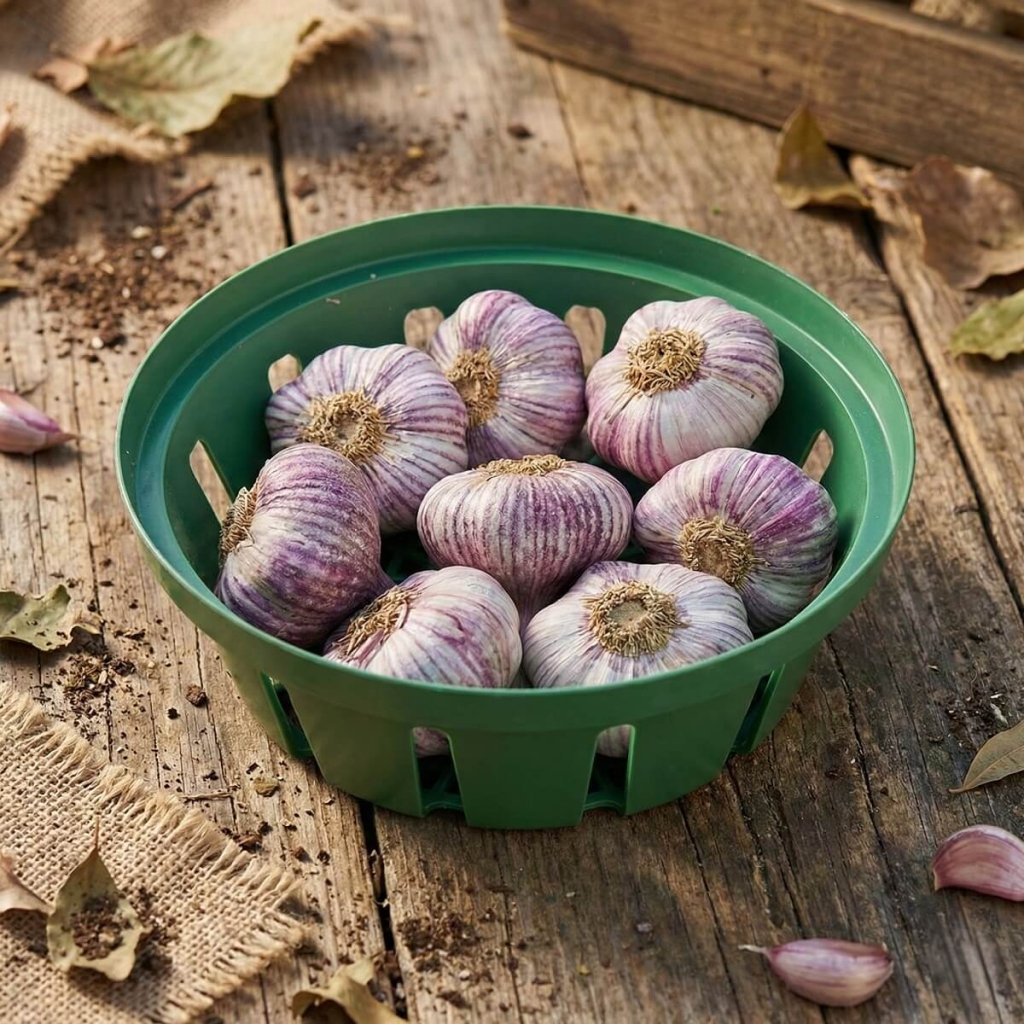
Tasmanian Purple is a remarkably adaptable turban variety bred in Tasmania, thriving across Australia from Hobart to Brisbane. These medium-sized bulbs produce 8-14 purple-skinned cloves with rich, sweet, nutty flavour. Generally mild with pleasant heat, the flavour intensifies when grown in colder regions. This easy-to-grow weakly bolting hardneck suits beginner and experienced gardeners alike. Early to mid-season planting and harvest. Stores 4-5 months. An excellent all-purpose cooking garlic that performs reliably across diverse Australian climates.
Growing Guide
Tasmanian Purple stands out as one of Australia's most adaptable garlic varieties, successfully bridging the gap between cool-climate hardnecks and warm-climate types. Bred in Tasmania, this turban group cultivar has proven itself from the cold midlands of Tasmania through Victoria, NSW, and even Queensland's subtropical regions, a truly remarkable climate range for a hardneck garlic.
Climate & Site Selection This cultivar's exceptional adaptability makes it ideal for gardeners uncertain about which variety suits their region. Tasmanian Purple performs particularly well in its namesake state but adapts readily to mild and warm climates where many hardneck varieties struggle. It's especially valuable for regions with marginal garlic-growing conditions, areas too warm for traditional cold-climate hardnecks but not suited to subtropical types.
As a weakly bolting hardneck, scape production varies with climate. In cooler regions, expect more reliable scaping; in warmer areas, scape production becomes inconsistent, some plants producing full scapes, others weak scapes, and some no scapes at all. This variability doesn't affect bulb quality and actually contributes to the variety's adaptability.
Choose a position with full sun exposure (6-8 hours minimum daily). While Tasmanian Purple isn't particularly fussy about conditions, it still benefits from well-drained soil. In coastal or humid regions, ensure excellent drainage to prevent waterlogging during winter. In heavy soils, create raised beds 15-20cm high.
Soil Preparation Despite being "not fussy," Tasmanian Purple responds to good soil preparation with larger bulbs and healthier plants. Prepare beds 3-4 weeks before planting.
Work well-aged compost or manure into soil to 20-30cm depth. The variety tolerates a wide pH range (5.5-7.0), making it suitable for gardens where soil pH is challenging to modify. Add a complete organic fertiliser or blood and bone at manufacturer's recommended rates.
In regions with summer rainfall (subtropical areas), incorporate extra organic matter to improve soil structure while maintaining drainage. The variety tolerates some humidity during growth but benefits from soil that drains freely after heavy rain.
Planting Planting timing varies with your location:
- Cool climates (Tasmania, Southern Highlands, high-altitude Victoria): April to early May
- Temperate regions (most of Victoria, southern NSW, Adelaide): mid-April to mid-May
- Warmer regions (northern NSW, southeast Queensland): late April to late May
This mid-season planting window suits Tasmanian Purple's adaptable nature. Unlike varieties requiring very early or very late planting, the flexible timing makes it forgiving for busy gardeners.
Separate bulbs into individual cloves 24-48 hours before planting. Select the largest cloves from healthy, disease-free bulbs. Tasmanian Purple typically produces 8-14 cloves per bulb depending on climate, cooler regions generally produce fewer, larger cloves (8-10), while warmer regions produce more numerous cloves (12-14) arranged in multiple layers.
Plant cloves 5-8cm deep with the pointed end upward. Space cloves 15cm apart in rows 30-35cm apart. This spacing accommodates the medium-sized bulbs (6-7cm diameter) while ensuring adequate air circulation.
Watering Consistent moisture is critical for Tasmanian Purple, the variety is notably sensitive to water stress. Plants suffering water shortage weaken prematurely, may fall over before maturity, and produce smaller bulbs. This sensitivity to drying out is one of the few specific requirements of this otherwise adaptable variety.
Water deeply 1-2 times weekly during active growth, providing 25-30mm each time. Deep watering develops strong root systems that better withstand environmental stress. In regions with reliable winter rainfall, supplement only during dry spells, but monitor soil moisture closely, don't assume winter rain provides adequate moisture without checking.
Continue regular watering through spring as temperatures rise. Tasmanian Purple matures quickly once weather heats up, and adequate moisture during this rapid bulb development phase directly impacts final bulb size. Reduce watering frequency only in the final 2-3 weeks before harvest, once lower leaves begin yellowing.
Unlike varieties tolerating complete water cutoff 2-3 weeks before harvest, Tasmanian Purple should maintain light moisture until 1-2 weeks before harvest to prevent premature plant collapse.
Fertilising Apply nitrogen-rich fertiliser 4-6 weeks after planting to support vigorous leaf development. Blood and bone, fish emulsion, or aged poultry manure work well. Each leaf produces one bulb wrapper layer, so robust early foliage growth contributes to better bulb protection.
Make a second nitrogen application 8-10 weeks after planting as plants reach peak vegetative growth. This supports the healthy leaf development needed for photosynthesis and bulb formation.
Switch to potassium-rich fertiliser in late winter/early spring as bulbs begin forming. Wood ash, potash, or complete organic fertilisers with higher potassium ratios support bulb development without encouraging late-season foliage that delays maturity. Cease nitrogen applications once bulbs start sizing to prevent delayed maturation and reduced storage life.
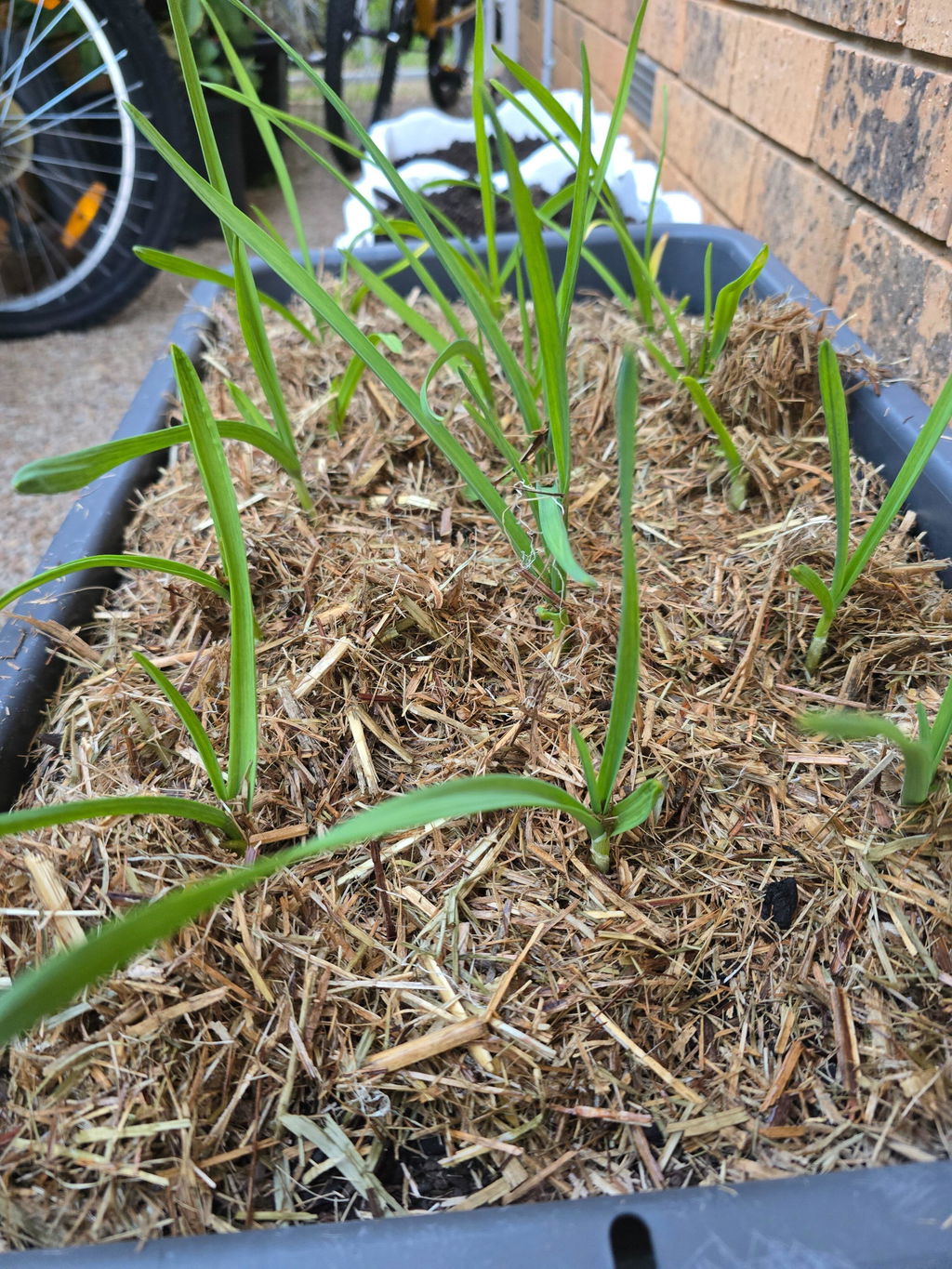
Mulching Apply 5-8cm of organic mulch immediately after planting. Pea straw, lucerne hay, or sugar cane mulch suppress weeds while maintaining the consistent soil moisture that Tasmanian Purple requires. Mulch also moderates soil temperature, important across the variety's wide climate range where temperature fluctuations can stress plants.
Keep mulch pulled back 2-3cm from stems to prevent collar rot, particularly important in humid regions. Refresh mulch in late winter if it has decomposed significantly, fresh mulch helps maintain critical spring moisture.
Pest & Disease Management Tasmanian Purple shows good general disease resistance but benefits from standard preventive practices:
Rust: Orange-brown pustules on leaves. Ensure good air circulation through appropriate spacing, avoid overhead watering, and remove affected leaves promptly. More common in humid coastal regions.
Downy Mildew: Grey-purple fuzzy growth on foliage in humid conditions. Improve air circulation, ensure plants receive adequate water (water stress increases susceptibility), and remove affected leaves.
Thrips: Tiny insects causing silvery streaking on leaves. Monitor regularly and spray with organic insecticidal soap if populations build. Well-watered plants show better resistance.
White Rot: Soil-borne fungal disease causing yellowing and bulb rot. Practice 3-4 year crop rotation with no alliums (garlic, onions, leeks, shallots) in the same location. Never plant where white rot has occurred previously.
Scape Management As a weakly bolting hardneck, scape production varies significantly:
Cool climates: Usually 100% of plants produce scapes. Remove when they form an upside-down U shape (180-degree loop) or begin straightening, typically 1-2 weeks after emergence. Cut where the scape meets the top leaf.
Warmer climates: Variable scape production is normal:
- Some plants produce full scapes
- Some produce weak scapes that remain short and floppy without forming proper loops
- Some produce no scape at all
According to the Australian Garlic Industry Association, scapes can be left to develop in Tasmanian Purple as they have little effect on bulb size. However, removing scapes prevents the hollow stalks from becoming disease entry points and produces tender scapes excellent for cooking.
Critical Timing Considerations Tasmanian Purple matures quickly once weather heats up. In warmer regions, this rapid maturation can catch gardeners by surprise—the variety goes from actively growing to ready for harvest in a compressed timeframe once temperatures rise. Begin monitoring plants closely from mid-spring onwards in warm regions, or from early summer in cool climates.
Like other turban varieties, split bulb skins occur if harvest is delayed. Monitor daily once lower leaves begin yellowing to catch the optimal harvest window.
Harvest & Storage
When to Harvest Tasmanian Purple matures in the early to mid-season range—typically late October to mid-November in warm regions, or November to early December in cooler climates. The exact timing depends on your location and seasonal temperatures, but the variety's tendency to mature quickly once weather heats up means careful monitoring is essential.
Climate-Specific Maturation:
- Subtropical regions (Brisbane, northern NSW): Late October to early November
- Temperate regions (Sydney, Melbourne, Adelaide): November
- Cool climates (Tasmania, Southern Highlands): Mid-November to early December
Visual Maturity Indicators: Begin checking plants when lower leaves start yellowing:
- Lower 4-5 leaves have turned yellow or brown
- Upper 5-6 leaves remain green (don't wait for complete die-back)
- Pseudostem feels slightly soft when gently squeezed
- Scape (if present) has dried and may be falling away
- Plants may lean or weaken—particularly common in warmer regions
Test Bulb Excavation: When 3-4 lower leaves have yellowed, carefully excavate soil from one bulb without fully lifting it:
- Check that bulbs have reached medium size (6-7cm diameter)
- Verify the characteristic large, round, flattened shape is fully formed
- Confirm individual cloves are well-defined and plump
- Ensure wrapper layers are developing but haven't split
- Check that papery outer skin is beginning to form
If conditions aren't met, cover the test bulb and check again in 3-4 days. Once one area shows readiness, the rest typically matures within 3-5 days—Tasmanian Purple matures reasonably uniformly.
The Split Skin Challenge: Like other turban varieties, Tasmanian Purple develops split bulb skins if harvest is delayed beyond optimal maturity. The medium to thick wrappers that protect bulbs well can split and flake once fully mature, particularly when:
- Harvest is delayed beyond peak maturity
- Weather turns warm and humid during final maturation
- Plants receive excessive water in the final weeks
- Rapid bulb development stretches wrapper layers
Harvest as soon as maturity is reached rather than waiting for additional size—split skins dramatically reduce storage life, exposing cloves to disease and moisture loss.
Harvesting Method Choose a dry period with at least 3-4 days of sunny weather forecast. Avoid harvesting before rain, as wet conditions during and after harvest promote fungal issues.
Stop all watering 7-10 days before planned harvest. Given Tasmanian Purple's sensitivity to water stress, maintain light moisture until the final week, then stop completely to allow initial in-ground curing.
Harvest procedure:
- Wait until morning dew has dried (mid-morning ideal)
- Loosen soil around bulbs using a garden fork, working 12-15cm away from plants to avoid piercing bulbs
- Gently lever soil upward, breaking the root zone
- Grasp stems near the bulb (not at the top of foliage) and lift carefully
- Shake off loose soil gently—don't wash bulbs or bang them together
- Lay bulbs on a tarp or in crates in shade
- Transport immediately to the curing area
Handle carefully—the medium to thick skins protect bulbs well when intact but split and flake easily with rough treatment. Any damage shortens the already moderate 4-5 month storage life.
Curing Process Proper curing maximizes Tasmanian Purple's 4-5 month storage potential:
Setup: Hang bulbs in bunches of 4-6 plants or lay in single layers on wire racks. The hollow scapes (where present) often fall out during drying, so if bunching, tie stems together securely. Never cure in direct contact with solid surfaces—complete air circulation is essential.
Location: Choose a well-ventilated area protected from rain and direct sunlight:
- Covered verandas with good cross-breeze
- Open sheds with cross-ventilation
- Garages with windows/doors open
- Drying racks under 50% shade cloth
In humid regions (coastal or subtropical areas where this variety thrives), prioritize maximum airflow. Consider using fans to enhance air movement if natural ventilation is limited.
Duration: Cure for 3-4 weeks minimum. The medium to thick skins require adequate drying time to toughen and seal properly. Curing is complete when:
- Outer skins are papery dry and rustle when touched
- Stems have shrivelled to 20-30% of fresh diameter
- Roots are completely dried and brittle
- Neck feels firm and dry when gently squeezed
- The purple-red fresh colour has mellowed to mainly white with dark to pale purple stripes
During Curing: Check bulbs every 2-3 days, immediately removing any showing mould, softening, or rot. In humid conditions where Tasmanian Purple often grows, vigilant monitoring prevents disease spread. The skins that "split and flake away as they age" can trap moisture if damaged, creating disease entry points.
Cleaning & Preparing for Storage Once fully cured:
- Trim roots to 5-10mm from the bulb base
- Cut stems 2-3cm above the bulb—hollow scapes often separate easily
- Gently brush off loose soil or damaged outer wrapper layers
- Handle with care—while the medium to thick wrappers provide good protection, they split and peel easily
Don't over-clean. Remove only the outermost layer if dirty or damaged—every wrapper layer removed shortens storage life. Tasmanian Purple's skins wrap bulbs well, so minimal cleaning is usually needed.
Sorting for Storage: Separate bulbs into three categories:
- Premium storage: Perfectly formed bulbs with intact, unsplit skins—these achieve the full 4-5 month storage
- Immediate use: Bulbs with split wrappers, minor damage, or skin cracking (use within 4-6 weeks)
- Seed stock: The largest, most perfect bulbs for next season's planting (particularly valuable given this variety's proven adaptability to your specific location)
Be realistic—bulbs with split skins won't store the full 4-5 months regardless of conditions. Use these promptly while preserving premium bulbs for later use.
Storage Conditions Tasmanian Purple stores 4-5 months under optimal conditions—moderate storage life typical of turban varieties:
Temperature: 10-15°C is ideal. Avoid storage areas exceeding 18°C, which accelerates sprouting and reduces storage to 3-4 months. Cool pantries, cellars, or air-conditioned storage rooms work well across the variety's wide climate range.
Humidity: 60-70% relative humidity prevents both excessive drying (causing clove shriveling) and moisture buildup (encouraging mould). Particularly important in humid regions where this variety often grows—avoid kitchens with cooking moisture or damp storage areas.
Light: Store in complete darkness. Light exposure triggers sprouting and can affect the attractive purple striping.
Air Circulation: Critical for preventing the skin flaking that occurs as bulbs age. Use mesh bags, wooden crates with wide spacing, or wire baskets. Never use plastic bags or airtight containers—the skins need air circulation to remain intact.
Storage Methods:
- Mesh bags: Hang from pantry hooks allowing air circulation
- Wooden crates: Stack with spacing for airflow
- Wire baskets: Excellent air circulation from all sides
- Braided strings: Traditional method if stems were left long
Maintenance During Storage: Check stored bulbs every 2-3 weeks:
- Remove any bulbs showing softening, sprouting, or mould immediately
- Gently squeeze bulbs to verify firmness—soft spots indicate internal breakdown
- Watch for skin flaking, which increases as bulbs age and can expose cloves
- Look for green shoots emerging—use these bulbs promptly
By late February to March (4-5 months post-harvest), most Tasmanian Purple bulbs will be used or showing sprouting signs. This is normal for turban varieties and why they're classified as "short storage" types.
Saving Seed for Next Season Tasmanian Purple's adaptability makes it excellent for developing your own local strain. Select the largest, most perfectly formed bulbs immediately after curing:
- Medium to large size (6-7cm or larger)
- Intact, unsplit skins
- Attractive purple colouration and striping
- No disease signs or damage
- Well-formed round, flattened shape
The variety will gradually adapt to your specific growing conditions over several seasons, potentially improving performance in your location. Store seed bulbs separately in optimal conditions. Separate into cloves only 24-48 hours before planting to maintain vigour.
All orders ship from Sydney, NSW, Australia.
Where We Ship
-
All over Australia, including WA & TAS. We do not ship seeds outside Australia.
Processing Times
-
Order dispatch or packing time, 1 to 3 business days. Weekends and public holidays excluded. Transit time is additional.
-
Western Australia orders are packed each Thursday and handed to Australia Post on Friday. Place WA orders before Wednesday 11:59 PM Sydney time for Friday dispatch.
Delivery Options and Prices
Standard Post and Parcels, Australia Post or courier
-
Typical delivery time, 3 to 10 business days. Remote WA and NT may take longer.
| Order contents | Price |
|---|---|
| Seed packets only, or any seeds or garden supplies up to 200 g | $3.95 |
| Upgrade seed packet delivery to tracked letter | Add $3.00 |
| Mixed items 200 g to 400 g | $5.95 |
| Mixed items 401 g to 2 kg | $10.95 |
| Mixed items over 2 kg, including seed potatoes, tubers, canes, rhizomes | $16.95 |
Free letter option for small seed orders
Seed packet orders under 1 g qualify for free untracked domestic letter shipping when the order value is $40 or more after discounts. Delivery for untracked letters may take 5 to 12 business days, sometimes longer.
Express Post and Parcels, Australia Post or courier
-
Typical delivery time is 1 to 3 business days. WA, NT, TAS, and remote areas may take longer.
| Order contents | Price |
|---|---|
| Seed packets only | $16 |
| Seed packets and bulk weight-based seeds up to 500 g | $19 |
| Bulk seeds 0 to 500 g | $19 |
| Bulk seeds 501 g to 1 kg | $21 |
| Bulk seeds 1.01 kg to 3 kg | $26 |
| Bulk seeds 3.01 kg to 5 kg | $45 |
| Bulk seeds 5.01 kg to 10 kg | $80 |
| Bulk seeds 10.01 kg to 15 kg | $120 |
Important for WA Express
We do not provide Express parcel service for WA orders because quarantine inspections delay delivery, which defeats the purpose of Express.
State Specific Requirements and Fees
-
Western Australia, add $6 per order for Quarantine inspection. All WA seed orders go to Quarantine WA for inspection. Tracking (if any) is activated after inspection, which may take up to 10 business days from our packing date. Delivery within WA generally takes an additional 1 to 5 business days after release from Perth Airport.
-
Tasmania, add $3 per order for Biosecurity paperwork. Maximum 1 kg per seed line item. Biosecurity Tasmania restrictions apply.
Tracking and Delivery
-
You will receive a dispatch email with a tracking number when your order ships from our warehouse. Some small-value orders may ship as untracked letters.
-
Signature on delivery is available. Add $5.95. If not selected, the carrier may leave the parcel in a safe place, your letterbox if it fits, or at a collection point. ID may be required for Registered or Signature services.
Delivery Timeframes and Late or Missing Orders
-
Dispatch and delivery times are estimates. Events outside our control, such as weather or carrier delays, can affect timing.
-
We use Australia Post guidelines to decide when an order is considered late or missing.
When an order is considered missing
| Service | Usual delivery time | Time before an order is counted as missing | Review period before replacement |
|---|---|---|---|
| Economy delivery | 3 to 12 business days | 20 business days | 2 to 3 business days |
| Express delivery | 1 to 3 business days | 5 business days beyond Australia Post’s estimate | 2 to 3 business days |
Delivery guarantee
If your order is lost or damaged in transit, we will work with you on a fair resolution, which may include a full refund, an upgrade to tracked delivery at a subsidised rate, or a one-time replacement. If we resend an order, that replacement is final and is sent at your own risk. No further refund or replacement will be provided.
Important Notes
-
We process orders after receiving cleared payment.
-
Postage rates are per order. We may combine multiple orders to the same recipient at the same address into one shipment.
-
Shipping charges are not discounted during product sales.
Need Help?
-
Phone, 1800 733 399
-
Business hours, Monday to Friday, 8 am to 5 pm NSW time (AEDT or AEST depending upon daylight savings)
-
Address, PO Box 148, Riverstone NSW 2765
-
ABN, 63 634 537 492
Frequently Asked Questions
Do you ship outside Australia
No. We only ship within Australia.
How long does Standard delivery take
Delivery typically takes 3 to 12 business days after your order is dispatched (remote WA and NT areas may experience longer timeframes). Orders are usually lodged with Australia Post the business day after packing, and delivery time is calculated from that lodgement date.
How long does Express delivery take
Most orders arrive in 1 to 3 business days. WA, NT, TAS, and remote areas may take longer.
Do WA orders have delays?
Yes. WA orders go through Quarantine inspection. Tracking activates after inspection.
Can I get a signature on delivery?
Yes. You can add a signature on delivery for $3.95.
When is an order considered missing
We follow Australia Post guidelines. See the timeframes above..
Estimate shipping
Shipping Restrictions
Western Australia Customers: We can ship most seed line items, except Quarantine WA restricted seed lines to WA. To help us ship your order as quickly and efficiently as possible, please do not include any seed items prohibited in WA; they are listed with the label 'NOT to WA'. Due to quarantine restrictions in WA, there is a 10kg seeds limit per variety. WA orders require additional handling time. Please remain within an approved limit when ordering seeds. We review every WA order before dispatch and remove (or reduce) excess seed quantity from your order to comply with WA biosecurity regulations. Please check further information here
Tasmania Customers: We can ship seeds to Tasmania. Please do not include seed line items labeled 'NOT to TAS'. Please note that the maximum allowable limit per permitted seed line item is 1kg per order.