
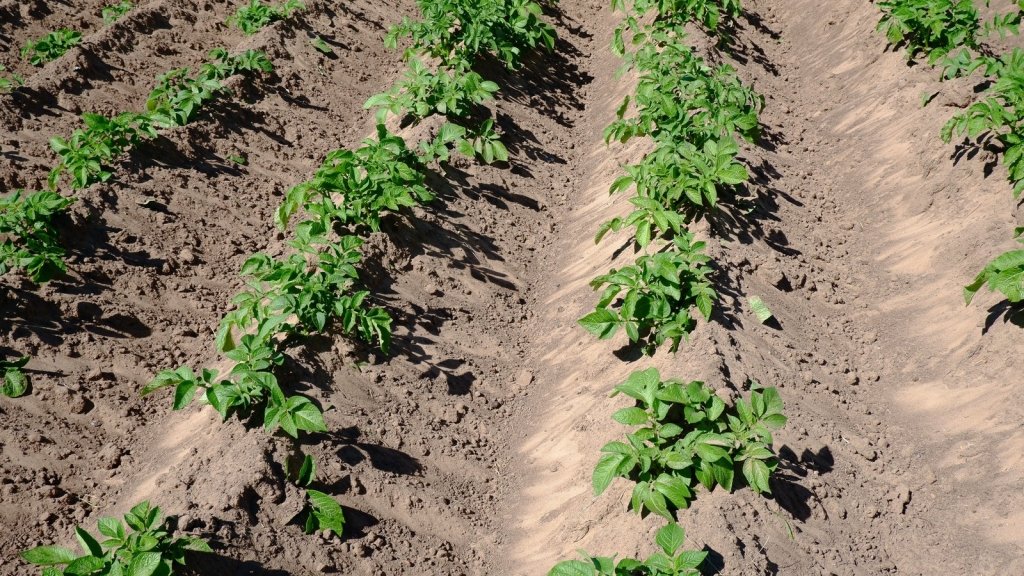
The useful question is not which plant loves potatoes. It is which plants will let you mound soil over the row, which will shade the crop or dry the bed out while tubers size, and which carry a disease potatoes also get. Most companion charts answer none of those.
The short version: Keep the row clear so you can hill it up, and keep the rest of the potato family (tomato, capsicum, chilli, eggplant, tamarillo and nightshade weeds) in another bed, because they share diseases and pests. Flowers belong at the row ends and along paths. Rotation and certified seed do the heavy lifting.
What the potato needs from the space around it
Room to hill up. The NSW Department of Primary Industries advises planting at least 15 cm deep and says good hilling at the right time substantially reduces tuber infestation by potato moth, using wide hills with soil thrown well up around the plants. The crop must also be free of tall weeds that would interfere with hilling, and a companion planted in the row behaves like that weed.
Light on its own leaves. Tubers are built from what the foliage makes, so a sweetcorn block or bean frame on the sunny side costs yield.
Steady water while tubers bulk. The same guidance says tuber damage is worst in heavy soils that crack when conditions are dry late in the season, and a thirsty neighbour opens those cracks for potato moth larvae.

What to keep out of the bed
The strongest evidence here is about shared pathogens. Target spot, or early blight, is one of the most common diseases of potato leaves and stems. Agriculture Victoria records that it is caused by the fungus Alternaria solani, and that the same organism attacks tomatoes, capsicums and related plants. It carries over on plant refuse in the soil, so the listed controls are rotation and healthy seed.
Late blight is the second, and the detail matters. NSW records that Phytophthora infestans of the A1 mating type is found in Australia, while the A2 mating type is exotic and not present here. Hosts include potato, capsicum, chilli, eggplant, pepino, tamarillo and tomato, plus weeds such as kangaroo apple and black nightshade. Suspected cases go to the Exotic Plant Pest Hotline, 1800 084 881.
Potato moth, Phthorimaea operculella, is described by NSW as the most destructive pest of potatoes in that state, a serious pest of tomatoes and eggplant, and a pest of potato-family weeds. Pulling nightshade out of the patch beats any companion.
Tomato potato psyllid: Western Australia, and now Victoria
PIRSA records that Bactericera cockerelli was first detected in Western Australia near Perth in February 2017 and is now established in that state, and that it feeds on tomato, potato, capsicum, chilli, tamarillo, eggplant, sweet potato and solanaceous weeds. In Perth and the south-west, a potato patch beside the tomatoes or under a tamarillo is a bridge the psyllid can cross. It is no longer only a Western Australian problem. The same PIRSA page records detections in south-west Victoria in November 2024 and in the northern suburbs of Melbourne in late 2025, and Agriculture Victoria now lists the psyllid as established and a serious pest for home gardeners throughout Victoria. In the other states and territories it is still treated as exotic, with import conditions on potato-family plants, so a suspected psyllid there goes to the Exotic Plant Pest Hotline, 1800 084 881. PIRSA also states Australia remains free of the bacterium the psyllid carries overseas, and DPIRD Western Australia lists Candidatus Liberibacter solanacearum as a declared pest that must be reported.

Marigolds and nematodes, done properly
This is the one piece of companion folklore with real published work behind it. A University of Hawaii extension review sets out that the nematicidal activity of marigold sits in the roots of growing plants, not in root or leaf extracts, that the species usually used are Tagetes patula, T. erecta and T. minuta, and that the crop should not be tilled in until fully established, roughly three to four months. Those trials ran in Hawaii and California, so treat them as mechanism and overseas results.
A few marigolds dotted between potato plants is not what was tested. The tested version is a dense block of one Tagetes species grown before the potatoes go in, and marigold seed is cheap enough to try that way.
Which nematode matters. That work is about root knot nematode, Meloidogyne. Potato cyst nematode is Globodera, and it is regulated. Agriculture Victoria lists Globodera rostochiensis as a declared notifiable pest found in parts of Victoria and eradicated from Western Australia, with Globodera pallida not yet known to occur here. Cysts can survive in soil for up to 20 years, and the advice for reducing risk is tested, certified seed. That one is a notification, not a gardening project.
Beans and peas: what is supportable
The usual claim is that legumes feed the potatoes beside them. The fixation is real, the timing is not. A South Australian soil fact sheet notes that 30 to 40 per cent of the nitrogen in a legume crop sits in the seed at maturity, and that legume residues contribute to following crops. Peas over winter, cut at the base with the roots left in, do more for spring potatoes than the same peas grown alongside.
Flowers that bring in aphid predators
Aphids matter because of what they carry. AuSPICA, which certifies Australian seed potatoes, warns that uncertified seed potatoes may carry potato virus Y, which is transmitted by aphids and can spread from a home garden to a seed potato field. Cesar Australia lists the predators that knock green peach aphid back: hoverfly larvae, lacewings, ladybird beetles and damsel bugs. NSW guidance says biological control can be enhanced by planting flowering plants within the crop, and Australian trials across four states used sweet alyssum, buckwheat and cornflower. Sow alyssum, cornflower, calendula, cosmos or dill along the path edge, clear of the hilling. If aphids are already thick, our guide to controlling aphids has the faster answers.

Rotation does the work a chart cannot
Every disease above survives in soil, crop debris or volunteer plants, so the calendar matters more than the neighbour. NSW is blunt: do not grow successive crops of potatoes in the same ground, because the second will be attacked early by moths bred on the remains of the first. Keep the ground clear of volunteer potatoes and weed hosts for months beforehand. Tomato, capsicum, chilli and eggplant count as the same crop, and our crop rotation plan sets out a sequence for four beds.
Certified seed, and the state borders
AuSPICA states that fields used for certified seed are soil sampled and tested negative for potato cyst nematode, and that crops are inspected for strict tolerances to potato virus Y. Tubers also cannot move freely around the country. Australian Interstate Quarantine records that potatoes brought into Western Australia from another state, except Tasmania, are not allowed into the Gin Gin and South-west growing areas, and that all of New South Wales is a Potato Biosecurity Zone. The Plant Biosecurity Manual Tasmania 2026 Edition lists living potato plants and unwashed potatoes as not permitted, with certified seed allowed as mini-tubers under conditions. Check where a supplier can ship before ordering certified seed potatoes.
When potatoes go in, by climate zone
These zones are broad groupings, so if you sit between two, lean on local cues such as your first and last frost dates.
- Tropical (Top End of the Northern Territory, far north Queensland, the Kimberley in Western Australia): night heat is the limit, since potatoes need night temperatures below 20 degrees for about four hours. Plant into the dry season, or on cooler high country, as Queensland does on the Atherton Tableland.
- Subtropical (south-east Queensland, northern New South Wales): autumn and winter, not spring. Queensland's main crop goes in during June and July, milder coastal districts in April and May, and the Lockyer Valley in February.
- Arid and semi-arid (inland South Australia and New South Wales, the Alice Springs district, the Western Australian goldfields): the risk is dry soil cracking late in the crop and letting potato moth reach the tubers. Keep water up as tubers bulk and the hills wide.
- Temperate (coastal New South Wales, most of Victoria, south-eastern South Australia): plant in spring once frost risk passes. In Victoria the psyllid is now established, so keep potatoes away from tomatoes, capsicum, chilli and eggplant, and look for the white sugar-like granules it leaves on leaves. On the New South Wales coast, potato moth is worst in dry spring weather, taking foliage from September to November and tubers after.
- Mediterranean (Perth and the south-west of Western Australia, Adelaide, the Fleurieu and Yorke Peninsulas): aim to have the crop bulking before high summer. In Western Australia the psyllid is established across Perth and the south-west, so keep potatoes clear of tomatoes and tamarillo, and interstate tubers cannot enter the Gin Gin and South-west growing areas.
- Cool and alpine (Tasmania, the Victorian and New South Wales high country, Canberra and the ACT, the Adelaide Hills): late frosts set the date, and Tasmanian site assessment counts frost-free days, with seed potato crops needing more than 90. Wait for frost risk to pass, or cover shoots on a cold night.
Frequently asked questions
Can I plant potatoes and tomatoes in the same bed if I space them out?
It is better not to. Target spot, late blight, potato moth and tomato potato psyllid all move between the two, and the target spot fungus carries over in soil, so distance within one bed does not reset the risk. The same goes for a bed that grew tomatoes last summer.
Do marigolds protect potatoes from potato cyst nematode?
There is no basis for saying so. The published Tagetes work is about root knot nematode, Meloidogyne, and depends on a dense stand grown for months. Potato cyst nematode is Globodera rostochiensis, a notifiable pest in Victoria, and the measure named for it is tested, certified seed.
So is there anything I can plant with potatoes?
Yes, at the edges. Flowers for nectar at the row ends and along the paths stay out of the way, and a quick salad crop at the bed ends works while the tops are small, as long as it never sits in the strip you will walk on and pull soil from. What fails is anything that has to hold the row until harvest.
Your next step
Pick the bed first and the variety second. Choose ground that has not carried potatoes, tomatoes, capsicum, chilli or eggplant for at least three years, which a four-bed rotation gives you, mark out rows you can walk between and mound, then order certified tubers. Our comparison of Dutch Cream and Kipfler helps with the variety, and how to chit seed potatoes covers greening them first.