
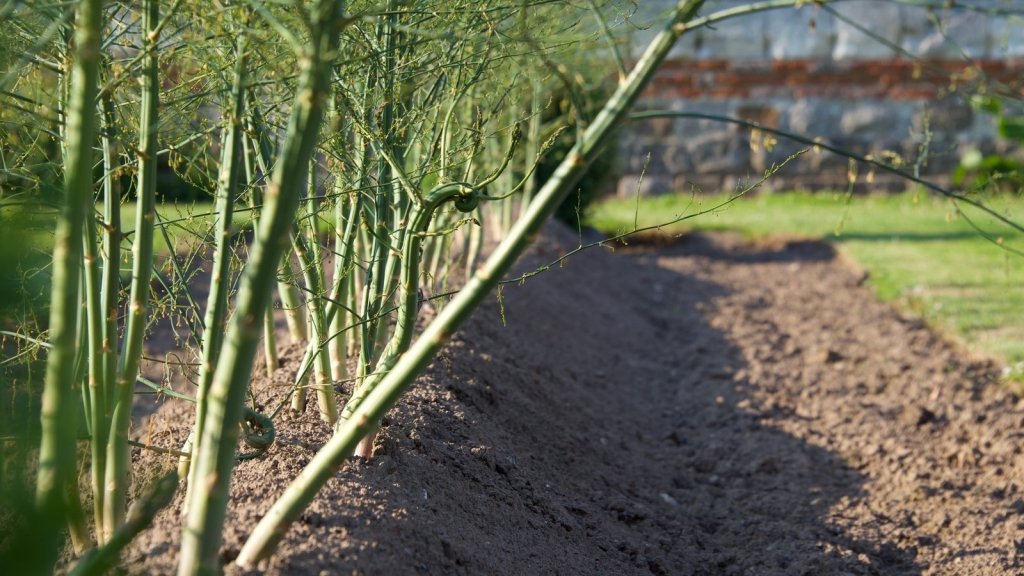
Companion planting advice assumes you can change your mind next season. An asparagus bed does not. The crowns go in once, a good stand can stay productive for 15 years or more, and the roots run too far and too shallow to dig the bed over later. The question is not what asparagus likes, but what you can live beside it for twenty years.
The short version: Keep the asparagus row bare, mulched and undisturbed, and put companions at the edge of the bed. Shallow rooted salad crops can use the gaps between rows during the spring cutting season, provided they are out before the fern closes over. Nothing perennial, spreading, tall or fork-harvested belongs near the crowns.
Why a permanent bed changes the rules
The crown sits about 15 cm down, which sounds contained. The roots are not. In the standard excavation study of vegetable root systems, asparagus roots ran sideways from the rhizome 1.2 to 1.8 m or more at depths of just 8 to 20 cm in six year old plants, and the same chapter reports plants of eight or nine years with roots 1.8 to 2.4 m deep and 2.4 to 3 m across. A fork pushed in within 1.5 m of a crown cuts the roots that carry next spring's crop, which is why Australian agronomy says cultivation over the row should be shallow or avoided.
Weeds are the second consequence. In an annual bed you cultivate mistakes out; here you cannot, so weeding is by hand for the life of the stand. A running grass such as couch or kikuyu that reaches a crown is effectively permanent, so settle organic weed control before a single crown goes in.

The asparagus year, and where the gaps are
Crowns go in during winter while dormant, and seed adds a year. Full production cannot be expected for at least three years: no spears in the first, a light cut in the second, a real season from the third.
- Cutting season, roughly August in warmer districts to December in cooler ones. The bed is low and open, and this is the window worth using.
- Fern phase, until the fern dies down. Spears run up into a fern 1.5 m or taller that replenishes the crown for next year. The bed is now a shaded, thirsty thicket.
- Cutting down, late autumn to winter. Leave the fern until completely dead, because nutrients are reabsorbed from the stem and foliage into the crown.
What can genuinely share the space
Match the companion to that window, not to a chart. What works is shallow rooted, fast and pulled by hand: radish, rocket, loose leaf lettuce, mizuna, baby spinach, coriander cut young. These feed in the top few centimetres and finish in four to eight weeks.
- Stay off the row. Sow between rows or in the path, keeping a working margin of about 30 cm from the crown line so that pulling a radish never disturbs a bud.
- Set an exit date, not a sowing date. Anything still standing when the fern closes over is shaded out, and drinks water the crown needs.
- Harvest by hand. If a crop needs a fork to lift it, it does not go in the bed.
NSW agronomy allows an intercrop between the rows on two conditions: enough water and feed that it is not competing, and no hosting of asparagus pests or diseases. It also notes that cover crops can compete with young asparagus in the establishment year and the few years after, and that ample water and feed reduce the effect. A commercial grower may intercrop those years to offset the slow start. In a home bed the simpler course is to leave the gaps mulched and empty until the third year, when there is a real cutting season to work around.

What to keep out
- Perennial spreaders. Mint, comfrey, Jerusalem artichoke, running grasses and a strawberry mat all need digging out eventually, and you cannot dig.
- Anything harvested with a fork. Potatoes, carrots, parsnips and dahlias sit at feeder root depth.
- Anything that grows into the fern. Sweet corn, sunflowers, climbing beans and tall tomatoes shade what funds next year's crop.
- Anything you must cut down mid season. Slashing a cover crop just before harvest can drive mites onto the asparagus.
- Self sown asparagus. Berries from female plants germinate readily, and the seedlings compete.
The alliums question, answered honestly
Nearly every chart says keep onions and garlic away from asparagus. We looked for the trial behind it and did not find one. Australian asparagus agronomy does not mention alliums at all, and a Washington State University extension horticulturist puts the general point plainly: there is no scientific basis for any of the several lists that exist describing traditional companion plants. One real connection exists, and it is timing, not chemistry. Onion thrips, Thrips tabaci, is the most common thrips on asparagus spears, and thrips move across when the plants they fed on dry off. A garlic row drying down in late spring sits inside the cutting season. Keep alliums out of the crown row, because you dig them out.
Flowers at the edge, and two catches
Here companion planting has real evidence behind it. In Australian trial plots in brassica crops across New South Wales, Victoria, South Australia and Queensland, sweet alyssum, buckwheat and cornflower were associated with more ladybeetles, brown lacewings and parasitoid wasps, and fewer pests alongside. Nobody has run that trial in asparagus, but the insects are the same ones. Dill, coriander and parsley left to flower are recommended for the same job, because their open umbels suit short tongued predators. A strip of alyssum down one side is easy to manage and to pull out.
Two catches follow from the bed being permanent. Many weeds and ornamentals, particularly perennials, host thrips, so a perennial border against the crowns becomes a reservoir; use annual flowers you can clear. And Rutherglen bug, Nysius vinitor, is one of the two most significant insect pests of Australian asparagus: as the weeds it breeds on senesce and dry, late stage nymphs and adults move up onto the crop canopy, so keep a flowering strip watered, and cut it before it seeds and dries off. Victorian gardeners should skip fennel, a declared noxious weed in Victoria, and use dill, coriander or ammi.

The pests and diseases that matter here
Do not import the northern hemisphere list. The common asparagus beetle, Crioceris asparagi, dominates European and North American advice, but the Atlas of Living Australia holds no Australian occurrence records for it (its only two records are overseas specimens and sightings), and Australian guidance does not list it.
That guidance names thrips and Rutherglen bug as the significant insect pests, with mites, snails and slugs as minor. Fusarium and Phytophthora are the long standing diseases, which makes drainage a bigger question than companions, and Stemphylium fern spot follows showery weather or overhead watering. Asparagus rust, Phomopsis stem blight and anthracnose were first detected in Queensland in 2000, and rust later spread to Victoria and New South Wales. All prefer still, damp air, so a companion growing into the fern slows the canopy drying after rain.
Feeding and mulch, because a companion competes for both
Mulch does most of the job a living companion is asked to do, without taking anything back. Straw, sawdust or bark at 100 mm depth gives adequate to good weed control in asparagus, and our guide to choosing mulch for the vegetable garden covers the trade-offs. Two cautions: in cooler districts mulch delays spear emergence by cooling the soil, and it may increase frost damage to spears, so rake it off the row in late winter where frost bites. Feed by spreading compost and well rotted manure on the surface rather than forking it in.
What changes by climate zone
These zones are broad groupings. If you sit between two of them, lean on local cues such as your own first and last frost dates.
- Tropical (far north Queensland, the Top End of the Northern Territory, the Kimberley in Western Australia): the hardest case. Without cold there is no true winter dormancy, growers report that plants do not last as long as further south, and anthracnose is recorded on asparagus in Queensland and the Northern Territory. Consider other perennial vegetables instead.
- Subtropical (south east Queensland, northern New South Wales): asparagus has been grown commercially in Queensland, and the three fern diseases were first found there, so airflow matters. Cutting starts early, around August.
- Arid and semi-arid (the Riverina and Sunraysia districts of New South Wales, the Victorian Mallee, the South Australian Riverland, inland Western Australia): asparagus is grown commercially under irrigation in the Riverina and Sunraysia, and the same rules apply across the zone. Bracts open early in the heat and spear quality drops, and Californian bred varieties suit better. Water is the limit, so a companion competes for it.
- Temperate (coastal and inland New South Wales, most of Victoria, south east South Australia): asparagus is at home, and cutting can run to December in cooler parts, the longest window for a salad crop between the rows.
- Mediterranean (Perth and the south west of Western Australia, Adelaide and the South Australian gulf districts): the fern phase falls in a dry summer, so irrigation sets next spring's crop. Keep the bed free of competitors and well mulched.
- Cool and alpine (Tasmania, the Victorian and New South Wales high country, Canberra): the cleanest winter dormancy, with a late start to cutting that can run into December. Watch the mulch, which cools the soil and can raise frost damage to spears.
Frequently asked questions
Can I grow tomatoes with asparagus?
The most repeated pairing on the charts, with no trial behind it. A tall tomato shades the fern and a bush tomato still wants summer water, so put tomatoes in the next bed, a metre back from the crown line.
Can I sow between the rows in the first two years?
You can, and commercial growers sometimes do to offset the slow start, but the intercrop must be fed and watered so it does not compete with the young crowns. In a home bed it is simpler to keep the gaps mulched and empty until the third year.
Can I start a new bed where asparagus grew before?
Choose fresh ground. Researchers describe an asparagus replant problem in which new plants stay unproductive in previously cropped soil, driven by Fusarium plus autotoxic compounds left by the earlier crop.
Is there a companion plant that stops asparagus pests?
Not on the current evidence. Flowering strips lift beneficial numbers, but thrips and Rutherglen bug arrive on migration from drying host plants nearby, so monitoring matters more.
Where to start
Ground first, crowns second, companions last. Clear the perennial weeds, build the row, plant, mulch, and leave the gaps empty until the third year. Our asparagus seeds take a year longer than crowns to a first cut, a small cost against twenty years of harvest.