
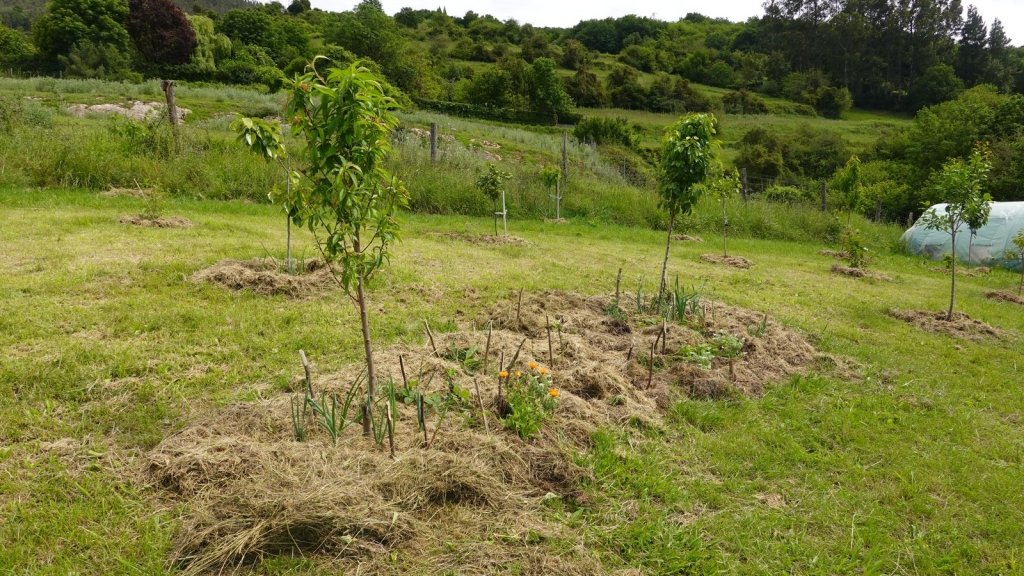
The ground under a backyard fruit tree is usually lawn or bare dirt. It can do better, but the tree has first claim on the water and nitrogen, and two common underplanting habits shorten its life.
The short version: Keep a mulched, plant-free circle around the trunk, with the mulch pulled back 10 cm to 15 cm from the bark, and put the understorey at and beyond the drip line. Lawn is the worst thing to grow there, sweet alyssum and coriander among the best, and an underplanted tree needs more water than a bare one.

Rule one: leave the collar bare
Do not pile mulch or plants against the trunk. Phytophthora root and trunk rot, caused by soil-borne Phytophthora species, is widespread in Victoria's fruit-growing districts according to Agriculture Victoria, and kills apple, peach, apricot, plum and cherry trees of any age. The spores need wet soil, so outbreaks track over-watering and poor drainage, and infection of the root crown is more likely to cause trunk rot than infection of roots further out. Mulch against the bark keeps that spot damp for days.
NSW Department of Primary Industries, in its finger lime Primefact (finger lime is a citrus), tells growers to keep mulch well away from the tree trunk to prevent collar rot. The Primefact gives no figure; 10 cm to 15 cm of dry bark is a practical gap that keeps the crown out of the damp, so rake the mulch back when it creeps in. A coarse mulch that does not mat down helps: see our guide to choosing mulch.
Where the roots actually are
Tree roots are not a mirror of the branches. Colorado State University Extension puts the spread of a mature root system at two to five times the width of the canopy, with fine feeder roots doing nearly all the uptake, and says to water a mature tree just outside the drip line. Those roots sit shallow: Colorado State puts half of a tree's roots in the top 30 cm, and NSW DPI's citrus soil guide treats the top 50 cm as the zone that matters, with feeder roots rarely below 1 m. Competition therefore happens at and beyond the drip line, not in a ring around the trunk, and that is exactly where you will be planting. You cannot avoid it, so the plan is: a bare collar for rot, a plant-free circle for a young tree, and beyond that plant where the light is and water for both.
Age matters: a tree in its first three or four years is still building the root system it will live on, while an older tree can carry an understorey if you water and feed for both.
Lawn is the worst option
Grass is a dense, shallow-rooted competitor sitting where the tree feeds. Utah State University Extension, summarising United States apple and cherry trials, reports that grasses deprive fruit trees of water and nutrients, that grass near apple trunks delayed the onset of fruiting and reduced growth compared with vegetation-free trees, and that adding more nitrogen did not overcome it. Apple and cherry work put the vegetation-free radius needed at roughly 60 cm to 90 cm. For a young tree, the best understorey is no understorey.
What to plant, by what you want

1. An insectary understorey
Hoverflies, lacewings and small parasitoid wasps need nectar and pollen as adults, though it is their larvae that deal with aphids and caterpillars. Most have short mouthparts and feed at small, shallow, open flowers, which points to the carrot family, the cabbage family and buckwheat. In Environmental Entomology, Ambrosino and colleagues, working in Oregon in the United States, recorded predatory hoverfly visits to coriander, buckwheat, phacelia and sweet alyssum, coriander drawing the most visits at one site. At a second site the pattern did not hold, and the hoverflies were North American species, so treat it as promising, not settled.
A workable mix beyond the drip line is sweet alyssum (Lobularia maritima) as a low carpet, coriander and dill left to bolt, buckwheat as a summer filler, and calendula or yarrow for a longer season. Sow in successions so something flowers while the tree fruits. One exclusion: fennel (Foeniculum vulgare) suits these insects but is a declared noxious weed in every Victorian catchment region on the Victorian noxious weeds list (restricted in nine regions, regionally controlled in Corangamite), so Victorian gardeners should use dill or coriander. Our guide to gardening for beneficial insects goes further; alyssum seeds are the cheapest start.
2. A living mulch or cover crop
For soil cover rather than flowers, sow a cover crop beyond the drip line and cut it rather than digging it in, which tears the feeder roots. Cut it before it sets seed, which in practice means at or just before peak flowering: NSW Government cover cropping guidance has cover crops terminated before seed set. Then leave the material where it falls. Under a deciduous tree, sow after leaf fall and slash in early spring; under an evergreen, sow in autumn and slash before the dry season. The cover crop and soil builder seeds collection includes understorey mixes, and our cover crop guide covers species. Citrus and other evergreens give no light window, so plant less under them, keep it low and beyond the drip line, and rely on mulch.
3. Bulbs and low perennials
This is the lowest-maintenance layer. Spring bulbs such as daffodils grow in late winter and early spring, then die back and sit dormant through the hot months, when the tree wants the water to itself. Chives, garlic chives, creeping thyme, oregano and yarrow are small, shallow and slow. Keep them outside the 60 cm radius circle.
4. Edible crops, honestly
Annual vegetables under a fruit tree usually lose. They are shallow-rooted, they want steady moisture exactly when the tree draws hardest, and they get less light as the canopy fills. Lettuce, rocket and Asian greens at the outer edge in the cooler months are realistic. Summer tomatoes or beans are not, unless you water for both.
Water and feeding
An underplanted tree needs more water than a bare one, because you have added transpiring plants to a shared root zone. Water the tree separately, at and just outside the drip line, rather than relying on what the understorey catches, and water deeply and less often so moisture passes below the understorey. Feed the tree as usual and treat the understorey as an extra call on the same nitrogen.
Fallen fruit, and the pests that use it

Fruit hidden in a dense understorey is fruit you do not pick up. That is the real cost of underplanting. Queensland fruit fly (Bactrocera tryoni) larvae mature in seven to ten days in summer and then emerge from the fruit to pupate in the soil, which is why Business Queensland advises against letting fallen fruit accumulate under trees. Mediterranean fruit fly larvae burrow into the soil to pupate in the same way, according to DPIRD Western Australia.
Which fly you have depends on where you garden. Biosecurity Tasmania states that Queensland fruit fly is present in the eastern mainland states and the Northern Territory, Mediterranean fruit fly is established in parts of Western Australia, and Tasmania is a recognised fruit fly pest free area. Our guide to fruit fly in the home garden covers netting and disposal.
Codling moth (Cydia pomonella) attacks apple, pear, quince, nashi, crab-apple and walnut, and overwinters as full-grown larvae in cocoons under bark crevices and in soil or debris around the base of the tree, so litter under the canopy is habitat. Western Australia is the exception: DPIRD advises that codling moth is not known to occur in the state, where it is a declared pest that must be reported. Either way, keep the understorey low enough to see the ground.
What this looks like in your climate zone
These zones are broad groupings. Gardeners between two of them should lean on local cues such as first and last frosts.
- Tropical (the Top End of the Northern Territory, far north Queensland, Darwin, Cairns): an understorey grows very fast in the wet season and needs repeated slashing. A clear collar matters most here, because soils stay saturated for long stretches.
- Subtropical (south-east Queensland, the northern rivers of New South Wales, Brisbane to Coffs Harbour): growth is close to year round, so a permanent low layer beats annual rotations, and Queensland fruit fly pressure is high enough that you must find drops daily.
- Arid and semi-arid (inland Western Australia, far western New South Wales, outback South Australia and Queensland, Alice Springs, districts such as Mildura): water is the constraint. Skip the understorey under a young tree; under an older one, mulch to the drip line and keep plants on the irrigation line.
- Temperate (coastal and tableland New South Wales, much of Victoria, the Sydney and Melbourne suburbs): the deciduous rhythm suits. Sow a cover crop after leaf fall, slash it in early spring, then follow with alyssum and coriander.
- Mediterranean (Perth and the south-west of Western Australia, Adelaide and southern South Australia, western Victoria): grow the understorey through the wet winter and cut it before the summer dry. In Western Australia the established fruit fly is Mediterranean fruit fly. Queensland fruit fly is a declared pest in Western Australia that DPIRD has eradicated from Perth suburbs ten times since 1989, so report any suspected find rather than assuming it is Mediterranean fruit fly. Codling moth is not known to occur in Western Australia; elsewhere in this zone assume it is present.
- Cool and alpine (Tasmania, Canberra and the ACT, the Victorian and southern New South Wales high country): the light window under a bare deciduous tree is long, so bulbs and winter greens are productive. Codling moth is a significant apple pest here, and Tasmania is a fruit fly pest free area.
Frequently asked questions
How far from the trunk should I start planting?
Leave 10 cm to 15 cm of bare bark, and for a young tree keep a plant-free mulched circle of at least 60 cm radius.
Can I leave the lawn and just mow it short?
Mowing cuts the top growth, not the root competition. Clearing the turf in a circle and mulching it is the change that matters, most of all for a tree under five.
Will an understorey stop pest attack?
Feeding adult hoverflies, lacewings and parasitoid wasps supports the predators that attack aphids and caterpillars. It does not replace netting against fruit fly, or picking up drops.
Where to start
Rake the mulch off the trunk and clear the grass from a circle of 60 cm radius around it. Once the tree is established, sow alyssum, coriander and buckwheat just outside the drip line.