
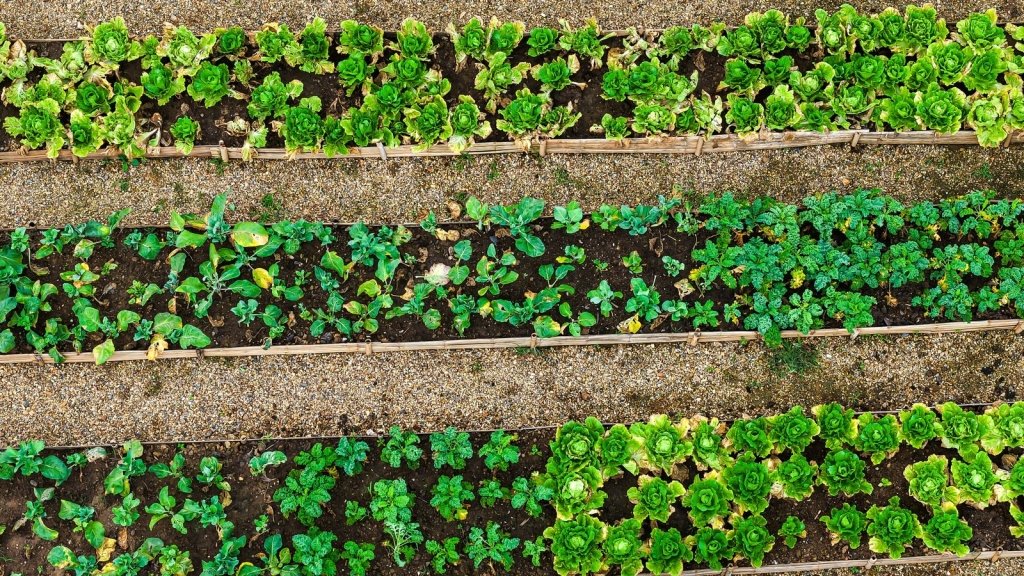
Two crops will share one bed when the second uses ground the first has not claimed yet. It goes wrong when both want the same room, water and light at once, leaving two half crops instead of one good one.
The short version: Keep the main crop at its full recommended spacing and fit the second crop into ground the main crop will not need for weeks yet, then compare the days to maturity of both so the fast one is out before the slow one closes over. If you have to squeeze the main crop to make room, you are not intercropping, you are overcrowding.
This is the spatial side of companion planting, not pest control. Our succession planting guide mentions slipping fast crops between slow ones as one of its methods; this article is the detail.

The rule: the main crop keeps its spacing
Start from the spacing the main crop actually needs and treat it as fixed. The second crop is a bonus taken from ground that would sit bare. Here is the arithmetic on a bed 120 cm wide and 2 m long.
Parsnip is the main crop. The Western Australian agriculture department guide puts parsnip rows 30 to 40 cm apart with plants thinned to 75 mm in the row, and warns that roots may be deformed if plants are crowded. Four rows at 30 cm fit across the bed, about 26 plants a row, roughly 104 parsnips. That number stays fixed.
Between those rows sit three alleys of bare soil, 30 cm across. Sow one row of radish down the centre of each alley, 15 cm from the parsnip either side, and thin it to 5 cm: about 40 radishes an alley, 120 from the bed, all pulled while the parsnips are seedlings. Narrow the parsnip rows to 20 cm to fit the radish in and you have traded deformed parsnips for a handful of radishes.
Days to maturity decides everything
Look up the days to maturity for both crops, usually printed on the packet, and ask one question: will the fast crop be gone before the slow one needs the room? Red radish is harvested three to eight weeks after planting and germinates in four to eight days. Parsnip takes 3.5 to 6 months, germinating in about 14 days in warm soil or up to four weeks in cold. Carrots in Western Australia's commercial districts are ready in 16 weeks from a summer sowing, up to 24 through winter, while home packets often say 12 to 16 weeks, so use the figure on yours, and sweet corn is ready to pick in 75 to 105 days. A gap of eight weeks or more is comfortable. Two or three weeks is not worth the risk.
The three gaps you can use
The time gap
The fast crop finishes before the slow one needs the room. Radish among parsnip or carrot is the classic version, and it does a second job: radish is up within about a week while parsnip may take a month, so the radish line marks the bed and shows where to hoe. A meta-analysis of annual intercrops found that staggering when each species draws on resources raised the yield advantage in mixtures of a C3 and a C4 crop, such as maize with a legume, but not in mixtures of two C3 crops, which is what most vegetable pairings are. Take the time gap as a way of keeping two crops out of each other's way, not as a promise of extra yield. Parsnip growers in Western Australia can use the same idea for shelter, sowing a nurse crop of cereal rye that shields the seedlings from wind, then removing it at three leaves.
The height gap
A low crop goes under a tall one that still lets light through. A meta-analysis of 58 shading and intercropping studies found that most crops tolerate about a 15 per cent cut in solar radiation with a less than proportional drop in yield, that leafy vegetables and root crops handle shade comparatively well, and that maize and grain legumes lose yield strongly even at low shade levels. So sweet corn goes on top and a leafy crop underneath. Sweet corn in New South Wales is grown with 75 to 96 cm between rows, and that alley sits bare for the first month. Under a canopy that lets little light through, such as a bean trellis, leafy crops are the ones with a chance. These were temperate and subtropical trials, so take them as a guide to layering, not a yield promise.
The root gap
A shallow feeder sits beside something that roots deeper. Spring onions have small root systems, so the soil has to be kept moist, while parsnip is credited with an effective rooting depth of 35 to 50 cm. Treat this gap carefully: published rooting depths vary between sources, and the same parsnip guide also calls parsnip roots shallow. Use it to set your watering, because the shallow partner dries out first.
Pairings worth trying
| Pairing | Gap used | Fast crop | Slow crop | Why it works |
|---|---|---|---|---|
| Radish with parsnip | Time | 3 to 8 weeks | 3.5 to 6 months | Out while the parsnip is a seedling, and it marks the rows |
| Radish with carrot | Time | 3 to 8 weeks | 12 to 24 weeks, check the packet | Same head start, and it shows where to hoe |
| Leafy salad under sweet corn | Height | Check the packet | 75 to 105 days | Leafy crops accept some shade, corn does not |
| Spring onion beside a longer crop | Root and time | 8 to 14 weeks | Longer season crop | Small roots work the surface, the partner goes deeper |
Where it goes wrong
Water and nutrients first. Two crops in a bed means two claims on the same water, and that trade turns bad in a hot dry summer. Sweet corn is more sensitive to moisture stress than field maize, and wilting from early tasselling can cut yield by up to 20 per cent. Radishes split without enough water. Average evaporation near Perth runs 8.8 mm a day in January against 1.9 mm in July, so a pairing that costs nothing in winter can cost the main crop in February. Across the arid and semi-arid inland, where water sets the limit rather than space, two crops on one irrigation is usually a poor trade. Feed for two as well.
Harvest access second. Leave a hand width beside every row you mean to pull. Separating the two crops at harvest was the hurdle every established intercropper the GRDC team visited named, and it scales down to a bed.
A third crop is one too many. Two species can be reasoned about. Three make the light, water and access questions hard to answer in advance. Watch plant families too: radish is a brassica, Raphanus sativus, so among cabbages it repeats the family in ground where a four year gap is recommended against clubroot.
Thinning and harvesting near a neighbour
Thin and harvest the fast crop so the neighbour stays put: water first so the soil releases the root, hold the soil down with your spare hand beside the slow crop's row, and pull straight up or snip at soil level. Our guide to thinning carrots, beetroot and radish covers the rest, including how thickly to sow in the first place. Top the alley up with compost once the fast crop is out.

Does it actually produce more?
The land equivalent ratio measures this: the land you would need under single crops to match what the mixed planting produced. Above 1.0 means the mixture won. A review for the Grains Research and Development Corporation collated historical Australian trials and reported a mean of 1.12 for cereal and legume intercrops and 1.49 for canola and legume mixtures, and lower yield risk for the mixtures than for the monocultures overall, because the second crop still yields something when the first fails. An international analysis of 226 field experiments reported a mean of 1.23, a land saving of about 19 per cent. Those figures come from grain paddocks, not vegetable beds, so treat them as reason to try the technique, not a number to expect.
Does the advice change by climate zone?
The rule does not change, but the size of the time gap does. These climate zones are broad groupings, so if you garden between two, lean on local cues such as your first and last frost dates.
- Tropical (far north Queensland, the Top End of the Northern Territory, the Kimberley in Western Australia): quick year round growth shortens the head start, so check your local guide for wet season windows.
- Subtropical (south east Queensland, the northern rivers of New South Wales): autumn and the spring shoulder work best, because radish quality falls away in midsummer heat.
- Arid and semi-arid (inland Western Australia and South Australia, inland New South Wales and Queensland, central Northern Territory): water sets the limit, not space, so keep pairings to the cooler months and follow your state or territory guide.
- Temperate (coastal New South Wales, much of Victoria, lowland northern Tasmania): early spring is the widest window, because the fast crop clears before the summer canopy closes.
- Mediterranean (Perth and the south west of Western Australia, Adelaide and the South Australian gulf districts): sow the fast partner in autumn, winter or early spring, since summer evaporation near Perth runs four to five times the winter rate.
- Cool and alpine (the Tasmanian highlands, the Canberra district and the ACT, alpine Victoria and New South Wales): cold soil slows both partners, and parsnip germination alone can stretch to four weeks.
Frequently asked questions
Can I sow the fast crop in the same row as the slow one?
You can, and it is the traditional way to mark a row of slow seed. Sow it sparingly, a few stations along the row rather than a continuous line, and pull it early. Sown thickly it competes with the crop you want.
Does intercropping reduce pests?
Sometimes, but that is a separate question with separate evidence. Intercrop for the space and the time, then judge any pest effect on its own merits.
What if the fast crop is not ready when the slow one closes over?
Harvest it anyway. A small radish is worth more than a deformed parsnip, and leaving the fast crop in past its window is how a pairing turns into a crowded bed.
A sensible first try
Pick one bed this spring, sow the slow crop at its proper spacing, and put a row of radish down each alley. Note the sowing date and both days to maturity figures, then check whether the fast crop cleared in time. If it did, try a leafy crop such as lettuce under a taller crop next season.