
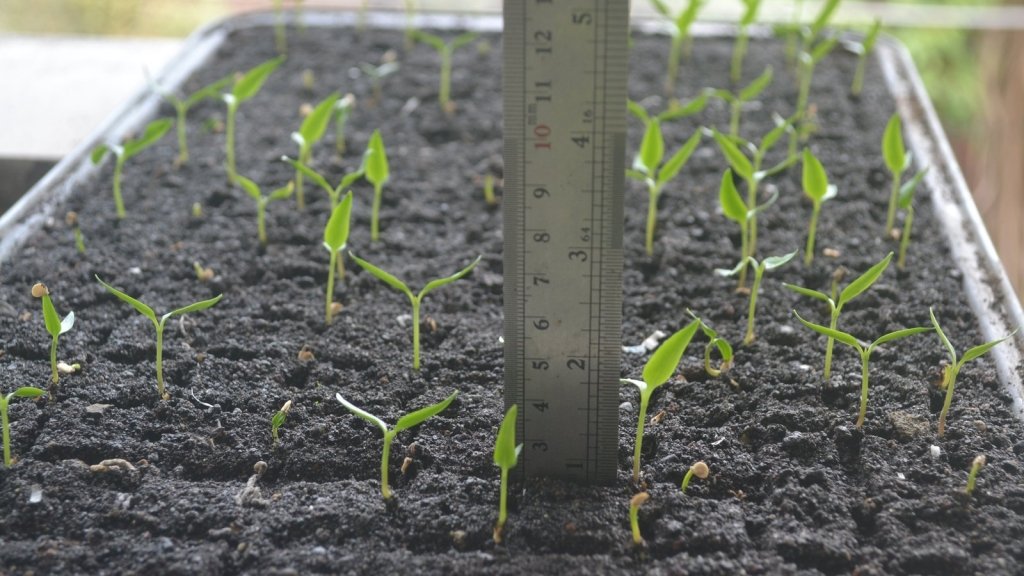
The short version: Spacing is not a suggestion. Plants set too close compete for light, water and nitrogen, shade each other, trap humid air that breeds mildew, and bolt early under the stress, so a crowded bed of twenty plants usually yields less than a properly spaced bed of ten. Read the three numbers on the packet as sowing distance, thinning distance and final spacing, and take the final one seriously. The guide below gives final spacings for the crops most Australian gardeners grow. If you want more from a small bed, use the four legitimate shortcuts, quick crops in the gaps, sow-thick-then-thin, staggered double rows and staggered timing, rather than simply squeezing plants together.
Every gardener has looked at a freshly planted bed, seen all that bare soil between the seedlings, and slipped a few extra plants in. Six weeks later the bed is a jungle and nothing in it is doing well. This guide explains why the packet says what it says, gives the numbers, and shows how to grow intensively without breaking the rules that matter.

Why the packet says what it says
Above ground, a plant needs uncontested light. Two lettuces 10 cm apart shade each other's outer leaves and both stay small. Air needs to move between plants too: crowded foliage holds moisture and warmth, which is exactly what powdery and downy mildew, moulds and many bacterial diseases want, and a single infection travels fast through touching leaves. Below ground, roots spread far wider than the plant above, and two root systems in the same volume of soil share the same water and nutrients. Plants under that kind of competition do what stressed plants do: they race to flower and set seed, which for lettuce, coriander, rocket and radish means bolting weeks early. Well spaced plants are simply healthier and heavier, and the extra weight per plant more than makes up for growing fewer of them.
The three numbers
Seed packets and growing guides usually carry three distances, and they are easy to muddle. The sowing distance is how far apart to drop seed, and it is deliberately closer than the plant needs, because not every seed germinates. The thinning distance is what you thin seedlings to once they are up, usually in one or two passes. The final spacing is the room a mature plant needs, and it is the number that decides the harvest. Row spacing, the gap between rows, is a separate figure that allows for your feet and your hoe as much as for the plants. Some packets print only one distance; if so, treat it as the final spacing.

A spacing guide for common crops
These final spacings follow the Eden Seeds Australian planting guide, cross-checked against Yates, and are given as plant spacing within the row, then row spacing. Compact varieties sit at the close end of each range and large ones at the wide end, and any variety-specific figure on your packet overrides the table.
- Leafy crops: lettuce 20 to 30 cm in rows 35 to 50 cm apart (minis 10 to 15 cm, large hearting types up to 40 cm); silverbeet 15 to 30 cm in rows 50 to 60 cm; spinach 12 to 20 cm in rows 30 to 40 cm; kale 40 to 50 cm in rows 50 to 100 cm.
- Root crops: radish 3 to 5 cm in rows 25 to 35 cm; carrot 2 to 5 cm in rows 25 to 30 cm (Yates allows rows as close as 10 cm for block planting); beetroot 5 to 10 cm in rows 45 to 60 cm.
- Onion family: onion 5 to 10 cm in rows 30 to 40 cm; garlic cloves 10 to 20 cm apart and 2 to 5 cm deep; leeks 10 to 15 cm in rows 30 to 40 cm.
- Legumes: bush beans 8 to 15 cm in rows 50 to 60 cm; climbing beans 10 to 20 cm along a trellis with rows about 100 cm apart; peas 5 to 8 cm in rows 45 to 60 cm.
- Sweet corn: 20 to 30 cm apart in rows 60 to 90 cm, best as a block of several short rows rather than one long one, because it is wind pollinated.
- Fruiting crops: tomato 40 to 60 cm in rows 60 to 150 cm, the close end for staked bush types and the wide end for sprawling vine types; capsicum 50 to 60 cm in rows 100 to 150 cm; eggplant 50 to 80 cm in rows 80 to 90 cm.
- Cucurbits: zucchini 50 to 90 cm in rows 90 to 110 cm; cucumber 40 to 60 cm in rows 120 to 150 cm, or closer up a trellis; pumpkin 90 to 120 cm in rows 250 to 300 cm.
- Brassicas: broccoli 35 to 50 cm in rows 50 to 60 cm; cabbage 35 to 60 cm in rows 50 to 75 cm; cauliflower 45 to 60 cm in rows 60 to 100 cm.
The tomato figure is the one most often wrong in practice. A determinate bush tomato stops at about half a metre and can be planted close; an indeterminate vine reaches two or three metres and needs the wide end of the range plus a serious stake. Our guide to determinate and indeterminate tomatoes explains the difference.

Rows or blocks?
Row planting puts plants in single lines with a path-width gap between rows. It suits anything you need to reach often to stake, tie, hill or pick, and it makes hoeing easy. Block or bed planting sets plants in a grid across a bed with paths only around the outside, so the row spacing shrinks to the plant spacing and far more goes into the same area. It suits leafy crops, roots, onions and anything harvested once. The trade is airflow and access: in a humid climate a tight block of tomatoes is asking for disease, while a tight block of carrots is simply efficient. Square metre gardens and Diggers' square metre plans are block planting with a grid drawn on top.
Four ways to bend the rules safely
1. Quick crops in the gaps
Plant the main crop at its full spacing, then sow radish, rocket, baby lettuce or spring onions between. They are harvested long before the main crop needs the space, and they shade out weeds meanwhile.
2. Sow thick, then thin to eat
Leafy crops and beetroot can be sown at half their final spacing and thinned progressively, with the thinnings eaten as baby leaves or baby beets. The survivors end up at full spacing without any bare bed along the way. Our guide to thinning root crops shows how.
3. Stagger the rows
Offset the planting holes in a double row so they form zigzags rather than a square grid. Each plant keeps its full distance to its nearest neighbours while the rows sit a little closer, which fits a few more plants into a bed without real crowding.
4. Stagger the timing
Plant young seedlings between mature plants that are nearly finished. The old plants come out as the new ones need the room, so the bed never carries two full-sized crops at once. This works best with fast crops that can be sown several times a season, and our guide to succession planting turns it into a calendar.

Too close, too far
Too close shows as small plants, tall thin stems reaching for light, early bolting in salad crops, yellowing lower leaves, mildew in the middle of the bed and a harvest that is disappointingly light for the number of plants. Too far shows as bare soil that grows weeds, water spent on nothing, and sun beating on soil that dries and crusts. Mulch fixes most of the second problem, and a quick crop in the gap fixes the rest, which is why generous spacing is the safer mistake.
How climate changes the numbers
- Tropical (Cairns and far north Queensland, Darwin and the Top End of the Northern Territory, the Kimberley in Western Australia): use the wide end of every range. Humidity and fungal disease pressure make airflow the priority, especially for tomatoes, cucurbits and beans.
- Subtropical (Brisbane and coastal Queensland, Coffs Harbour and northern New South Wales): wide spacing in the humid summer and standard spacing for the dry winter crops.
- Arid and semi-arid (inland Queensland, Broken Hill and Dubbo in New South Wales, Mildura in Victoria, inland South Australia and Western Australia, Alice Springs in the Northern Territory): standard spacing with heavy mulch; slightly closer planting of leafy crops in blocks helps shade the soil, but water competition sets the limit.
- Temperate (Sydney and New South Wales, Melbourne and Victoria): the table as printed. Widen tomatoes and cucurbits in a humid Sydney summer.
- Mediterranean (Perth and southern Western Australia, Adelaide and the Adelaide Plains in South Australia): standard spacing; the dry summer air allows the closer end for fruiting crops if water keeps up.
- Cool and alpine (Hobart and Tasmania, Canberra and the ACT, Ballarat in Victoria, Orange and Armidale on the New South Wales tablelands, and the alpine country of the Snowy Mountains and the Victorian high country): plants grow smaller in a short season, so the closer end of each range is realistic, and a full canopy of leaves gives a little extra protection from overnight cold.
In every zone, tall crops cast their shadow to the south, so put them at the southern edge of a bed, or where the shadow falls on a path, and keep low, sun-loving crops to the north of them.
Frequently asked questions
Can I ignore spacing in a raised bed with rich soil?
You can plant closer in a deep, well-fed, well-watered bed, which is the whole idea of square metre gardening, but light and airflow do not change with the soil. Leafy and root crops tolerate it; tomatoes, capsicum and cucurbits do not.
How many corn plants do I need?
Corn needs a block for pollination. Gardenate suggests a block of four rows of four, sixteen plants, as a workable minimum; a single long row pollinates poorly and gives patchy cobs.
Does spacing matter for herbs?
Yes. Basil, coriander and parsley bolt faster when crowded, and mint and oregano smother whatever they are planted next to. Give soft herbs 20 to 30 cm.
Should I thin or transplant the extras?
Thin roots and direct-sown crops with scissors and leave them. Leafy seedlings and brassicas can be lifted carefully and replanted elsewhere while small.
Give every plant the room the packet asks for and use the gaps cleverly, and a small bed will outyield a crowded big one. Sustainable Gardening Australia's sweet corn notes explain the block-planting rule for the crop where spacing matters most.
Related growing guides
- Why thinning is the step everyone skips
- Succession planting: how to harvest continuously, not all at once
- Determinate vs Indeterminate Tomatoes: Which Should You Actually Grow?
Plan the bed, then choose the seed: browse our vegetable seeds, compact varieties for pots and small beds and heirloom seeds.