
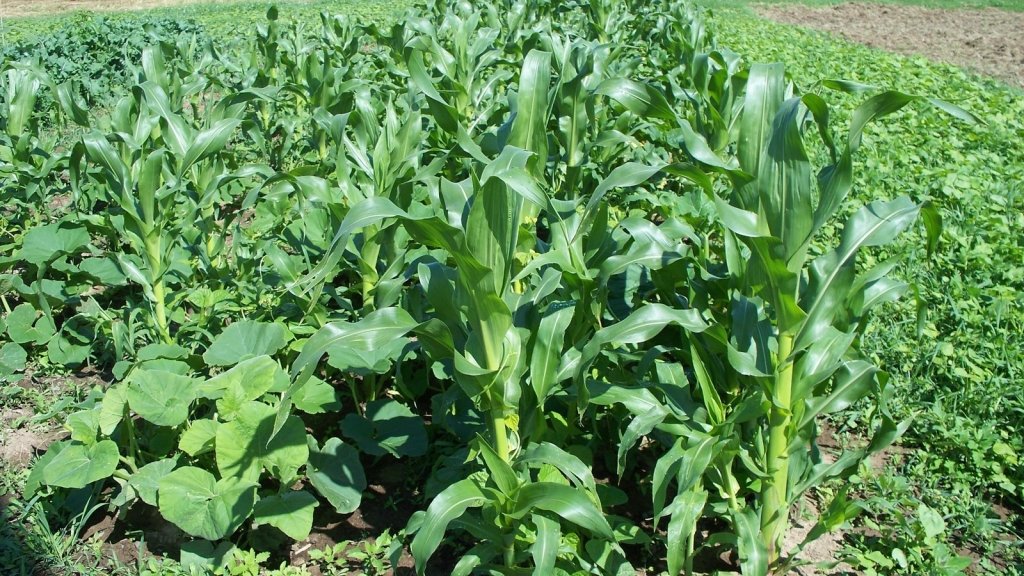
The Three Sisters is corn, climbing beans and squash grown in one patch, each doing a job the other two cannot. It has a long history in North America and the mechanics hold up in an Australian backyard. Two things sink most home attempts: planting all three at once, and expecting the beans to feed the corn.
The short version: Sow the corn first, in a block rather than a single row, so wind can pollinate it. Add climbing beans once the corn is about 15 cm tall, put a trailing pumpkin or squash in at the same time but in roughly one spot in seven, and feed the bed as though the corn were growing alone.
Where it comes from
Corn (Zea mays), bean (Phaseolus vulgaris) and pumpkin or squash (Cucurbita pepo) grown together on mounds is a traditional cropping system of the Haudenosaunee, called Iroquois in older writing, in north-eastern North America. Jane Mt.Pleasant, a Cornell University agronomist and Tuscarora descendant, treats the mounds as part of the system, not just the intercrop. Her 2016 paper in Ethnobiology Letters reports archaeologist John Hart's conclusion that the three were not grown together as a polyculture until after about 700 years ago, and quotes Arthur Parker's 1910 record that Haudenosaunee farmers planted them together partly for the saving in labour, and partly because the plants were understood to be "guarded by three inseparable spirits and would not thrive apart".

Does it work here, and what does the evidence support
Three parts are mechanically sound. The corn stalk is a living trellis for a climbing bean, one of the functions Mt.Pleasant lists in her assessment of the mound system. The squash runs flat with large leaves that fill space the other two do not use, and she credits that habit with much of the weed suppression. Three plants of different heights also catch more light per square metre than one flat canopy, and a study in Annals of Botany found their roots foraging at different depths.
It is a trade. Mt.Pleasant and Burt found corn yielded much the same whether grown with beans and pumpkin or alone, while bean and squash yields dropped sharply. Good deal for cobs, poor one for beans.
The nitrogen claim, handled honestly
That the beans feed the corn is the part gardeners overstate. Most of the nitrogen a bean fixes goes into the bean plant. Mt.Pleasant describes two real pathways: small amounts shed from bean roots during the season, which the corn can pick up, and the larger amount released later as bean residues break down. Cornell's Three Sisters planting instructions put it bluntly: most of the nitrogen the beans convert will not reach the corn and pumpkins in the first year, and side dressing is needed for a decent crop. The GRDC factsheet on nitrogen fixation in crop legumes frames the Australian payoff the same way: a lower fertiliser bill for the following crop. Our guide to companion planting in Australia covers which other claims hold up.
The layout: block it, do not line it up
Sweet corn is wind pollinated, and pollen from a single row blows away instead of landing on the silks. The Northern Territory's home garden guide to sweet corn says corn should go in multiple rows or clumps rather than single rows, because block plantings help wind assisted pollination. Every blank patch on a cob is a silk that got no pollen.
Two layouts work. For mounds, Cornell calls for low hills 900 mm to 1.2 m apart in both directions, five to seven corn seeds spread across each top, sown 25 mm to 40 mm deep. Four mounds by four gives a block about 3.6 m square. For a flat bed, the Queensland sweet corn growing guide uses rows 75 cm apart with 20 cm to 25 cm between plants. Either way, at least four rows side by side.

Timing: the part that decides it
Plant all three at once and the beans smother corn seedlings that cannot carry them.
- Corn first. New South Wales guidance asks for soil at sowing depth of at least 12 degrees C and rising, with 14 to 16 degrees C the minimum for supersweet types. A soil thermometer settles it, and we cover the method in the kitchen thermometer test.
- Beans once the corn is about 15 cm tall. That is Cornell's trigger, and it is a height, not a date. In warm spring soil it usually falls two to four weeks after sowing. Put four or five bean seeds around each mound and thin to three or four.
- Squash with the beans, and sparingly. Cornell puts pumpkin in every seventh hill, warning that one in every hill would swamp the site with vine.
Choosing the three
Use a climbing or pole bean. A bush bean cannot climb and will sit in the corn's shade producing little. Climbing forms of the common bean (Phaseolus vulgaris) such as Blue Lake and Purple King suit every zone. Scarlet runner beans (Phaseolus coccineus) are for Cool and alpine and the cooler Temperate gardens only: they drop their flowers without setting pods once summer days pass about 30 degrees C, so in the warmer zones they climb the corn and give almost nothing. Check the habit when you browse bean seeds. Use a trailing pumpkin or squash, not a bush zucchini: the third sister has to run and cover open ground. Our guide to growing pumpkins in Australia covers space and curing.
For the corn, the traditional system used tall flint, dent and flour corns, and Cornell still recommends them, warning that popcorn often does not grow tall enough and gets overwhelmed. A sweet corn works if you pick the tallest, longest-season variety you can find and give the beans a longer head start, and you will be picking cobs at the milk stage through a bean vine. If you want dry corn for grinding or a stronger stalk, a flint or dent maize is the closer match. See corn seeds for heights and days to maturity.
Water and feeding: the corn sets the bill
Corn is hungry and thirsty, and interplanting does not change that. Per metre of row, the NT guide suggests 50 g of complete fertiliser and 75 g of superphosphate dug in beside the row at planting, then 10 g of urea as a side dressing at about 25 and 50 days. Manure and compost work more slowly. If you are growing on mounds rather than rows, use the Northern Territory Agnote's per square metre rates instead: about 2 kg of compost or well rotted manure dug in, a complete fertiliser at 70 g per square metre before planting, and a side dressing of urea at 20 g per square metre once the corn is 30 to 40 cm high, kept out of the leaf funnel. The Agnote also notes that in wet conditions the side dressing may need repeating because nitrogen leaches. Timing matters as much as the total: up to 60 per cent of the corn's nitrogen is taken up in the fortnight either side of tasselling, so get the bed right before the tassels show.
The critical watering window runs from three weeks before the silks appear to two weeks after; stress there means small cobs and blank kernels. Around Alice Springs the NT guide puts demand at roughly 4 mm a day in September, rising to about 10 mm a day by midsummer.

What goes wrong
- Beans dragging down young corn. A timing fault. Wait for the 15 cm mark, and unwind any runner that reaches the growing tip.
- Squash smothering the lot. One pumpkin per seventh mound, and steer the leaders into the paths as they run.
- Gappy cobs. Too few corn plants, or a row instead of a block. Hot, dry, windy weather above 35 degrees C at silking does it too, which the Queensland and New South Wales guides both flag. Tapping the tassels over the silks on a still morning helps a thin block.
- No way in to harvest. Leave a clear path through the middle. Cobs are ready when the silks dry off, the husk feels tight and a punctured kernel runs milky, and that window is short.
When to sow, by climate zone
These come from the national planting table in the Queensland guide and the NT guide. They are commercial windows, so aim early in them.
- Tropical: the Top End of the Northern Territory, far north Queensland and the Kimberley in Western Australia. Sow in the dry season, because storms at silking wreck pollination: Queensland's dry tropics plant early March to late August, Kununurra April to early September. In the Top End, the Northern Territory Agnote says most varieties do well in the dry season and can be sown at any time of year, but a wet season crop needs a well drained site or ridges, and continuous rain spoils pollination.
- Subtropical: south-east Queensland and the northern rivers of New South Wales. Southern Queensland plants early August to late February, and Bundaberg has two windows, January to April and mid July to mid September.
- Arid and semi-arid: Alice Springs and central Australia, inland Western Australia, western Queensland, far western New South Wales and the South Australian pastoral country. The NT guide says to sow once frost risk passes, usually about September, through to early February, and many gardeners fit in two crops.
- Temperate: coastal and inland New South Wales and much of Victoria. The Sydney Basin plants August to late February, the Riverina mid September to early January, and southern Victoria including Melbourne early October to January.
- Mediterranean: Perth, the Western Australian south-west and wheatbelt, Adelaide and the South Australian gulfs. Perth has the longest window in the country, mid August to mid March. Bunbury and Busselton run mid September to early February, Manjimup and Albany November to January, the South Australian Riverland September to February.
- Cool and alpine: Tasmania, Canberra and the ACT, the New South Wales tablelands and the Victorian high country. The window is narrow: northern Tasmania plants late October to November, Bathurst mid November to late December. Sow after the last frost, and count back from your first autumn frost, because the crop must be picked before it.
These zones are broad groupings. If you sit between two, or high within one, lean on local cues: your own frost dates and the morning soil temperature at sowing depth.
Frequently asked questions
Can I use bush beans instead of climbing beans?
Not usefully. A bush bean does not twine, so it gains nothing from the corn and loses light to it. Grow bush beans in their own sunny row.
Do the beans mean I can skip feeding the corn?
No. Most of the nitrogen the beans fix stays in the beans this season. Feed on the corn's schedule, and treat the nitrogen in bean residues as next season's benefit.
Will my corn cross with a neighbour's corn?
It can. Commercially, supersweet types are separated from standard sweet corn and maize by distance, or by 14 to 21 days of flowering time, because cross pollination turns the kernels starchy. On a suburban block, stagger your sowing dates.
A sensible first attempt
Start with one block of nine to sixteen corn plants this spring, add climbing beans at the 15 cm mark and one pumpkin at the edge. Note when each went in and how the cobs filled.