
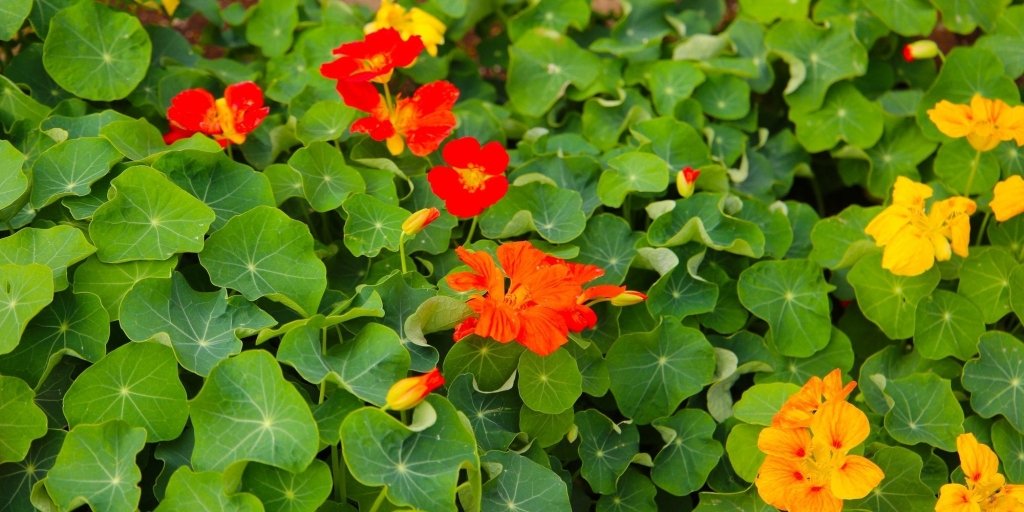
Why nasturtiums earn their space
Nasturtiums pay their way more than once. They pull aphids off the crops you want to eat, they flower for months on soil too poor for much else, and the leaves, flowers and green seed pods all go in the kitchen.
Soil and pots
Nasturtiums do best on lean ground. Rich, well fed soil gives a mound of large leaves and very few flowers, so plant them in a bed that has not just been manured and skip the fertiliser. In a pot, use a plain free draining mix rather than a rich one, with a little coconut coir through it in hot districts to hold moisture. Full sun brings the most flowers, although they take part shade where summers are fierce.

Sowing
The seeds are large and easy to handle. Sow them 15 to 20mm deep and 25 to 30cm apart, directly where they are to grow, because nasturtiums put down a taproot and resent being moved. If you do raise seedlings, use deep cells and plant out while they are small. Mulch around the seed, not over it, and expect seedlings in 7 to 14 days.
Dwarf types such as Tom Thumb Mix suit pots and bed edges, while trailing types such as Yeti Cream will run along a fence.

When to sow around Australia
- Temperate (Sydney, Melbourne, Newcastle, coastal New South Wales and Victoria, southern South Australia): September to November, and again in January.
- Mediterranean (Perth, south west Western Australia, Adelaide, the South Australian gulf country): the same September to November window. Plants slow right down in the dry summer, so sow early and give them afternoon shade.
- Cool and alpine (Tasmania, Canberra, Ballarat, Armidale, the tablelands): October to December, once frost has passed.
- Subtropical (Brisbane, the Sunshine Coast, Bundaberg, Coffs Harbour, Lismore): March to June, and August to September, skipping the humid summer.
- Tropical (Darwin, Cairns, Townsville, Broome, the Top End): April to July, through the dry season.
- Arid and semi-arid (Alice Springs, Broken Hill, Kalgoorlie, Mildura, most of the inland): March and September, either side of the heat.
These are broad groupings. If you garden between two of them, lean on your local frost dates rather than a map.
Companion plants
Nasturtiums work as a trap crop. Aphids settle on them in preference to nearby crops, which makes them useful beside the pumpkin and squash family, legumes, tomatoes and leafy greens such as lettuce, and they are a long standing companion for roses for the same reason. A trap crop only helps if you look at it, so check weekly and squash or hose the aphids off, or the planting turns into a nursery beside your vegetables. The squash bug named in much overseas garden writing is not present in Australia, and the pumpkin beetles that chew cucurbit leaves here are not drawn to nasturtiums.
Eating them
The leaves and flowers are edible with a peppery bite, and the green seed pods pickle well in place of capers. Pick from plants you have not sprayed, and rinse the aphids off first.
Self seeding and keeping them in bounds
Nasturtiums set seed freely and come up again on their own, so one sowing often carries a garden for years, and seed is easy to collect if you want to choose where they grow. They are grown as an annual, dying back at the end of autumn or with the first frost, though they may run on into a second season where there is no frost. That vigour has a cost. Nasturtium has escaped gardens and naturalised in bushland in Victoria, South Australia, New South Wales, Queensland and Western Australia. It is not a declared weed anywhere, but if you garden near bushland, a gully or a creek line, deadhead before the pods drop and put spent plants in the compost or the bin, never over the back fence.
Related growing guides
- Companion planting in Australia: what really helps, and what is folklore
- Trap Crops: Using Sacrificial Plants to Lure Pests Away
- Aphids: How to Spot, Control and Prevent Them in an Australian Garden
Ready to plant? Browse our Nasturtium seeds.