


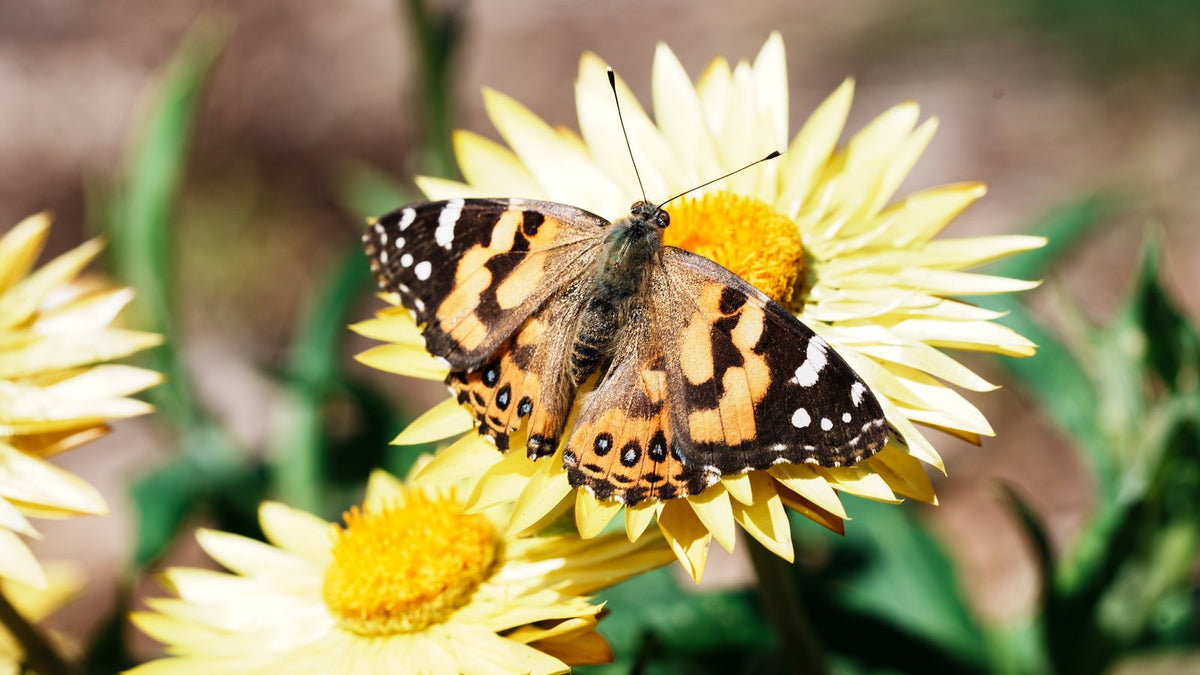

The short version: Butterflies come for nectar but stay to breed, and they breed only where their caterpillars can eat. So butterfly attracting plants in Australia come in two kinds: sunny clumps of nectar flowers, easy from seed, and the native host plants each species lays its eggs on, such as native grasses, peas, wattles and everlasting daisies. Add shelter, a damp patch of bare ground and no insecticide.
A butterfly drifts over the fence, spends a minute on the cosmos and is gone. The flowers did their job. Unless it was only passing through, the garden gave it no reason to stay.
This guide covers both: flowers from a packet, and the host plants that let butterflies breed.
Why butterflies visit but never stay
Adult butterflies sip from many flowers, but each species lays its eggs on its own short list of host plants, some on a single species, Green Adelaide's butterfly fact sheet explains. Perth Zoo adds that the caterpillar's plant is generally not the one the adult feeds from, and that host plants matter more, because they let butterflies breed. Or, as Green Adelaide puts it, you need caterpillars to get butterflies.
Flowers that attract butterflies: the nectar half
Butterflies feed most easily from bright flowers with a flat or tubular shape, the Maroochy Bushland Botanic Garden on the Sunshine Coast notes. Green Adelaide suggests clumps of one kind in sun from mid-morning to mid-afternoon, as adults are rarely seen feeding in shade. Easy from seed:
- Cosmos Bright Lights Mix: open, flat red, orange and golden flowers, tolerant of heat and dry conditions.
- Zinnia Cutflower Formula Blend: tall double zinnias for cutting, which the listing says thrive in hot weather and attract beneficial insects.
Both are frost tender: sow them 5 to 7 mm deep, direct after the last frost or earlier in trays under cover, space them 30 to 50 cm apart and expect flowers in 10 to 14 weeks.

Plants for butterflies to lay eggs: native host plants
This is the half that keeps butterflies around. Pairings from Green Adelaide and the Maroochy garden's south-east Queensland list:
- Native grasses: kangaroo grass (Themeda triandra) for the common brown, and tussock grass (Poa) for grass darts and skippers.
- Native peas: scurf-peas (Cullen) for the chequered swallowtail, and native sarsaparilla (Hardenbergia violacea) for the common grass-blue.
- Wattles, fan-flowers and finger lime: golden wattle (Acacia pycnantha) for the two-spotted line-blue, Scaevola and Goodenia for the meadow argus, and finger lime (Citrus australasica) for the dainty swallowtail.
One host plant comes from a packet. The paper daisy, Xerochrysum bracteatum, is the main host plant for caterpillars of the Australian painted lady, according to the Maroochy garden, and its flowers feed adult butterflies too. The store's Everlasting Daisy Mixed is a garden selection of that species with extra double flowers, sown on the surface of a seed tray at 22 to 25 °C, its listing says.
For the rest, ask a local native nursery what grows naturally in your suburb. Then leave the caterpillars to it, and check for chrysalises before you prune or rake. Perth Zoo calls a few chewed leaves a small price to pay, and it is hard to argue with a garden that pays you back in wings.

Sun, shelter, water and no sprays
Butterflies cannot make their own body heat, so they bask. Green Adelaide suggests flat stones in a sunny, sheltered spot, plants of different heights for cover, and taller plants placed to break strong wind, which can tear wings. Butterflies also puddle, drawing water and salts from mud, so leave some bare ground in a damp corner.
Then put the insecticide away, as Green Adelaide advises, and that includes Bt, an organic spray that kills caterpillars.
Caution: milkweed, lantana and Dutchman's pipe
Weed status varies by state, so ask your council about any plant you are unsure of.
- Some gardeners plant milkweed for the monarch, which Green Adelaide notes is an introduced butterfly; it suggests native Cullen instead. Red-head cotton bush (Asclepias curassavica) and narrow-leaved cotton bush (Gomphocarpus fruticosus) are both regarded as environmental weeds in Queensland and Western Australia, the second in New South Wales, Victoria and Tasmania too. Both bleed a milky sap and are poisonous to stock; the narrow-leaved one is poisonous to people too, and its sap can irritate skin, so wear gloves and keep any milkweed away from bushland.
- Lantana (Lantana camara) is one of Australia's Weeds of National Significance, and in Queensland a restricted invasive plant that must not be given away, sold or released into the environment.
- Dutchman's pipe (Aristolochia elegans, also known as A. littoralis) resembles native plants that butterflies feed and lay eggs on, but it poisons the larvae and threatens the rare Richmond birdwing. It is restricted in Queensland, and the Queensland Government's Dutchman's pipe page shows how to recognise it.
When to sow, zone by zone
Months are rough guides from the store's sowing calendars and grow guides. The zones are broad groupings, so between two, follow your local frosts.
- Tropical (Darwin in the Northern Territory, Cairns and Townsville in Queensland): cosmos and zinnia through the dry season, roughly April to August.
- Subtropical (Brisbane and south-east Queensland, and northern New South Wales): cosmos and zinnia from about August, everlastings in autumn to early winter.
- Arid and semi-arid (Alice Springs in the Northern Territory, Broken Hill in New South Wales, Mildura in Victoria, Kalgoorlie in Western Australia): cosmos and zinnia in spring once frosts end, everlastings about April and May; keep the surface damp in hot winds.
- Temperate (Sydney and the New South Wales coast, Melbourne in Victoria): cosmos and zinnia about September to December, everlastings in autumn or late winter to spring.
- Mediterranean (Perth and southern Western Australia, Adelaide in South Australia): cosmos and zinnia about September to December, with summer water, and everlastings about March to June. For hosts, try Green Adelaide's list or, in the south-west, Perth Zoo's everlastings and native violets.
- Cool and alpine (Tasmania, Canberra in the ACT, Ballarat in Victoria, Orange and Armidale in New South Wales, Stanthorpe in Queensland): start cosmos and zinnia in trays in October, then plant them out and sow everlastings after the last frost, often around Melbourne Cup Day.
Frequently asked questions
What plants do butterflies lay eggs on?
Each species has its own, most often native grasses, peas, wattles or daisies such as everlastings.
What are good butterfly attracting plants in Queensland?
Maroochy Bushland Botanic Garden, on the Sunshine Coast, lists kangaroo grass, native sarsaparilla, finger lime, paper daisy and, for the Richmond birdwing, birdwing vine (Pararistolochia praevenosa).
What are good butterfly attracting plants in South Australia?
Green Adelaide lists local natives such as common everlasting, austral trefoil, running postman, pale fanflower and common tussock-grass.
Is milkweed good for butterflies in Australia?
It feeds the introduced monarch, and two milkweeds are environmental weeds in several states. Green Adelaide suggests planting native Cullen for the chequered swallowtail instead.
Sow the flowers for the visit, plant the natives for the stay, and watch the everlastings for the first caterpillar.
Related growing guides
- Gardening for bees and beneficial insects
- Flowers for bees in the vegetable garden
- Growing everlasting daisies from seed
Browse the native seed range for more to sow.