
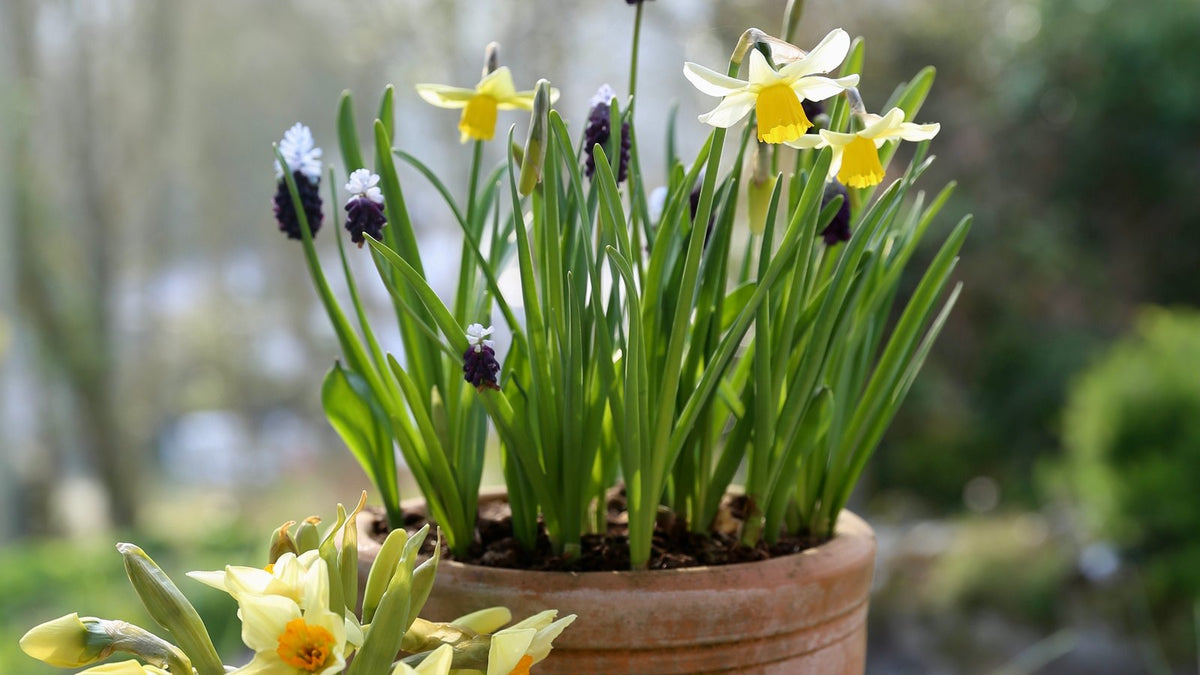

The short version: A bulb lasagne is one deep, free-draining pot planted with two or three layers of bulbs: the biggest deepest, the smallest near the top, each layer over the gaps in the one below. Choose bulbs that flower at different times and the pot takes turns through spring. Plant in autumn, or early winter after a chill. Outside cool and alpine gardens, most tulips need the fridge first, and in warmer zones some other bulbs do too. In the tropics it is a dry-season gamble.
A balcony often has room for one good pot, and a single flush of daffodils can feel like a short visit. Layering stretches it: two or three plantings share the pot, and each new layer's leaves help hide the fading ones below. It is the one lasagne where the bottom layer is often served last.
How a bulb lasagne works
Each bulb sits at the depth its size calls for, so one deep pot holds stacked plantings: the Royal Horticultural Society puts the largest, latest-flowering bulbs at the bottom and the smallest, earliest on top.
Depth follows size; flowering order is a separate choice. Late tulips are the classic bottom layer, being big and late, but other deep bulbs may flower first: what matters is that each layer flowers at its own time, so read each label.
Which bulbs go in which layer
| Layer | Good candidates | Notes |
|---|---|---|
| Bottom, about 18 cm down | Tulips, large-cupped and trumpet daffodils | Gardening Australia sets a late tulip here. Our large-cupped daffodil listings give 10 to 15 cm in garden soil. |
| Middle | Hyacinths, Dutch iris, jonquilla daffodils | Hyacinths grow into solid plants, so give them a little extra room. Our Dutch iris listings give 8 to 15 cm. |
| Top | Grape hyacinths, crocus, anemones, miniature daffodils | Anemone corms are soaked for 3 to 4 hours and go about 5 cm deep, pointed end down. |
Our bulb listings give daffodils and hyacinths August to September, anemones August to October and Dutch iris September to November, so three layers can carry colour from late winter well into spring.

Building the pot, step by step
Gardening Australia shows the whole job in its bulb lasagne demonstration; the measurements here follow the RHS.
- Set the pot where it will stay. Use one at least 30 cm wide and deep, with drainage holes. Once full, it will not move to the sunny end of the balcony without an argument.
- Cover the drainage hole, do not block it. Broken pot pieces over one large hole stop the mix washing out. Use a good, free-draining potting mix: bulbs rot when soggy.
- Fill to the first layer. Put at least 10 cm of mix in the base, then the bottom bulbs, pointed end up, a bulb's width apart and clear of the wall.
- Cover, then stagger. Bury the bulbs, firm gently, and set the next layer over the gaps so every shoot has a clear path.
- Finish with the smallest bulbs, if they fit, under 5 to 10 cm of mix, about three times their height, with the surface at least 2 cm below the rim.
- Water in well to settle everything, and stand the pot in sun.
If bare mix all winter looks bleak, Gardening Australia suggests pansies or violas over the top. The bulbs come up through them.
Chilling: the warm-climate catch
A tulip bulb already holds next spring's flower bud, and needs roughly two months under 13°C to open it on a proper stem. Except in cool and alpine gardens, most tulips spend 6 to 10 weeks in the fridge first; Gardening Australia grows the species Tulipa montana without one. In warmer zones other bulbs join the tulips, as the zone lines below say; the full table is in our spring bulbs guide.
Use a paper bag marked "poisonous, not food", in the crisper, away from ripening fruit, whose ethylene can spoil the bud. Do not freeze them, and take them out by 12 weeks. Every layer goes in on one day, so time the chill to end when the pot is due.
When to plant, zone by zone
The six zones are broad groupings of our own, not a published bulb calendar, so read the months as a guide, and if you sit between two, or high up, go by local signs such as the first and last frost.
- Tropical (Darwin, Northern Territory; Cairns and Townsville, Queensland). Mostly a no: dry-season warmth gives no chill, and wet-season rain rots the bulbs. For a try, chill daffodils, and here jonquils too, for 6 to 8 weeks, pot them in May or June under cover from rain, and treat them as annuals.
- Subtropical (Brisbane and south-east Queensland, plus northern New South Wales). A pot with chilled tulips goes in during June or July, its hyacinths, daffodils, Dutch iris and grape hyacinths chilled 6 to 8 weeks too. Tazetta jonquils, sparaxis, ixia and ranunculus need no chill and go in during April and May, the simpler pot to try.
- Arid and semi-arid (Alice Springs, Northern Territory; Broken Hill, New South Wales; Mildura, Victoria; Kalgoorlie, Western Australia). Wait until the heat breaks, usually April or May, with chilled tulips in May or June, and chill hyacinths too in milder districts. Water through a dry winter and shelter the pot from hot spring wind.
- Temperate (Sydney and the coast of New South Wales; Melbourne, Victoria). Melbourne can begin in March, Sydney mostly in April. Most tulips need the fridge in both; in Sydney, hyacinths and crocus do too.
- Mediterranean (Perth and the south of Western Australia; Adelaide, South Australia). Plant as the first autumn rain arrives, March to May; chilled hyacinths and tulips wait until May. Happy Valley Seeds does not send flower bulbs to Western Australia, so Perth gardeners will need local bulbs.
- Cool and alpine (Tasmania; Canberra, ACT; Ballarat, Victoria; Orange and Armidale, New South Wales; Stanthorpe, Queensland). Winter usually does the chilling here. Plant early, mostly in March or April, and tulips in April or May. We do not send flower bulbs to Tasmania.
Care from first shoot to last flower
Until shoots show, water only when the mix starts to dry. Then water regularly without letting it stay sodden, and tip out the saucer after rain. Keep the pot in sun, handy for watering, and put it on show as the buds colour.

With so many bulbs in one pot, Gardening Australia gives a liquid feed every fortnight or so while they grow. Avoid high-nitrogen feeds, linked to basal rot, and fresh chook manure. Snap off spent flowers so nothing goes into seed.
After flowering: lift, keep or replace
Leave the leaves, and keep watering, until they yellow and wither, about 6 to 8 weeks, while the bulb rebuilds next year's flower; then stop watering. Gardening Australia lifts and stores the bulbs cool and dry until planting time; the RHS moves the pot out of view or plants the bulbs out. A pot left planted goes under cover from summer rain.
Grape hyacinths and sparaxis can spread into bushland in the south: cut spent stems before they set seed, and bin spare bulbs and corms.
What goes wrong
- Rot in a wet pot. A blocked hole, a full saucer or steady watering before shoots appear can rot bulbs unseen, so plant only firm, plump bulbs.
- A layer that never shows, or shows only leaves. A rotted bulb never shows. Leaves alone after a mild winter often mean a missed chill. Anemones and ranunculus go in pointed end down.
- Small flowers in year two. Usually the leaves were cut, or the pot dried off, before they yellowed, and a crowded pot runs short of food. Fresh bulbs are the reliable fix.
A hyacinth on the windowsill
For scent indoors, Gardening Australia chills hyacinths in the crisper for 6 to 7 weeks and suggests one in an hourglass bulb vase, sitting just above, not in, the water, or it may rot. It stays dark until it shoots, in a couple of months, then comes into the light to flower.
Safety: poisonous bulbs and potting mix
The Animal Poisons Helpline warns that daffodils, jonquils, hyacinths and tulips can poison dogs and cats, and that the bulb is the most dangerous part, so keep bags of bulbs out of reach and pets away from a new pot. According to the Queensland Poisons Information Centre, stored daffodil bulbs are often taken for onions, and their sap can irritate skin and eyes: store bulbs labelled and apart from food, and wear gloves to plant. If someone eats part of a bulb, phone 13 11 26 for the Poisons Information Centre. For a pet, contact your vet, or phone 1300 869 738 for the Animal Poisons Helpline. Potting mix can carry Legionella bacteria: put on gloves and a mask before opening the bag away from your face, wet the mix down and wash your hands with soap afterwards, as NSW Health advises.
Frequently asked questions
Can I make a bulb lasagne in a smaller pot?
Two layers of small bulbs can work, since bulbs in pots need not go as deep as in the ground. For tulips or large daffodils, keep to 30 cm wide and deep.
Do I put the whole planted pot in the fridge?
No. Chill only the dry bulbs that need it, in their bag.
Will the deep bulbs grow through the layer above?
Yes, up between the bulbs above, which is why the layers are staggered.
Can I use the same bulbs next year?
Daffodils tend to return where winters are cool or temperate, jonquils across most zones, and crocus and grape hyacinths where winters bite. Tulips outside cool gardens, daffodils and hyacinths in the subtropics and most bulbs in the tropics are usually treated as annuals, and anemones and ranunculus tend to fade within a few years.
One pot, three plantings and a little patience with the leaves: that is the whole recipe.
Related growing guides
- Spring bulbs: when to plant, how deep, and which to chill
- Flowers to sow in March
- Why plants fail to flower
Browse our flowering bulbs, or viola seeds to sow for a winter cover over the pot.