
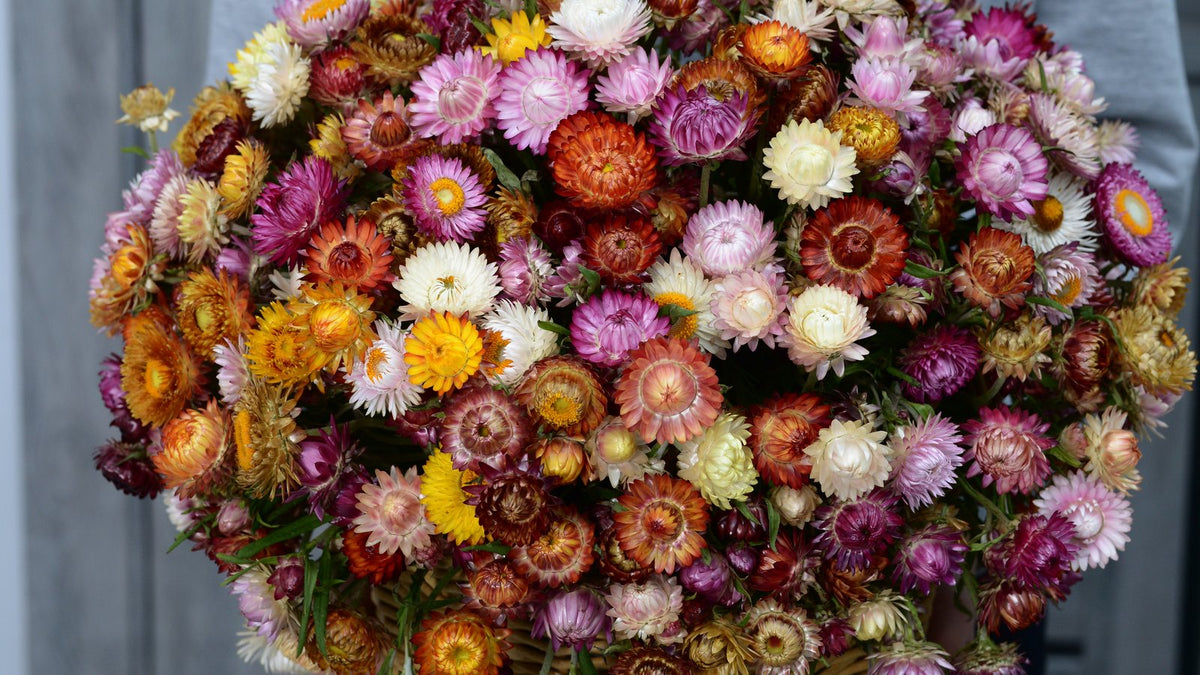

The short version: The flowers that dry best carry their colour in stiff, papery parts: the bracts of everlasting daisies and globe amaranth, the calyces of statice and bells of Ireland, and the seed pods of honesty and nigella. Pick each at its own stage, on a dry day once the dew is gone. Strip the leaves, band small bunches and hang them head down somewhere warm, dark, dry and airy for two to five weeks. Keep the finished stems out of direct sun and damp.
Run a finger over a statice spray in the garden and it rustles like paper. That is the whole secret: there is very little water in the coloured part to lose.
Growing these flowers is ordinary gardening. The skill is in timing the cut, which differs from flower to flower, and in giving the bunches a place to finish without fading.
Why some flowers keep their colour
Everlasting flowers carry their colour in papery petals or bract-like modified leaves that are already stiff and dry on the living plant. Gardening Australia says the papery outer "petals" of everlasting daisies are bracts, and that they hold their shape and colour for years. In statice the colour is in the calyx, the cup around each tiny flower: the cream petals wither and drop as it dries, and the calyx stays. The "bells" of bells of Ireland are green calyces too. With honesty and nigella you are drying the seed pod.
Which flowers to grow, and when to pick each one
The picking stages come mainly from Iowa State University Extension's list of everlasting flowers, and for celosia from the University of Maryland.
| Flower | The part that dries | When to pick | How to dry | Example varieties |
|---|---|---|---|---|
| Everlasting daisy (Xerochrysum bracteatum) | Papery bracts | Outer bracts open, centre still tight; the head keeps opening as it dries | Bunches, or heads alone on a screen | Mixed, Tom Thumb Mixed, Golden Yellow |
| Statice (Limonium sinuatum) | Coloured calyces | Every calyx on the stem has opened | Bunches | Pacific Mix, Petite Bouquet Mixed |
| Globe amaranth (Gomphrena globosa) | Papery bracts | Heads at peak colour and fully open, before they age | Bunches | Tall Mix, Tall White |
| Celosia (Celosia argentea) | Plumes or combs | Plumes about half open; crested heads once the centre has expanded, before the edges discolour | Bunches, dried quickly | Forest Fire, Pampas Plume Tall Mix, Kurume Orange Red |
| Bells of Ireland (Moluccella laevis) | Green calyces | Bells fully open and firm | Small bunches | Bells of Ireland |
| Nigella (Nigella damascena) | Seed pods | Pods firm and papery, stripes still showing | Head down in a paper bag | Persian Jewels Mixed, Miss Jekyll White |
| Honesty (Lunaria annua) | Silver pod centres | Pods turning from green to brown | Dry the stems, then rub off the outer skins | Lunaria Biennis Honesty Mixed |
The store's everlasting daisies are the golden everlasting, Xerochrysum bracteatum. The Mixed and Tom Thumb Mixed listings use its older name, Helichrysum bracteatum, which the Australian Native Plants Society says still turns up in many publications.
Honesty is the slow one. Its listing calls it a biennial: leaves in the first year, then flowers and pods the spring after a winter's cold. Our guide to annuals, perennials and biennials explains the two-year cycle.

Picking: a dry day and clean stems
Pick after the dew or rain has dried off, and leave chewed or spotted heads behind: bruises and damage show up more once a flower dries.
Cutting late has its own costs: celosia cut late develops seed that shatters indoors, and globe amaranth heads left too long may fall apart once dried. Everlasting daisies forgive an early cut, since the head keeps opening.
Hanging the bunches
- Strip the leaves from every stem you are drying.
- Band small bunches with a rubber band or twist tie rather than string, because the bunches shrink as they dry.
- Hang them head down, which keeps the stems straight, in a warm, dark, dry, well ventilated place such as a shed or spare room. Avoid the kitchen, laundry and bathroom, where moist air can slow or stop the drying.
- Wait until the heads feel crisp and dry to the touch, usually two to three weeks and sometimes up to five.
Dried stems are brittle, so everlasting daisy heads can be dried without stems on a screen or in an open box. Nigella pods drop seed: hang them inside paper bags, a few stems to a bag so they dry faster. For honesty, rub off the two outer skins once the pods are dry to show the silvery membrane. Bells of Ireland fade to a pale beige in time, so do not expect them to stay green.

Keeping the colour
Light is the main thief: direct sunlight fades drying flowers. Illinois Extension notes that blue and yellow flowers hold their colour when air dried while pinks tend to fade. Speed helps too: celosia keeps its best colour when dried quickly. Keep finished bunches away from sunny windows and store spares somewhere dark and dry. A pink everlasting left on a sunny sill can fade to a polite beige.

Self-sowing and weeds
Several of these flowers have escaped from gardens. The Royal Botanic Gardens Victoria records statice as naturalised in Victoria, Western Australia, South Australia, New South Wales and Tasmania, mainly on dry sandy roadsides, and WeedScan lists it as an environmental weed and invasive garden escapee. The Queensland Government lists celosia (Celosia argentea) as an environmental weed in Queensland. Honesty and bells of Ireland have also naturalised in several states, and nigella in South Australia, with roadside escapes in Victoria. Picking at the stages above keeps most seed off the ground. Nigella and honesty pods hold theirs, so catch it in the paper bag or as the skins come off. Do not let them seed near bushland, and check your council's weed list. The Royal Botanic Gardens Victoria statice profile shows where it has spread.
When to sow drying flowers in your climate zone
Everlasting daisies, statice, nigella, bells of Ireland and honesty are the cool-season group, mostly sown in autumn. Globe amaranth and celosia are frost-tender heat lovers. The months follow the store's grow guides and are starting points: soil warmth, rain and your local frosts decide the day.
- Tropical (Cairns and Townsville in Queensland, Darwin in the Northern Territory): the cool-season group early in the dry season, about April to June. Celosia and globe amaranth take the heat. Skip honesty: lowland tropical winters are likely too warm for it to flower.
- Subtropical (Brisbane and south-east Queensland, northern New South Wales): the cool-season group about March to June, before humid summer; heat lovers from August.
- Arid and semi-arid (Kalgoorlie in Western Australia, Mildura in Victoria, Broken Hill in New South Wales, Alice Springs in the Northern Territory): the cool-season group about March to May; heat lovers from September, once inland frosts end.
- Temperate (Sydney and the New South Wales coast, Melbourne in Victoria): the cool-season group about March to May, with a spring sowing also possible for everlastings, bells of Ireland and honesty. Heat lovers from September in Sydney; Melbourne starts them in trays.
- Mediterranean (Adelaide in South Australia, Perth and southern Western Australia): the cool-season group with the autumn rain, about March to May; heat lovers from September, well mulched, because summer arrives dry and early.
- Cool and alpine (Tasmania, the ACT around Canberra, Stanthorpe in Queensland, the New South Wales tablelands around Orange and Armidale, Ballarat in Victoria): about February to April in milder gardens, or September to November once hard frosts ease, with bells of Ireland kept to spring. Raise celosia and globe amaranth under cover and set them out once the last frost has passed.
These zones are broad groupings, so if your garden sits between two, your own frost dates are the better guide.
Frequently asked questions
Do I need silica gel to dry these flowers?
No. Air drying is the simplest method, and the everlasting types dry out very easily. Silica gel keeps more colour in softer flowers such as roses.
Why did my dried flowers fade?
Usually sun, slow drying or late picking. Pick at the stages in the table, dry somewhere dark and airy, and display out of direct light.
How long do dried everlastings last?
Gardening Australia says everlasting daisies hold their shape and colour for years. Bells of Ireland last for years too, though their green fades to beige. Keep them out of sun and damp.
Should dried stems go in a vase of water?
No. Stand them in a dry vase: the weeks of hanging were spent taking the water out.
A bed of papery flowers in spring can still be colouring the house when the garden outside has gone quiet for winter.
Related growing guides
- Picking and conditioning homegrown flowers
- Eight cut flowers worth sowing from seed
- Growing everlasting daisies from seed
- Harvesting, drying and storing herbs
To start a drying bed, browse our everlasting daisy seeds and statice seeds.