
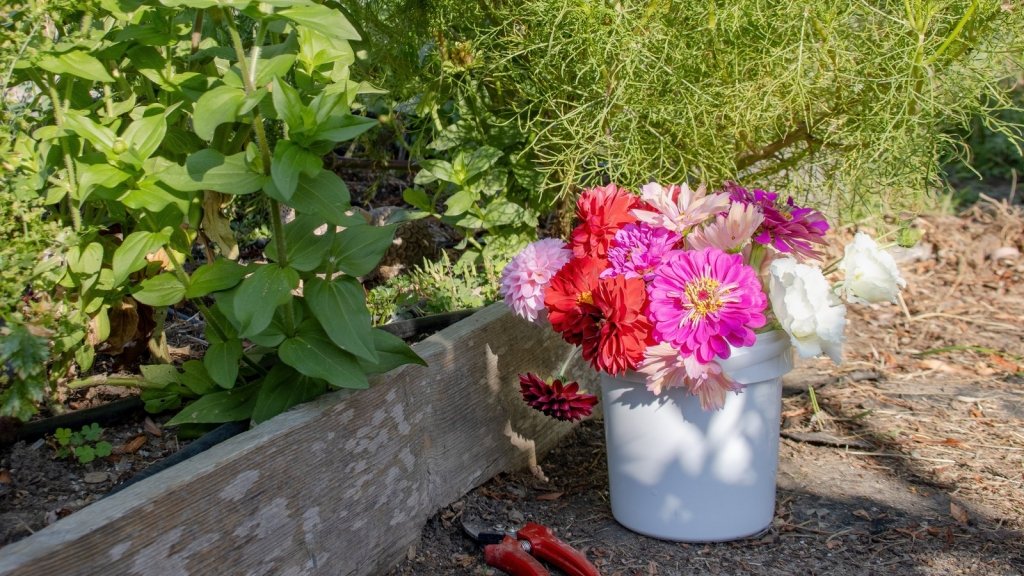

The short version: Pick in the cool of early morning or late evening, and carry a bucket of clean water into the garden so stems go straight in. Cut each type at its stage: tight bud for poppies and tulips, the first florets opening for snapdragons and gladioli, fully open for zinnias and dahlias, which will not open further, and sunflowers as the first petals lift. Strip the leaves below the water line, cut on an angle, then give the stems a long cool drink.
For any one flower, the difference between a vase that lasts two days and one that lasts ten is rarely the seed packet. It is the twenty minutes around the cut, and the long stand in clean water that follows it, which growers call conditioning.
Our guide to cut flowers to grow from seed covers what to plant.

Pick early or late, and take the bucket with you
Cut in the first hour or two after sunrise, or in the last of the light. Overnight a plant refills its stems, so a morning flower is turgid; by late morning the leaves lose water faster than the roots replace it. The Australian wildflower industry's RIRDC postharvest manual is blunt: flowers picked under stress, too immature or too open will not last.
Fill a bucket 10 to 15 cm deep and take it with you, so every stem goes in as it is cut. A cut stem draws air as soon as it leaves the plant, and air in the channels stops it drinking.
Use sharp, clean snips: a blunt blade crushes the channels it is meant to open. Cut away from your body and keep blades out of reach of children.
Cut each flower at the stage it will actually finish
Some flowers keep opening in the vase and some do not. Picked too green, a flower may never open; too late, it sheds petals.
- Cut in tight bud: poppies as the bud cracks and shows colour, peonies at the soft marshmallow stage, tulips coloured but closed.
- Cut as the first florets open on a spike: snapdragons with two or three florets out, gladioli at the colour break, stock with the lower third open, delphinium and larkspur the same.
- Cut open, or nearly: zinnias, marigolds, dahlias and hydrangeas will not open much further. Take zinnias and marigolds fully open, dahlias three quarters open, and hydrangeas once the heads feel papery.
- Sunflowers are the exception: cut as the first petals lift off the disc. The rest open within a day indoors, and a fully open head sheds petals sooner.
The wiggle test settles zinnias: hold the stem 20 cm below the flower and shake gently, and a head that flops will droop in the vase. Judge dahlias by the back petals, which turn papery with age. Our zinnia guide has more.

Conditioning: the long drink that does the work
Bacteria are the enemy. They multiply in flower water and block the vessels a stem drinks through, which is why flowers wilt in a slimy bucket. Wash buckets and vases in hot soapy water.
- Strip every leaf below the water line. Submerged leaves rot and feed the bacteria.
- Recut each stem on a long angle, taking off two or three centimetres.
- For anything that has been out of water, make that cut with the end under water.
- Stand everything in clean, cool water somewhere cool and dark for a few hours, or overnight.
Stems that need something extra
Two of these use a flame or just boiled water. Work at the bench with children and pets away, pour into a heatproof jug, and let a seared end cool.
- Hollow stems such as hippeastrum (often sold as amaryllis), delphinium, lupin and dahlia can be turned upside down, filled with tepid water and plugged with cotton wool.
- Milky sap stems such as poppies and euphorbia leak a latex that seals the cut. Euphorbia sap is a serious irritant, so wear gloves and eye protection and keep your hands from your face. To seal the end, hold it in a flame for a few seconds, or stand the bottom 2 to 3 cm in just boiled water for 20 to 30 seconds, heads clear of the steam.
- Woody stems such as lilac, hydrangea and gum foliage are thirsty. Cut on a long slant and split the base about 2 cm up, never hammer one flat.
- Flowers that dislike deep water: gerberas rot if they stand deep, so give them a few centimetres of clean water, changed often. Some growers treat dahlias the same.
Vase water: cool, clean, and away from the fruit bowl
Use cool, clean water in a scrubbed vase, changed every day or two, with a centimetre off the stems each time. Keep it out of direct sun and away from the fruit bowl: ripening fruit gives off ethylene, a gas that stops buds opening, drops petals and ages flowers early. Sweet peas, carnations, delphinium, snapdragons and lisianthus are the most sensitive.
Flower food does three jobs: sugar feeds the bloom, a biocide holds bacteria down, and an acidifier helps water move up the stem. Three kitchen ingredients do the same, per litre: a teaspoon of sugar, half a teaspoon of household bleach, and a tablespoon of white vinegar or lemon juice. Gardening Australia's do it yourself flower preserver uses all three. Measure each into the water, never bleach onto neat vinegar, and mix fresh at every change: acidified bleach stops working within hours. Aspirin has thin support at best and a copper coin none; lemonade brings sugar and acid but nothing to check the bacteria.
How long they last, and why cutting brings more
Rough ranges:
- Celosia, statice and everlasting daisies: two weeks or more, then they dry.
- Zinnias: about 7 to 10 days.
- Snapdragons, stock and marigolds: a week or two.
- Sunflowers and gladioli: roughly a week.
- Cosmos and dahlias: about 5 to 7 days.
- Sweet peas: often only 3 to 5 days.
Cutting is not a tax on the garden. Annuals flower to set seed, so taking the blooms first can push the plant to make more, and cutting deep encourages branching. Zinnias, cosmos, sweet peas and dahlias repay it.
A short word on safety
Some garden flowers are toxic and vase water is a bacterial soup, so keep arrangements away from small children and pets, and never let anyone drink from a vase. The RSPCA notes that all parts of a lily are toxic to cats, pollen included, and the vase water thought to be as well. Day lilies count, and any exposure is an emergency. The Queensland Poisons Information Centre reports that the sap of petty spurge, a common euphorbia, causes intense pain and blistering on skin and severe swelling in the eye. Rinse an eye splash for 15 minutes and get urgent medical attention. The number is 13 11 26.
When the cutting season runs in your climate zone
- Tropical (Darwin in the Northern Territory, Cairns and Townsville in Queensland): the dry season carries the picking, roughly May to September. Heat shortens vase life, so cut at first light.
- Subtropical (Brisbane and the Sunshine Coast in Queensland, Coffs Harbour and Lismore in northern New South Wales): a long season, spring and autumn the sweet spots.
- Arid and semi-arid (Alice Springs in the Northern Territory, Broken Hill in New South Wales, Mildura in Victoria, Kalgoorlie in Western Australia, inland and central-west Queensland): spring and autumn are the windows; in summer pick within the hour after sunrise.
- Temperate (Sydney, Newcastle and Wollongong in New South Wales, Melbourne and Geelong in Victoria at the cold end): a long run from about October to May.
- Mediterranean (Perth and Margaret River in Western Australia, Adelaide and the Barossa in South Australia): a heavy spring flush, then a dry summer needing steady water.
- Cool and alpine (Tasmania, Canberra and the ACT, Ballarat in Victoria, Orange, Bathurst and Armidale in New South Wales, Stanthorpe in Queensland): a shorter season, but often the best vase life: cool nights mean unstressed stems.
These are broad groupings: local frost dates and the temperature on the day overrule the month. We know of no cutting calendar for the whole country, so treat any guide, ours included, as a start.
Frequently asked questions
Morning or evening, which is really better?
Either, as long as it is cool. Morning is the safer default, because stems refill overnight and come indoors cool.
Why do my zinnias flop the day after I pick them?
Usually they were cut too young, so shake the stem 20 cm below the head and cut only the rigid ones. If a rigid stem flops, suspect a dirty bucket.
Do I need flower food, or is sugar enough?
Sugar alone feeds the bacteria as well as the flower. Flower food adds a biocide and an acidifier, which is why it works.
Should I cut stems under water?
Mainly for stems that have been out of water or have wilted, because it stops air being drawn up. Bucket to vase, a clean cut is fine.
Can I revive a wilted flower?
Often, yes. Recut under water and stand the stem deep in cool water in a dark room for a few hours. Papery petals are past saving.
How often should I change the water?
Every day or two, and sooner if it clouds or smells. Rinse the vase each time: the film on the glass reseeds bacteria faster than the water does.
Get the timing, the bucket and the long drink right, and a vase still good at the end of its week was almost certainly picked before breakfast.
Related growing guides
If the picking patch has gaps, our flower seeds include reliable vase fillers, among them zinnia seeds and cosmos seeds.