
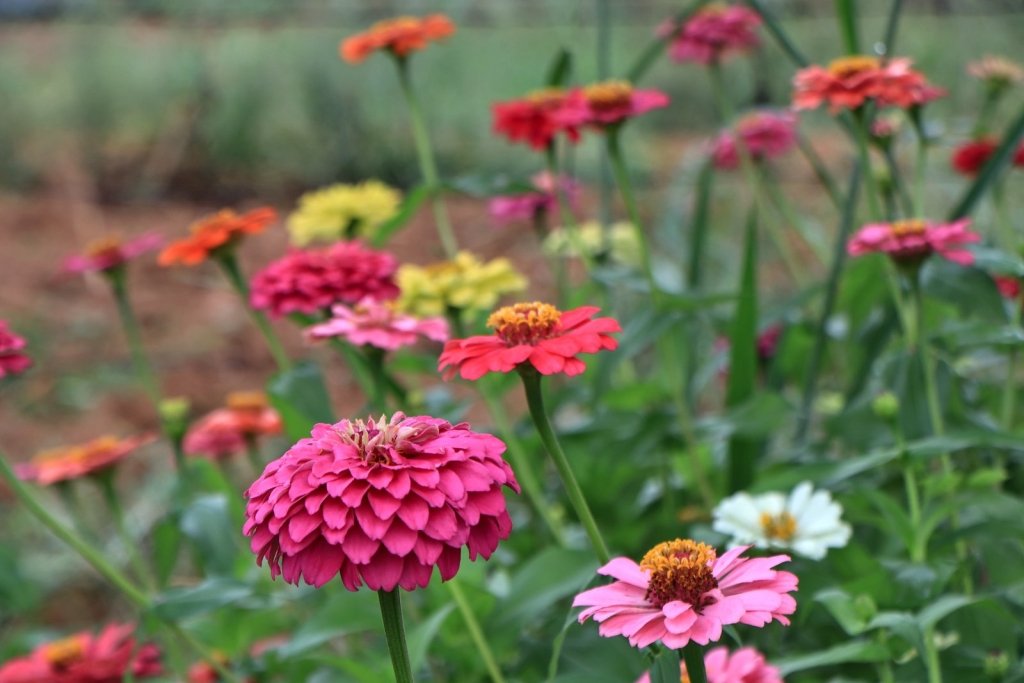

The short version: Where frost has finished and the soil has warmed, zinnia, cosmos, sunflower, marigold, celosia and portulaca can go straight into the bed and flower six to fourteen weeks later. In cool and alpine gardens, start them in cells under cover and plant out after the last frost. In the tropics the build-up is arriving, so sow a few tough flowers in well-drained pots. Sow cut flowers in small batches, and check before sowing anything that spreads itself.
By October, cool-season annuals are peaking in southern gardens, and the gaps between them start to show. That bare strip at the end of the tomato bed is made for a row of zinnias, and warm soil has the seed up in days rather than weeks.
Below are October flowers for each climate zone, drawn from the grow guides behind our what to sow now page, plus flowers for bees and the vase, and a few to handle with care.
Warm soil is the green light for the summer flowers
The heat lovers are frost tender and sulk in cold ground, so soil warmth decides the date, not the calendar. From our grow guides:
- Sunflower: soil at 12 degrees C or more and rising, heavy frosts over. Flowers in about 8 to 12 weeks.
- Cosmos: soil at 16 degrees C or more, last frost passed. Flowers in 10 to 14 weeks.
- Zinnia: after frost, into a warm seedbed; germinates best at 22 to 25 degrees C. Flowers in 10 to 13 weeks.
- Portulaca: soil at about 21 degrees C. It needs light to germinate, so give it no more than a 1 mm dusting of mix. First flowers in 6 to 7 weeks.
- Marigold and celosia: after frost, into warm ground. Marigolds flower in 8 to 12 weeks, celosia in 12 to 14.
Sunflowers and zinnias dislike root disturbance, so sow them where they will grow, or in deep cells planted out small. Anything raised under cover needs a week or so of hardening off before it faces full sun and wind.
What to sow in October, zone by zone
These zones are broad groupings. Between two of them, or at altitude, lean on local cues such as your usual last frost date.
Tropical (Darwin in the Northern Territory, Cairns and Townsville in Queensland, Broome in Western Australia). October brings the build-up, and our grow guides list four flowers: celosia, portulaca, begonia and cardinal climber, with October the last month for all but celosia. Grow them in pots or raised beds so downpours drain away, with begonias in part shade, and pick cardinal climber pods before they split, as a parent vine is a weed up north.
Subtropical (Brisbane and south-east Queensland, northern New South Wales). Sow zinnia, cosmos, sunflower, marigold, celosia, portulaca, vinca, salvia, rudbeckia, impatiens and aster, with October the last spring month for coreopsis and verbena. Space zinnias generously against midsummer mildew.
Arid and semi-arid (Alice Springs in the Northern Territory, Broken Hill in New South Wales, Mildura in Victoria, Kalgoorlie in Western Australia). Once the last inland frost has passed, sow zinnia, cosmos, sunflower, marigold, celosia, portulaca, vinca and salvia. October closes the window for calendula, nasturtium, petunia and aster. Mulch deeply around seedlings and water steadily in drying wind.
Temperate (Sydney and the New South Wales coast, Melbourne in Victoria). Sydney can sow zinnia, cosmos, sunflower, marigold, celosia, portulaca, vinca, salvia, petunia and nasturtium through October. Melbourne, the cool end, waits until late October for zinnias and raises marigold and celosia in trays to plant out around Melbourne Cup weekend. Across the zone, it is the last call for cornflower, dianthus, delphinium and carnation.
Mediterranean (Perth and southern Western Australia, Adelaide in South Australia). Sow zinnia, cosmos, sunflower, marigold, celosia, portulaca, vinca, salvia, rudbeckia and petunia. October is the final month for alyssum, calendula and gypsophila. Summer heat arrives dry and early, so mulch well around seedlings, soak deeply, and treat water-repellent sand with a wetting agent at the label rate.
Cool and alpine (Tasmania, Canberra in the ACT, Ballarat in Victoria, Orange and Armidale in New South Wales, Stanthorpe in Queensland). October opens the window for zinnia, cosmos, sunflower, marigold, celosia and portulaca. Start them in cells under cover and plant out after the last frost, often early November, later at altitude. Cornflower and larkspur, in their final month, and sweet pea can go in direct once hard frosts ease, while snapdragon and statice are best started in trays under cover.
Flowers for bees and hoverflies beside the vegetables
The NSW Government advises a variety of flowering plants with overlapping flowering times, and notes that one hoverfly larva can eat up to 300 aphids. For October, that means a mix:
- Cosmos and zinnia for open, daisy-shaped heads through summer.
- Sunflower at the back of the bed. Pollen-free cut-flower varieties offer no pollen, so choose a pollen-bearing type for this job.
- Marigold as an edging through the warm months.
- Alyssum and calendula for a low, quick-flowering edge in temperate, Mediterranean and cool gardens.
Beside zucchini, pumpkin and cucumber, they keep bees near the crops that need them. Our lesson on growing flowers among the vegetables for bees covers the layout.

Cut flowers: sow a little, then sow again
Small batches a few weeks apart spread the picking season.
- Zinnias reward picking. Cut often and remove faded heads, since a plant left to set seed soon slows down. Where the window runs to January, as in temperate and Mediterranean gardens, a November or December sowing carries flowers into autumn.
- Cosmos benefits from a second sowing two to four weeks after the first.
- Sunflowers depend on type. Single-stem varieties give one main flower per plant, so sow a short row every two or three weeks. Branching varieties give several stems each and need fewer sowings.
- Celosia and gypsophila add texture: celosia cuts fresh or dried, and regular picking keeps gypsophila sprays coming.
Dahlias grow from seed too, sown into warm soil after the last frost. Most flower in their first summer, each one a surprise, as seedlings do not match their parent. See dahlias from seed or tubers.

Check before you sow anything that spreads itself
A few garden flowers escape into bushland or are regulated. Check these two first:
- Ox-eye daisy (Leucanthemum vulgare), sometimes sold as the chrysanthemum 'May Queen', is a declared noxious weed across Victoria. NSW WeedWise, run by the NSW Department of Primary Industries, says it should not be sold in parts of New South Wales, and in the Hunter and Murray regions the regional weed plans say it should not be bought, sold or grown.
- Californian poppy (Eschscholzia californica) is regarded as an environmental weed in parts of Western Australia, New South Wales and Victoria, and has naturalised south of Perth. If you grow it, pick off faded flowers and green pods every few days, and skip it next to bushland.
Ageratum, celosia and nasturtium are environmental weeds in some regions too, and South Australia's environment department advises against nasturtium. Near bushland or a creek, deadhead before seed ripens and ask your council for local advice.
A caution about poisonous flowers
Several October flowers are poisonous if eaten. Every part of larkspur and delphinium is poisonous, and vinca (Madagascar periwinkle) can poison dogs and cats if they eat it. Sweet pea seeds and pods are not for eating either, so keep them apart from garden pea seed. Keep these plants and their seed away from children and pets. If anyone swallows part of a plant, call the Poisons Information Centre on 13 11 26, or a vet for a pet.
Frequently asked questions
Can I sow zinnias straight into the garden in October?
Yes, in most zones, once frost is over and the soil is warm. Melbourne gardens usually wait until late October, and cool and alpine gardens start them in deep cells under cover.
What flowers can I sow in October in the tropics?
Our grow guides list celosia, portulaca, begonia and cardinal climber. Most tropical flower sowing falls in the dry season, from April to June.
Which October flowers are best for bees?
Cosmos, zinnia, sunflower and marigold, plus alyssum and calendula in temperate, Mediterranean and cool gardens. Kinds flowering at different times feed bees for longer.
Is it too late to sow sweet peas in October?
In cool and alpine gardens, no: sow them once hard frosts ease, until November. In the other five zones, sweet peas are mainly an autumn sowing, so keep the packet for March.
A packet of zinnia seed and a warm October afternoon is a small outlay for a summer of picking.
Related growing guides
- Eight easy cut flowers to grow from seed
- How to grow zinnias from seed and keep them blooming
- Gardening for bees and beneficial insects
- Self-seeding flowers that come back every year
Browse all flower seeds, or go straight to zinnia seeds for the cutting bed.