
How to Grow Zinnias in Australia
Sow zinnias 5 to 7 mm deep once frost is over and the soil holds at least 21°C, in full sun and free-draining soil. Space plants 30 to 45 cm apart and water the soil, not the leaves, early in the day. Pinch once at about 30 cm, then cut and deadhead often. Flowers usually start 10 to 13 weeks after sowing.

| Sun | Full sun, 6 hours minimum |
|---|---|
| Water | Deep, steady watering at the base |
| Soil | Free-draining, compost-rich, pH about 6.3 to 6.8 |
| Feed | Compost at planting; liquid feeds; potash from budding |
| Spacing | 30 to 45 cm |
| Depth | 5 to 7 mm |
| Germination | 7 to 14 days at 22 to 25°C |
| Harvest | 10 to 13 weeks |
| Container | Dwarf types: 6 L pot, 20 cm wide |
| Frost | Frost-tender; plant out after the last frost |
| Use | Cut flowers, bedding, borders, pots and pollinators |
Zinnia (Zinnia elegans) is a warm-season annual in the daisy family, Asteraceae, grown for garden colour, pots and cut flowers. It revels in Australian summer heat and can flower for months from one sowing. The usual mistake is to stop picking, because a plant left to set seed soon stops making flowers.
Three mistakes that matter
- Sowing into cold soil. Zinnias are frost tender, and seed sitting in cold, wet soil comes up slowly or rots before it shoots. Wait for the soil temperature in When to plant, or start seed in deep cells under cover.
- Crowding plants and wetting the leaves. Powdery mildew spreads fastest through crowded plants with damp leaves and still air. Give each plant the full spacing in Sowing Seeds, and water the soil early in the day so leaves are dry by nightfall.
- Leaving spent flowers on the plant. A zinnia that sets seed has done its job, and flowering often tails off by late summer. Cut for the vase and remove faded heads every few days, as set out in Deadheading.
When to plant
Sow once the frosts are over and the soil holds at least 21°C. Seed germinates best between 22 and 25°C. For a longer run of flowers, sow a second batch about two weeks after the first.
| Zone | Example cities | Sow | Flowering | Notes |
|---|---|---|---|---|
| Tropical | Darwin NT; Cairns, Townsville QLD; Broome WA | Apr-Aug | Jul-Nov | Sow through the dry season; wet-season humidity brings powdery mildew, and heavy rain waterlogs seedlings. |
| Subtropical | Brisbane, Gold Coast, Bundaberg QLD; Coffs Harbour, Lismore NSW | Aug-Mar | Nov-Jun | A long window; give plants extra room in humid midsummer, when mildew is at its worst. |
| Arid and semi-arid | Alice Springs NT; Mildura VIC; Broken Hill, Dubbo NSW; Kalgoorlie WA | Sep-Feb | Dec-Apr | Sow after the inland frosts; mulch deeply and water steadily while seedlings establish in the heat. |
| Temperate | Sydney, Newcastle, Wollongong NSW; Melbourne, Geelong VIC | Sep-Jan | Dec-Apr | Sydney can sow from late September; Melbourne, the cool end, waits until the soil warms in late October. |
| Mediterranean | Perth, Bunbury WA; Adelaide SA | Sep-Jan | Dec-Apr | Start from late September; summer heat arrives dry and early, so mulch well and soak deeply. |
| Cool and alpine | Canberra ACT; Hobart TAS; Ballarat VIC; Armidale NSW | Oct-Dec | Jan-Apr | Start in cells under cover in October; plant out after the last frost, often Melbourne Cup weekend. |
Where spring is slow to warm, start seed in cells under cover about four weeks before the last frost. Late sowings keep flowering until the cold nights of autumn stop them.
Site, soil and setup
Choose a spot with at least six hours of direct sun a day, sheltered from strong wind. Zinnias need free-draining soil with compost through it, and do best at a pH of about 6.3 to 6.8.
| Where | What to do |
|---|---|
| Every bed | Before sowing, dig in a 5 cm layer of compost with blood and bone at 100 to 150 g per square metre. |
| Acid soil, below pH 6.3 | Spread garden lime at 100 to 200 g per square metre and dig it in 4 weeks ahead of sowing. |
| Heavy clay that stays wet | Build a raised bed. Gypsum at 500 g to 1 kg per square metre helps only dispersive clay: drop a dry crumb in rainwater, and a milky cloud within 20 hours confirms it. |
| Sandy or inland soil that sheds water | Water in a wetting agent at the label rate before sowing. |
Where you can, grow zinnias in a different bed each year. The leaf spot fungus described in Pests and diseases can survive in old zinnia debris for up to two years.
Container growing
Compact types such as 'Thumbelina Dwarf Mix', 'Formula Mix' and 'Envy' suit pots, and 'Dream' grows well in a large tub. A dwarf type needs a pot at least 20 cm wide and deep, about 6 L of fresh potting mix. Tall types need at least 40 L and a pot 40 cm across.
- Watering: pots dry out quickly in summer heat, so check them daily and water whenever the surface feels dry.
- Feeding: water in fish and seaweed blend at 25 mL per 9 L every fortnight. From the first flowers, switch to liquid potash at the label rate, fortnightly.
- Position: a hot, sunny patio or balcony out of strong wind.
Sowing Seeds
Sow zinnias direct where they will flower, because they resent root disturbance, and start them in cells only where spring is cool.
Sowing direct
- Sow seed 5 to 7 mm deep, with a few seeds at each spot and the spots 30 to 45 cm apart.
- Keep the soil damp but never soggy; seedlings usually appear in 7 to 14 days.
- Thin to the strongest seedling at each spot once true leaves show.
- Mulch with sugar cane or pea straw once seedlings stand about 5 cm tall.

Starting under cover
- Sow one or two seeds per deep cell or small pot of seed raising mix, 5 to 7 mm deep.
- Keep the tray warm and bright; a seedling heat mat helps hold the germination temperature.
- Plant out after about four weeks, once seedlings have true leaves and stand 5 to 10 cm tall, before roots circle the cell.
- Harden off seedlings over one to two weeks first (moving them outdoors for longer each day so they adjust to sun and wind).
- Set each seedling at the same depth it grew in the cell, then water it in well.
Tall doubles give the longest stems for cutting.
| Type | Height | Varieties | Flowers |
|---|---|---|---|
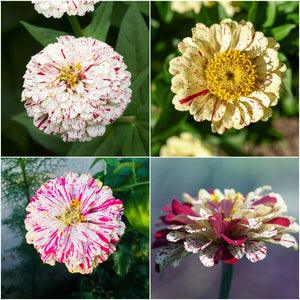
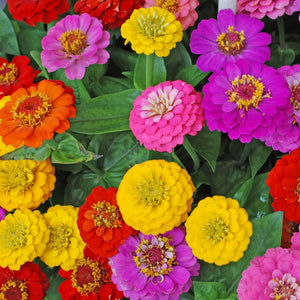
| Dwarf bedding | 15 to 30 cm | 'Thumbelina Dwarf Mix', 'Formula Mix' | Small blooms in pink, white, scarlet, orange and yellow; 'Formula Mix' has dahlia-form flowers 8 to 12 cm across |
| Button or pompon | Up to 60 cm | 'Lilliput White', 'Lilliput Mix' | Small, ball-shaped, fully double flowers for posies |
| Mid-height | 50 to 60 cm | 'Persian Carpet Mixed', 'Oriole', 'Envy' | Small bicoloured blooms; orange-red doubles fading to gold; lime-green semi-doubles |
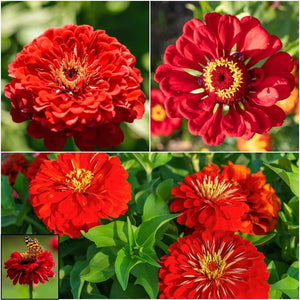
| Tall cutting | 70 to 100 cm | 'Scarlet Flame', 'Dream', 'Violet Queen', 'Purple Prince' | Large semi-doubles and doubles; 'Violet Queen' blooms reach 10 to 15 cm across, and 'Purple Prince' is dahlia-flowered |
| Cactus-flowered | Up to 90 cm | 'Burpeeana Mixed' | Spiky, quilled petals like a cactus flower |
Care by growth stage
Warmth, steady water and a feed that shifts to potassium once buds form keep zinnias flowering. Weeks count from sowing.
| Stage | Water | Feed | Watch for |
|---|---|---|---|
| Seedlings (weeks 1 to 4) | Keep the soil damp, watering gently at the base | Nothing until the first true leaves, then seaweed solution at half strength (15 mL per 9 L) fortnightly | Seedlings collapsing at soil level (see Common problems) |
| Young plants (weeks 4 to 7) | Water deeply at the base, early in the day, when the surface dries | Fish and seaweed blend at 25 mL per 9 L fortnightly | Aphids on shoot tips; pinch plants at about 30 cm (see Deadheading) |
| Budding (weeks 7 to 10) | Keep the soil evenly moist under the mulch | Sulphate of potash at 30 to 50 g per square metre, scattered around plants and watered in | Pale, speckled leaves from two-spotted mite in hot, dry weather |
| Flowering (week 10 onward) | Keep watering steadily right through cutting, without easing off | Liquid potash at the label rate fortnightly | White powdery film or brown leaf spots (see Pests and diseases) |
If you prefer a conventional feed: mix a controlled release all-purpose granular (NPK around 14-5-10) into the soil at planting. Water in an all-purpose soluble (NPK around 23-4-18 to 27-5-9) fortnightly during leafy growth. From the first buds, switch to a flowering soluble (NPK around 15-4-26 to 15-5-20) fortnightly.

Deadheading
Cutting and deadheading keep a zinnia making flowers instead of seed, and one pinch early on gives more stems to cut.
- Pinch once: at about 30 cm tall, take off the top few centimetres just above a pair of leaves with clean, sharp snips.
- Deadhead often: every few days, cut each faded flower back to a leafy joint, where the plant branches, rather than leaving a bare stalk.
- Cut for the vase: a long stem taken back to a leaf pair does the same job and pushes fresh side shoots.
- Dwarf bedding types: snip off spent heads as they brown; compact types such as 'Thumbelina Dwarf Mix' hide many under fresh growth.
- End of season: bin spent plants and fallen leaves rather than composting them, as leaf spot and mildew fungi survive on debris.
Companion planting
Zinnias pull bees, butterflies and hoverflies into the garden, so the best partners are plants that gain from those visitors.
Grows well with
- Sweet alyssum (Lobularia maritima): a low edging in front that draws hoverflies, whose larvae eat aphids.
- Cosmos (Cosmos bipinnatus): wants the same sun and heat, and also brings in hoverflies.
- Zucchini, cucumber and other summer vegetables: zinnias beside the bed keep bees busy nearby.

Keep apart
- Short plants on the south side of tall types: zinnias up to 1 m tall shade them for much of the day.
- Pumpkins and squash sprawling into the bed: their big leaves smother the airflow that keeps mildew down.
Harvesting Blooms
Cut when a flower is fully or almost fully open and the stem just below it is firm, because zinnias open little further once picked.
- Cut in the early morning or cool of the evening, since stems cut in midday heat wilt quickly.
- Give each stem the wiggle test: shake it gently, and cut only if the stem stays straight.
- Strip leaves that would sit below the waterline, and stand stems in clean water straight away.

In a clean vase, stems usually last 7 to 10 days. To hold them for a day or two, keep them cool at 4 to 10°C and no colder, as zinnias are sensitive to cold damage. Tall types fill a jug on their own, while button types suit a small posy.
Common problems
Seedlings collapse at soil level. Damping off (Pythium species and Rhizoctonia solani) rots young stems, most often in wet, cold seed raising mix or soil. Read more
Transplants sit still for weeks. Zinnias hate root disturbance, so seedlings moved from shallow punnets often stall while direct-sown plants catch up.
Double flowers open single. Stress such as transplant shock can make double types carry single blooms for a period afterwards.
Tall plants flop in storms. An unpinched plant on one tall stalk, heavy with flowers, can blow over in summer wind and rain.
Pests and diseases
Leaf diseases rise with humidity, so a muggy Brisbane summer and the tropical wet season are the hardest times for zinnias.
Powdery mildew (Golovinomyces species). A white, floury film spreads across the leaves in warm, humid spells and weakens the plant. Caught early, a spray of 1 part full-cream milk to 10 parts water can slow it.
Alternaria leaf spot (Alternaria zinniae). Reddish-brown spots with greyish-white centres grow and merge until leaves brown and dry, and petals can spot too.
Aphids (family Aphididae). These small sap-suckers gather on new shoots and under leaves, which can wilt or discolour and turn sticky with honeydew. Read more
Two-spotted mite (Tetranychus urticae). Tiny mites speckle leaves pale and spin fine webbing underneath, and numbers build fast in hot, dry, dusty weather. Read more
Prevention first
- Thin crowded seedlings and pull weeds, so air moves freely between plants.
- Choose varieties listed with good mildew tolerance, such as 'Formula Mix' and 'Tetra State Fair'.
- Hose shoot tips and leaf undersides with a firm jet to knock off aphids and mites.
- Pick off spotted leaves and put them in the bin, not the compost.
Tips
- In cool zones with a short summer, choose quicker, lower types such as 'Formula Mix' or the early-blooming 'Thumbelina Dwarf Mix'.
- Pinch only half the plants in a row: pinched stems flower a little later, so the display lasts longer.
- For bees and butterflies, grow some single-flowered types, as an open centre is easier to reach than a tight pompon.
- Zinnias have become weeds in some parts of Australia, so check your council's advice before letting plants drop seed near bushland.
Questions
When should I plant zinnia seeds in Australia?
Sow once frost is over and the soil holds at least 21°C. That is Sep to Jan in temperate and Mediterranean areas, Oct to Dec in cool areas, and Sep to Feb inland. Sow Aug to Mar in the subtropics, and Apr to Aug in the tropics, through the dry season.
Should I pinch out my zinnias?
Yes, for more stems. When a plant is about 30 cm tall, snip off the top few centimetres just above a pair of leaves. It branches from lower down, giving more flowers on shorter, sturdier stems. Pinched stems flower a little later.
Why do my zinnias have white powder on the leaves?
That is powdery mildew, a fungus that thrives in warm, humid weather with poor airflow. Space plants 30 to 45 cm apart and water the soil, not the leaves, early in the day. Remove badly affected leaves and bin them rather than composting.
How long do zinnias take to flower from seed?
Usually 10 to 13 weeks from sowing, depending on the variety and the warmth of the season. Regular cutting and deadheading then keep plants flowering until cold nights or frost stop them.
Can zinnias grow in pots?
Yes. Compact types such as 'Thumbelina Dwarf Mix' and 'Formula Mix' suit a pot at least 20 cm wide and deep. Tall types need a tub of at least 40 L. Use fresh potting mix, a sunny spot out of strong wind, and check the water daily in summer.
How long do cut zinnias last in a vase?
Usually 7 to 10 days. Cut fully open flowers on firm stems in the cool of the morning or evening. Strip leaves below the waterline and stand the stems in clean water straight away.
Grow it



More flower guides
All flowers
Ageratum
Grow ageratum from seed in Australia: surface sowing, months for six climate zones, spacing, pots, deadheading, weed and livestock cautions and pests to watch.
| Position | Full sun, 6 hours or more |
|---|---|
| Depth | Surface, 1 mm at most |
| Spacing | 30 cm; Red Flint 40 cm |
| First pick | 12 to 14 weeks from sowing |

Alyssum
Grow alyssum from seed in Australia: sowing months for six climate zones, surface sowing, spacing, pots, shearing for more flowers, and the pests to watch.
| Position | Full sun or part shade |
|---|---|
| Depth | Surface sow, press in |
| Spacing | 15 to 20 cm |
| First pick | 8 to 9 weeks from sowing |

Aquilegia
Grow aquilegia from seed in Australia: chilling the seed, when to sow in six climate zones, part shade, pots, deadheading, cut flowers and common pests.
| Position | Part shade or morning sun |
|---|---|
| Depth | Surface, 3 mm cover at most |
| Spacing | 30 to 50 cm |
| First pick | From about 28 weeks |

Aster
Grow China asters in Australia: sowing months for six climate zones, spacing, pots, watering, Fusarium wilt and thrips, and cutting blooms for the vase.
| Position | Full sun, 6 hours minimum |
|---|---|
| Depth | 6 mm |
| Spacing | 30 to 40 cm |
| First pick | 13 to 16 weeks |