
How to Grow Billy Buttons in Australia
Billy buttons is a short-lived native perennial grown for golden globe flowers that dry for years. Press the fine seed onto moist mix without burying it and keep trays at 21 to 24°C; seedlings appear in 14 to 21 days. Plant out 20 to 30 cm apart in full sun and free-draining soil, feed lightly, and expect flowers about 13 to 17 weeks after sowing.
| Sun | Full sun |
|---|---|
| Water | Steady while young; copes with dry spells |
| Soil | Free-draining sand, loam or clay; any pH |
| Feed | Light; low-phosphorus feeds only |
| Spacing | 20 to 30 cm apart |
| Depth | Surface sow, press in |
| Germination | 14 to 21 days at 21 to 24°C |
| Harvest | Flowers 13 to 17 weeks |
| Container | Yes; deep pot around 25 cm wide |
| Frost | Tolerates light frost once established |
| Use | Fresh and dried cut flowers, native gardens |
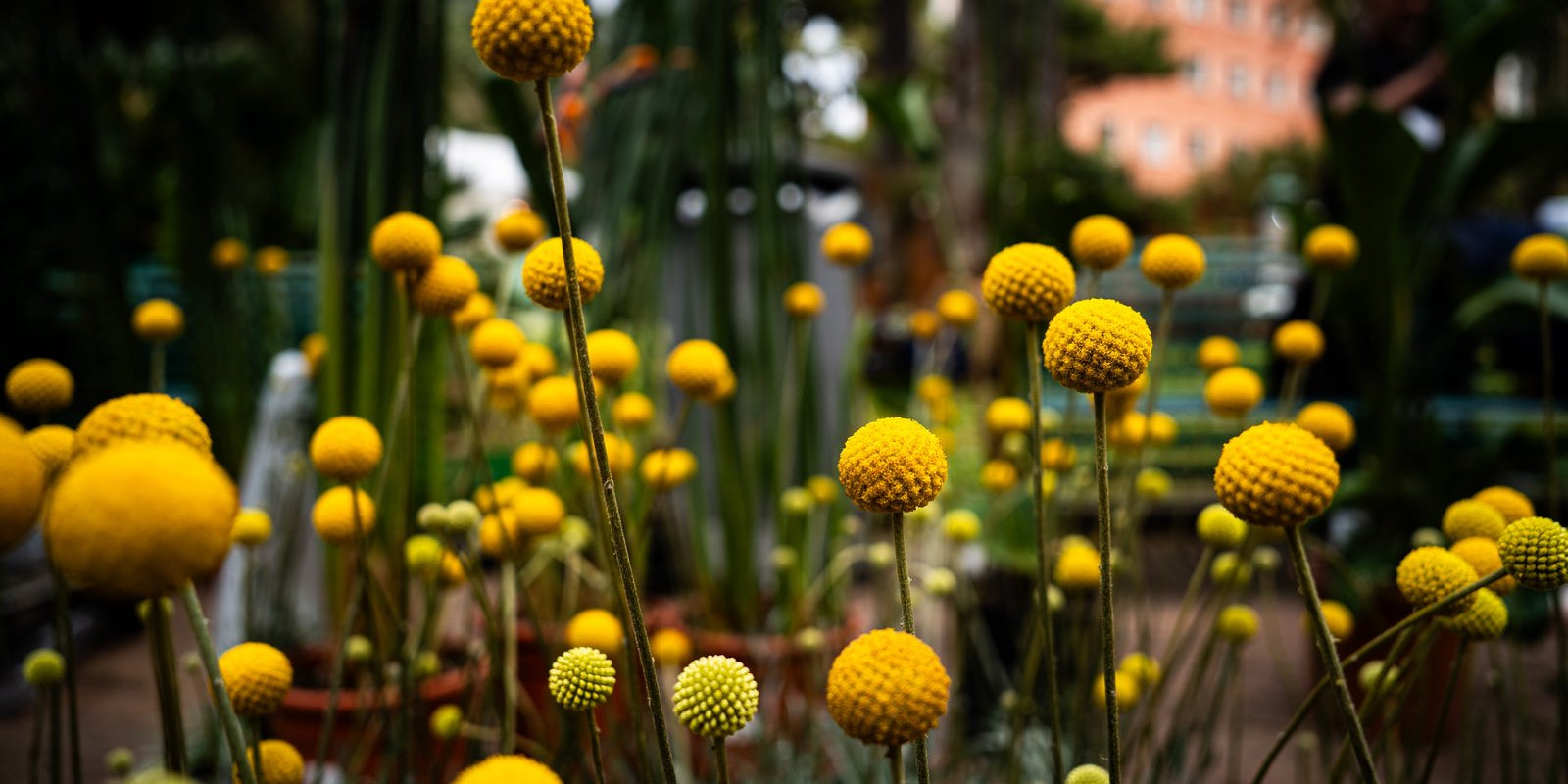
Billy buttons (Pycnosorus globosus), long sold as Craspedia globosa, is a native perennial daisy (Asteraceae) grown for golden globe flowers on tall, bare stems. It grows wild on inland plains and roadsides from Queensland to South Australia, and its heads hold their shape and colour for years once dried. The mistake most gardeners make is burying the fine seed, which needs light to germinate.
Three mistakes that matter
- Burying the seed. Seed covered with a layer of mix often fails to appear, because light helps it germinate. Press it firmly onto the surface of moist seed raising mix and add no more than a fine dusting of vermiculite.
- Letting water sit around the crown. The plant copes with heavy soil and brief winter wet. Soggy ground or thick mulch against the crown can rot it, most often in humid summers. Choose an open, free-draining spot and keep mulch thin.
- Feeding it like a bedding annual. Rich feeding and shade produce soft, leafy growth, floppy stems and fewer flowers. Give it full sun, a lean diet and low-phosphorus products, as set out under Care by growth stage.
When to plant
Seed germinates at 21 to 24°C, so warmth decides the start. Sow while days stay warm, in autumn or spring in most zones, or start trays earlier on a seedling heat mat. One sowing is enough: each plant forms a clump that flowers from early spring into summer for a few years.
| Zone | Example cities | Sow | Harvest | Notes |
|---|---|---|---|---|
| Tropical | Darwin NT; Cairns, Townsville QLD; Broome WA | Apr-Jul | Aug-Nov | Sow in the dry season and grow as an annual; humid wet season build-up weather usually ends the plants. |
| Subtropical | Brisbane, Sunshine Coast, Bundaberg QLD; Coffs Harbour NSW | Mar-Sep | Jul-Jan | Autumn and winter sowings flower before summer humidity. Warm midwinter trays on a heat mat; give plants open air. |
| Arid and semi-arid | Alice Springs NT; Broken Hill, Dubbo NSW; Mildura VIC; Kalgoorlie WA | Mar-May and Aug-Oct | Sep-Feb | Its home climate. Autumn sowings flower in spring; water steadily through flowering and use a wetting agent on sand. |
| Temperate | Sydney, Newcastle, Wollongong NSW; Melbourne, Geelong VIC | Mar-Apr and Aug-Nov | Oct-Mar | Autumn sowings flower from mid-spring. Start spring trays on a heat mat until nights warm. |
| Mediterranean | Perth, Bunbury WA; Adelaide and the SA coast | Mar-May and Sep-Oct | Sep-Feb | Autumn sowings establish over the wet winter and flower before dry heat; water spring sowings through summer. |
| Cool and alpine | Hobart, Launceston TAS; Canberra ACT; Ballarat VIC; Orange NSW | Jan-Mar and Sep-Dec | Oct-Apr | Summer sowings establish before hard frost and flower next spring. Start spring trays indoors; plant out after the last frost. |
In frosty gardens, start trays indoors about six weeks before the last frost and plant out once it passes. In the tropics and subtropics, sow early enough for plants to flower before humid summer weather arrives.
Site, soil and setup
| Need | What to do |
|---|---|
| Sun | Full sun for the most flowers and the straightest stems. It tolerates light shade, but stems grow softer and flowers fewer. |
| Soil | Sand, loam or clay all suit it if water drains away. In the wild it grows in moist, low-lying spots on heavy soil, so it does not need poor, dry sand. |
| pH | Acid, neutral or alkaline soils all suit it, so no liming is needed for this plant. |
| Drainage | Essential (see Three mistakes that matter). On clay that stays wet after rain, plant into a raised bed or a mound. |
| Bed preparation | Weed thoroughly and dig in a 5 cm layer of compost before planting. Skip manures and blood and bone, which carry phosphorus. |
| Mulch | A thin layer of fine mulch holds moisture. Keep it well clear of the woolly crown. |
| Water-repellent soil | On sandy inland soils that shed water, apply a wetting agent at the label rate. |
| Coastal gardens | It suits coastal gardens and rockeries as well as native and cottage beds. |
Billy buttons stays in one place for years, so it needs no yearly rotation. For ground that stays soggy, read about waterlogged garden soil before planting.
Container growing
The silver rosette and tall gold stems suit a deep pot on a sunny deck. Give one plant a deep pot, around 25 cm wide and deep (about 8 L), with generous drainage holes. Fill it with native potting mix, adding coarse sand or perlite if the mix feels heavy.
- Watering. Pots dry out faster than beds, so check them often through spring and summer. Never leave the pot standing in a saucer of water. See watering pots through summer.
- Feeding. Give worm casting liquid, diluted to weak tea colour, every fortnight from spring until flowering ends.
- Position. Full sun, with open air around the plant in humid gardens.
Sowing Seeds
Start billy buttons in trays or cells, where the fine seed stays lit, warm and safe from snails.
| Step | Detail |
|---|---|
| Depth | Surface, pressed in firmly; at most a fine dusting of vermiculite |
| Tray warmth | As under When to plant |
| Emergence | 14 to 21 days, often uneven |
| Sow ahead of planting out | 6 to 8 weeks |
| Plant out | 5 to 10 cm tall, with several true leaves |
| Spacing | 20 to 30 cm |
| Flower stems | Usually 40 to 60 cm; to 1.2 m in the wild |
| First flowers | About 13 to 17 weeks from sowing |
Starting under cover
- Fill a cell tray or punnet with fresh seed raising mix, firm it and water it before sowing.
- Sow two or three seeds per cell, so each seedling moves on later without its roots being torn apart.
- Press the seed onto the surface, as in sowing tiny seeds, then mist it or water the tray from below.
- Keep the tray at the warmth under When to plant, in bright light out of direct sun, under a clear cover.
- Lift the cover once seedlings appear, and thin each cell to the strongest one.
- Seedlings can trickle up over several weeks, so do not tip out a tray too early.
Sowing direct
Seed can go straight into a fine, weed-free bed once the soil is as warm as under When to plant. Press it onto raked soil, keep the surface moist with a fine spray and thin seedlings to the spacing in the table above.
Transplanting
Billy buttons resents root disturbance, so move each seedling with its whole root ball. Harden seedlings off first (a week or so of gradually longer spells outdoors that toughens soft growth), as in hardening off seedlings. Plant in groups at that spacing, at pot depth, and water in with seaweed solution at 30 mL per 9 L.
Care by growth stage
Steady moisture while young, sharp drainage and a lean diet decide how well billy buttons flowers. It needs far less feeding than annual cut flowers, and phosphorus-rich products are best left out.
| Stage | Water | Feed | Watch for |
|---|---|---|---|
| Seedlings in trays, weeks 1 to 6 | Keep the mix just moist; mist, or water from below | Nothing until the first true leaves, then seaweed solution at half strength, 15 mL per 9 L, every fortnight | Damping off (seedlings rotting at soil level in wet mix); pale, stretched seedlings |
| Planting out, weeks 6 to 10 | Water deeply at planting, then whenever the soil is dry 5 cm down | Compost at bed preparation (see Site, soil and setup), then seaweed solution at 30 mL per 9 L every fortnight for a month | Snails and slugs at night |
| Growing on, weeks 10 to 13 | Water deeply in the morning when the soil is dry 5 cm down; keep water off the leaves | Worm casting liquid, diluted to weak tea colour, every fortnight | Aphids on new growth and rising flower stems |
| Flowering, from about week 13 | Keep watering steady through flowering and picking, never soggy | Sulphate of potash at 30 g per square metre, once, as the first buttons colour, watered in | A crown that yellows or rots in humid weather |
| Established clumps, from the second spring | Water in long hot or dry spells; it copes with short dry periods | Seaweed solution at 30 mL per 9 L every fortnight from late winter until buds show | Old, untidy leaves and a thinning clump |
Weeks count from sowing. If growth stalls in poor soil, scratch in a light dose of controlled release granular made for native plants, labelled low in phosphorus, each spring.

Deadheading
Removing spent heads keeps new flowers coming, and a tidy-up after flowering keeps the clump dense.
- Snip each browned head off at the base of its stem while the plant is flowering.
- Pick for the vase often, because picking does the same job as deadheading.
- Once flowering ends, cut every remaining stem back to the base.
- Trim old leaves that turn untidy or die down, but never cut into fresh growth in the centre.
- Leave a few heads to ripen on the plant if you want to save seed.
Companion planting
Billy buttons suits a sunny native or cottage bed beside plants that share its drainage and leave its crown in open air. Its flowers also draw bees, butterflies and other beneficial insects.
Grows well with
- Everlasting daisies, native paper daisies that share the same sun, soil and drying use.
- Brachycome, a low native daisy that edges the bed without crowding the clump.
- Statice, another dried flower that likes the same sunny, free-draining bed.
- Native grasses, whose fine leaves set off the round gold heads.

Keep apart
- Sunflowers and other tall, dense plants, which shade the clump and soften its stems.
- Mint and other fast spreaders, which overrun a slow clump.
- Lettuce and other soft seedlings, which draw snails and slugs to the same bed.
Harvesting and Drying Blooms
Cut billy buttons once each ball is fully round and evenly golden, before any of its tiny florets open.
- Cut in the cool of the morning with sharp secateurs or snips.
- Take the longest stem possible, cutting at the base, so picking also deadheads.
- Strip the lower leaves and stand fresh stems in a clean bucket of water straight away.
- To dry, tie small bunches and hang them upside down somewhere dark, dry and airy.
- Or stand stems upright in an empty vase, where they dry in place.

Keep fresh stems in a cool room and change the water every few days.
Use billy buttons fresh in native posies, or dried in everlasting arrangements beside paper daisies and grasses.
Common problems
Seeds did not come up. Buried seed (see Three mistakes that matter), a tray that dried out or one kept too cool are the usual causes. Read more
Pale, stretched seedlings. Seedlings raised in poor light stretch and flop before they reach the garden. Read more
Seedlings sulk after planting out. Torn roots set the plant back, so move each seedling with its root ball intact. Read more
Plant collapses at the base. Root or crown rot takes hold where water sits around the crown, and an affected plant seldom recovers. Read more
Floppy stems and few flowers. Too little sun or too much feed gives soft growth; move the plant into full sun and feed lightly.
Plant fades after a few years. It is a short-lived perennial, so sow fresh seed every few years, or take cuttings from a good plant as under Tips.
Pests and diseases
Snails, slugs and aphids cause most of the damage, and seldom badly on a plant in full sun.
Common garden snail (Cornu aspersum). This introduced snail, found in every state and territory, chews young leaves and seedlings at night, and slugs do the same. Sink shallow beer traps into the soil or ring pots with copper tape. Read more
Aphids (family Aphididae). These small, soft-bodied insects cluster on new growth and developing flower stems, sucking sap and leaving sticky honeydew. Hose them off, or spray horticultural oil or soapy water, but not in hot weather. Read more
Damping off (Pythium species and Rhizoctonia solani). These soil-borne pathogens rot seedlings at soil level, so they collapse in the tray, most often in wet mix. Read more
Prevention first
- Sow in fresh seed raising mix in clean trays, and lift the cover once seedlings appear.
- Keep to the spacing under Sowing Seeds, so air moves around each crown.
- Check new growth and flower stems each week from spring.
- Clear leaf litter and rubbish where snails and slugs hide by day.
Tips
- Take cuttings from healthy growth of your best plant; they root quickly and carry it on after the parent fades. See taking cuttings.
- Plant against green foliage, where the silver leaves and gold heads stand out most.
- Collect seed from a ripe head: each seed carries a small plume of feathery hairs, so pick it on a still, dry day.
- Common billy buttons (Craspedia variabilis) is a different, shorter plant that shares the common name; check the botanical name when buying.
Questions
Are billy buttons and Craspedia globosa the same plant?
Yes. Craspedia globosa was renamed Pycnosorus globosus, and seed is still often sold under the old name. Several true Craspedia species are also called billy buttons, such as common billy buttons (Craspedia variabilis). In Craspedia the tiny flowers sit on short stalks within the ball; in Pycnosorus they do not.
Do billy buttons come back every year?
Usually, for a few years. Billy buttons is a short-lived perennial that is often grown as an annual. It regrows from an underground rootstock each spring in most gardens. Cut spent stems to the base after flowering, and sow fresh seed or take cuttings every few years to keep plants coming.
How do you dry billy buttons?
Cut the stems once each ball is fully round and evenly golden, before the tiny florets open. Tie small bunches and hang them upside down somewhere dark, dry and airy. Kept out of direct sun, the dried heads hold their shape and colour for years.
Why are my billy button seeds not germinating?
The usual causes are burying the seed, a cold tray or mix that dried out. Press the seed onto moist seed raising mix, cover it with no more than a dusting of vermiculite, and keep it at 21 to 24°C. Seedlings appear in 14 to 21 days, often unevenly.
Can billy buttons grow in pots?
Yes. Use a deep pot around 25 cm wide with generous drainage holes, filled with native potting mix and some coarse sand or perlite. Stand it in full sun, never in a saucer of water, and check the mix often in warm weather.
How tall do billy buttons grow?
Flower stems usually reach 40 to 60 cm in the garden, above a low rosette of silvery woolly leaves. In rich, moist ground they can grow taller, and wild plants reach 1.2 m.
Grow it
More flower guides
All flowers
Ageratum
Grow ageratum from seed in Australia: surface sowing, months for six climate zones, spacing, pots, deadheading, weed and livestock cautions and pests to watch.
| Position | Full sun, 6 hours or more |
|---|---|
| Depth | Surface, 1 mm at most |
| Spacing | 30 cm; Red Flint 40 cm |
| First pick | 12 to 14 weeks from sowing |

Alyssum
Grow alyssum from seed in Australia: sowing months for six climate zones, surface sowing, spacing, pots, shearing for more flowers, and the pests to watch.
| Position | Full sun or part shade |
|---|---|
| Depth | Surface sow, press in |
| Spacing | 15 to 20 cm |
| First pick | 8 to 9 weeks from sowing |

Aquilegia
Grow aquilegia from seed in Australia: chilling the seed, when to sow in six climate zones, part shade, pots, deadheading, cut flowers and common pests.
| Position | Part shade or morning sun |
|---|---|
| Depth | Surface, 3 mm cover at most |
| Spacing | 30 to 50 cm |
| First pick | From about 28 weeks |

Aster
Grow China asters in Australia: sowing months for six climate zones, spacing, pots, watering, Fusarium wilt and thrips, and cutting blooms for the vase.
| Position | Full sun, 6 hours minimum |
|---|---|
| Depth | 6 mm |
| Spacing | 30 to 40 cm |
| First pick | 13 to 16 weeks |