
How to Grow Four O'Clocks in Australia
Four o'clock is a frost-tender perennial with scented flowers that open in the late afternoon. Sow the large seed 6 mm to 2 cm deep once soil reaches 20 to 22°C and frost has passed. Space plants 30 to 60 cm apart in full sun. Flowers usually start 11 to 12 weeks after sowing. The seeds and roots are poisonous, and it self-seeds.
| Sun | Full sun |
|---|---|
| Water | Deep soaks when dry 5 cm down |
| Soil | Almost any free-draining soil, humus-rich best |
| Feed | Light: compost, seaweed solution, fish and seaweed |
| Spacing | 30 to 60 cm |
| Depth | 6 mm to 2 cm |
| Germination | 1 to 3 weeks at 20 to 22°C |
| Harvest | Flowers 11 to 12 weeks |
| Container | Yes; pot of at least 10 L |
| Frost | Tender; tuber survives light frost under mulch |
| Use | Evening-scented borders, summer hedges, pots by doorways |
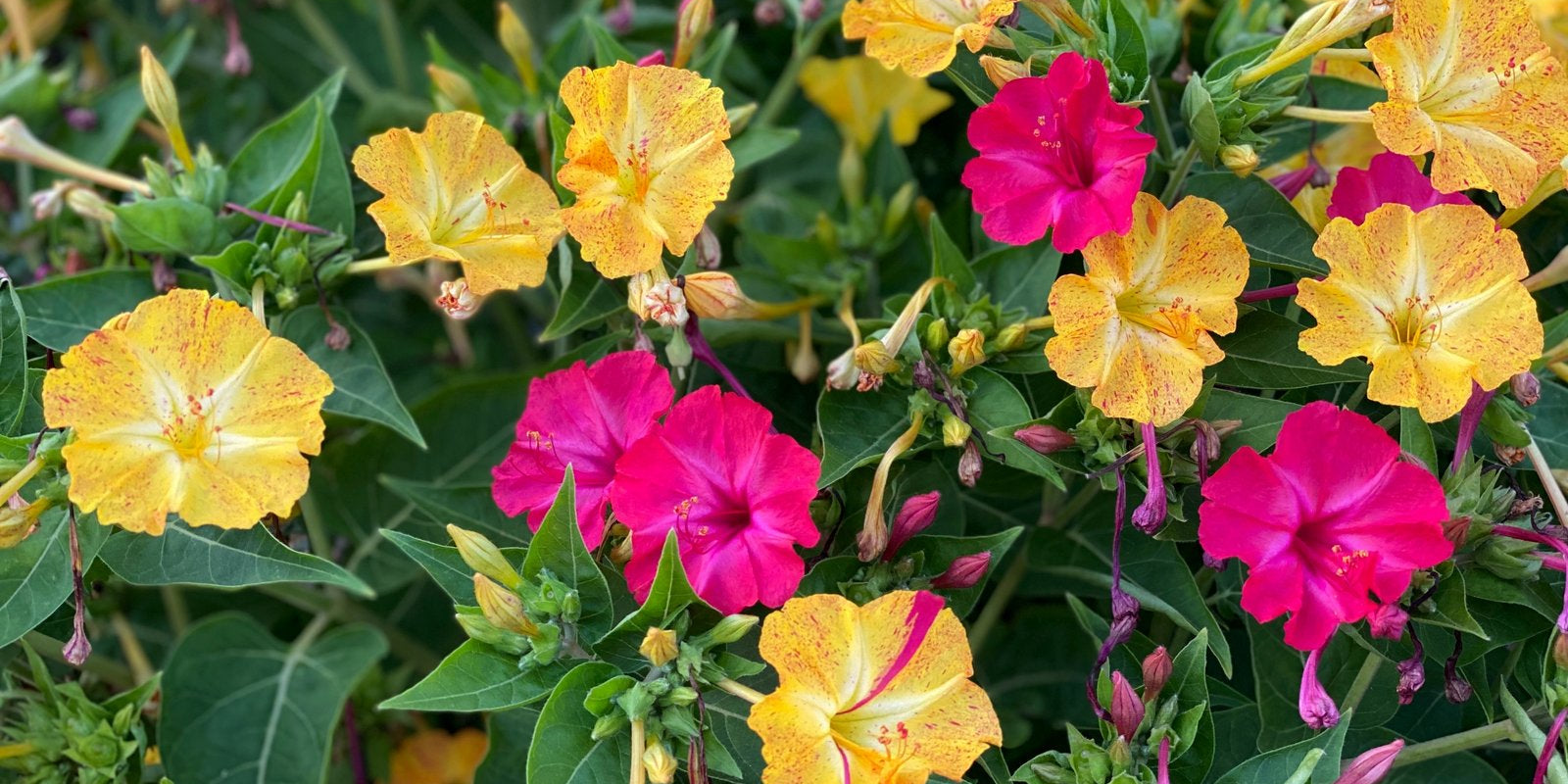
Four o'clock (Mirabilis jalapa), also called marvel of Peru, is a bushy perennial in the family Nyctaginaceae. It is grown for fragrant, trumpet-shaped flowers that open late in the afternoon, often in several colours on one plant. It thrives in hot summers and forms a tuber that regrows where winters are mild. Frost cuts it down, so cold districts grow it as an annual. The mistake most gardeners make is letting it seed freely, because it is poisonous and can escape the garden.
Three mistakes that matter
- Letting the seed fall. Four o'clock self-seeds, and its tuber sends up new shoots, so one plant can become a patch. It has escaped into bushland and creek banks in several states. Pick off seed before it drops and dig out strays.
- Sowing into cold soil. Seed sits idle or rots in cold ground, and frost kills young plants outright. Wait until the frosts are over, about when tomatoes go in, or start trays under cover.
- Leaving the tuber in frozen ground. The tuber (a swollen, food-storing root) survives light frost under mulch but can die in hard freezes. In frosty inland and highland gardens, lift it in autumn, as under Harvesting Blooms.
When to plant
Four o'clock seed germinates when the soil holds 20 to 22°C, so sow once the soil has warmed and frosts have passed. In frosty districts, start trays under cover 6 to 8 weeks before the last frost. One sowing is enough, because plants flower for months and the tubers can return.
| Zone | Example cities | Sow | Flowering | Notes |
|---|---|---|---|---|
| Tropical | Darwin NT; Cairns, Townsville QLD; Broome WA | Mar-Sep | Jun-Dec | Sow through the dry season. It has escaped into rainforest edges on the Atherton Tableland, so collect seed. |
| Subtropical | Brisbane, Sunshine Coast, Bundaberg QLD; Coffs Harbour NSW | Sep-Nov and Feb-Mar | Dec-May | Sow once soil warms in spring. A weed of Brisbane waterways, so keep plants and seed away from creeks. |
| Arid and semi-arid | Alice Springs NT; Broken Hill NSW; Mildura VIC; Kalgoorlie WA | Sep-Nov | Dec-Apr | Sow after inland frosts end. Mulch deeply; leaves droop in afternoon heat and recover by evening. |
| Temperate | Sydney, Newcastle, Wollongong NSW; Melbourne, Geelong VIC | Oct-Dec | Jan-Apr | Sydney soil warms by October. In Melbourne, plant out around Melbourne Cup weekend, after the last frost. |
| Mediterranean | Perth, Bunbury WA; Adelaide and the SA coast | Oct-Dec | Jan-Apr | Mulch against the long, dry summer. It has escaped near Perth, so gather seed before it drops. |
| Cool and alpine | Hobart, Launceston TAS; Canberra ACT; Ballarat VIC; Orange NSW | Oct-Dec | Feb-Apr | Start trays under cover, plant out after the last frost, and lift tubers before autumn frosts. |
Sowings made early in a window flower longest before the cold. A seedling heat mat holds a tray at the right warmth in a slow spring.
Site, soil and setup
| Need | What to do |
|---|---|
| Sun | Full sun, 6 hours or more a day. Plants tolerate part shade but flower less. |
| Soil | Almost any soil, from sand to clay, as long as it drains. Humus-rich loam gives the best growth. |
| pH | Mildly acid to mildly alkaline. On strongly acid soil, spread garden lime at 100 to 200 g per square metre 4 weeks before planting. |
| Bed preparation | Weed thoroughly, loosen the soil and dig in a 5 cm layer of compost or well-rotted manure. |
| Shelter | A spot out of strong wind, because the stems are brittle and snap easily. |
| Position | A permanent spot away from vegetable beds, creeks, bushland and children's play areas. |
Four o'clock is a perennial, so it needs no rotation. Choose its bed with the weed record below in mind: it is a minor environmental weed in several states, although no state declares it.
| State or territory | Where it has gone wild | Legal status |
|---|---|---|
| Queensland | Naturalised, most common in the south-east; a weed of Brisbane waterways and far north rainforest edges | Not a prohibited or restricted invasive plant |
| New South Wales | Naturalised on the north and central coast, including Sydney bushland | Not listed in NSW WeedWise |
| Victoria | Sparingly naturalised, with records from Melbourne, Ballarat and Toongabbie in Gippsland | Not a declared noxious weed |
| South Australia | Naturalised in the south-east | Not a declared plant |
| Western Australia | Naturalised in coastal south-western districts, including a bushland remnant at Victoria Park, Perth | Permitted on the state organism list |
| Tasmania | Naturalised at waste disposal sites near Scottsdale and St Helens in the north-east | Not a declared weed |
| Northern Territory | Not recorded as naturalised | Not on the territory weed list |
| ACT | Doubtfully naturalised | Not a declared pest |
Rules change, so check with your council or state biosecurity agency before planting near bushland.
Container growing
A pot keeps the tuber contained and saves lifting it for winter. Give one plant a pot of at least 10 L, about 28 cm across, and use premium potting mix. Set it by a doorway or window, where the evening scent carries indoors.
- Watering. Water when the mix is dry a finger's depth down; see watering pots through summer.
- Feeding. Give fish and seaweed blend at 25 mL per 9 L once a fortnight from planting until the first flowers.
- Position. Full sun, sheltered from strong wind.
- Winter. In frosty gardens, move the pot to a dry, frost-free shed once the tops die back.
Sowing Seeds
Start four o'clocks in cells or small pots under cover, or sow them straight into a warm bed after the last frost.
| Tall Mix at a glance | Detail |
|---|---|
| Flower colours | Cerise, burgundy, pink, yellow and white, often mixed or striped on one plant |
| Height | 60 to 90 cm; older plants can reach 1 m or more |
| Seed | Large, black and wrinkled, so each seed can be placed by hand |
| Depth | 6 mm to 2 cm |
| Emergence | 1 to 3 weeks in warm soil |
| Spacing | 30 to 60 cm |
| First flowers | About 11 to 12 weeks from sowing |
Starting under cover
- Soak the seed in water overnight before sowing, which can speed germination.
- Fill cells or 8 cm pots with fresh seed raising mix and water it first.
- Sow two seeds per cell at the depth in the table, and firm the mix over them.
- Keep the mix moist but never wet, at the temperature under When to plant.
- Once both seeds come up, snip out the weaker one at soil level.
- Grow seedlings on in full light so they stay short and sturdy.

Sowing direct
Sow where plants are to flower once the soil is warm and frost is over. Soak the seed overnight first, as for trays. Set two seeds per spot at the spacing in the table, then keep the soil moist until seedlings show. Thin each spot to the strongest seedling, and protect them from snails for the first few weeks.
Transplanting
Plant out seedlings that stand 5 to 10 cm tall with true leaves, after the last frost. First harden them off (a week of gradually longer outdoor stays, so leaves toughen to sun and wind), as in hardening off seedlings. Water each in with seaweed solution at 30 mL per 9 L.
Care by growth stage
Warmth decides how well four o'clock grows: once settled, it takes heat and dry spells with little help and flowers from summer into autumn.
| Stage | Water | Feed | Watch for |
|---|---|---|---|
| Seedlings in trays, weeks 1 to 6 | Keep the mix moist but never wet | Nothing until the first true leaves, then seaweed solution at half strength, 15 mL per 9 L, every fortnight | Damping off; pale, stretched seedlings |
| Planting out, weeks 6 to 8 | Water deeply at planting, then when the soil is dry 5 cm down | A handful of worm castings in each hole; water in with seaweed solution at 30 mL per 9 L | Snails at night; wind damage |
| Growing on, weeks 8 to 11 | A deep soak at the base, early morning or late afternoon, when the soil is dry 5 cm down | Fish and seaweed blend at 25 mL per 9 L once a fortnight until buds show | Aphids on soft new shoots |
| Flowering, from about week 11 to the first frost | Keep watering steady through dry spells, at soil level | In poor soil, sulphate of potash at 30 g per square metre once, as flowering starts | Leaves drooping in afternoon heat; seed falling |
| Autumn and winter | Water less as growth slows; keep lifted tubers dry | None | Frost killing the tops |
| Returning tubers, from the next spring | Water once new shoots appear | Pelletised chicken manure at 100 g per square metre, then a 5 cm compost mulch clear of the stems | Suckers and self-sown seedlings |
Week ranges run from the sowing date. If growth stalls in poor sand, a light dose of all-purpose controlled release granular (NPK around 14-5-10), scratched in once in spring, can help.

Cutting Back
Pinching and trimming keep four o'clock dense and tidy, and removing seed stops it spreading.
- Pinch out the growing tips of young plants for denser, bushier growth.
- Snap off faded flowers every few days, because they cling to the plant.
- When flowering finishes, cut stems back to just above a pair of lower leaves.
- After frost kills the tops, cut the stems to ground level.
- Pull self-sown seedlings while small, and dig out suckers with their roots.
- Bin unwanted tubers rather than composting them, because they can resprout.
Companion planting
Four o'clock belongs at the back of a sunny border or along a path, where daytime flowers carry the colour while its blooms stay shut.
Grows well with
- Zinnia, a warm-season flower sown at the same time into the same sunny beds.
- Cosmos, whose airy daytime flowers fill the hours before four o'clocks open.
- Salvia, which shares its liking for sun and heat.
- Asiatic lilies, whose large flowers contrast with the small trumpets.

Keep apart
Harvesting Blooms
Each flower opens in the late afternoon, sooner on cloudy days, and wilts by the next morning, so dusk is the time to enjoy them.
- Visit at dusk, when fresh flowers open and release their scent.
- Snap off wilted flowers in the morning, as under Cutting Back.
- Collect seed once the fruits turn black and wrinkled, before they drop.
- Wear gloves to handle seed, and to dig or lift roots.
- In frosty districts, dig tubers before the first frost and shake off the soil.

Dry collected seed on a tray for a week, then store it in a labelled paper envelope, somewhere cool, dry and out of children's reach. Store lifted tubers in a dry, cool, frost-free shed until spring, then replant after the last frost.
Common problems
No seedlings. Cold soil is the usual cause (see Three mistakes that matter); seed can also lie dormant until the soil warms. Read more
Thin, leaning seedlings. Too little light makes seedlings stretch, so move trays into full light. Read more
Flowers never seem to open. They open late in the day and close overnight, so look again at dusk.
Leaves droop in the afternoon. Heat makes leaves wilt by day, and they recover as the evening cools; water only when the soil is dry 5 cm down.
Stems snap or sprawl. The stems are weak and brittle, so give plants shelter from wind and pinch young tips as under Cutting Back.
No regrowth in spring. Frost much below minus 5°C can kill the tuber in the ground; see Three mistakes that matter.
Pests and diseases
Four o'clock has few serious enemies, and most trouble strikes soft young growth.
Green peach aphid (Myzus persicae). Clusters of small aphids suck sap from young shoots and leave sticky honeydew. Hose small colonies off, or spray insecticidal soap on a cool day. Read more
Common garden snail (Cornu aspersum). Snails feed on tender leaves and shoots at night and leave slimy trails. Hand-pick them by torchlight and remove their daytime hiding spots. Read more
Damping off (Pythium species and Rhizoctonia solani). Seedlings collapse at soil level, rotted by common soil fungi and water moulds that thrive in wet mix. Read more
Prevention first
- Use fresh seed raising mix and clean pots for every sowing.
- Water trays and beds so the mix stays moist but never soggy.
- Check new shoots weekly, and leave early aphids for ladybirds and hoverflies.
- Clear boards, pots and weeds where snails shelter near seedlings.
Tips
- Plant Tall Mix at the closer spacing, 30 cm, for a summer hedge or screen along a fence.
- Adelaide gardeners grew four o'clocks soon after the colony was founded. Some forty years later, a local newspaper called them too vulgar for a genteel garden.
- Label lifted tubers clearly in the shed, because the poisonous root looks like an edible one and has been mistaken for a herb.
- Move a plant in its first year if it must move at all. Where winters are mild, an old tuber can grow 30 cm or more long and weigh up to 18 kg.
Questions
Why do four o'clock flowers only open in the afternoon?
Four o'clock flowers open late in the afternoon or early evening, and sooner on cloudy days. Each flower lasts one night and wilts by the next morning. The timing suits the night-flying moths that pollinate them, and it gives the plant its common name.
Are four o'clocks poisonous to children and pets?
Yes. The seeds, roots and leaves are poisonous if eaten and can cause stomach pain, vomiting and diarrhoea in people. Pets that chew the plant may drool or vomit. Handling the roots can irritate skin. Keep seed away from children and pets, and call the Poisons Information Line on 13 11 26 if any is swallowed.
Are four o'clocks a weed in Australia?
Four o'clock is a minor environmental weed, naturalised in Queensland, New South Wales, Victoria, South Australia, Western Australia and, at a few sites, Tasmania. It is most common in south-east Queensland. No state or territory declares it, and it is permitted in Western Australia. Collect seed, dig out strays and keep plants away from creeks and bushland.
Do four o'clocks come back every year?
Often, yes. Four o'clock forms a tuber that regrows in spring where winters stay mild. Frost kills the tops, and the tuber survives light frost under a good mulch. Where frosts are hard, dig the tuber before the first frost, store it dry and frost-free, and replant after the last frost.
How long do four o'clock seeds take to germinate?
Usually 1 to 3 weeks at a soil temperature of 20 to 22°C. Sow the large black seed 6 mm to 2 cm deep and keep the mix moist but never wet. Seed in cold soil can lie dormant until the soil warms, so wait for warm weather or use a heat mat.
Can one four o'clock plant have different coloured flowers?
Yes. A single plant can carry flowers of several colours at once, or change over the season. Flowers can also be striped, splashed or two-toned. The coloured trumpet is the calyx, because the flowers have no true petals. Tall Mix gives cerise, burgundy, pink, yellow and white.
Grow it
More flower guides
All flowers
Ageratum
Grow ageratum from seed in Australia: surface sowing, months for six climate zones, spacing, pots, deadheading, weed and livestock cautions and pests to watch.
| Position | Full sun, 6 hours or more |
|---|---|
| Depth | Surface, 1 mm at most |
| Spacing | 30 cm; Red Flint 40 cm |
| First pick | 12 to 14 weeks from sowing |

Alyssum
Grow alyssum from seed in Australia: sowing months for six climate zones, surface sowing, spacing, pots, shearing for more flowers, and the pests to watch.
| Position | Full sun or part shade |
|---|---|
| Depth | Surface sow, press in |
| Spacing | 15 to 20 cm |
| First pick | 8 to 9 weeks from sowing |

Aquilegia
Grow aquilegia from seed in Australia: chilling the seed, when to sow in six climate zones, part shade, pots, deadheading, cut flowers and common pests.
| Position | Part shade or morning sun |
|---|---|
| Depth | Surface, 3 mm cover at most |
| Spacing | 30 to 50 cm |
| First pick | From about 28 weeks |

Aster
Grow China asters in Australia: sowing months for six climate zones, spacing, pots, watering, Fusarium wilt and thrips, and cutting blooms for the vase.
| Position | Full sun, 6 hours minimum |
|---|---|
| Depth | 6 mm |
| Spacing | 30 to 40 cm |
| First pick | 13 to 16 weeks |