
How to Grow Pansies in Australia
Sow pansy seed in late summer and autumn, 5 to 6 mm deep in trays covered to keep them dark, at about 17 to 22°C. Seedlings usually appear in 1 to 4 weeks. Plant out 20 to 30 cm apart at 8 to 12 weeks, in full winter sun or afternoon shade in warm areas. Flowers usually open 16 to 17 weeks from sowing.

| Sun | Full sun in cool months |
|---|---|
| Water | Evenly moist, never waterlogged |
| Soil | Rich, free-draining, pH 6.0 to 6.5 |
| Feed | Light; fish and seaweed blend fortnightly when flowering |
| Spacing | 20 to 30 cm |
| Depth | 5 to 6 mm, kept dark |
| Germination | 1 to 4 weeks at 17 to 22°C |
| Harvest | 16 to 17 weeks from sowing |
| Container | 5 L pot each; 10 L for groups |
| Frost | Tolerates light frost |
| Use | Beds, pots, baskets, posies and edible flowers |
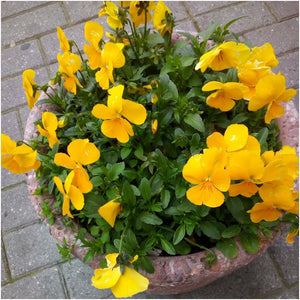
Garden pansy (Viola × wittrockiana) is a hybrid in the violet family, Violaceae, grown as a cool-season annual for its large, often dark-faced flowers. It brightens beds, pots and baskets through winter, and the flowers are edible. The usual failure is timing: seed sown as the weather warms flowers briefly, then stretches and fades.
Three mistakes that matter
- Sowing as the weather warms. Heat cuts pansies short, and plants raised into warm spring weather soon stretch, stop flowering and die back. Start them in late summer or autumn instead, within the months for your zone in When to plant.
- Sowing on the surface. Light holds pansy seed back, so a tray left uncovered on a bright bench can give few seedlings or none. Bury the seed and block the light, following the steps in Sowing Seeds.
- Letting spent flowers set seed. Ripening seed pods take energy the plant would otherwise put into new flowers. Remove blooms as they fade, following Deadheading, and a planting can stay in flower for months.
When to plant
Pansy seed germinates best at about 17 to 22°C, so sow once the worst of the summer heat has passed. Southern gardens traditionally plant seedlings out around Anzac Day. Pansies usually take 110 to 120 days from sowing to flower, so early sowings bring colour from late autumn.
| Zone | Example cities | Sow | Flowering | Notes |
|---|---|---|---|---|
| Tropical | Darwin NT; Cairns, Townsville QLD; Kununurra WA | Apr-Jun | Jul-Oct | Raise trays in the coolest, shadiest spot; plants flower through the dry season and fade in the build-up. |
| Subtropical | Brisbane, Gold Coast, Rockhampton QLD; Lismore NSW | Mar-Jun | Jun-Oct | Get plants flowering before the hot weather; afternoon shade lengthens the display into spring. |
| Arid and semi-arid | Alice Springs NT; Broken Hill NSW; Mildura VIC; Port Augusta SA | Mar-Jun | Jun-Oct | Plants take light inland frost; mulch and water steadily once dry spring heat returns. |
| Temperate | Sydney, Newcastle, Wollongong NSW; Melbourne, Geelong VIC | Feb-May | May-Nov | Shade late-summer trays from the heat; plant seedlings out around Anzac Day for winter flowers. |
| Mediterranean | Perth, Bunbury WA; Adelaide SA | Feb-May | May-Oct | Sow as the summer heat eases; plants flower through the wet winter and fade in dry late-spring heat. |
| Cool and alpine | Hobart TAS; Canberra ACT; Orange NSW; Stanthorpe QLD | Jan-Apr and Sep-Oct | Apr-Feb | Sow late summer for autumn and winter colour, or under cover in spring for summer flowers. |
Early in a window, while days are still hot, germinate trays somewhere cool and out of the afternoon sun. Late sowings flower later, carrying colour into spring.
Site, soil and setup
Pansies flower best in full sun through the cool months, with at least 3 hours of direct sun a day. In warm zones, and for spring plantings, choose a spot shaded from the afternoon sun. The soil should drain freely and be rich in organic matter, ideally at pH 6.0 to 6.5.
| Where | What to do |
|---|---|
| Every bed | Weed, fork the soil loose, then mix in compost 5 cm deep and pelletised chicken manure at 100 g per square metre. |
| Soil below pH 6.0 | Lime it with garden lime or dolomite lime at 100 to 200 g per square metre, dug in 4 weeks ahead. |
| Soil above pH 7.0 | Lower it with elemental sulphur at 25 to 50 g per square metre, at least 3 months ahead. |
| Clay, or ground that stays wet | Build the bed up. Gypsum at 500 g to 1 kg per square metre works only on dispersive clay, which clouds rainwater within 20 hours when an air-dried crumb is dropped in. |
| Sand that sheds water | Before planting, water in a wetting agent at the label rate; mulch after planting. |
Black root rot and damping off can linger in soil and old plant debris, so move pansies to a different bed each year.
Container growing
A single plant needs a pot 20 cm or more across and deep, which holds about 5 L. A group needs 10 L or more, such as a 30 cm pot of about 13.5 L. For pots, choose 'Rococo Frilled Mixed' or 'Bambini Mixed'; for hanging baskets, 'Swiss Giants Rhinegold' or 'Arkwright Ruby'.
Use fresh potting mix. Bagged mix can carry Legionella bacteria, so moisten it before you handle it, wear a mask and gloves, and wash your hands when done.
- Watering: water at the base in the morning, keeping the mix moist but never soggy.
- Feeding: fish and seaweed blend at 25 mL per 9 L, fortnightly while the plants grow and flower.
- Position: winter sun, then shelter from the afternoon sun once spring warms, which stretches out the flowering.
Sowing Seeds
Pansies are best started in trays or punnets, where darkness and moisture are easy to control.
Starting under cover
- Sprinkle the seed thinly over fresh seed raising mix in a clean tray or punnet, then cover it with 5 to 6 mm of mix.
- Firm the surface, mist it with a spray bottle, then cover the tray with plastic film pierced with a few holes.
- Add a sheet of newspaper or cardboard over the film to block the light.
- Hold the tray at the germination temperature in When to plant, and expect seedlings in 1 to 4 weeks.
- Lift both covers off the day the first seedlings appear, and give the tray bright light.
Transplanting
- When the first true leaves open, prick out the seedlings (move each into its own cell or small pot).
- Harden off the young plants (get them used to outdoor sun and wind by leaving them out a little longer each day).
- They are ready to plant out at 5 to 10 cm tall, usually 8 to 12 weeks from sowing.
- Allow 20 to 30 cm between plants, and set each no deeper than it sat in the punnet.
- Settle them in with seaweed solution at half strength, 15 mL per 9 L.
| Variety | Flowers | Best use |
|---|---|---|
| 'Clear Crystals' (Black, Orange, Space Blue, Yellow and Mixed) | A single clean colour on every petal, without a dark blotch | Large patches of one colour, or several single colours combined |
| 'Swiss Giants Rhinegold' | Big golden yellow blooms with purple markings, on short stems | Beds, containers, hanging baskets and among rocks |
| 'Rococo Frilled Mixed' | Frilled, heart-shaped petals in mixed colours with dark blotched centres | Containers; a compact 15 to 20 cm |
| 'Arkwright Ruby' | Deep ruby petals edged and centred in gold | Hanging baskets, borders and beds |
| 'Bambini Mixed' | Large for a viola, in many colours and bicolours with pansy faces | Containers and borders |
| 'Mix (Random Variety)' | Several types in pinks, reds, yellows, purples, whites and blues, some blotched | A mixed bed or border |
'Heartsease Johnny Jump Up' and 'Tricolor' share the collection but are small-flowered violas, covered in Violas.
Care by growth stage
Steady moisture and cool, bright weather decide how long pansies flower. Feeding stays light, because a well-prepared bed does most of the work.
| Stage | Water | Feed | Watch for |
|---|---|---|---|
| Seedlings in trays (weeks 1 to 12) | Mist the surface to keep the mix damp, not wet | No feed before the first true leaves; then half-strength seaweed solution, 15 mL per 9 L, every fortnight | Seedlings collapsing at soil level; pale, stretched seedlings |
| Planted out (weeks 8 to 16) | Soak the soil at the base in the morning; add a thin mulch | Worm casting liquid, weak tea colour, every fortnight | Snails and slugs feeding at night; cutworms (Agrotis species) felling young plants at ground level: scratch the soil by the stem and remove the curled caterpillar |
| Flowering (from about week 16) | Evenly moist soil, dry leaves | Fish and seaweed blend, 25 mL per 9 L, every fortnight | Aphids on stems and shoots; fading flowers to remove; grey mould on old petals |
| Warming spring and late season | Water steadily to the last flowers; shift pots out of the afternoon sun | Seaweed solution, 30 mL per 9 L, after hot weather | Stems stretching and flowering slowing as the heat builds |
Where growth stalls but the roots look healthy, scratch in a little all-purpose controlled release granular (NPK around 14-5-10) at the label rate.

Deadheading
Start as the first flowers fade and keep going while the plants bloom, so no seed pods form.
- How to cut: cut each fading flower back to just above a leaf, using sharp snips or secateurs.
- How often: go over the plants daily if you can, removing any flower past its best.
- After the first flush: trim the plants lightly, which stops them turning leggy.
- For seed: leave a few pods on the plant until they dry and split into three.
- End of the season: pull plants out once summer heat leaves them straggly, and sow again in late summer.
Companion planting
Pansies pair best with plants of the same cool season that neither shade nor smother them.
Grows well with
- Violas: their spreading habit fills the gaps between the more upright pansies.
- Spring bulbs such as tulips and daffodils: pansies set over the bulbs flower while the bulbs are still below ground.
- Calendula: a taller cool-season annual that sits behind the lower pansies.
- Lettuce and other winter vegetables: pansies tuck into the gaps along the edge of the patch.
Keep apart
- Peas on a trellis to the north: their winter shade falls across plants that need full sun.
- Nasturtiums: they grow rampantly and can swamp low bedding.
Harvesting Blooms
Pick flowers once they are fully open, as heads for eating or with stalks for a small vase.
- Pick early in the morning, while the flowers are well hydrated, or just before you use them.
- For eating, pick only from plants that have not been sprayed.
- Rinse flowers well before they go into food.

Picked flowers keep for a few days in the fridge, on damp paper towel in a sealed container. They suit salads, ice cubes and crystallised cake decorations.
Common problems
No seedlings appear. Light reaching the seed is the usual cause (see Three mistakes that matter), followed by mix that dries out or runs too warm. Read more
Seedlings topple over. Damping off (a seedling rot at the soil line, mostly from Pythium species and Rhizoctonia solani) is favoured by wet mix. Read more
Seedlings are long and spindly. Warmth and too little light stretch them, so grow trays on in the coolest, brightest spot you have. Read more
Plants sprawl and flower poorly. Too much shade is the usual cause, so move pots into more sun or choose a brighter bed next time.
Flowering stops as spring warms. See the first and third points in Three mistakes that matter.
Pests and diseases
Snails and aphids are the usual pests, and moulds and mildews follow damp, shaded or crowded plantings.
Aphids (family Aphididae). These small sap-suckers cluster on stems and new shoots, and infested plants yellow and grow poorly. Blast them off with the hose or use insecticidal soap. Read more
Garden snail (Cornu aspersum) and grey field slug (Deroceras reticulatum). They chew leaves and young plants after dark, especially after rain. Sink shallow dishes of beer as traps. Copper tape stops them on plastic or wooden pots and beds, but corrodes corrugated iron. Read more
Powdery mildew (Golovinomyces orontii). White powdery patches spread across the leaves. Pick off the worst leaves and water early, then spray 1 part full-cream milk to 10 parts water. Read more
Downy mildew (Peronospora violae). Yellow to grey-brown patches form on the leaves, with a mauve growth underneath. Remove affected plants and space the rest so the leaves dry quickly. Read more
Grey mould (Botrytis cinerea). A grey mould rots ageing petals, mostly in cool weather with heavy dew. Clear away spent flowers quickly and water at soil level.
Black root rot (Thielaviopsis basicola). Growth stalls, and brown spots on the roots spread and blacken. Lift and discard sick plants, fix the drainage and put the next planting in another bed.
Prevention first
- Give plants the full spacing from Sowing Seeds, which lets wet leaves dry fast.
- Water at soil level, and in the morning.
- Start every sowing in fresh mix and scrubbed trays.
- Check young plantings by torchlight for snails and slugs.
Tips
- Plant yellow and blue pansies beside a door or path, where their faint early-morning scent can be noticed.
- Give children a pot of pansies to pick posies from. Growing from seed with kids has more ideas.
- Let a few plants drop their seed in a corner, and seedlings may come up by themselves.
Questions
When do you plant pansy seeds in Australia?
In late summer and autumn in most areas. Sydney, Melbourne, Perth and Adelaide sow Feb to May, and Brisbane and the subtropics Mar to Jun. Darwin and the tropics sow Apr to Jun, in a cool spot. Canberra, Hobart and other cool areas sow Jan to Apr, or under cover in Sep and Oct.
Do pansy seeds need darkness to germinate?
Yes. Cover the seed with 5 to 6 mm of mix and lay newspaper or cardboard over the tray. Seedlings usually show within 1 to 4 weeks at about 17 to 22°C. Take the cover off as soon as they appear, and move the tray into bright light.
How long do pansies take to flower from seed?
Usually about 110 to 120 days, or 16 to 17 weeks. Seedlings go out 8 to 12 weeks after sowing, once they are 5 to 10 cm tall. With regular deadheading, plants can keep flowering for months.
Are pansies annuals or perennials?
Garden pansies are short-lived perennials grown as annuals. They flower from autumn into spring, then turn straggly or die back in summer heat. Most gardeners pull them out and sow again in late summer.
Can you eat pansy flowers?
Yes, the flowers are edible. Pick them early in the morning from plants that have not been sprayed, and wash them well. Use them in salads, in ice cubes or to decorate cakes, and only eat flowers you know are safe.
What is the difference between pansies and violas?
Pansies have larger flowers and a more upright habit. Violas carry more, smaller flowers on spreading plants and are a little more tolerant of frost and part shade. Both are sown and grown the same way.
Grow it



More flower guides
All flowers
Ageratum
Grow ageratum from seed in Australia: surface sowing, months for six climate zones, spacing, pots, deadheading, weed and livestock cautions and pests to watch.
| Position | Full sun, 6 hours or more |
|---|---|
| Depth | Surface, 1 mm at most |
| Spacing | 30 cm; Red Flint 40 cm |
| First pick | 12 to 14 weeks from sowing |

Alyssum
Grow alyssum from seed in Australia: sowing months for six climate zones, surface sowing, spacing, pots, shearing for more flowers, and the pests to watch.
| Position | Full sun or part shade |
|---|---|
| Depth | Surface sow, press in |
| Spacing | 15 to 20 cm |
| First pick | 8 to 9 weeks from sowing |

Aquilegia
Grow aquilegia from seed in Australia: chilling the seed, when to sow in six climate zones, part shade, pots, deadheading, cut flowers and common pests.
| Position | Part shade or morning sun |
|---|---|
| Depth | Surface, 3 mm cover at most |
| Spacing | 30 to 50 cm |
| First pick | From about 28 weeks |

Aster
Grow China asters in Australia: sowing months for six climate zones, spacing, pots, watering, Fusarium wilt and thrips, and cutting blooms for the vase.
| Position | Full sun, 6 hours minimum |
|---|---|
| Depth | 6 mm |
| Spacing | 30 to 40 cm |
| First pick | 13 to 16 weeks |