
How to Grow Alyssum in Australia
Sow alyssum seed in autumn and spring in most Australian gardens, and in the dry season in the tropics. Press it onto the surface without covering, as it needs light; seedlings appear in 7 to 14 days. Thin to 15 to 20 cm apart in full sun and free-draining soil. Flowers usually open 8 to 9 weeks from sowing; shear plants by half when they tire.

| Sun | Full sun or part shade |
|---|---|
| Water | When the top 5 cm is dry |
| Soil | Free-draining, moderately fertile, pH 6 to 7 |
| Feed | Light; compost at planting, seaweed solution fortnightly |
| Spacing | 15 to 20 cm |
| Depth | Surface sow, press in |
| Germination | 7 to 21 days at 15 to 24°C |
| Harvest | 8 to 9 weeks from sowing |
| Container | Pots and baskets of 10 L or more |
| Frost | Takes light frost; 'Mountain Gold' very hardy |
| Use | Edging, pots, beneficial insects, edible flowers |
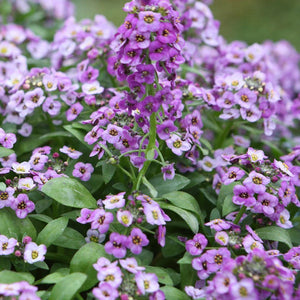
Sweet alyssum (Lobularia maritima) is a low, honey-scented flower in the cabbage family, Brassicaceae, grown for edging, pots and the beneficial insects its nectar feeds. It flowers for months in most Australian gardens from a pinch of seed.
Three mistakes that matter
- Burying the seed. Alyssum seed needs light to germinate, so seed raked in deep often fails to come up at all. Press it onto the surface, or cover it with no more than 2 mm of fine mix, as set out in Sowing Seeds.
- Heavy soil and wet leaves. Plants sitting in wet ground can rot at the base, and leaves kept damp invite downy mildew. Choose a free-draining spot, as set out in Site, soil and setup, and water the soil rather than the plants.
- Leaving tired plants alone in the heat. Flowering slows in hot weather and plants turn straggly. Shear them back by half and water them, as described in Deadheading, and fresh flowers usually follow once nights cool.
When to plant
Seed germinates in soil at about 15 to 24°C, and 'Mountain Gold' in cooler soil of about 10 to 17°C. Autumn and spring are the main sowing windows in the south, and the dry season in the tropics; avoid extreme heat and hard frost. A sowing in each window keeps an edge in flower for much of the year.
| Zone | Example cities | Sow | Flowering | Notes |
|---|---|---|---|---|
| Tropical | Darwin NT; Cairns, Townsville QLD; Broome WA | Apr-Jul | Jun-Oct | Sow as the wet season ends; plants tire in the humid heat of the build-up. |
| Subtropical | Brisbane, Sunshine Coast, Bundaberg QLD; Coffs Harbour NSW | Mar-Aug | May-Nov | Autumn and winter sowings flower through the mild months; summer humidity brings downy mildew and rot. |
| Arid and semi-arid | Alice Springs NT; Broken Hill, Dubbo NSW; Mildura VIC; Kalgoorlie WA | Mar-May and Aug | May-Nov | Sow once the heat breaks; give afternoon shade, mulch and steady water as spring heat builds. |
| Temperate | Sydney, Newcastle, Wollongong NSW; Melbourne VIC | Feb-May and Aug-Nov | Apr-Jan | Autumn sowings flower through the mild coastal winter; spring sowings flower into summer. |
| Mediterranean | Perth, Bunbury WA; Adelaide SA | Mar-May and Aug-Oct | May-Dec | Autumn sowings grow on winter rain; spring sowings need steady water before the dry heat arrives. |
| Cool and alpine | Hobart TAS; Canberra ACT; Ballarat VIC; Armidale NSW | Sep-Jan | Nov-Apr | Sow once hard frosts ease; plants take light frost, and a January sowing flowers into autumn. |
At the hot end of a window, raise seedlings in a shaded spot and plant them out as the weather cools.
Site, soil and setup
Give alyssum full sun, or at least three hours of direct sun a day; in hot inland and northern gardens it welcomes afternoon shade. It wants light, moderately fertile soil that drains freely, with a pH of about 6 to 7.
| Where | What to do |
|---|---|
| Every bed | Weed, loosen the soil with a fork and dig in a 5 cm layer of compost before sowing. |
| Acid soil, below pH 6 | Dig in garden lime at 100 to 200 g per square metre, 4 weeks before sowing. |
| Heavy clay or ground that stays wet | Build a raised bed or mound. Gypsum at 500 g to 1 kg per square metre helps only dispersive clay: an air-dried crumb in rainwater that clouds within 20 hours confirms it. |
| Sandy soil that sheds water | Water in a wetting agent at the label rate before sowing. |
Alyssum is a crucifer and can catch clubroot, which swells roots into firm, club-shaped galls. Do not sow it where cabbages or other brassicas have had that disease.
Container growing
Alyssum spills over pots, window boxes and hanging baskets. Use fresh potting mix in a container of at least 10 L with drainage holes; a 30 cm pot holds about 13.5 L. Potting mix can carry Legionella bacteria, so wet it first, wear gloves and a mask, and wash your hands afterwards. The compact 'Tiny Tim', the trailing 'Magic Circles Mixed', 'New Carpet of Snow' and 'Royal Carpet' all suit pots.
- Watering: water whenever the top 5 cm of mix is dry.
- Feeding: potted plants need more than beds. Water in fish and seaweed blend at 25 mL per 9 L fortnightly once flowering starts.
- Position: as for beds, but move pots into afternoon shade in hot spells.
Sowing Seeds
Scatter the seed straight onto the bed where it is to flower, or raise it in cell trays and plant out small clumps.
Sowing direct
- Rake the soil fine and level, then scatter the seed thinly over the surface.
- Press it in with a flat board so it touches the soil, leaving it uncovered or under no more than 2 mm of fine mix.
- Keep the surface moist but never wet; seedlings usually appear in 7 to 14 days.
- Thin seedlings to 15 to 20 cm apart once they have true leaves, or to about 10 cm for a dense edge.

Starting in trays
- Fill cell trays with seed raising mix and drop a pinch of seed on the surface of each cell.
- Mist the surface so the seed is not washed away, and keep the trays in bright light.
- Plant each clump out whole about 4 to 5 weeks after sowing, 15 to 20 cm apart.
- Harden off the seedlings first (set them outside for a little longer each day so they adjust to sun and wind).
- Water them in with seaweed solution at half strength, 15 mL per 9 L.
Six of the seven varieties are sweet alyssum, grown the same way and usually flowering 8 to 9 weeks from sowing.
| Variety | Flowers | Good to know |
|---|---|---|
| 'New Carpet of Snow' | White, in dense clusters | Classic low edging; beds and front borders |
| 'Tiny Tim' | White, sweetly scented | Dwarf; the tightest edging and small pots |
| 'Benthamii' | White with yellow centres, honey scented | Popular with bees |
| 'Rosie O'Day' | Rose pink, sweetly scented | Borders, beds and rockeries |
| 'Royal Carpet' | Royal purple | Borders, beds and rockeries |
| 'Magic Circles Mixed' | White, purple and pink pastels | Trailing ground cover, grows to about 15 cm; sun or part shade; germinates in 2 to 3 weeks |
| 'Mountain Gold' | Golden yellow, in spring | A different plant, basket of gold; see below |
'Mountain Gold' is basket of gold (Aurinia saxatilis), an evergreen perennial for rockeries and walls that lives a few years. Surface sow it in autumn or early spring. Space plants 20 to 30 cm apart in poor, gritty, sharply drained soil and do not feed them, as rich soil makes them leggy. It flowers for 4 to 6 weeks in spring and does best where winters are cool.
Care by growth stage
Drainage and a timely trim decide how long alyssum flowers. It is a light feeder, and well-prepared soil carries it most of the way.
| Stage | Water | Feed | Watch for |
|---|---|---|---|
| Seedlings (weeks 1 to 4) | Mist or water gently so the surface stays moist but never wet | Nothing until the first true leaves, then worm casting liquid diluted to weak tea colour fortnightly | Seedlings collapsing at soil level; snails on emerging seedlings |
| Young plants (weeks 4 to 8) | Water deeply at the base when the top 5 cm of soil is dry | Seaweed solution at 30 mL per 9 L fortnightly | Snails and slugs after planting out; crowded seedlings to thin |
| Flowering (from about week 8) | Keep watering at the base so the leaves stay dry | Fish and seaweed blend at 25 mL per 9 L fortnightly, only if growth looks pale or slow | Grey growth under leaves (downy mildew); aphids on shoot tips |
| Hot weather and late season | Keep watering steadily right through; established plants tolerate short dry spells | Seaweed solution at 30 mL per 9 L after shearing back | Flowering slowing and plants opening in the middle; time to shear |
If growth stalls in very poor soil, scratch in a light dose of all-purpose controlled release granular (NPK around 14-5-10) at the label rate.

Deadheading
The flowers are too small to snip one by one, so shear alyssum instead.
- After the first flush: clip the whole plant over lightly with shears to bring on more flowers.
- In summer heat: when flowering slows, cut plants back by about half, then water and feed as in the last row of the care table.
- Self-sown seedlings: leave a few flowers to set seed at the edge of a vegie patch, and pull seedlings where they are not wanted.
- 'Mountain Gold': cut it back by about half once the spring flowers fade, which keeps it compact and stops it self-sowing.
- End of the run: pull out plants that stay woody and bare after shearing, and sow again.
Companion planting
Alyssum nectar feeds hover flies, ladybirds and tiny parasitic wasps, which then hunt aphids and caterpillars on nearby crops.
Grows well with
- Lettuce: one alyssum plant to every ten lettuces brings in hover flies.
- Strawberries: alyssum tucked between them draws predators and pollinating flies.
- Cabbages and other brassicas: its flowers feed a parasitic wasp of the diamondback moth, but not the moth.
- Aubretia: another low spring flower that shares walls and rockeries with 'Mountain Gold'.
Keep apart
- Tall, leafy crops such as corn or sunflowers on the north side: their shade leaves alyssum thin and slow to flower.
- Sprawling zucchini and pumpkin: their big leaves smother a low edging within weeks.
Harvesting Blooms
Sweet alyssum flowers are edible, so pick sprigs once the flowers are fully open, early in the morning.
- Pick only from plants that have not been sprayed, and wash the flowers before eating them.
- Snip short sprigs with scissors, taking only a few from each plant.
- For seed, cut stems once most of the small flat pods have dried and turned brown.
Dry seed pods in a paper bag, then store the seed in a labelled envelope somewhere cool, dry and dark. Scatter the flowers over cakes and breakfast bowls, or freeze them into ice cubes. The edible note applies to sweet alyssum, not 'Mountain Gold'.
Common problems
Seed does not come up. Seed buried too deep, a surface left to dry out, or soil far outside the temperature in When to plant are the usual causes. Read more
Seedlings collapse at soil level. Damping off (seedlings killed by soil-borne organisms, mainly Pythium species and Rhizoctonia solani) strikes most often in wet seed raising mix. Read more
Seedlings grow tall and pale. Too little light stretches them, so move trays into full light straight after germination. Read more
Plants rot at the base. Stem and crown rots follow poor drainage, the second point in Three mistakes that matter; lift the bed or move plants to a pot.
Flowering stops in summer. See the third point in Three mistakes that matter.
Pests and diseases
Alyssum has few serious problems; most trouble comes from snails and from mildew in crowded, damp plantings.
Garden snail (Cornu aspersum) and grey field slug (Deroceras reticulatum). They feed at night on tender seedlings and shoots, leaving holes and slime trails. Collect them by torchlight, set shallow beer traps, or run copper tape around wooden or plastic pots and beds. Read more
Downy mildew (Hyaloperonospora species). Yellow to grey-brown patches appear on the leaves, with a whitish to grey growth underneath, and leaves can pucker. Remove affected leaves and thin crowded plants. Read more
Aphids (family Aphididae). These small sap-suckers cluster on soft shoot tips, especially on 'Mountain Gold', and leave sticky honeydew. Hose them off first; if they persist, spray insecticidal soap at the label rate late in the day, away from open flowers. Read more
Cabbage white butterfly (Pieris rapae). Its green caterpillars chew alyssum, one of their host plants; pick them off by hand. Read more
Prevention first
- Thin seedlings to the spacing in Sowing Seeds so air moves between plants.
- Water at soil level, as set out in Care by growth stage.
- Start trays with fresh seed raising mix in clean cells.
- Check new seedlings for snails at dusk for the first few weeks.
Tips
- Mix the dust-fine seed with a spoonful of dry sand before scattering, so it spreads evenly. Read more
- Plant white varieties beside a path or seat, as the white forms are often the most fragrant.
- Near bushland, reserves and coastal dunes, shear plants before they set seed. Alyssum is an emerging environmental weed in Tasmania and has escaped into conservation areas in New South Wales, Victoria, South Australia and Western Australia.
Questions
When should I plant alyssum seeds in Australia?
Autumn and spring suit most southern gardens. Temperate areas sow Feb to May and Aug to Nov, and Perth and Adelaide Mar to May and Aug to Oct. Subtropical gardens sow Mar to Aug, tropical gardens Apr to Jul, and cool gardens Sep to Jan.
Do alyssum seeds need to be covered?
No. Alyssum seed needs light to germinate. Scatter it on the surface and press it in so it touches the soil, uncovered or under no more than 2 mm of fine mix. Keep the surface moist. Seedlings usually appear in 7 to 14 days, or up to 3 weeks for 'Magic Circles Mixed'.
Does alyssum come back every year?
Sweet alyssum is grown as an annual, although it can live a little longer in mild gardens. It self-sows readily, so seedlings often come up the next season. Alyssum 'Mountain Gold' is a different plant, basket of gold, a perennial that lives a few years.
Why has my alyssum stopped flowering?
Hot weather is the usual cause. Shear the plants back by about half, water them well and feed once with seaweed solution at 30 mL per 9 L. They usually flower again once nights cool. Poorly drained soil and wet leaves can also stop them, through rot and downy mildew.
Is alyssum good to plant in a vegetable garden?
Yes. Its nectar feeds hover flies, ladybirds and parasitic wasps that attack aphids and caterpillars. Try one alyssum plant for every ten crop plants. Avoid beds where brassicas have had clubroot, as alyssum can catch it too.
Can you grow alyssum in pots or hanging baskets?
Yes. Use a container of at least 10 L with drainage holes, such as a 30 cm pot. The varieties 'Tiny Tim' and 'Magic Circles Mixed' suit pots and baskets. Water when the top 5 cm is dry. Once flowering starts, feed fish and seaweed blend at 25 mL per 9 L fortnightly.
Grow it




More flower guides
All flowers
Ageratum
Grow ageratum from seed in Australia: surface sowing, months for six climate zones, spacing, pots, deadheading, weed and livestock cautions and pests to watch.
| Position | Full sun, 6 hours or more |
|---|---|
| Depth | Surface, 1 mm at most |
| Spacing | 30 cm; Red Flint 40 cm |
| First pick | 12 to 14 weeks from sowing |

Aquilegia
Grow aquilegia from seed in Australia: chilling the seed, when to sow in six climate zones, part shade, pots, deadheading, cut flowers and common pests.
| Position | Part shade or morning sun |
|---|---|
| Depth | Surface, 3 mm cover at most |
| Spacing | 30 to 50 cm |
| First pick | From about 28 weeks |

Aster
Grow China asters in Australia: sowing months for six climate zones, spacing, pots, watering, Fusarium wilt and thrips, and cutting blooms for the vase.
| Position | Full sun, 6 hours minimum |
|---|---|
| Depth | 6 mm |
| Spacing | 30 to 40 cm |
| First pick | 13 to 16 weeks |

Aubretia
Growing aubretia as a hardy groundcover in Australian gardens: sowing, position, trimming after flowering, companion plants and common pests.
| Position | Full sun, 6 hours or more |
|---|---|
| Depth | On the surface, barely covered |
| Spacing | 25 to 30 cm |
| First pick | Spring, after a winter chill |