
How to Grow Lamb's Ears in Australia
Lamb's ear is a hardy, silver-leaved perennial you can raise from seed. Press the seed onto moist mix without burying it and keep trays at 18 to 22°C; seedlings appear in 14 to 35 days. Plant out 30 to 45 cm apart in full sun and lean, free-draining soil. Water sparingly at soil level, because wet soil and damp leaves rot it.
| Sun | Full sun; afternoon shade in heat |
|---|---|
| Water | Sparingly; let soil dry between waterings |
| Soil | Free-draining and lean, pH about 6 to 8 |
| Feed | Minimal: seaweed solution for seedlings, little after |
| Spacing | 30 to 45 cm apart |
| Depth | Surface sow, press in |
| Germination | 14 to 35 days at 18 to 22°C |
| Harvest | Leaves from about 23 weeks |
| Container | Yes; wide pot at least 60 cm |
| Frost | Frost hardy; leaves suffer in harsh winters |
| Use | Edging, groundcover, pots, posies and dried stems |
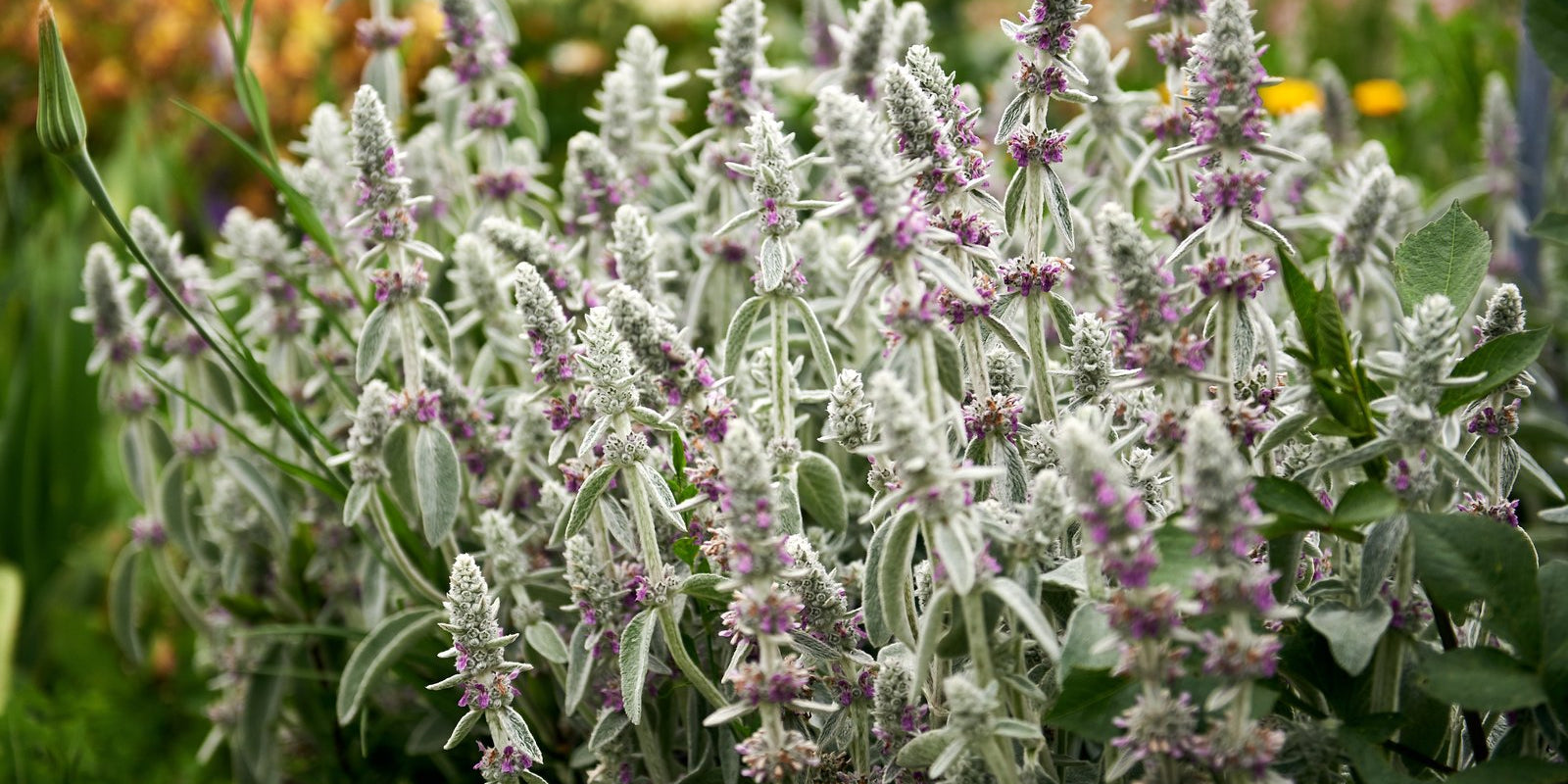
Lamb's ear (Stachys byzantina) is a low, mat-forming perennial in the mint family (Lamiaceae). It is grown for its thick, silver, felted leaves and woolly spikes of small rose purple flowers. It comes from rocky hills between Turkey and Iran, so it suits Australia's dry summers and sulks wherever humidity lingers. Most failures come from kindness: wet soil, damp leaves and rich feeding harm it far more than a dry spell.
Three mistakes that matter
- Burying the seed. Lamb's ear seed needs light to germinate, so seed pushed under the mix often never appears. Press it onto moist seed raising mix and cover it with no more than a dusting of vermiculite.
- Planting in soil that stays wet. Roots and crowns rot in wet soil, and leaves that stay damp invite disease. Plant in free-draining soil or a raised bed, and let the soil dry out between waterings.
- Treating it like a hungry bedding plant. Plants look best in lean soil, and in rich soil the clump spreads hard. Skip the manure and feed only as set out under Care by growth stage.
When to plant
Seed germinates at 18 to 22°C, so the warmth of the seed tray decides when to start. Sow in autumn while days stay warm, or in spring once a tray on a bright sill or a seedling heat mat holds 18°C. One sowing is enough, because each plant becomes a spreading clump that lasts for years.
| Zone | Example cities | Sow | Harvest | Notes |
|---|---|---|---|---|
| Tropical | Darwin NT; Cairns, Townsville QLD; Broome WA | Apr-May | Sep-Oct | A dry-season trial only, best in pots. Wet-season rain and humidity usually rot plants, and flowers are few. |
| Subtropical | Brisbane, Sunshine Coast, Bundaberg QLD; Coffs Harbour NSW | Mar-May | Sep-Dec | Autumn sowings grow through the mild, dry winter. Humid summers often rot clumps, so use raised beds or pots. |
| Arid and semi-arid | Alice Springs NT; Broken Hill NSW; Mildura VIC; Kalgoorlie WA | Mar-Apr and Aug-Sep | Oct-Feb | Dry air suits the woolly leaves. Give afternoon shade in extreme heat and water deeply but rarely. |
| Temperate | Sydney, Newcastle, Wollongong NSW; Melbourne, Geelong VIC | Mar-May and Sep-Nov | Nov-Feb | Melbourne summers suit it. Through humid Sydney summers, plant in raised, airy spots and water at soil level. |
| Mediterranean | Perth, Bunbury WA; Adelaide and the SA coast | Mar-May and Sep-Oct | Oct-Jan | Long, dry summers suit it well. Autumn sowings establish on winter rain and flower from late spring. |
| Cool and alpine | Hobart, Launceston TAS; Canberra ACT; Ballarat VIC; Orange NSW | Feb-Mar and Sep-Nov | Dec-Mar | Raise spring trays indoors at 18 to 22°C and plant out after the last frost. Established clumps are frost hardy. |
Flowering needs vernalisation (a spell of winter cold that switches a plant over to flowering), so most plants flower after their first winter. At the cold edge of a window, raise trays indoors; at the humid edge, sow early so plants establish before the muggy months.
Site, soil and setup
| Need | What to do |
|---|---|
| Sun | Full sun. In hot inland summers, light afternoon shade helps, but deep shade keeps the leaves damp and invites disease. |
| Soil | Average to poor, free-draining soil. Sandy, gravelly and loam soils all suit it. On water-repellent arid soils, a wetting agent at the label rate helps water soak in. |
| pH | About 6 to 8, and it tolerates acid, neutral and alkaline soil, so it needs no lime. Lime only where a test reads well below 6 and other plants in the bed want it: garden lime at 100 to 200 g per square metre, 4 weeks before planting. |
| Drainage | Essential (see Three mistakes that matter). On heavy clay or in humid districts, build a raised bed or a mound rather than planting in a pit. |
| Bed preparation | In heavy or very poor soil only, dig in a 5 cm layer of compost. Add a handful of worm castings to each planting hole. No manure. |
| Mulch | A gravel mulch under the leaves keeps them off wet soil and helps prevent rot. Keep any organic mulch clear of the crown. |
A clump stays put for years, so there is no yearly rotation; set divisions into a fresh, well-drained spot. For ground that stays soggy after rain, read about waterlogged garden soil.
Container growing
Lamb's ear spreads sideways, so give it a pot or trough of about 50 to 70 L, at least 60 cm across, with drainage holes. Fill it with premium potting mix and stand the pot on feet so water drains away. The one variety in the range is 'Deep Rose', and its silver leaves set off brighter flowers planted in the same pot.
- Watering. Water when the top few centimetres of mix are dry, at the base of the plant, and empty any saucer. See watering pots through summer.
- Feeding. Give seaweed solution at 30 mL per 9 L every fortnight through spring, and nothing more.
- Position. Full sun. In heavy rain, move the pot under the eaves or onto a covered verandah.
- Dividing. Once the clump fills the pot, divide it in spring and repot the healthiest outer piece.
Sowing Seeds
Start lamb's ear in trays, where the light-hungry seed stays moist, lit and out of reach of snails.
Starting under cover
- Fill a clean tray with fresh seed raising mix, firm it and water it before sowing.
- Scatter the seed thinly and press it onto the surface without burying it (see Three mistakes that matter).
- Keep the tray at the temperature under When to plant, in bright light out of direct sun, under a clear cover. Water from below.
- Seedlings appear in 14 to 35 days. Lift the cover once they do, so air can move.
- Prick out each seedling into an 8 cm pot once it can be handled by a leaf, and grow it on somewhere cooler and bright.
| Variety | Leaves | Flowers | Height | Depth | Spacing | Emerges |
|---|---|---|---|---|---|---|
| Lamb's Ear 'Deep Rose' | Silver, thick and woolly, in low rosettes | Small rose purple flowers in whorls on woolly spikes, late spring and summer | Leaves 10 to 20 cm; flower spikes to about 45 cm | Surface, pressed in | 30 to 45 cm | 14 to 35 days |
Sowing direct
Seed can go straight onto raked, weed-free soil in mild autumn or spring weather. The seedlings are slow and easily lost to weeds and snails, so trays are the surer start. Press the seed onto the surface, keep it moist with a fine spray and thin seedlings to 30 to 45 cm apart.
Transplanting
Plant out once roots fill the 8 cm pot, usually 10 to 12 weeks after sowing and after the last frost. Harden seedlings off first (10 to 15 days of gradually longer spells outdoors that toughen soft growth), as in hardening off seedlings.
Set each plant at the depth it grew in the pot, 30 to 45 cm apart. Water it in with seaweed solution at 30 mL per 9 L. The wider spacing gives single plants room; the closer one knits into a carpet sooner.
Care by growth stage
Dry leaves, dry crowns and a light hand with feed decide how long a clump lives. Water deeply but rarely once plants settle, always at soil level.
| Stage | Water | Feed | Watch for |
|---|---|---|---|
| Seedlings in trays, weeks 1 to 6 | Keep the mix just moist, slightly on the dry side; water from below | Nothing until the first true leaves, then seaweed solution at half strength, 15 mL per 9 L, every fortnight | Damping off (a soil-borne rot that topples seedlings at the base); pale, stretched seedlings |
| Young plants in pots, weeks 6 to 12 | Water when the surface of the mix dries | Seaweed solution at 30 mL per 9 L every fortnight | Snails and slugs at night |
| Planting out, first 3 weeks in the ground | Water deeply at planting, then once or twice a week until settled | Worm castings in the planting hole (see Site, soil and setup) and seaweed solution at planting | Snails and slugs |
| Growing on, first summer | About once a week, or rely on rain; let the soil dry between waterings | None; plants look best in lean soil | Leaf rot in humid weather; powdery mildew |
| Flowering, late spring and summer after a winter | Keep the same steady regime while stems are cut, in the morning at soil level | None needed | Leaves rotting after summer storms |
| Established clumps, each spring | Water only in long dry spells | On poor sandy soil only, pelletised chicken manure at 100 g per square metre, once in early spring | Dead winter leaves; a bare centre |
If growth stalls in very poor soil, scratch a light dose of all-purpose controlled release granular (NPK around 14-5-10) around the clump in spring.

Trimming and Shaping
A little regular tidying keeps the mat silver and stops rot spreading. Nothing needs hard pruning.
- For a neat silver carpet, cut flower spikes off at their base as they appear. Leave them if you want flowers for bees and for cutting.
- Once flowering ends, cut the spent spikes back to the leaves.
- Pick off yellow, damaged or rotting leaves as soon as you see them, so rot cannot spread through the clump.
- At the end of winter, clear away dead leaves before new growth starts.
- Pull out or dig up rooted stems that creep beyond their space.
- Divide clumps every 2 to 4 years in spring, keeping the young outer pieces, as in dividing perennials.
Companion planting
Lamb's ear belongs at the sunny front of a dry border, beside plants that want the same lean, free-draining soil and sparse water.
Grows well with
- Lavender, a low-water herb that shares its sun and sharp drainage.
- Thyme and sage, dry-soil herbs that suit the same watering.
- Roses, which it underplants well, as long as the rose bed is not kept wet.
- Catmint and sedums, whose flowers and fleshy leaves contrast with the silver felt.

Keep apart
- Lettuce and other thirsty crops, whose frequent watering keeps lamb's ear too wet.
- Impatiens and other shade lovers, which need moist soil and shelter it does not want.
- Mint, a fast spreader of damp soil that competes for the same ground.
- Sunflowers and other tall, dense plants, whose shade keeps the woolly leaves damp.
Harvesting Stems
Cut flower stems as the lowest flowers on a spike begin to open. Pick leaves whenever the clump is growing strongly, from about 23 weeks after sowing.
- Cut in the late morning, once dew has dried, and never when the plant is wet from rain.
- Cut each stem close to the base of the plant, so picking doubles as tidying.
- Stand stems in a shallow container of water as you pick, so they do not wilt and set crooked.
- Take leaves from near the base, and no more than a third of the clump at once.
- Leave a few spikes to ripen if you want seed; the small brown nutlets form in the old flowers.
To dry stems, strip the larger lower leaves and band the stems into bundles 2.5 to 4 cm across. Bigger bundles dry slowly and can go mouldy. Hang them upside down in a dark, airy room at room temperature. They are ready in two to four weeks, once stiff and papery.
Damp air can make dried heads droop, so keep them somewhere dry and lay them flat or angled in arrangements. Use the leaves in fresh posies and the dried stems in wreaths and dried arrangements.
Common problems
Seeds did not come up. Buried seed (see Three mistakes that matter), a tray that dried out or one kept below 18°C are the usual causes. Slow seed can take five weeks. Read more
Brown, mushy leaves in summer. The woolly leaves hold water, so rain and humidity rot them, worst in crowded clumps; pick them off and thin or divide the clump.
Whole clump collapses. Root and crown rots take hold when soil stays wet; lift any healthy pieces into better drainage. Read more
No flower spikes. Young plants flower only after a winter's chill, so warm-zone plants may flower little; spikes cut off early also mean no flowers.
Bare, dead centre. An old clump has worn out in the middle; divide it as under Trimming and Shaping.
Plants creep into paths. Stems root where they touch soil and spikes can self-sow; trim runners and cut spent spikes before they drop seed.
Pests and diseases
Few pests bother the felted leaves; snails at the seedling stage and mildew in muggy weather are the main ones to watch.
Common garden snail (Cornu aspersum). This introduced snail lives in every state and territory, away from the tropics and desert. It chews seedlings and soft young leaves, as do slugs. Hunt them under leaves and rocks, sink shallow beer traps or ring pots with copper tape. If you bait, scatter an iron-based bait thinly, because a dog that eats a large amount of any snail bait can be poisoned. Read more
Powdery mildew (order Erysiphales). White to greyish patches spread over leaves and stems; plants do not usually die, but they look shabby. Remove badly affected leaves and, on a sunny morning, spray 1 part full-cream milk to 10 parts water. Read more
Damping off (Pythium species and Rhizoctonia solani). These soil-borne pathogens rot seedlings at soil level, so they topple over in the tray. Read more
Prevention first
- Sow in fresh seed raising mix in clean trays, and lift the cover once seedlings appear.
- Give plants room and divide crowded clumps so air moves through them.
- Water at soil level in the morning, never over the leaves.
- After rain, check under leaves and around rocks where snails shelter by day.
Tips
- Plant it beside a path or between stepping stones, where people brush past and stroke the leaves. It is a favourite in children's gardens.
- Use the silver leaves as a foil for bold flower colours, or in a moon garden of white flowers and silver leaves.
- Pot up spare divisions for friends, and water each one well for its first couple of weeks.
Questions
Can you grow lamb's ear from seed?
Yes. Press the seed onto moist seed raising mix, because it needs light to germinate, and keep the tray at 18 to 22°C. Seedlings appear in 14 to 35 days. Plants grown from seed usually flower after their first winter, since the plant needs a spell of cold before it flowers.
Why is my lamb's ear rotting?
Too much water is the usual cause. The woolly leaves hold moisture, so rain, humidity and overhead watering rot them, and roots and crowns rot in soil that stays wet. Pick off rotting leaves, water only at soil level, divide crowded clumps and move plants into free-draining soil or a raised bed.
Should I cut the flowers off lamb's ear?
It depends on what you grow it for. Many gardeners cut the spikes off as they appear to keep a neat silver mat. Left on, the rose purple flowers draw bees and make good cut and dried stems. Either way, cut spent spikes back to the leaves once flowering ends.
Will lamb's ear grow in humid Brisbane?
It can, with care, but humid summers often rot it. Sow in autumn so plants grow through the drier winter and spring. Plant in a raised bed, a mound or a pot in full sun. Water only at soil level, and move pots under cover in heavy summer rain.
Is lamb's ear the same as betony or woundwort?
Lamb's ear is Stachys byzantina, sometimes sold as woolly betony or woolly woundwort. Wood betony (Stachys officinalis) is a different species, and the other woundworts are other Stachys species. The seed sold as 'Deep Rose' is true lamb's ear, with silver felted leaves and rose purple flowers.
Why does my nursery lamb's ear never flower?
Some nursery forms are chosen for leaves, not flowers. 'Silver Carpet' rarely flowers and is raised from divisions, and 'Big Ears' flowers only sporadically. Lamb's ear raised from seed, such as 'Deep Rose', does flower, usually after its first winter.
Grow it
More flower guides
All flowers
Ageratum
Grow ageratum from seed in Australia: surface sowing, months for six climate zones, spacing, pots, deadheading, weed and livestock cautions and pests to watch.
| Position | Full sun, 6 hours or more |
|---|---|
| Depth | Surface, 1 mm at most |
| Spacing | 30 cm; Red Flint 40 cm |
| First pick | 12 to 14 weeks from sowing |

Alyssum
Grow alyssum from seed in Australia: sowing months for six climate zones, surface sowing, spacing, pots, shearing for more flowers, and the pests to watch.
| Position | Full sun or part shade |
|---|---|
| Depth | Surface sow, press in |
| Spacing | 15 to 20 cm |
| First pick | 8 to 9 weeks from sowing |

Aquilegia
Grow aquilegia from seed in Australia: chilling the seed, when to sow in six climate zones, part shade, pots, deadheading, cut flowers and common pests.
| Position | Part shade or morning sun |
|---|---|
| Depth | Surface, 3 mm cover at most |
| Spacing | 30 to 50 cm |
| First pick | From about 28 weeks |

Aster
Grow China asters in Australia: sowing months for six climate zones, spacing, pots, watering, Fusarium wilt and thrips, and cutting blooms for the vase.
| Position | Full sun, 6 hours minimum |
|---|---|
| Depth | 6 mm |
| Spacing | 30 to 40 cm |
| First pick | 13 to 16 weeks |