
How to Grow Sea Holly in Australia
Sea holly is a tough, drought-hardy perennial with steel blue, spiny flower heads. Chill the seed for about four weeks, press it onto the surface of deep cells, and keep it at 20 to 24°C. Plant out young, 30 to 45 cm apart, in full sun and lean, free-draining soil. Do not feed it. Many plants flower in their second summer.
| Sun | Full sun |
|---|---|
| Water | Low once established; hates wet feet |
| Soil | Lean, sandy or loamy, very free-draining |
| Feed | Minimal: seaweed solution at planting |
| Spacing | 30 to 45 cm apart |
| Depth | Surface, light vermiculite dusting |
| Germination | 1 to 3 weeks at 20 to 24°C |
| Harvest | 29 weeks; often second summer |
| Container | Yes; pot 30 cm wide, 40 cm deep |
| Frost | Hardy once established |
| Use | Dry borders, coastal gardens, cut and dried flowers |
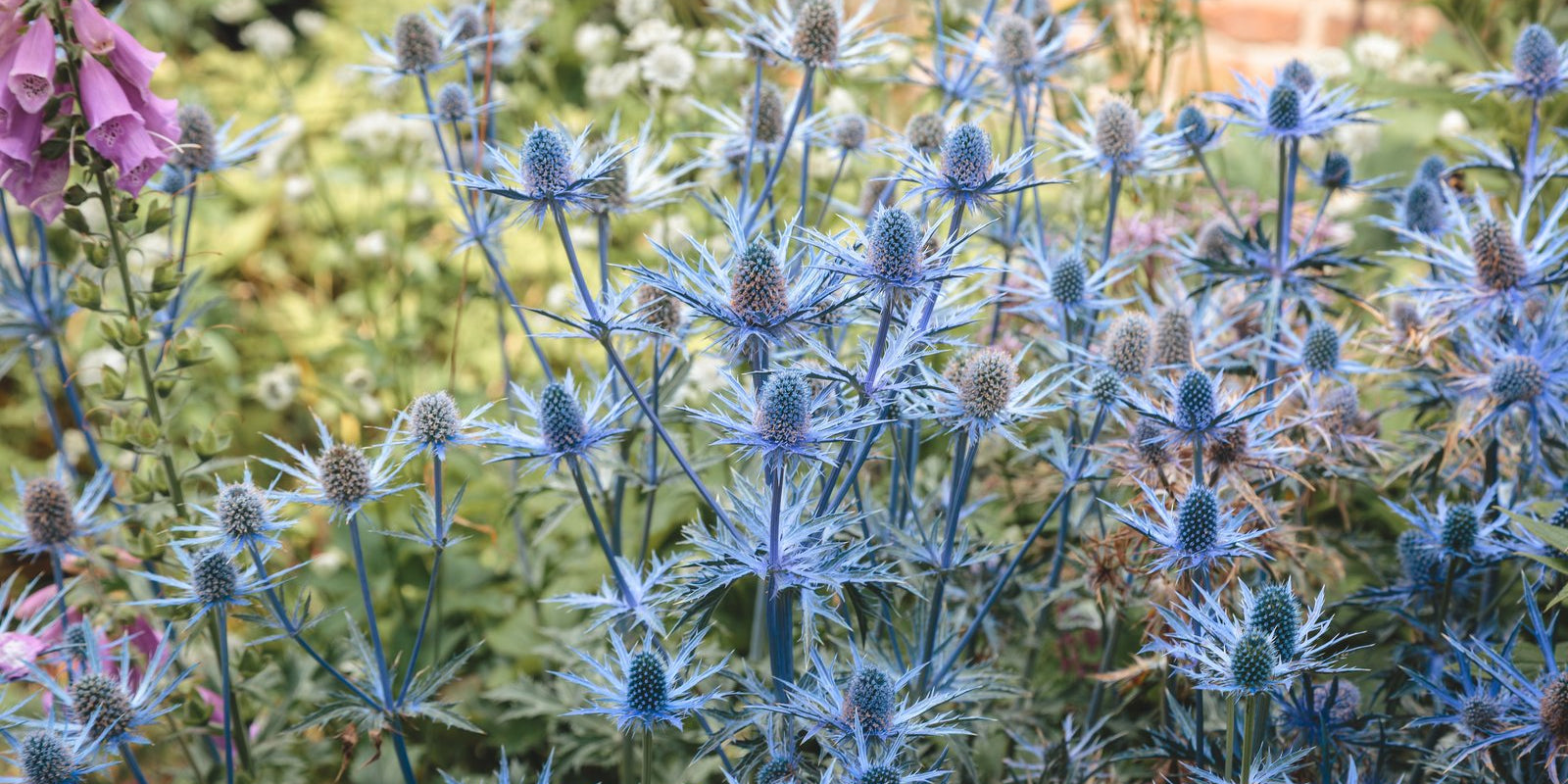
Sea holly (Eryngium planum) is a clump-forming perennial in the carrot family (Apiaceae), grown for steel blue, thistle-like heads ringed with spiny bracts. It shrugs off drought, salty wind and sandy soil, and its flowers last well in a vase or dried. The mistake most gardeners make is pampering it.
Three mistakes that matter
- Planting in rich soil and feeding it. Fertile soil makes tall, soft stems that sprawl and may need staking, and well-fed plants tend to live shorter lives. Plant in lean, free-draining soil and skip the manure.
- Leaving the roots wet. Sea holly is prone to root rot, and soil that stays wet through winter is the usual cause. Plant into a mound, raised bed or gravel garden, and once plants are established water only in long dry spells.
- Moving it late. The plant grows a deep taproot (a single main root, like a carrot's) and transplants poorly once established. Sow in deep cells, plant out while young, and choose a spot where it can stay.
When to plant
Seed germinates far more evenly after about four weeks of cold, moist conditions, a treatment called cold stratification. After that it comes up best at 20 to 24°C. Sow in autumn, around Anzac Day in the south, in trays left outdoors so winter supplies the chill. Chill spring sowings in the fridge first (see cold stratification). One sowing is enough, because each clump can last several years.
| Zone | Example cities | Sow | Flowering | Notes |
|---|---|---|---|---|
| Tropical | Darwin NT; Cairns, Townsville QLD; Broome WA | Apr-May | Oct-Dec | A trial only: fridge-chill the seed and grow it in a gritty pot; wet-season rain usually rots the roots. |
| Subtropical | Brisbane, Sunshine Coast, Bundaberg QLD; Coffs Harbour NSW | Apr-Jul | Nov-Feb | Chill seed in the fridge first. Plant in a raised, gritty bed, because humid summer rain invites root rot. |
| Arid and semi-arid | Alice Springs NT; Broken Hill NSW; Mildura VIC; Kalgoorlie WA | Mar-May and Aug-Sep | Nov-Feb | Suits the dry heat. Water deeply through the first summer, then only in long dry spells. |
| Temperate | Sydney, Newcastle, Wollongong NSW; Melbourne, Geelong VIC | Mar-May and Aug-Oct | Dec-Mar | Autumn trays left outdoors get their winter chill; chill spring sowings in the fridge. Handles coastal salt wind. |
| Mediterranean | Perth, Bunbury WA; Adelaide and the SA coast | Mar-May and Aug-Sep | Nov-Feb | Sandy soil and dry summers suit it. Autumn sowings let cool winter weather do the chilling. |
| Cool and alpine | Hobart, Launceston TAS; Canberra ACT; Ballarat VIC; Orange NSW | Mar-Apr and Sep-Nov | Jan-Mar | Autumn trays overwinter outdoors for chilling; plant out after the last frost. Established clumps take hard frost. |
Late autumn sowings in cold gardens can sit in the tray until spring warmth arrives, so leave them outside and keep them moist. In warm zones with no real winter, the fridge is the only reliable chill.
Site, soil and setup
| Need | What to do |
|---|---|
| Sun | Full sun, at least 6 hours a day. More sun gives a deeper blue; in shade the stems lean and flop. |
| Soil | Dry, sandy or loamy, poor to moderately fertile. Coastal sand, such as Perth's, suits it. Heavy clay does not: grow it in a pot or a raised bed instead. |
| pH | Acid, neutral or alkaline soil all suit it, so most gardens need no correction. |
| Drainage | Essential, above all in winter (see Three mistakes that matter). Dig a handful of coarse grit into each planting hole on heavier soil. |
| Mulch | A layer of gravel or coarse grit keeps the roots cool in summer and lets water drain away from the crown. Keep straw or other organic mulch clear of the crown, where it holds moisture and invites rot. |
| Bed preparation | No manure or compost dug in. On very poor sand, add a handful of worm castings to each planting hole. |
| Water-repellent soil | Where water beads and runs off dry sand, apply a wetting agent at the label rate before planting. |
A clump stays in one place for years, so it needs no crop rotation. Give it the hot, dry corner where thirstier plants struggle: a sunny bank, a driveway bed or a garden open to salty coastal wind.
Container growing
Sea holly grows well in a pot deep enough for the taproot, because a root that hits the bottom bends. Use one at least 30 cm wide and 40 cm deep, about 28 L, with one plant to a pot. Fill it with premium potting mix and add about a third coarse sand or grit for drainage. Sea holly 'Deep Blue' grows 45 to 90 cm tall, so stand the pot out of strong wind.
- Watering. Water when the top of the mix is dry, and never let the pot sit in a saucer of water. See watering pots through summer.
- Feeding. Potting mix runs out of nutrients. Give fish and seaweed blend at 25 mL per 9 L every fortnight from spring until the first flowers open.
- Position. Full sun all day, such as a sunny balcony, patio or driveway.
- Wet months. Move the pot out of the rain or raise it on pot feet through winter in the south and the wet season in the north.
Sowing Seeds
Start sea holly 'Deep Blue' in deep cells or forestry tubes, where the young taproot grows straight.
Starting under cover
- Fill the cells or tubes with fresh seed raising mix, and water it before sowing.
- Press a few seeds onto the surface of each cell. Cover them with no more than a dusting of vermiculite, because the seed needs light.
- For spring sowings, seal the sown tray in a plastic bag and chill it in the fridge for about four weeks. Do the same for every sowing in the tropics and subtropics.
- Then move the tray to the warmth under When to plant, in bright light. Seedlings usually appear in 1 to 3 weeks, though some take up to 90 days.
- Water from below or mist, so the surface seed is not washed out of place.
- Thin each cell to the strongest seedling by snipping the others at soil level.
Sowing direct
Sowing where the plant will grow avoids transplanting altogether. Outside the tropics and subtropics, sow in autumn and let winter do the chilling. Press a few seeds onto raked, weed-free soil 30 to 45 cm apart and mark each spot. In those two warm zones, start seed under cover instead. Keep the surface just moist until seedlings show, then thin each group to one.
Transplanting
Plant out once there are a few true leaves, and before roots circle the cell. That is usually 10 to 16 weeks after sowing, plus any weeks spent chilling. Harden seedlings off first (a week or so of gradually longer spells outdoors that toughens soft growth), as in hardening off seedlings. In frosty gardens, plant out after the last frost. Set each plant 30 to 45 cm apart with its crown at soil level. Water it in with seaweed solution at 30 mL per 9 L.
Care by growth stage
Lean soil, sun and restraint with the hose decide how well sea holly flowers and how long it lives. Most feeding happens only in the seed tray and at planting.
| Stage | Water | Feed | Watch for |
|---|---|---|---|
| Seedlings in cells, until planting out | Keep the mix just moist; water from below | Nothing until the first true leaves, then seaweed solution at half strength, 15 mL per 9 L, every fortnight | Damping off (seedlings rotting at soil level); roots circling the cell |
| Planting out and settling in, the first 4 weeks | Water deeply at planting, then whenever the top few centimetres of soil dry out | Worm castings in the hole on poor sand (see Site, soil and setup) and seaweed solution at 30 mL per 9 L at planting | Snails and slugs on young leaves |
| First year, leafy rosette | A deep soak weekly in hot, dry weather, tapering off as the plant establishes | None in garden soil | Aphids on soft new growth |
| Flowering, from the first or second summer | Water only in long dry spells, and carry on as usual while cutting stems | None; extra feed makes stems flop | Powdery mildew in humid weather |
| Established clumps, autumn and winter | Usually none; rain is enough | None | Yellowing or collapse from root rot in wet soil |
Many plants flower in their second summer, and some in their first from an early sowing. If growth stalls in very poor soil, a light dose of all-purpose controlled release granular (NPK around 14-5-10) scratched in each spring can help.

Deadheading
Deadheading keeps the plant tidy and can prolong flowering, while a few heads left standing supply seed and a winter outline. Wear gloves, because the bracts and stem leaves are spiny.
- Cut faded flower heads back to a side shoot or bud while the plant is flowering.
- Remove spent heads before they drop seed if you want no self-sown seedlings.
- After flowering ends, cut the flowering stems down to the base and leave the basal leaves.
- Leave some dried heads standing into winter if you like their outline, or for seed.
- In late winter, clear dead foliage from around the crown so it does not hold water and rot.
- Lift and move self-sown seedlings while they are small, before the taproot runs deep.
Companion planting
Sea holly looks best rising through lower plants that share its taste for sun, dry soil and little fuss.
Grows well with
- Salvias, which want the same sun and dry soil, with contrasting soft flower spikes.
- Lavender, another lean-soil plant that dislikes wet feet.
- Rudbeckia and coreopsis, whose yellow flowers set off the blue heads.
- Dianthus, a low edging that fills the sunny front of a dry bed.
- Statice, another flower for drying that likes the same sun and free-draining soil.

Keep apart
- Thirsty vegetables such as lettuce, whose regular watering keeps the soil too wet.
- Mint and other fast spreaders, which crowd the crown.
- Sunflowers and other tall, dense plants, which shade it and make it lean.
Harvesting Blooms
Cut stems once the whole head and its ring of bracts have turned blue, before the tiny flowers are fully open.
- Cut in the cool of the morning with sharp secateurs.
- Take the stem low, above a pair of leaves, so side shoots keep flowering.
- Strip the lower leaves and stand the stems in water straight away.
- For drying, cut a few heads at the same stage and bunch them loosely.
| Use | How to keep it |
|---|---|
| Fresh in a vase | Keep the vase in a cool room out of direct sun and top up the water daily. The fresh flowers smell faintly of manure, so a vase suits a verandah better than a dining table. |
| Dried | Hang small bunches upside down in a dry, airy place out of direct sun, such as a shed or garage, for several weeks. |
| Seed | Cut heads that have dried brown on the plant, dry them a week or two more in a paper bag, then shake out the seed and store it cool and dry. |

Dried heads hold their spiky shape, so they suit wreaths and winter arrangements.
Common problems
Seeds did not come up. Seed sown without a cold spell, buried too deep or given up on too soon is the usual cause, since germination is uneven. Read more
No flowers in the first summer. This is normal: many seedlings spend their first year as a leafy rosette and flower the next.
Stems flop and sprawl. Rich soil or too little sun is the cause (see Three mistakes that matter); move future plants to leaner, sunnier ground.
Flowers are grey-green, not blue. Colour deepens in full sun, so plants in part shade stay paler.
Plant yellows and collapses. Root rot in wet or heavy soil is the likely cause, and a badly rotted plant seldom recovers. Read more
Pests and diseases
Sea holly has few serious problems, and most trouble comes from snails on young plants.
Common garden snail (Cornu aspersum). This introduced snail, a major pest in Australia, chews young leaves, and slugs do the same; mature leaves are too tough for much damage. Set shallow beer traps, or ring pots with copper tape. Read more
Aphids (family Aphididae). Small sap-sucking insects cluster on soft new growth and leave sticky honeydew. Hose them off, or spray horticultural oil or soapy water on a cool day. Read more
Powdery mildew (Erysiphe species). White powdery patches spread over the leaves in warm, humid weather. Remove badly affected leaves and spray 1 part full-cream milk to 10 parts water. Read more
Damping off (Pythium species and Rhizoctonia solani). These soil-borne pathogens rot the young taproot, so seedlings collapse in the cell. Read more
Prevention first
- Sow in fresh seed raising mix in clean cells, and water from below.
- Plant in full sun at the spacing under Sowing Seeds, so leaves dry fast after rain.
- Water at soil level in the morning, never late in the day.
- Clear leaf litter and rubbish near young plants, where snails hide by day.
Tips
- Plant a little back from path edges and play areas, where the spiny bracts will not catch legs or small hands.
- Try it where rabbits get into the garden, because its spiny leaves resist their browsing.
- Bees and butterflies visit the flowers, so plant it near the vegie patch to draw pollinators in.
- Do not confuse it with the native blue devil (Eryngium ovinum), a related species, or with globe thistle (Echinops), a different plant altogether.
- Seedlings from saved seed can differ from their parent. To keep a favourite plant exactly, take root cuttings from it in late winter.
Questions
Does sea holly flower in its first year from seed?
Sometimes. An early sowing can flower in its first summer, but many plants spend the first year as a leafy rosette and flower in the second. After that, an established clump flowers each summer, often into autumn.
Do sea holly seeds need cold stratification?
It helps. Seed germinates far more evenly after about four weeks of cold, moist conditions. Outside the tropics and subtropics, sow in autumn and leave the trays outdoors. For a spring sowing, or in those warm zones, seal the sown tray in a plastic bag in the fridge for four weeks. Then move it to 20 to 24°C.
Is sea holly drought tolerant?
Yes, once established. Its deep taproot reaches water far down, so it needs watering only in long dry spells. Young plants need regular water until they settle in. Wet soil, especially in winter, is a bigger threat than drought.
Why is my sea holly flopping over?
Rich soil, extra fertiliser or too little sun make tall, soft stems that sprawl. Grow it in lean, free-draining soil in full sun and do not feed it. Plants in fertile soil may need a stake or neighbours to lean on.
How do you dry sea holly flowers?
Cut the stems once the heads and bracts have turned blue. Hang small bunches upside down in a dry, airy place out of direct sun, such as a shed, for several weeks. The dried heads keep their spiky shape for wreaths and arrangements.
Is sea holly the same as the native blue devil?
No. Both belong to the genus Eryngium, but the blue devil (Eryngium ovinum) is an Australian native species. Sea holly 'Deep Blue' is Eryngium planum, a perennial from central and south-eastern Europe to central Asia.
Grow it
More flower guides
All flowers
Ageratum
Grow ageratum from seed in Australia: surface sowing, months for six climate zones, spacing, pots, deadheading, weed and livestock cautions and pests to watch.
| Position | Full sun, 6 hours or more |
|---|---|
| Depth | Surface, 1 mm at most |
| Spacing | 30 cm; Red Flint 40 cm |
| First pick | 12 to 14 weeks from sowing |

Alyssum
Grow alyssum from seed in Australia: sowing months for six climate zones, surface sowing, spacing, pots, shearing for more flowers, and the pests to watch.
| Position | Full sun or part shade |
|---|---|
| Depth | Surface sow, press in |
| Spacing | 15 to 20 cm |
| First pick | 8 to 9 weeks from sowing |

Aquilegia
Grow aquilegia from seed in Australia: chilling the seed, when to sow in six climate zones, part shade, pots, deadheading, cut flowers and common pests.
| Position | Part shade or morning sun |
|---|---|
| Depth | Surface, 3 mm cover at most |
| Spacing | 30 to 50 cm |
| First pick | From about 28 weeks |

Aster
Grow China asters in Australia: sowing months for six climate zones, spacing, pots, watering, Fusarium wilt and thrips, and cutting blooms for the vase.
| Position | Full sun, 6 hours minimum |
|---|---|
| Depth | 6 mm |
| Spacing | 30 to 40 cm |
| First pick | 13 to 16 weeks |