
How to Grow Amaranth Flowers in Australia
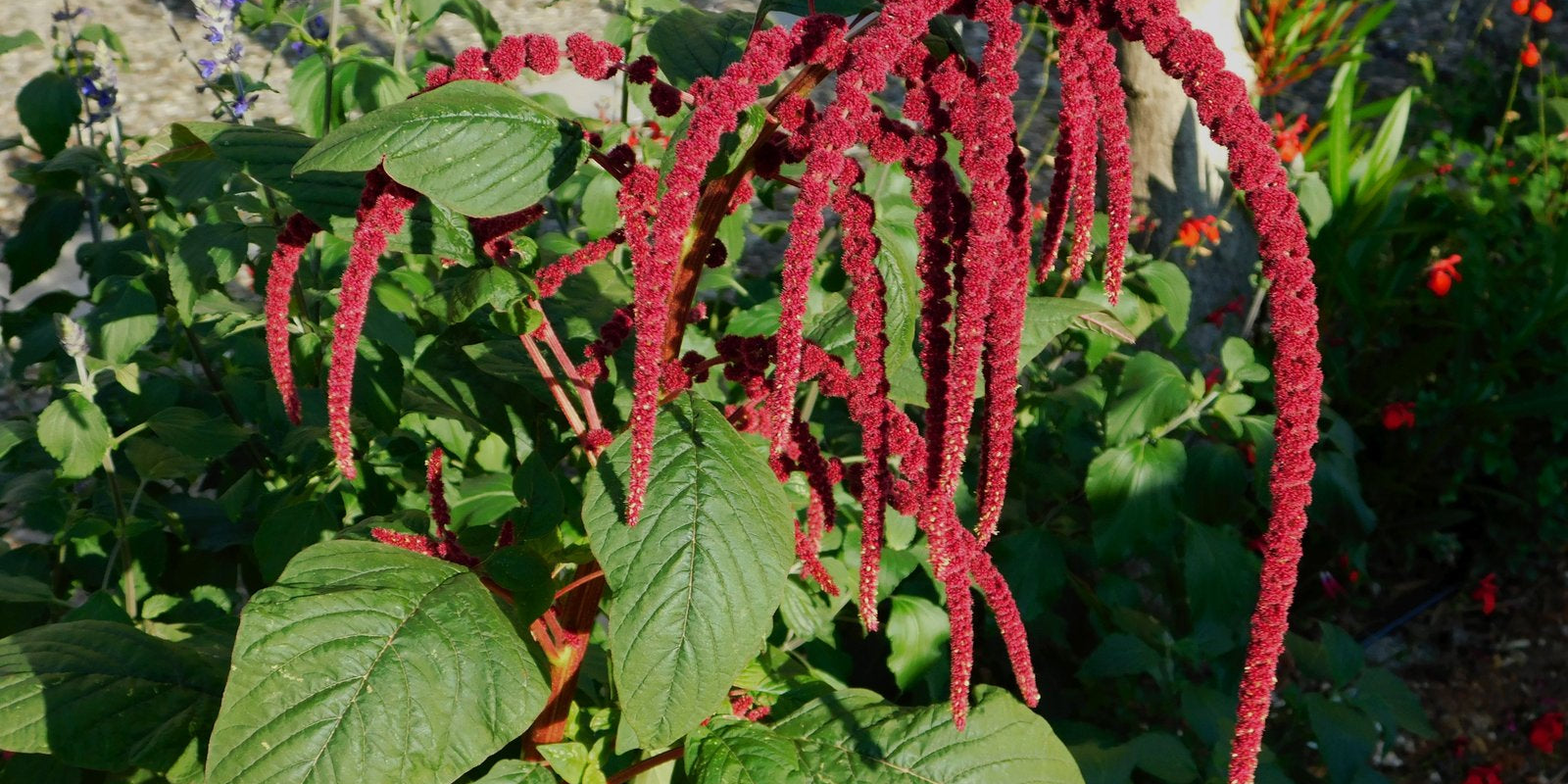
Sow amaranth seed 2 to 5 mm deep once frosts are over and the soil holds at least 18°C, in full sun and free-draining soil. Space plants 40 to 80 cm apart, depending on the type, and feed lightly. Stake tall and hanging types. Tassels and plumes usually reach full display 100 to 110 days after sowing.
| Sun | Full sun, out of strong wind |
|---|---|
| Water | Steady while young, then fairly drought tolerant |
| Soil | Free-draining, average fertility, pH about 6.5 to 7.5 |
| Feed | Compost at sowing; light liquid feeds only |
| Spacing | 40 to 80 cm |
| Depth | 2 to 5 mm |
| Germination | 7 to 14 days at 21 to 26°C |
| Harvest | 14 to 16 weeks |
| Container | Compact types: 13.5 L pot, 30 cm wide |
| Frost | Frost-tender; sow after the last frost |
| Support | Stake tall and hanging types |
| Use | Borders, pots, cut and dried flowers, bird seed |
Ornamental amaranths (Amaranthus species) belong to the amaranth family, Amaranthaceae, and are grown for drooping tassels, upright plumes and leaves that colour like a bonfire. They thrive in Australian summer heat and ask for little once established. The usual mistake is to feed them like a hungry vegetable, which gives soft, top-heavy plants and duller leaves.
Three mistakes that matter
- Sowing before the soil warms. Amaranth seedlings are very sensitive to frost, and seed in cold soil comes up slowly and patchily. Wait for the soil temperature in When to plant, or start seed in cells under cover.
- Feeding like a vegetable. Rich, nitrogen-heavy soil gives soft, lanky stems that lean or collapse, and Joseph's coat (Amaranthus tricolor) leaves lose their bright colour. Dig in compost and keep later feeds light, as Care by growth stage sets out.
- Letting the tassels drop their seed. Ripe heads shed seed readily, and several amaranth species have naturalised in Australia. Cut tassels and plumes for the vase or for drying before the seed falls, as Pinching and Deadheading explains.
When to plant
Sow once frosts are over and the soil holds at least 18°C. Seedlings usually appear in one to two weeks at 21 to 26°C. Plants take roughly 100 to 110 days to reach full display, so count back from your first cold nights. For a longer show, sow a second batch about a month after the first.
| Zone | Example cities | Sow | Harvest | Notes |
|---|---|---|---|---|
| Tropical | Darwin, Katherine NT; Cairns, Townsville QLD; Broome WA | Apr-Aug | Jul-Dec | Sow through the dry season so plumes stand before wet-season storms, which can topple tall plants. |
| Subtropical | Brisbane, Bundaberg, Rockhampton QLD; Coffs Harbour, Lismore NSW | Aug-Mar | Nov-Jun | A long window from late winter; sow by March so plants reach full display before the coolest weeks. |
| Arid and semi-arid | Alice Springs NT; Mildura VIC; Broken Hill, Dubbo NSW; Kalgoorlie WA | Sep-Jan | Dec-May | Sow once inland frosts end; January sowings must flower before May frosts. Mulch deeply and water steadily. |
| Temperate | Sydney, Newcastle, Wollongong NSW; Melbourne, Geelong VIC | Sep-Jan | Dec-May | Sydney can sow from September; Melbourne, the cool end, waits for warm soil in late October. |
| Mediterranean | Perth, Bunbury WA; Adelaide SA | Sep-Jan | Dec-May | Summer heat arrives dry and early, so mulch well and water deeply while young plants establish. |
| Cool and alpine | Canberra ACT; Hobart TAS; Ballarat VIC; Armidale NSW | Oct-Dec | Jan-Apr | Start seed under cover in October; plant out after the last frost, often Melbourne Cup weekend. |
Where spring is slow to warm, start seed under cover four to five weeks before your last frost.
Site, soil and setup
Give amaranths full sun and shelter from strong wind, because tall, soft stems lean or snap in a gale. They want free-draining soil of average fertility and grow well at a pH of about 6.5 to 7.5.
| Where | What to do |
|---|---|
| Every bed | Dig in a 5 cm layer of compost before sowing. Leave out extra manure, because rich soil makes soft, floppy growth. |
| Acid soil, below pH 6.5 | Spread garden lime or dolomite lime at 100 to 200 g per square metre and dig it in 4 weeks before sowing. |
| Poor, sandy soil | Add pelletised chicken manure at 100 g per square metre at sowing, and no more. |
| Heavy clay that stays wet | Build a raised bed or mound, since amaranths dislike heavy soil and young plants rot in cold, wet ground. |
| Sandy or inland soil that sheds water | Water in a wetting agent at the label rate before sowing. |
Avoid following beetroot or silverbeet, which share the beet webworm, and move away from any bed where root-knot nematodes troubled the last crop.
Container growing
Compact 'Pygmy Torch' and the Joseph's coat lines 'Early Splendour' and 'Illumination' suit pots. Love-lies-bleeding (Amaranthus caudatus) can tumble over the rim of a large tub. Use a pot at least 30 cm across, about 13.5 L, filled with fresh premium potting mix. Potting mix can carry Legionella bacteria, so wet it before handling, wear gloves and a mask, and wash your hands afterwards.
- Watering: pots dry out fast in summer, so check them daily and water whenever the top few centimetres feel dry.
- Feeding: water in fish and seaweed blend at 25 mL per 9 L fortnightly.
- Position: full sun, out of strong wind, in a pot heavy enough not to tip once the plant is tall.
Sowing Seeds
Sow amaranths direct where they will grow, and start them in cells only where the warm season is short or slow to arrive.
Sowing direct
- Sow the tiny seed 2 to 5 mm deep into fine, firm soil; mixing it with dry sand helps spread it evenly.
- Keep the surface damp but never soggy until seedlings appear, usually in 7 to 14 days.
- Thin in two or three stages to the spacing in the table below, keeping the sturdiest seedlings.
- Mulch once seedlings stand about 5 cm tall.
Starting under cover
- Sow two or three seeds per cell of seed raising mix, just covered, and keep the tray warm; a seedling heat mat helps.
- Give seedlings strong light from the day they emerge, as weak light makes them thin and spindly.
- Thin each cell to the strongest seedling and plant out after four to five weeks, before roots circle the cell.
- Harden off seedlings over about a week first (moving them outdoors for longer each day so they adjust to sun and wind).
The nine lines fall into three groups; heights and spacings are those on each listing.
| Group | Lines | Height and spacing | What it changes |
|---|---|---|---|
| Hanging tassels: love-lies-bleeding (Amaranthus caudatus) | 'Caudatus Red'; 'Caudatus Viridus Green', listed as Amaranthus hypochondriacus, though the Royal Horticultural Society places green 'Viridis' in Amaranthus caudatus | 60 to 80 cm listed, 70 cm apart; green love-lies-bleeding can reach 1 to 1.5 m | Heavy tassels pull stems over, so stake every plant |
| Upright plumes (grain-type amaranths) | 'Oeschberg' (Amaranthus cruentus); 'Pygmy Torch' and the yellow-green plumed line (Amaranthus hypochondriacus); 'Red Cathedral' (species not given on its listing) | 45 to 60 cm for most, 40 to 70 cm apart; 'Red Cathedral' 160 cm, 70 cm apart | 'Pygmy Torch' and the yellow-green line are compact and may need no stake; 'Red Cathedral' needs one |
| Joseph's coat foliage (Amaranthus tricolor) | 'Early Splendour', 'Illumination', 'Molten Fire' | 60 cm, 40 cm apart; 'Molten Fire' 80 cm, 80 cm apart | Grown for coloured top leaves, not flowers; colour is brightest in full sun on lean soil |
Amaranth grown for eating has its own Amaranth guide. Globe amaranth (Gomphrena) and Celosia are separate genera with guides of their own.
Care by growth stage
Steady water while young and a light hand with feed decide how amaranths turn out. Weeks count from sowing.
| Stage | Water | Feed | Watch for |
|---|---|---|---|
| Seedlings (weeks 1 to 4) | Keep the surface damp with a gentle spray | Nothing until the first true leaves, then seaweed solution at half strength (15 mL per 9 L) fortnightly | Seedlings collapsing at soil level; snails chewing seedlings overnight |
| Young plants (weeks 4 to 8) | Water deeply at the base when the top few centimetres dry | Fish and seaweed blend at 25 mL per 9 L monthly, only if growth looks pale or slow | Aphids on shoot tips; webbed leaves from beet webworm; time to pinch (see Pinching and Deadheading) |
| Stretching and budding (weeks 8 to 12) | Water deeply once or twice a week in dry spells, under mulch | None needed in a bed dug with compost; extra nitrogen makes stems flop | Tall plants leaning in wind; stake them before the plumes colour |
| Flowering and cutting (weeks 13 to 16 onward) | Keep watering steadily right through cutting, without easing off | None in beds; pots stay on fish and seaweed blend fortnightly | Faded heads shedding seed; silvery, crinkled leaves from thrips in the north |
Set a stake beside each tall or hanging plant at about knee height. Tie the main stem loosely at two points. 'Red Cathedral', love-lies-bleeding and the Joseph's coat lines need this most in windy spots.
If growth stalls in poor soil, a light dose of all-purpose controlled release granular (NPK around 14-5-10) scratched into the soil can help.
Pinching and Deadheading
One early pinch gives bushier plants with more, slimmer stems for cutting, and taking heads off before they shed keeps self-sown seedlings in check.
- Pinch once: when a young plant has six to eight sets of leaves, snip out the growing tip just above a leaf.
- Cut as you go: every stem cut for the vase or for drying is one less head to drop seed in the bed.
- Before seed falls: cut faded tassels and plumes as their colour dulls, and bag them for the bin.
- End of season: pull spent plants before the last heads ripen, and compost only those without seed.
None of the species sold is on a state or territory declared weed list, but several are recorded as naturalised. The yellow-green line's listing also names slim amaranth (Amaranthus hybridus). It is naturalised everywhere except Tasmania.
| Where | Declared weed lists | Recorded as naturalised |
|---|---|---|
| Queensland | No amaranth on the prohibited or restricted lists | Love-lies-bleeding and Joseph's coat, both doubtfully |
| New South Wales | No amaranth among prohibited matter or in NSW WeedWise | Love-lies-bleeding and Amaranthus cruentus |
| Victoria | No amaranth on the noxious weeds list | Love-lies-bleeding and Amaranthus cruentus, both doubtfully |
| Tasmania | Declares tumbleweed (Amaranthus albus), a different species | None of the species sold |
| South Australia | No amaranth among the declared plants | Love-lies-bleeding and Amaranthus cruentus |
| Western Australia | All species sold are permitted; spiny amaranth (Amaranthus spinosus) and Amaranthus blitoides are declared and prohibited | Love-lies-bleeding, Amaranthus cruentus and Joseph's coat |
| Northern Territory | Declares Amaranthus dubius, a different species, not to be introduced | Joseph's coat; love-lies-bleeding formerly |
| Australian Capital Territory | No amaranth among declared pest plants | Love-lies-bleeding |
Companion planting
Amaranths want the same hot, sunny bed as other summer flowers, and tall types make a backdrop for shorter plants in front.
Grows well with
- Marigolds and zinnias: they share full sun and heat, and their flowers sit well against bold amaranth leaves.
- Capsicum, chilli and eggplant: good neighbours that want the same warm soil and long summer.

Keep apart
- Beetroot and silverbeet: beet webworm feeds on both as well as on amaranth.
- Tomatoes, beans and cucumbers where root-knot nematodes are present: all are hosts and keep numbers high.
- Short sun-lovers on the shady side of tall types: plants up to 1.6 m tall shade them for much of the day.
Cutting and Drying Flowers
Cut tassels and plumes when about three-quarters of the tiny flowers along them have opened.
- Cut long stems with clean secateurs, back to a leaf joint.
- Strip leaves that would sit below the waterline and stand stems in clean water straight away.
- For drying, strip all the leaves, tie small bunches and hang them upside down in a warm, dry, airy shed for 2 to 3 weeks.
- Cut Joseph's coat stems for their coloured tops, and expect them to last only about 5 days in a vase.
Fresh tassels and plumes usually last about a week in a vase. Dried stems keep their shape, which is how the genus earned its name, from the Greek for unfading.
Hanging tassels spill over the rim of a tall vase, while upright plumes add height and texture to a dried arrangement.
Common problems
Patchy rows. Poor germination is common in amaranth, and the tiny seed fails if sown too deep or left to dry out.
Seedlings collapse at soil level. Damping off (Pythium species and Rhizoctonia solani) rots young stems, most often in wet soil or mix when temperatures do not suit the seedling. Read more
Thin, floppy seedlings. Low light and too much nitrogen make amaranth seedlings weak and spindly before they reach the garden. Read more
Joseph's coat leaves stay dull. Too much fertiliser, very rich soil or too little sun can leave the top leaves green instead of red and gold.
Pests and diseases
Amaranths are seldom badly troubled, and most damage comes from sap-suckers and leaf-eaters in warm weather.
Aphids (family Aphididae). Small sap-suckers cluster on shoot tips and under leaves, leaving growth distorted and sticky with honeydew. Read more
Beet webworm (Spoladea recurvalis). Brownish-green caterpillars with sparse white hairs live together in silky webs of leaves; pick off and bin webbed leaves when first seen.
Common garden snail (Cornu aspersum). Snails chew seedlings and young leaves overnight, most after rain, so check by torchlight and hand-pick. Read more
Root-knot nematodes (Meloidogyne species). These soil pests swell roots into galls and leave plants stunted, wilting and yellow, worst in warm climates and sandy soils. Read more
Melon thrips (Thrips palmi). In northern Australia these tiny insects rasp leaves until they turn silvery and crinkled, especially along the veins. Read more
Prevention first
- Sow into warm, free-draining soil so seedlings grow away quickly.
- Hose aphids off shoot tips and leaf undersides with a firm jet.
- In the north, check the undersides of new leaves weekly for thrips from planting.
- Rotate beds, and pull and bin plants with galled roots rather than composting them.
Tips
- In a short cool-zone summer, the compact 'Pygmy Torch' fits a smaller bed and may need no stake.
- Birds relish ripe amaranth seed. Hang a few cut heads in a paper bag for an aviary or feeder, so the seed stays out of the bed.
- Run a line of love-lies-bleeding along the edge of a raised bed or low wall, where the tassels can hang free.
Questions
When should I plant amaranth flower seeds in Australia?
Sow once frosts are over and the soil holds at least 18°C. That is Sep to Jan in temperate, Mediterranean and inland areas, and Oct to Dec in cool areas. Sow Aug to Mar in the subtropics, and Apr to Aug in the tropics, through the dry season.
Is ornamental amaranth a declared weed in Australia?
None of the species sold is on a state or territory declared weed list, though several are recorded as naturalised. Western Australia lists them as permitted. Cut tassels and plumes before they shed seed, especially near bushland, to stop self-sown seedlings.
Does love-lies-bleeding need staking?
Usually, yes. Heavy hanging tassels pull the stems over, and tall, soft plants lean in strong wind. Set a stake at about knee height and tie the main stem loosely at two points. Compact upright types such as 'Pygmy Torch' may need no stake.
How do you dry amaranth flowers?
Cut stems when about three-quarters of the tiny flowers have opened. Strip the leaves, tie small bunches and hang them upside down in a warm, dry, airy place for 2 to 3 weeks. Hanging keeps the stems straight as they dry.
What is the difference between love-lies-bleeding and Joseph's coat?
Love-lies-bleeding (Amaranthus caudatus) is grown for long, drooping flower tassels. Joseph's coat (Amaranthus tricolor) is grown for its red, gold and green top leaves, and its flowers are small. Joseph's coat colours best in full sun on lean soil.
Can amaranth grow in pots?
Yes. Compact 'Pygmy Torch' and the Joseph's coat lines suit a pot at least 30 cm across, about 13.5 L. Use fresh premium potting mix and a sunny spot out of wind. Water in fish and seaweed blend at 25 mL per 9 L fortnightly.
Grow it
Tap Add beside a size to put it in your cart. You stay on this page.
- Amaranth - Caudatus Red seedsFrom $2.99
- Amaranth - Caudatus Viridus Green seedsFrom $1.00
- Amaranth - Early Splendour seedsFrom $2.99
- Amaranth - Green Thumb seedsFrom $1.10
- Amaranth - Illumination seedsFrom $2.99
- Amaranth - Molten Fire seedsFrom $1.00
- Amaranth - Oeschberg seedsFrom $2.99
- Amaranth - Pygmy Torch seedsFrom $2.99


More flowers to sow in October
All flowers
Ageratum
Grow ageratum from seed in Australia: surface sowing, months for six climate zones, spacing, pots, deadheading, weed and livestock cautions and pests to watch.
| Position | Full sun, 6 hours or more |
|---|---|
| Depth | Surface, 1 mm at most |
| Spacing | 30 cm; Red Flint 40 cm |
| First pick | 12 to 14 weeks from sowing |

Alyssum
Grow alyssum from seed in Australia: sowing months for six climate zones, surface sowing, spacing, pots, shearing for more flowers, and the pests to watch.
| Position | Full sun or part shade |
|---|---|
| Depth | Surface sow, press in |
| Spacing | 15 to 20 cm |
| First pick | 8 to 9 weeks from sowing |

Aster
Grow China asters in Australia: sowing months for six climate zones, spacing, pots, watering, Fusarium wilt and thrips, and cutting blooms for the vase.
| Position | Full sun, 6 hours minimum |
|---|---|
| Depth | 6 mm |
| Spacing | 30 to 40 cm |
| First pick | 13 to 16 weeks |

Baby Blue Eyes
Grow baby blue eyes from seed in Australia: autumn sowing months for six climate zones, depth, spacing, shade, pots, pests and saving seed for next year.
| Position | Full sun to part shade |
|---|---|
| Depth | 2 to 3 mm |
| Spacing | 15 to 20 cm |
| First pick | Flowers in 12 to 16 weeks |