
How to Grow Candytuft in Australia
Sow candytuft 2 to 4 mm deep in mild autumn soil, at about 10 to 20°C, in full sun and free-draining soil. Space plants 20 to 30 cm apart, water only when the top 5 cm dries, and feed lightly. Plants usually flower 12 to 14 weeks after sowing. Deadhead regularly, and trim lightly after the first flush to bring on more flowers.

| Sun | Full sun, 6 hours minimum |
|---|---|
| Water | Water deeply when the top 5 cm dries |
| Soil | Free-draining, poor to average, pH about 6.0 to 7.0 |
| Feed | Compost at sowing; light feeds only |
| Spacing | 20 to 30 cm |
| Depth | 2 to 4 mm |
| Germination | 10 to 21 days |
| Harvest | 12 to 14 weeks |
| Container | Compact types: 10 L pot, 25 cm wide |
| Frost | Frost hardy; sow in autumn in most zones |
| Use | Edging, rockeries, pots, posies and pollinators |
Candytuft (Iberis species) is an annual or perennial in the cabbage family, Brassicaceae, grown for massed heads of white, pink, lilac or purple flowers. It shrugs off frost and poor soil, which makes it one of the more forgiving flowers to raise from seed in Australian gardens. The usual mistake is sowing it with the summer annuals, when in most zones it does best from an autumn sowing.
Three mistakes that matter
- Sowing into warm spring soil. Candytuft is sown for the cooler months, and in warm zones a spring sowing can run into summer heat before the plants have flowered well. Sow in autumn, as set out in When to plant, and keep spring sowings for cool districts.
- Feeding and watering too generously. Candytuft is at home in poor, free-draining soil, and plants kept wet can suffer root rot. Water only when the top 5 cm of soil is dry, and feed lightly as shown in Care by growth stage.
- Crowding plants or growing them in shade. Plants set too close together, or grown with only part-day sun, turn spindly and carry fewer flowers. Give them at least six hours of direct sun and thin seedlings to the spacing in Sowing Seeds.
When to plant
Sow candytuft when the soil is about 10 to 20°C, which makes autumn the main sowing season across most of Australia. Seedlings are frost hardy, so autumn sowings grow on through the cooler months and usually flower in winter and spring.
| Zone | Example cities | Sow | Flowering | Notes |
|---|---|---|---|---|
| Tropical | Darwin NT; Cairns, Townsville QLD; Broome WA | Apr-Jun | Jul-Sep | Sow as the dry season starts; wet-season heat and humidity usually end the display. |
| Subtropical | Brisbane, Gold Coast, Bundaberg QLD; Coffs Harbour, Lismore NSW | Mar-Jul | Jun-Oct | Autumn and winter sowings flower through the mild, dry winter and spring. |
| Arid and semi-arid | Alice Springs NT; Broken Hill, Dubbo NSW; Mildura VIC; Kalgoorlie WA | Mar-Jun | Jul-Oct | Sow once the summer heat breaks; seedlings cope with inland winter frost. |
| Temperate | Sydney, Newcastle, Wollongong NSW; Melbourne, Geelong VIC | Feb-Aug | May-Nov | Autumn is the main window, around Anzac Day; late-winter sowings flower into early summer. |
| Mediterranean | Perth, Bunbury WA; Adelaide SA | Mar-Jun | Jul-Oct | Sow with the autumn rains so plants flower before the long, dry summer. |
| Cool and alpine | Canberra ACT; Hobart TAS; Ballarat VIC; Armidale NSW | Feb-Apr and Sep-Nov | Sep-Feb | Sow early in autumn so plants settle before hard frost and flower in spring, or sow as frosts ease. |
In cool and alpine gardens, sow early in autumn so plants settle before hard frost, rest through winter and flower in spring. Otherwise, wait for the spring window once frosts ease.
Site, soil and setup
Choose a spot with at least six hours of direct sun a day. Where summers are hot, a little afternoon shade helps late plants hold their flowers. Candytuft needs free-draining soil, grows happily in poor or sandy ground and suits coastal gardens. A pH of about 6.0 to 7.0 is ideal, and very alkaline soil is tolerated.
| Where | What to do |
|---|---|
| Every bed | Dig a 5 cm layer of compost through the top of the soil before sowing. Candytuft needs little else. |
| Acid soil, below pH 6.0 | Scatter dolomite lime at 100 to 200 g per square metre and dig it in 4 weeks before sowing. |
| Heavy clay that stays wet | Sow on a raised bed or mound. Gypsum at 500 g to 1 kg per square metre improves only dispersive clay: an air-dried crumb that clouds rainwater within 20 hours shows your clay is the dispersive kind. |
| Sandy or inland soil that sheds water | Water in a wetting agent at the label rate before sowing. |
| A bed where clubroot has struck | Sow candytuft somewhere else. The clubroot organism can survive in soil for up to 20 years. |
Do not sow candytuft where cabbage, broccoli or other cabbage-family crops grew last season, since it shares their soil diseases.
Container growing
The compact 'Dwarf Fairy', the trailing 'Gibraltarica' and 'Iceberg' all suit pots and window boxes. Use a pot of at least 10 L, about 25 cm across and 20 cm deep, filled with fresh potting mix.
- Watering: check pots every few days and water when the mix is dry a few centimetres down, letting the excess drain away.
- Feeding: potting mix runs short of food sooner than garden soil. Water in fish and seaweed blend at 25 mL per 9 L fortnightly from the first true leaves.
- Position: full sun on a patio, balcony or step, with a little afternoon shade in hot inland summers.
Sowing Seeds
Sow candytuft direct where it is to flower, because it dislikes being moved, and raise seedlings in cells only when the bed is not ready.
Sowing direct
- Sow seed 2 to 4 mm deep, a few seeds to each spot, with the spots 20 to 30 cm apart.
- Water with a fine mist or gentle rose so the seed stays put, and keep the surface just moist.
- Seedlings usually appear in 10 to 21 days.
- Thin to the strongest seedling at each spot once true leaves show.
Starting under cover
- Sow one or two seeds per cell of seed raising mix, 2 to 4 mm deep.
- Plant out once seedlings have their first true leaves and stand 5 to 10 cm tall, before roots circle the cell.
- Harden off seedlings first over a week, up to two (giving them longer outside each day so they adjust to sun and wind).
- Set each seedling at the depth it grew and water it in with seaweed solution at half strength.
The five candytufts in the range fall into three groups, and the group decides height, habit and how long a plant lives.
| Group | Height | Varieties | What to expect |
|---|---|---|---|
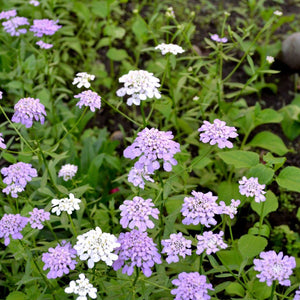
| Globe candytuft (Iberis umbellata), annual | About 25 cm for 'Dwarf Fairy'; 30 to 50 cm for 'Umbellata Mixed' | 'Dwarf Fairy', 'Umbellata Mixed' | Domed clusters in purple, lilac, pink, mauve and white. 'Dwarf Fairy' suits mass planting; 'Umbellata Mixed' is taller and looser. |
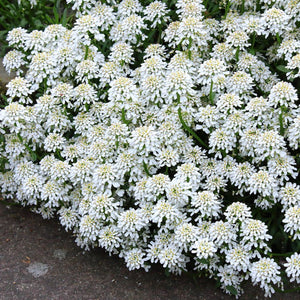
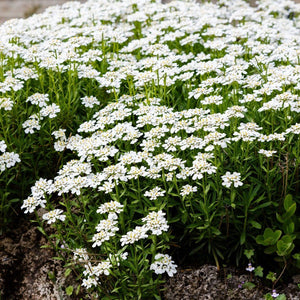
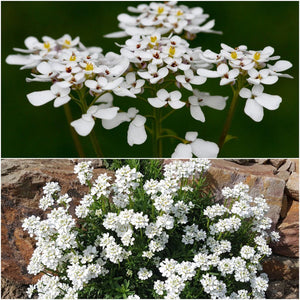
| White annuals for cutting | 30 to 45 cm | 'Empress White' (rocket candytuft, Iberis amara), 'Iceberg' | Clusters of white flowers on upright stems for borders and posies. 'Empress White' is creamy white and lightly fragrant. |
| Gibraltar candytuft (Iberis gibraltarica), perennial | 15 to 30 cm | 'Gibraltarica' | Lavender-pink flowers that open very pale and darken with age, over evergreen leaves. It spreads or trails over walls, steps and rockeries, and copes with dry spells. |
Care by growth stage
Candytuft is a light feeder, and in well-prepared soil it may need no extra fertiliser at all. Weeks count from sowing.
| Stage | Water | Feed | Watch for |
|---|---|---|---|
| Seedlings (weeks 1 to 4) | Mist or sprinkle gently to keep the surface just moist | Nothing until the first true leaves, then seaweed solution at half strength (15 mL per 9 L) fortnightly | Snails at night; seedlings toppling at soil level (see Common problems) |
| Young plants (weeks 4 to 8) | Water deeply at the base, early in the day, when the top 5 cm of soil is dry | In poor soil only, fish and seaweed blend at 25 mL per 9 L fortnightly | Green caterpillars on the leaves; crowded seedlings that need thinning |
| Budding (weeks 8 to 12) | Keep watering on the same schedule; do not let plants sit wet | Sulphate of potash at 30 g per square metre, once, scattered around plants and watered in | Plants wilting on warm afternoons in moist soil, a sign to check the roots |
| Flowering (week 12 onward) | Keep watering steadily right through flowering and cutting | No more feed in beds; pots keep the fortnightly fish and seaweed blend | Grey, fuzzy mould on heads in damp weather; faded heads to remove (see Deadheading) |
If growth stalls in very poor soil, scratch a light dose of all-purpose controlled release granular (NPK around 14-5-10) into the soil around the plants.
Deadheading
Removing spent heads keeps candytuft flowering for longer, and a light trim after the first big flush can bring on another.
- Deadhead regularly: cut faded heads back to just above a set of leaves with sharp snips.
- Trim after the flush: when most flowers have faded, shear plants lightly all over to encourage a second flowering.
- Gibraltar candytuft: cut it back after flowering to keep it compact and bushy, or leave it to trail over a wall.
- Seed for next year: late in the season, leave a few heads to form pods for seed or self-sown seedlings. Cut them into a paper bag once the pods turn brown and dry, and hang it somewhere cool and airy.
- End of season: pull finished annuals and check the roots; bin any with swollen, knobbly roots rather than composting them.
Companion planting
Candytuft draws bees and butterflies, and its low, tidy habit makes it a natural front-row partner for other cool-season flowers.
Grows well with
- Alyssum: another low edger sown at the same time of year, for a white and mauve border front.
- Violas and pansies: compact cool-season flowers that fill the gaps between candytuft plants.
- Cornflowers: taller cool-season annuals to stand behind candytuft in a cottage border.
- Aubretia: a mat-forming perennial for dry-stone walls and rockeries beside Gibraltar candytuft.

Keep apart
- Cabbage, broccoli and other cabbage-family vegetables: they share clubroot and cabbage white caterpillars, so a candytuft edging can keep both going.
- Pumpkins and other sprawling summer crops: their big leaves shade and smother low plants.
Harvesting Blooms
Cut stems for the vase when a quarter to a third of the small flowers in each head are open.
- Choose the longest stems; 'Empress White' and 'Iceberg' give the best for cutting.
- Cut back to just above a pair of leaves or a side shoot, so the plant keeps branching.
- Strip any leaves that would sit below the waterline, and stand stems in clean water straight away.
Cut candytuft usually lasts about a week in a vase. Once the petals drop, the flat green seed pods left behind are attractive fresh or dried. To dry them, hang stems upside down somewhere warm and dark for 2 to 3 weeks, until firm. Short dwarf stems suit a jam jar posy, while the white types add height to a mixed bunch.
Common problems
Seedlings collapse at soil level. Damping off (Pythium species and Rhizoctonia solani) rots young stems, most often in wet, cold seed raising mix or soil. Read more
Few seedlings come up. Seed buried much deeper than 4 mm, or a surface allowed to dry out, often gives patchy germination. Read more
Transplants sit still. Candytuft does not like its roots disturbed, so seedlings moved late from punnets often stall while direct-sown plants catch up.
Candytuft comes up all over the bed. Plants left to set seed self-sow freely, so deadhead before pods ripen or grow candytuft in pots.
Pests and diseases
Candytuft has few serious problems; these are the ones worth watching for.
Snails and slugs (Cornu aspersum and Deroceras reticulatum). They graze seedlings to stalks overnight, especially after autumn rain. Hand-pick after dark, and use an iron-based bait, which is safer around pets and wildlife. Read more
Cabbage white butterfly (Pieris rapae). Its velvety green caterpillars feed on most cabbage-family plants and can chew holes in candytuft leaves. Pick them off, or spray a caterpillar-specific Bacillus thuringiensis (Bt) product. Read more
Clubroot (Plasmodiophora brassicae). This soil-borne disease swells and distorts the roots, and plants wilt on warm afternoons, stunt or turn pale. Nothing cures an infected plant, so remove it, roots and all.
Grey mould (Botrytis species). A grey, fuzzy mould rots flower heads in cool, damp weather. Cut off affected heads and water at soil level, not over the flowers.
Prevention first
- Space plants at the full spacing so air moves freely through the flower heads.
- Improve drainage and lime acid soil, because clubroot thrives in warm, wet, acid ground.
- Water the soil early in the day, so flowers and leaves dry before evening.
- Check seedlings with a torch after dark and after rain, when snails are feeding.
Tips
- For a longer display, sow a fresh patch about every two weeks through your zone's window.
- Plant Gibraltar candytuft along paths and steps, where its evergreen leaves keep the edges green through winter.
- Keep a short row of 'Empress White' or 'Iceberg' just for cutting, so picking never thins out the border.
- Check your local council's weed advice before letting candytuft seed near bushland.
Questions
When should I plant candytuft seeds in Australia?
In most of Australia, sow in autumn, when the soil is cool. That is Feb to Aug in temperate areas, Mar to Jun in Perth, Adelaide and inland, and Mar to Jul in the subtropics. Tropical gardens sow Apr to Jun. Cool areas sow Feb to Apr, or Sep to Nov.
Is candytuft an annual or a perennial?
Both kinds exist. Globe candytuft, including 'Dwarf Fairy' and 'Umbellata Mixed', and the white 'Empress White' and 'Iceberg' are annuals that flower and die in one season. Gibraltar candytuft is an evergreen perennial for rockeries and walls.
Does candytuft come back every year?
Annual types do not regrow, but they often self-sow if some heads are left to form seed. Fresh seedlings then appear the following season. Gibraltar candytuft is perennial, and a trim after flowering keeps it compact and bushy.
How long does candytuft take to flower from seed?
Usually 12 to 14 weeks from sowing. Autumn sowings grow slowly through the cooler months and tend to flower in winter and spring, or not until spring in cold districts.
Can candytuft grow in pots?
Yes. Compact 'Dwarf Fairy', trailing 'Gibraltarica' and 'Iceberg' suit pots and window boxes. Use a pot of at least 10 L with fresh potting mix, in full sun. Water when the mix is dry a few centimetres down, and feed fortnightly with fish and seaweed blend.
Why is it called candytuft?
The name has nothing to do with sweets. Candytuft means a tufted plant from Candia, the old name for Crete. The botanical name Iberis comes from Iberia, the Roman name for Spain.
Grow it

More flower guides
All flowers
Ageratum
Grow ageratum from seed in Australia: surface sowing, months for six climate zones, spacing, pots, deadheading, weed and livestock cautions and pests to watch.
| Position | Full sun, 6 hours or more |
|---|---|
| Depth | Surface, 1 mm at most |
| Spacing | 30 cm; Red Flint 40 cm |
| First pick | 12 to 14 weeks from sowing |

Alyssum
Grow alyssum from seed in Australia: sowing months for six climate zones, surface sowing, spacing, pots, shearing for more flowers, and the pests to watch.
| Position | Full sun or part shade |
|---|---|
| Depth | Surface sow, press in |
| Spacing | 15 to 20 cm |
| First pick | 8 to 9 weeks from sowing |

Aquilegia
Grow aquilegia from seed in Australia: chilling the seed, when to sow in six climate zones, part shade, pots, deadheading, cut flowers and common pests.
| Position | Part shade or morning sun |
|---|---|
| Depth | Surface, 3 mm cover at most |
| Spacing | 30 to 50 cm |
| First pick | From about 28 weeks |

Aster
Grow China asters in Australia: sowing months for six climate zones, spacing, pots, watering, Fusarium wilt and thrips, and cutting blooms for the vase.
| Position | Full sun, 6 hours minimum |
|---|---|
| Depth | 6 mm |
| Spacing | 30 to 40 cm |
| First pick | 13 to 16 weeks |