
How to Grow Moonflowers in Australia
Moonflower is a night-flowering vine grown from seed. Nick each seed and soak it overnight, then sow 15 mm deep and 30 cm apart once frost is over and the soil holds 22°C. Give it full sun, a trellis at least 2 m tall and average soil without rich feeding. Flowers open at dusk from about 10 weeks. The seeds are poisonous.
| Sun | Full sun, 6 hours minimum |
|---|---|
| Water | Evenly moist, never soggy; steady through flowering |
| Soil | Free-draining, moderately fertile; acid to alkaline |
| Feed | Compost at planting; light liquid feeds; potash from budding |
| Spacing | 30 cm |
| Depth | 15 mm, nicked and soaked |
| Germination | 7 to 30 days at 22 to 28°C |
| Harvest | Flowers from about 10 weeks |
| Container | 30 L pot, 40 cm wide, with trellis |
| Frost | Frost-tender; sow after the last frost |
| Support | Trellis, mesh or strings at least 2 m |
| Use | Night-scented screens, trellises, arches and large pots |
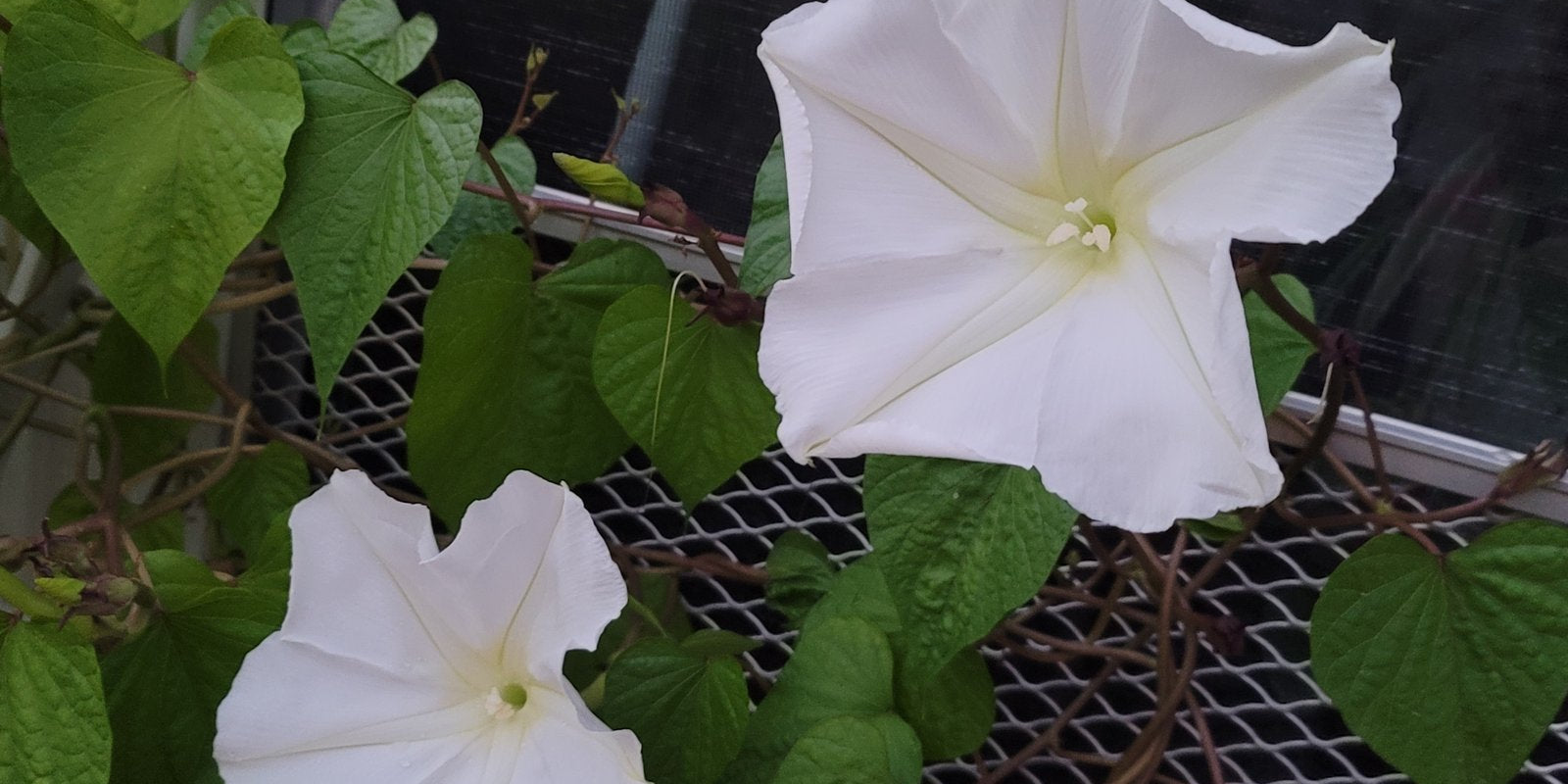
Moonflower (Ipomoea alba) is a twining vine in the morning glory family, Convolvulaceae, grown for fragrant white flowers that open at dusk. Perennial in the tropics and a summer annual further south, it can cover a trellis in one season and draws hawk moths after dark. The usual stumble is the seed: its hard coat needs breaking before it will drink, and cold soil leaves it sulking.
Three mistakes that matter
- Sowing untreated seed into cold soil. The hard coat keeps water out, and seed sitting in cold, wet soil can rot before it wakes. Nick and soak every seed as set out in Sowing Seeds, and wait for the soil temperature in When to plant.
- Feeding it like a vegetable. Rich soil and nitrogen feeds grow metres of leafy vine with few flowers. Dig in compost once before sowing, then hold back, using only the light feeds in Care by growth stage.
- Letting it seed near bushland. It has escaped gardens along creeks in south-east Queensland and northern New South Wales, smothering native plants. Check Weed status by state, then pick pods and bin prunings.
When to plant
Sow once frost is over and the soil holds at least 22°C; seed germinates best between 22 and 28°C. One sowing is enough, because a single vine keeps opening flowers from summer until the first cold nights.
| Zone | Example cities | Sow | Flowering | Notes |
|---|---|---|---|---|
| Tropical | Darwin NT; Cairns, Townsville QLD; Broome WA | Apr-Aug | Jul-Dec | Sow in the dry season; the vine lives on for years here, so pick pods and keep it from creeks. |
| Subtropical | Brisbane, Gold Coast, Sunshine Coast, Rockhampton QLD | Sep-Dec | Dec-May | Sow once soil warms in spring. Not for the NSW North Coast, where it is a regional priority weed. |
| Arid and semi-arid | Alice Springs NT; Mildura VIC; Broken Hill NSW; Kalgoorlie WA | Oct-Dec | Jan-Apr | Sow after the inland frosts; mulch deeply and water steadily through the dry heat. |
| Temperate | Sydney, Newcastle, Wollongong NSW; Melbourne, Geelong VIC | Oct-Dec | Jan-Apr | Sydney can sow from October; Melbourne, the cool end, waits for November or starts seed under cover. |
| Mediterranean | Perth, Bunbury WA; Adelaide SA | Oct-Dec | Jan-Apr | Sow from mid-spring; summer heat arrives dry and early, so mulch well and soak deeply. |
| Cool and alpine | Canberra ACT; Hobart TAS; Ballarat VIC; Armidale NSW | Nov-Dec | Feb-Apr | Start under cover in October; plant out after the last frost, often Melbourne Cup weekend. Flowering is brief. |
Where spring is slow to warm, start seed in pots under cover four to six weeks before the last frost. Moonflower responds to day length and often waits until late summer to flower, so an early start buys a longer show.
Site, soil and setup
Choose a spot with at least six hours of direct sun and room for a sturdy support. Moonflower likes moderately fertile, free-draining soil that stays moist, and flowers better in average soil than in rich beds. It grows in acid, neutral and alkaline soils, so most gardens need no pH correction.
| Where | What to do |
|---|---|
| Every bed | Dig in a 5 cm layer of compost before sowing, and a handful of worm castings where each seed goes. Skip manure and blood and bone. |
| Heavy clay that stays wet | Build a raised bed. Gypsum at 500 g to 1 kg per square metre helps only dispersive clay. To test, drop a dry crumb in rainwater: a milky cloud within 20 hours confirms it. |
| Sandy or inland soil that sheds water | Water in a wetting agent at the label rate before sowing. |
| The support | Put the trellis, mesh or strings in place before sowing, so the vine climbs from day one. |
Rotation matters little for a flower sown once a year. Damping off fungi are common in garden soil, though, so start pots in fresh seed raising mix.
Weed status by state
The rules differ by state, and lists change, so confirm with your state agency before sowing.
| State or territory | Status of Ipomoea alba | What it means in the garden |
|---|---|---|
| Queensland | Not a prohibited or restricted invasive plant; an environmental weed in the south-east | Everyone carries a general biosecurity obligation to minimise the risk. Seed and stem pieces travel in water, so keep it well away from creeks and bushland. |
| New South Wales | Regional priority weed on the North Coast, with eradication and containment zones | Across the North Coast region, including Port Macquarie-Hastings, Coffs Harbour, Lismore and Tweed, it should not be bought, sold, moved or released. Choose another climber there. Elsewhere, the general biosecurity duty applies. |
| Victoria | Not a declared noxious weed | Grow it, and stop it seeding into bushland. |
| South Australia | Not a declared plant and not on the list of plants prohibited from sale | Grow it, and stop it seeding into bushland. |
| Western Australia | A permitted organism on the Western Australian Organism List | Grow it, and stop it seeding into bushland. |
| Tasmania | Not a declared weed | Frost ends it each year; remove pods anyway. |
| Northern Territory | Not a declared weed | It lives for years here, so pick pods and keep it away from waterways. |
| Australian Capital Territory | Not a declared pest plant | Frost ends it each year; remove pods anyway. |
Container growing
Use a pot of at least 30 L, about 40 cm across, filled with fresh potting mix. Fix a trellis or obelisk in the pot, or run a wire to a fence. The seed is the plain species, with no dwarf form, so expect a vine of 3 m or more.
- Watering: pots dry out fast in summer, so check daily and water whenever the top few centimetres feel dry.
- Feeding: seaweed solution at 30 mL per 9 L fortnightly while it climbs. From the first buds, switch to liquid potash at the label rate, fortnightly.
- Position: full sun beside a seat, door or window you use in the evening.
- Winter: in frosty zones, a potted vine can spend winter somewhere bright and frost-free.
Sowing Seeds
Break the seed coat first, then sow direct beside the support or into pots under cover.
Preparing the seed
Each seed is large, about 10 mm long, with a coat that water struggles to enter. Rub one side lightly on sandpaper, or nick the coat with a nail file. Soak the seeds overnight in lukewarm water and sow them straight away while they are plump. A seed that has not swelled can be nicked again and soaked another night. More on scarification (breaking the seed coat).
Sowing direct
- Sow two seeds 15 mm deep at each spot along the foot of the support, with spots 30 cm apart.
- Keep the soil damp but never soggy.
- Nicked, soaked seed often comes up in 7 to 14 days in warm soil; untreated seed or cooler soil can take 21 to 30 days.
- Once true leaves show, snip the weaker seedling at each spot at soil level.
Starting under cover
- Sow one prepared seed 15 mm deep in each small pot of seed raising mix.
- Keep the pots warm and bright; a seedling heat mat helps hold 22 to 28°C.
- Plant out after the last frost, once seedlings stand 5 to 10 cm tall.
- Harden off seedlings first (moving them outdoors for longer each day over a week).
Care by growth stage
Warmth, steady moisture and a light hand with food decide the display. Weeks count from sowing.
| Stage | Water | Feed | Watch for |
|---|---|---|---|
| Seedlings (weeks 1 to 4) | Keep the soil damp, watering gently at the base | Nothing until the first true leaves, then seaweed solution at half strength (15 mL per 9 L) fortnightly | Seedlings collapsing at soil level (see Common problems) |
| Climbing (weeks 4 to 8) | Water deeply when the top few centimetres dry, and mulch | Seaweed solution at 30 mL per 9 L fortnightly; no high-nitrogen feeds | Aphids on shoot tips; shoots wandering off the support |
| Budding (weeks 8 to 10) | Keep the soil evenly moist under the mulch | Sulphate of potash at 30 g per square metre, scattered once and watered in | Pale, speckled leaves from two-spotted mite in hot, dry weather |
| Flowering (week 10 onward) | Keep watering steadily right through flowering; a dry spell cuts the show short | Liquid potash at the label rate fortnightly | Chewed leaves and large green caterpillars (see Pests and diseases) |
If growth stalls in very poor soil, a light dose of all-purpose controlled release granular (NPK around 14-5-10) scratched into the soil can help.

Pruning and Training
Moonflower climbs by twining its stems, so it needs a support to wrap around and some guidance early.
- Support: use a trellis, wire mesh, chain wire or taut strings at least 2 m tall, fixed firmly enough to carry a heavy, leafy vine.
- Train: wind young shoots around the support in the direction they already turn. That direction is fixed in the plant, and it does not reverse south of the equator.
- Tidy: cut back stray stems as they wander, and cut the whole vine back after flowering; in frost-free gardens it regrows.
- Seed pods: snip off spent flowers and young pods unless you are saving seed, so the vine cannot sow itself.
- Prunings: stem pieces can take root where they touch soil, so bag or bin them rather than composting or dumping them.
- End of season: in frosty zones, pull out the blackened vine after the first frost.
Companion planting
Good partners use the same support in another season or light up the ground below.
Grows well with
- Sweet peas: a cool-season climber that flowers from late winter into spring, then hands the same trellis to moonflower for summer.
- Alyssum (Lobularia maritima): a low, honey-scented edging for the foot of the vine; choose white forms, which catch the light at night.

Keep apart
- Sweet potato: Queensland researchers advise sweet potato growers to remove moonflower, a close relative that could harbour viruses.
- Beans, cucumbers and other vegetable climbers on a shared trellis: a moonflower vine soon smothers them.
Harvesting Blooms
The harvest is mostly the evening show: each flower, 8 to 15 cm across, opens around dusk, often within minutes, and lasts one night.
- Look for fat, spiralled buds in late afternoon, and be there at dusk to watch them open.
- Expect the strongest scent after dark, as the evening air cools.
- On overcast or cool days, flowers can stay open well into the next morning.
- For seed, let a few flowers set pods; the pod stalk thickens as the pod ripens.
- Pick pods once they turn from green to dark brown, before they split and drop their four seeds.

Dry the seed indoors, then store it in a sealed, labelled jar somewhere cool, dry and well out of reach. It can stay alive for at least 18 months; sow it the next spring, nicked and soaked as before.
Common problems
Seedlings collapse at soil level. Damping off (Pythium species and Rhizoctonia solani) rots young stems, most often in cold, wet mix or soil. Read more
A leafy vine, but no flowers yet. Moonflower often waits until late summer to bloom. If it is still bare then, stop nitrogen feeds and check for six hours of sun.
Petals snag or tear as they open. In cool weather the flowers stay open longer, and their folded segments can catch and rip as they unwind.
Seedlings pop up the next spring. Pull them while small; they grew from pods left to split.
Pests and diseases
Moonflower has few serious troubles; these three turn up through summer.
Convolvulus hawk moth (Agrius convolvuli). Its caterpillars, green at first with a tail horn and up to about 9 cm long, eat leaves across the morning glory family. Pick them off by hand.
Aphids (family Aphididae). Small sap-suckers cluster on soft shoot tips and under leaves, leaving sticky honeydew. Read more
Two-spotted mite (Tetranychus urticae). Tiny mites speckle leaves pale and spin fine webbing underneath in hot, dry, dusty weather. Read more
Prevention first
- Check shoot tips and the undersides of leaves every week through summer.
- Knock aphids and mites off with a firm jet of water, repeated every few days.
- Water deeply in hot spells, since stressed, dusty plants invite mites.
- Spray insecticidal soap on a bad aphid outbreak, late in the day.
Tips
- Check the botanical name before you buy: datura, also called moonflower, and brugmansia, the angel's trumpet, are different and poisonous plants.
- Pair it with Japanese morning glory (Ipomoea nil) or cardinal climber, which flower by day, and give each vine its own part of the support. Never plant blue morning glory (Ipomoea indica), an invasive weed.
- Label each spot sown direct: in cool soil the seed can take a month to show, and an unmarked spot is easily dug over.
Questions
When should I plant moonflower seeds in Australia?
Sow once frost is over and the soil holds at least 22°C. In temperate, Mediterranean and inland areas that is Oct to Dec. Sow Sep to Dec in the subtropics, and Apr to Aug in the tropical dry season. In cool areas, start seed under cover in October and plant out in November.
Why are my moonflower seeds not germinating?
Usually the hard seed coat or cold soil is to blame. Rub each seed lightly on sandpaper or nick it with a nail file, then soak it overnight in lukewarm water. Sow 15 mm deep in soil of 22 to 28°C. Treated seed often comes up in 7 to 14 days.
Are moonflower seeds poisonous?
Yes. The seeds are reported to be poisonous and can cause vomiting if eaten, and no part of the plant is edible. Keep seeds and pods away from children and pets, and store saved seed in a sealed, labelled jar. For advice, call the Poisons Information Line on 13 11 26.
Is moonflower a weed in Australia?
It is an environmental weed in Queensland and New South Wales. On the NSW North Coast it is a regional priority weed, and there it should not be bought, sold or moved. It is not declared in the other states and territories. Pick pods before they split and bin prunings.
Can I grow moonflower in a pot?
Yes, in a pot of at least 30 L with a sturdy trellis or obelisk, as the vine can reach 3 m or more. Use fresh potting mix, a sunny spot, and check the water daily in summer. In frosty areas a potted vine can be cut back and kept frost-free over winter.
Why is my moonflower vine not flowering?
Moonflower often holds its buds until late summer, as flowering responds to day length. Too much nitrogen or rich soil also grows leaves instead of flowers, and so does less than six hours of sun. Hold back on feeding and give it the sunniest spot you have.
Grow it
More flower guides
All flowers
Ageratum
Grow ageratum from seed in Australia: surface sowing, months for six climate zones, spacing, pots, deadheading, weed and livestock cautions and pests to watch.
| Position | Full sun, 6 hours or more |
|---|---|
| Depth | Surface, 1 mm at most |
| Spacing | 30 cm; Red Flint 40 cm |
| First pick | 12 to 14 weeks from sowing |

Alyssum
Grow alyssum from seed in Australia: sowing months for six climate zones, surface sowing, spacing, pots, shearing for more flowers, and the pests to watch.
| Position | Full sun or part shade |
|---|---|
| Depth | Surface sow, press in |
| Spacing | 15 to 20 cm |
| First pick | 8 to 9 weeks from sowing |

Aquilegia
Grow aquilegia from seed in Australia: chilling the seed, when to sow in six climate zones, part shade, pots, deadheading, cut flowers and common pests.
| Position | Part shade or morning sun |
|---|---|
| Depth | Surface, 3 mm cover at most |
| Spacing | 30 to 50 cm |
| First pick | From about 28 weeks |

Aster
Grow China asters in Australia: sowing months for six climate zones, spacing, pots, watering, Fusarium wilt and thrips, and cutting blooms for the vase.
| Position | Full sun, 6 hours minimum |
|---|---|
| Depth | 6 mm |
| Spacing | 30 to 40 cm |
| First pick | 13 to 16 weeks |