
How to Grow Gaillardia in Australia
Gaillardia, or blanket flower, is a tough daisy for hot, dry, sunny gardens. The Single Flowered Mix is an annual species. Press the seed onto the surface, because it needs light, and seedlings appear in 7 to 20 days. Space plants 30 to 40 cm apart in sandy, free-draining soil. First flowers usually open about 16 weeks after sowing. It is prohibited in Western Australia.
| Sun | Full sun |
|---|---|
| Water | Moist to establish, then deep, occasional soaks |
| Soil | Sandy, free-draining, pH about 6 to 8 |
| Feed | Light: compost at planting, seaweed solution |
| Spacing | 30 to 40 cm |
| Depth | Surface to 3 mm |
| Germination | 7 to 20 days at 15 to 21°C |
| Harvest | About 16 weeks from sowing |
| Container | Yes; pot at least 25 cm wide |
| Frost | Flowers until frost; perennial types are hardy |
| Use | Hot borders, coastal gardens, cut flowers, butterflies |
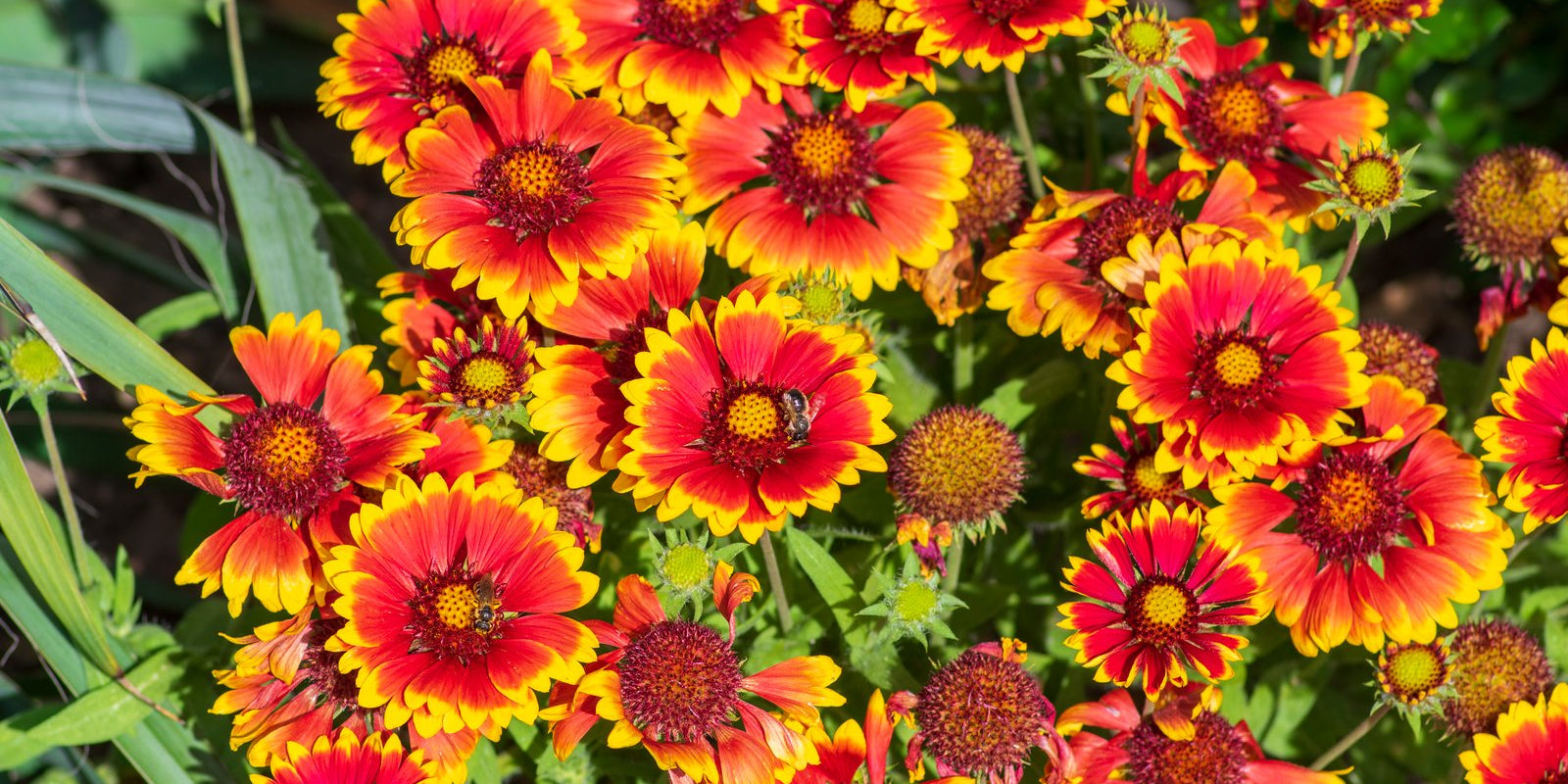
Gaillardia, or blanket flower (Gaillardia pulchella), is a sun-loving member of the daisy family (Asteraceae). It is grown for red, orange and yellow daisies from spring into autumn. The Single Flowered Mix is this species: an annual that can live on as a short-lived perennial in warm gardens. The perennial blanket flowers are Gaillardia aristata and its hybrid with the annual, Gaillardia x grandiflora. All of them take heat, drought, sandy soil and salty wind, and feed butterflies and native bees. The mistake most gardeners make is kindness: rich soil and frequent water rot the roots and cut flowering short.
Three mistakes that matter
- Rich, wet soil. Roots rot in soil that stays wet, and plants in heavy clay rarely survive winter. Plant in sandy or gritty, free-draining soil in full sun, skip the manure, and let the surface dry between waterings.
- Burying the seed. The annual blanket flower needs light to germinate, so seed raked deep or buried under mix can fail to come up. Press it onto the surface, or cover it with no more than 3 mm of fine mix.
- Expecting it to return like a perennial. In most gardens the Single Flowered Mix flowers for months, sets seed and dies. Leave a few heads to self-sow or save seed, and sow again each year.
When to plant
Seed germinates best when the soil sits between about 15 and 21°C, and slowly down to 10°C. Sow in spring once frosts have passed, or in autumn where winters are mild.
| Zone | Example cities | Sow | Flowering | Notes |
|---|---|---|---|---|
| Tropical | Darwin, Katherine NT; Cairns, Townsville QLD | Apr-Jul | Aug-Dec | Sow as the dry season starts, in free-draining sand. Wet-season rain and humidity often rot plants. |
| Subtropical | Brisbane, Gold Coast, Sunshine Coast QLD; Coffs Harbour NSW | Mar-May and Aug-Oct | Jul-Mar | Autumn sowings flower through the drier spring. Plant on mounds so summer storms drain away from the crown. |
| Arid and semi-arid | Alice Springs NT; Broken Hill, Dubbo NSW; Mildura VIC | Jul-Aug | Nov-Apr | Raise trays under cover and plant out after the last frost. Established plants need only occasional deep soaks. |
| Temperate | Sydney, Newcastle, Wollongong NSW; Melbourne, Geelong VIC | Sep-Oct and Mar-Apr | Oct-May | Autumn sowings root over winter and flower from spring. In Melbourne, raise trays under cover and plant out in November. |
| Mediterranean | Adelaide and the SA coast; Perth, Bunbury WA | Mar-May and Sep-Oct | Oct-Apr | Gaillardia pulchella is prohibited in WA, so grow permitted perennial types there. Autumn sowings root on winter rain. |
| Cool and alpine | Hobart, Launceston TAS; Canberra ACT; Ballarat VIC; Orange NSW | Sep-Oct | Jan-Apr | Raise trays under cover from September and plant out in November, after the last frost. Flowering stops with autumn frosts. |
In frosty districts, start trays under cover 4 to 6 weeks before the last frost and plant out once it has passed. Late in a window, water seedlings steadily, because the soil dries fast in heat.
Site, soil and setup
| Need | What to do |
|---|---|
| Sun | Full sun, 6 hours or more a day. Plants tolerate light shade. |
| Soil | Sandy, gritty or average loam. Poor soil suits it. On water-repellent sand in dry districts, apply a wetting agent at the label rate. |
| pH | About 6 to 8. If a test reads below 6, spread garden lime at 100 to 200 g per square metre 4 weeks before planting. |
| Drainage | Essential. On clay, or in districts with heavy summer rain, plant on a mound, a raised bed or in a pot. |
| Bed preparation | Dig in a 5 cm layer of compost and nothing richer. |
| Coastal gardens | Tolerates salt spray, sandy soil and heat. |
Blanket flower sits outside the vegetable rotation, so give it a sunny border, a dry bank or the hot edge of the vegie patch. See sandy, clay or loam soils if you are unsure what you have.
Weed status by state
Blanket flowers have escaped gardens in several states, and Western Australia bans the annual species. Check your state in the table before sowing, and deadhead every flower near bushland or coastal dunes.
| State or territory | Status |
|---|---|
| Western Australia | Gaillardia pulchella, the species in the Single Flowered Mix, is a declared pest, prohibited statewide: it may be brought in and kept only under permit. G. aristata and G. x grandiflora are permitted. |
| Queensland | G. pulchella is naturalised. It is not a prohibited or restricted invasive plant. |
| New South Wales | G. x grandiflora is naturalised, including on Lord Howe Island. No gaillardia is on the NSW WeedWise list. |
| Victoria | G. pulchella was formerly naturalised. No gaillardia is a declared noxious weed. |
| South Australia | G. x grandiflora is naturalised. No gaillardia is a declared plant. |
| Tasmania | No naturalised record, and not a declared weed. |
| Northern Territory | No naturalised record, and not a declared weed. |
| Australian Capital Territory | No naturalised record. Check current rules with the ACT Government. |
Container growing
Blanket flower suits a pot on a hot patio, and a pot keeps its seed out of bushland. Give one plant a pot at least 25 cm wide, about 10 L, or three plants a pot 40 cm wide. Use premium potting mix with about a third coarse sand or perlite mixed through. Potting mix can carry Legionella bacteria, so wet it down, wear gloves and a mask, and wash your hands afterwards. Compact perennial types such as 'Goblin' and 'Fanfare' suit smaller pots.
- Watering. Water when the top 3 cm of mix is dry, and never leave the pot standing in water. See watering pots through summer.
- Feeding. Potting mix holds little food, so give fish and seaweed blend at 25 mL per 9 L each fortnight from first buds to midsummer.
- Position. Full sun, moved under the eaves through long spells of heavy rain.
Sowing Seeds
Sow blanket flower where it is to flower, or in trays in frosty districts. Due to quarantine restrictions and our shipping policy, we cannot send gaillardia seed to Western Australia.
| Blanket flower | Life cycle | Height | Spacing | First flowers |
|---|---|---|---|---|
| Single Flowered Mix (G. pulchella), red, orange or yellow rays, often yellow-tipped | Annual; sometimes a short-lived perennial in frost-free gardens | 30 to 90 cm | 30 to 40 cm | About 16 weeks from sowing |
| G. aristata, yellow rays around a purple-brown centre | Perennial | 30 to 90 cm | 30 to 60 cm | 4 to 5 months from sowing |
| G. x grandiflora, the garden hybrid, large flowers | Short-lived perennial, about 2 years | 30 to 90 cm | 45 to 60 cm | 4 to 5 months from sowing |
Sowing direct
- Rake the bed to a fine surface, water it, and scatter the seed thinly.
- Press the seed in with your palm, and cover it with no more than 3 mm of fine soil.
- Keep the surface moist until seedlings appear, usually in 7 to 20 days.
- Mark the patch: young seedlings look like dandelions and are easily weeded out.
- Thin to the spacing in the table once seedlings have two or three true leaves.

Starting under cover
Fill a punnet or cell tray with fresh seed raising mix and water it first. Press two or three seeds onto each cell and leave them uncovered or barely covered. Keep the tray bright, moist and at the temperature under When to plant, then thin to the strongest seedling per cell.
Transplanting
Plant out 4 to 8 weeks after sowing, once roots fill the cell and frost has passed. First harden them off (a week of gradually longer outdoor stays, so leaves toughen to sun and wind), as in hardening off seedlings. Set each plant at the depth it grew and water it in with seaweed solution at 30 mL per 9 L.
Care by growth stage
Drainage and restraint decide how well blanket flower grows: steady moisture until roots take hold, then deep, occasional water and very little food.
| Stage | Water | Feed | Watch for |
|---|---|---|---|
| Seedlings, weeks 1 to 6 | Keep the surface just moist; water trays from below | Nothing until the first true leaves, then seaweed solution at half strength, 15 mL per 9 L, every fortnight | Damping off; snails on direct-sown seedlings |
| Planting out, weeks 4 to 8 | Water deeply at planting, then when the top 3 cm of soil is dry | A handful of worm castings in each hole and seaweed solution at 30 mL per 9 L to water in | Wilting in hot, dry wind for the first week |
| Growing on, weeks 8 to 14 | A deep soak once a week in dry weather; let the surface dry between | None needed in a compost-prepared bed | Aphids on shoot tips; thrips in the first buds |
| Flowering, from about week 16 | Keep watering steady in long dry spells, at soil level in the morning | Fish and seaweed blend at 25 mL per 9 L, fortnightly for the first month of flowering | Powdery mildew; faded flowers to remove |
| Plants that live on, from the first winter | Only in long dry spells; keep the crown dry through winter | Compost as a 5 cm mulch in spring, kept clear of the crown | Root rot after long wet spells |
Week ranges run from the sowing date. If growth stalls in very poor sand, scratch in a light dose of all-purpose controlled release granular (NPK around 14-5-10) in early spring.

Deadheading
Removing spent flowers keeps plants tidy, can bring more blooms and may help perennial types live longer. Wear gloves when deadheading and thinning, because the hairy leaves can irritate sensitive skin.
- Snip each faded flower back to the next leaf or bud on its stem, every week or so.
- If flowering stalls in midsummer heat, cut plants back to encourage an autumn flush.
- Cut perennial types back to about 15 cm in late summer to help them survive winter.
- Late in the season, let a few flowers ripen into round, fuzzy seed heads for self-sowing and birds, unless you garden near bushland.
Companion planting
Its long run of flowers feeds bees and beneficial insects from spring into autumn.
Grows well with
- Coreopsis and rudbeckia, prairie daisies that share its sun and dry soil.
- Sunflowers, which make a tall back row of daisies behind it.
- Salvia with blue or purple flowers, which cools the hot reds and yellows.
- Lavender, whose grey leaves suit the same lean, free-draining soil.
- Yarrow, whose fine, ferny leaves contrast with the broad, hairy gaillardia leaves.

Keep apart
- Lettuce and other crops that need rich, constantly moist soil.
- Low plants such as violas, which a sprawling blanket flower can shade out.
Harvesting Blooms
Cut blanket flowers when they are fully open, with the petals spread and the central disc showing.
- Pick early in the morning, while stems are full of water.
- Cut a long stem just above a leaf, so side shoots carry the next flowers.
- Strip any leaves that would sit below the water line.
- Stand stems in clean, cool water straight away.
- Wear gloves, as for deadheading.

Blanket flowers are long-lasting cut flowers. Use them in hot-coloured posies with sunflowers and rudbeckia.
Common problems
No seedlings. Seed buried too deep (see Three mistakes that matter), a surface allowed to dry, or cold soil is usually to blame. Read more
Thin, leaning seedlings. Tray seedlings stretch when light is weak, so move them into full sun as soon as they emerge. Read more
Plants wilt and rot at the base. Root rot sets in when soil stays wet, often after long spells of heavy summer rain; replant into a mound or pot. Read more
Lots of leaves, few flowers. Shade, rich soil or regular feeding push leaves at the expense of flowers; move plants into full sun and stop feeding.
Plants die after one summer. The Single Flowered Mix is usually an annual (see Three mistakes that matter), and perennial types burn out after heavy flowering.
Pests and diseases
Blanket flower has few serious pests or diseases.
Leafcurl plum aphid (Brachycaudus helichrysi). In Australia this aphid feeds on daisy-family plants, and it is recorded on G. pulchella, crowding onto shoot tips and buds. Hose off small colonies; for repeat outbreaks, spray soapy water or horticultural oil, never in hot weather. Read more
Western flower thrips (Frankliniella occidentalis). These tiny, slender insects breed in the flowers of many garden plants and weeds, and spread tomato spotted wilt virus. Tap a flower over white paper to check for them, and pull broadleaf weeds nearby. Read more
Powdery mildew (Erysiphales). White, powdery patches spread over the leaves, worst in warm, humid weather. Remove the worst leaves and spray 1 part full-cream milk to 10 parts water. Read more
Common garden snail (Cornu aspersum). Snails and slugs chew young seedlings, often overnight. Pick them off by torchlight after rain, and protect direct-sown patches until plants toughen. Read more
Damping off (Pythium species and Rhizoctonia solani). Seedlings pinch in at soil level and topple over, rotted by these common soil fungi and water moulds. Read more
Prevention first
- Use new seed raising mix and scrubbed trays for every sowing.
- Keep to the spacing under Sowing Seeds, so air moves through the leaves.
- Water at soil level in the morning, so leaves dry by midday.
- Check shoot tips weekly in spring, and leave early aphids for ladybirds and hoverflies.
Tips
- Save seed from heads that have dried with no petals left. Stored dry in the fridge, it can keep for up to four years.
- Use the Single Flowered Mix as an edging along a sunny driveway or path.
- Give children a patch of their own, because plants grow fast. See growing from seed with kids.
Questions
Is gaillardia an annual or a perennial?
It depends on the species. Gaillardia pulchella, sold as the Single Flowered Mix, is an annual that sometimes lives on in frost-free gardens. Gaillardia aristata is a perennial. The garden hybrid, Gaillardia x grandiflora, is a short-lived perennial that lasts about two years on average.
Can I grow gaillardia in Western Australia?
Not the annual species. Gaillardia pulchella, the species in the Single Flowered Mix, is a declared pest in Western Australia, prohibited statewide and kept only under permit. The perennial Gaillardia aristata and the hybrid Gaillardia x grandiflora are listed as permitted there.
Do gaillardia seeds need light to germinate?
The annual blanket flower does. Press the seed onto moist mix or soil and cover it with no more than 3 mm of fine mix. Keep it moist at 15 to 21°C, and seedlings usually appear in 7 to 20 days.
Why is my blanket flower dying?
Wet soil is the usual cause: roots rot in heavy clay or after long spells of rain. Blanket flower needs sandy, free-draining soil, full sun and very little feeding. The annual species also dies naturally once it has set seed, so leave a few heads to self-sow.
Should I deadhead gaillardia?
Yes, through the main flowering months. Removing faded flowers keeps plants tidy and can bring more blooms. Toward autumn, let a few heads ripen for self-sowing and for birds, except near bushland or coastal dunes, where every seed head should come off.
Is gaillardia good for bees and butterflies?
Yes. Butterflies and native bees visit the flowers, and seed-eating birds feed on the ripe heads. Plant it in full sun beside coreopsis, salvia or lavender for a long-flowering patch.
Grow it
More flower guides
All flowers
Ageratum
Grow ageratum from seed in Australia: surface sowing, months for six climate zones, spacing, pots, deadheading, weed and livestock cautions and pests to watch.
| Position | Full sun, 6 hours or more |
|---|---|
| Depth | Surface, 1 mm at most |
| Spacing | 30 cm; Red Flint 40 cm |
| First pick | 12 to 14 weeks from sowing |

Alyssum
Grow alyssum from seed in Australia: sowing months for six climate zones, surface sowing, spacing, pots, shearing for more flowers, and the pests to watch.
| Position | Full sun or part shade |
|---|---|
| Depth | Surface sow, press in |
| Spacing | 15 to 20 cm |
| First pick | 8 to 9 weeks from sowing |

Aquilegia
Grow aquilegia from seed in Australia: chilling the seed, when to sow in six climate zones, part shade, pots, deadheading, cut flowers and common pests.
| Position | Part shade or morning sun |
|---|---|
| Depth | Surface, 3 mm cover at most |
| Spacing | 30 to 50 cm |
| First pick | From about 28 weeks |

Aster
Grow China asters in Australia: sowing months for six climate zones, spacing, pots, watering, Fusarium wilt and thrips, and cutting blooms for the vase.
| Position | Full sun, 6 hours minimum |
|---|---|
| Depth | 6 mm |
| Spacing | 30 to 40 cm |
| First pick | 13 to 16 weeks |