
How to Grow Forget Me Nots in Australia
Sow forget me not seed in late summer and autumn, no deeper than 3 mm, in moist soil rich in organic matter. Seedlings appear in 10 to 21 days at about 18 to 22°C. Thin to 20 to 30 cm apart in part shade. Plants need a cool spell to flower, usually 10 to 24 weeks from sowing, in late winter and spring.

| Sun | Part shade or morning sun |
|---|---|
| Water | Keep evenly moist; dislikes drying out |
| Soil | Moist, rich in organic matter; any pH |
| Feed | Light; compost at sowing, seaweed solution fortnightly |
| Spacing | 20 to 30 cm |
| Depth | 3 mm, lightly covered |
| Germination | 10 to 21 days at 18 to 22°C |
| Harvest | Usually 10 to 24 weeks |
| Container | Pots at least 20 cm wide and deep |
| Frost | Hardy; needs a cool spell to flower |
| Use | Shady beds, bulb underplanting, pots, posies, bees |
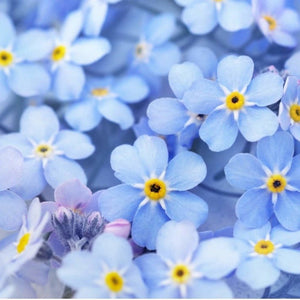
Forget me not (Myosotis sylvatica) is a low, hairy biennial in the borage family, Boraginaceae. It is grown for sprays of small blue, pink or white flowers with yellow eyes. It brightens damp, shady corners where little else flowers, and it self-sows for years. The step most gardeners get wrong is timing. Sow it in late summer or autumn, not spring, so it grows through the cool months before flowering.
Three mistakes that matter
- Sowing in spring in a warm zone. Forget me nots need a spell of cool weather to start flowering (vernalisation, a cold period that switches on flower buds). Spring sowings in the north can meet summer heat first. Sow in your zone's window under When to plant.
- Planting in a hot, dry spot. Heat and drought wilt forget me nots and can kill them, and afternoon sun dries the soil around their roots fast. Grow them in part shade or morning sun, mulch them, and keep the soil moist.
- Letting every plant drop seed. Garden forget me not has escaped into moist, shaded bush in Victoria, Western Australia, South Australia, New South Wales and Tasmania. Near bushland or a creek, pull plants as flowering fades and check your council's weed advice.
When to plant
Seed germinates best in soil of about 18 to 22°C. Sow once the worst of the summer heat has passed, from late summer into autumn. One sowing a year is enough, because plants left to seed send up their own seedlings in the same months.
| Zone | Example cities | Sow | Flowering | Notes |
|---|---|---|---|---|
| Tropical | Darwin NT; Cairns, Townsville QLD; Broome WA | Apr-Jun | Jul-Sep | A dry-season display in bright shade; without real cool nights flowering is often light, and plants fade by the build-up. |
| Subtropical | Brisbane, Gold Coast, Bundaberg QLD; Coffs Harbour NSW | Mar-Jun | Jul-Oct | Autumn sowings flower through late winter and spring; plants tire once humid summer heat arrives. |
| Arid and semi-arid | Alice Springs NT; Mildura VIC; Dubbo NSW; Kalgoorlie WA | Mar-May | Aug-Oct | Cold inland winters suit them; give afternoon shade and steady water as spring heat builds. |
| Temperate | Sydney, Newcastle, Wollongong NSW; Melbourne VIC | Feb-May | Aug-Nov | Sow once late summer heat eases; Melbourne and cooler hills often flower into early summer. |
| Mediterranean | Perth, Bunbury WA; Adelaide SA | Mar-May | Aug-Oct | Sow as autumn cools; winter rain suits plants, which fade in the dry late-spring heat. |
| Cool and alpine | Hobart TAS; Canberra ACT; Ballarat VIC; Armidale NSW | Feb-Apr and Aug-Sep | Sep-Jan | Autumn sowings flower in spring; late-winter sowings under cover flower into summer. Frost is no problem. |
A good marker in the south is to have seed in by about Anzac Day. In cool and alpine gardens, a late winter sowing in trays under cover flowers later, into summer.
Site, soil and setup
Part shade suits forget me nots best, and full sun works in cool gardens where the soil stays moist. They grow in acid, neutral or alkaline soil, and they like it rich in organic matter and moist but not waterlogged.
| Where | What to do |
|---|---|
| Every bed | Weed thoroughly, fork the soil loose and dig in a 5 cm layer of compost before sowing. |
| Clay or damp ground | Garden forget me nots tolerate soil that is occasionally wet. Chinese forget me not does not, so raise the bed for it. |
| Sandy soil that dries fast | Dig in extra compost, water in a wetting agent at the label rate, and mulch once seedlings reach about 5 cm. |
| Strongly acid soil | Scatter garden lime at 100 to 200 g per square metre, 4 weeks before sowing. |
The fungi behind damping off survive between plantings on old plant material. Do not sow where seedlings collapsed the season before.
Container growing
All the garden forget me nots suit pots and hanging baskets, and 'Indigo Compacta' and 'Blue Basket' are good starting points. Choose a pot at least 20 cm wide and deep, which holds about 5 L. A 30 cm pot of about 13.5 L suits a small group. Bagged potting mix can carry Legionella bacteria, so dampen it first, wear a mask and gloves, and wash your hands afterwards.
- Watering: keep the mix moist but never soggy, and check pots daily in warm or windy weather.
- Feeding: from the first flower buds, give fish and seaweed blend at 25 mL per 9 L every fortnight.
- Position: morning sun and afternoon shade, or the bright shade under a tree or verandah.
Sowing Seeds
Sow forget me nots straight where they are to flower, or in trays to plant out once they have true leaves.
Sowing direct
- Rake the soil fine, sow thinly and cover the seed lightly, no deeper than 3 mm.
- Keep the surface moist, never wet or dry, until seedlings appear.
- Seedlings usually emerge in 10 to 21 days at the soil temperature given in When to plant.
- Thin to 20 to 30 cm apart once seedlings are large enough to handle.

Starting in trays
- Fill trays or punnets with seed raising mix and sow the seed 3 mm deep.
- Stand trays in a shaded, sheltered spot while late summer days are still hot.
- Plant seedlings out at 5 to 10 cm tall with true leaves, usually 4 to 5 weeks after sowing.
- Harden off tray-raised seedlings first (stand them outdoors a few hours a day, then longer, over about a week).
- Water them in with seaweed solution at half strength, 15 mL per 9 L.
The six garden varieties are all Myosotis sylvatica, sown and grown the same way, and they differ only in flower colour.
| Variety | Flowers | Good to know |
|---|---|---|
| 'Indigo Blue' | Light blue to indigo, yellow centres | Borders, woodland plantings and pots, to about 30 cm |
| 'Indigo Compacta' | Deep blue to indigo, yellow centres | Pots, baskets and edging, to about 30 cm |
| 'Blue Basket' | Clusters of small blue flowers | Hanging baskets, pots and mixed borders |
| 'Rose' | Rose pink, yellow centres | Mixes well with blue varieties in a bed |
| 'White' | White, yellow centres | Lights up a shaded corner |
| 'Choice Mix' | White, pink and blue together | Self-sown seedlings come up in mixed colours |
Chinese forget me not (Cynoglossum amabile) is a different plant in the same family, taller and summer flowering. Grow it much the same way, with the differences below.
| What differs | Garden forget me not | Chinese forget me not 'Firmament' |
|---|---|---|
| When to sow | Late summer and autumn | Spring after frost in cool and temperate zones; late winter to autumn in the north |
| Seed cover | Light, no deeper than 3 mm | Cover the seed, because it needs darkness to germinate |
| Emergence | 10 to 21 days | 5 to 14 days at 18 to 21°C |
| Height and spacing | To about 30 cm, 20 to 30 cm apart | 45 to 60 cm, about 30 cm apart |
| Flowering | Late winter and spring | Summer in the south, until cooler weather in late autumn |
| Soil | Moist, tolerates occasional wet | Free-draining, dislikes wet soil |
All parts of Chinese forget me not are poisonous if eaten, and they can harm the liver of horses that graze it. Keep it away from paddocks and grazing animals.
Care by growth stage
Moist soil and a cool spell decide how well forget me nots flower. They are light feeders, and compost dug in before sowing carries them most of the way.
| Stage | Water | Feed | Watch for |
|---|---|---|---|
| Seedlings (weeks 1 to 5) | Water gently so the surface never dries | Nothing until true leaves, then seaweed solution at half strength, 15 mL per 9 L, fortnightly | Snails and slugs at night; seedlings collapsing at soil level |
| Leafy rosettes (weeks 5 to about 12) | Water deeply when the soil is dry 5 cm down; mulch around plants | Worm casting liquid diluted to weak tea colour, fortnightly | Crowded plants; thin or transplant the extras |
| Flowering (about weeks 10 to 24, late winter and spring) | Keep the soil evenly moist and water at the base, not over the leaves | Fish and seaweed blend at 25 mL per 9 L fortnightly, only if growth looks pale | White powder on leaves; faded sprays to snip |
| Late flowering and seed | Keep watering steadily to the end, for flowers and for seed | Seaweed solution at 30 mL per 9 L after a hot spell | Grey, mildewed leaves as flowering slows; seed dropping near bushland |
In poor soil, a light scattering of all-purpose controlled release granular (NPK around 14-5-10) at the label rate can help.

Deadheading
Snipping faded sprays keeps plants flowering longer, and it also decides how many seedlings you get next year.
- Through flowering: cut faded sprays just above a set of leaves with sharp snips.
- When flowering slows: pull out or cut back plants once the leaves turn grey with mildew.
- For self-sown seedlings: leave a few plants to ripen seed in a bed where they are welcome.
- Near bushland: remove every plant before seed forms.
- Chinese forget me not: deadhead through summer to keep fresh sprays coming.
Companion planting
Forget me nots pair best with plants that share their moist, part shaded spot and flower around the same time.
Grows well with
- Violas: low cool-season flowers sown in the same autumn months, for the front of a shady bed.
- Tulips and other spring bulbs: planted together in autumn, the forget me nots carpet the ground beneath the taller flowers.
- Roses and shrubs: forget me nots are a classic low underplanting beneath them.
Keep apart
- Lavender: it needs free-draining, drier soil than forget me nots, so one of them always suffers.
- Thyme: it wants full sun and sparing water once established, the opposite of a damp, shady bed.
Harvesting Blooms
Cut stems for the vase early in the day, when about half the flowers on each spray have opened.
- Cut the longest stems you can, just above a set of leaves.
- Strip off every leaf that would sit below the waterline.
- Stand the stems in a clean bucket of cool water straight away.
- Let them drink in a cool spot for a while before arranging them.

Keep arrangements in a cool room out of direct sun. Garden forget me nots make a soft filler in a posy of spring flowers. The longer stems of Chinese forget me not suit summer bunches, and they can be dried for crafts.
Common problems
Seed does not come up. Soil that is still too hot, or dries out after sowing, is the usual cause. Wait for cooler weather and keep the surface moist. Read more
Seedlings collapse at soil level. Damping off (a seedling rot caused by Pythium species and Rhizoctonia solani) strikes seedlings growing in wet soil or mix. Read more
Plenty of leaves but few flowers. Plants that missed a cool spell often flower poorly; see the first point in Three mistakes that matter.
Plants wilt and die in summer. Heat and dry soil are the cause; see the second point in Three mistakes that matter.
Seedlings come up everywhere. Plants that ripened seed the year before are the source, so hoe out the extras while small or move them where you want them.
Pests and diseases
Forget me nots have few serious pests; snails take seedlings, and mildew arrives as flowering winds down.
Common garden snail (Cornu aspersum) and grey field slug (Deroceras reticulatum). They chew seedlings to the ground after dark and leave silvery slime trails. Hand-pick them by torchlight about two hours after sunset, and set beer traps. Read more
Powdery mildew (Golovinomyces species). White powdery patches spread over leaves and stems, mostly after flowering and in crowded plants. Remove the worst leaves and spray 1 part full-cream milk to 10 parts water. Read more
Downy mildew (Peronospora myosotidis). Pale patches show on top of the leaves, with a grey down beneath, in cool, wet weather. Pull and bin badly affected plants, because milk sprays do not reliably control it. Read more
Prevention first
- Keep to the spacing in Sowing Seeds, so air moves between plants.
- Water the soil, not the leaves, and do it early in the day.
- Walk the beds with a torch after dark while seedlings are small.
- Clear out spent plants once flowering ends rather than leaving them to mildew.
Tips
- For a loose, natural carpet under trees, scatter sow the seed over roughened soil and rake it in lightly.
- Flower colour is often deeper on plants grown in light shade than in full sun.
- Lift self-sown seedlings while they are small and replant them where you want them.
- Seed clings to socks and pet fur, so brush off after walking through plants in seed near bushland.
Questions
When do you plant forget me not seeds in Australia?
Sow in late summer and autumn so plants grow through the cool months. Sydney and Melbourne sow Feb to May, Perth and Adelaide Mar to May, and Brisbane Mar to Jun. Cool areas such as Canberra and Hobart sow Feb to Apr, with a second sowing under cover in Aug and Sep.
Do forget me nots grow in shade?
Yes. Part shade or morning sun with afternoon shade suits them best, and flower colour is often deeper in light shade. Full sun works in cool gardens only if the soil stays moist. Hot, dry positions wilt plants and can kill them.
Are forget me nots annual or perennial?
Garden forget me not is a biennial or short-lived perennial, usually grown as an annual. Sown in autumn, it flowers from late winter into spring, then sets seed and declines. Self-sown seedlings often come up the following autumn, which is why a patch can last for years.
Why are my forget me nots not flowering?
They usually missed the cool spell that triggers flowering, most often because seed went in during spring in a warm zone. Sow in late summer or autumn instead. Very dry soil and deep shade can also cut flowering.
Are forget me nots invasive in Australia?
Garden forget me not has naturalised in moist, shaded bush in Victoria, Western Australia, South Australia, New South Wales and Tasmania. Near bushland or creeks, remove plants before they set seed and check your council's weed advice.
What is the difference between Chinese forget me not and forget me not?
Chinese forget me not is Cynoglossum amabile, a different plant in the same family. It grows 45 to 60 cm tall, is sown in spring in the south, and flowers in summer. Garden forget me not grows to about 30 cm and flowers in late winter and spring. Chinese forget me not is poisonous if eaten.
Grow it



More flower guides
All flowers
Ageratum
Grow ageratum from seed in Australia: surface sowing, months for six climate zones, spacing, pots, deadheading, weed and livestock cautions and pests to watch.
| Position | Full sun, 6 hours or more |
|---|---|
| Depth | Surface, 1 mm at most |
| Spacing | 30 cm; Red Flint 40 cm |
| First pick | 12 to 14 weeks from sowing |

Alyssum
Grow alyssum from seed in Australia: sowing months for six climate zones, surface sowing, spacing, pots, shearing for more flowers, and the pests to watch.
| Position | Full sun or part shade |
|---|---|
| Depth | Surface sow, press in |
| Spacing | 15 to 20 cm |
| First pick | 8 to 9 weeks from sowing |

Aquilegia
Grow aquilegia from seed in Australia: chilling the seed, when to sow in six climate zones, part shade, pots, deadheading, cut flowers and common pests.
| Position | Part shade or morning sun |
|---|---|
| Depth | Surface, 3 mm cover at most |
| Spacing | 30 to 50 cm |
| First pick | From about 28 weeks |

Aster
Grow China asters in Australia: sowing months for six climate zones, spacing, pots, watering, Fusarium wilt and thrips, and cutting blooms for the vase.
| Position | Full sun, 6 hours minimum |
|---|---|
| Depth | 6 mm |
| Spacing | 30 to 40 cm |
| First pick | 13 to 16 weeks |