
How to Grow Everlasting Daisies in Australia
Sow everlasting daisy seed on the surface and barely cover it, because light helps it germinate. Sow in autumn where winters are mild or dry, and in spring after frost elsewhere. Grow in full sun and lean, free-draining soil, 25 to 40 cm apart, with little feed. Spring sowings usually flower in 10 to 14 weeks and autumn sowings in spring; cut flowers for drying before the centre opens.

| Sun | Full sun, 6 hours minimum |
|---|---|
| Water | Deep watering when dry 10 cm down |
| Soil | Light, sandy, free-draining; acid to alkaline |
| Feed | Light: fish and seaweed blend every three weeks |
| Spacing | 25 to 40 cm |
| Depth | Surface, barely covered |
| Germination | 1 to 3 weeks at 10 to 25°C |
| Harvest | 10 to 14 weeks; autumn sowings flower in spring |
| Container | Tom Thumb Mixed in a 20 L pot |
| Frost | Tolerates light frost |
| Use | Borders, pots, cut flowers and dried arrangements |
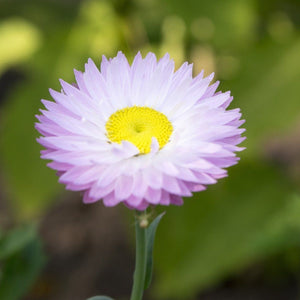
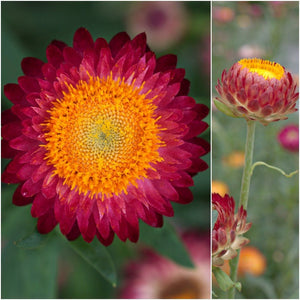
Everlasting daisy (Xerochrysum bracteatum, formerly Helichrysum bracteatum) is an Australian native of the daisy family, Asteraceae, grown for papery flowers that keep their colour. The colour is carried by stiff bracts (modified leaves that look like petals) in gold, lemon, white, pink, scarlet, copper and purple-red. It thrives on sun and lean, free-draining soil, and the usual mistake is giving it the rich, wet bed a hungry annual would want.
Three mistakes that matter
- Burying the seed. The seed is tiny and light helps it germinate, so seed sown deep or raked well in often never appears. Press it onto the surface and barely cover it, as set out in Sowing Seeds.
- Rich, wet soil. In heavy, poorly drained soil or part shade, plants stretch, flower poorly and often die young. Choose full sun and a sandy, free-draining bed, and leave out the manure (see Site, soil and setup).
- Cutting for drying too late. The flowers keep opening after they are cut, so a flower picked fully open dries flat with its centre showing. Cut at the stage described in Harvesting and Drying Blooms.
When to plant
Where winters are mild or dry, sow in autumn as the soil cools, so plants root through winter and flower from spring. Around Anzac Day suits many southern gardens. Where winters are frosty, sow in spring once the frosts ease. Seed comes up in soil from about 10 to 25°C, so cooling autumn soil suits it; under cover, aim for 18 to 25°C. One sowing per window is usually enough, because deadheaded plants flower for months.
| Zone | Example cities | Sow | Harvest | Notes |
|---|---|---|---|---|
| Tropical | Darwin NT; Cairns, Townsville QLD; Broome WA | Apr-Jun | Jul-Oct | Few planners list it; sow early in the dry season in a raised bed and clear plants before the wet. |
| Subtropical | Brisbane, Sunshine Coast, Bundaberg QLD; Coffs Harbour NSW | Mar-Jul | Jul-Dec | Autumn and winter sowings flower from late winter into spring, before summer humidity and storms. |
| Arid and semi-arid | Alice Springs NT; Mildura VIC; Broken Hill NSW; Kalgoorlie WA | Apr-May | Aug-Dec | Planners do not list it, though it grows wild inland; sow in autumn so plants root before the heat. |
| Temperate | Sydney, Newcastle, Wollongong NSW; Melbourne, Geelong VIC | Mar-May and Aug-Oct | Sep-Mar | Autumn sowings give the big spring show; in Melbourne, sow in spring once frosts ease. |
| Mediterranean | Perth, Bunbury WA; Adelaide SA | Mar-Jun and Aug-Sep | Aug-Jan | Sow after the autumn break for spring flowers; spring sowings need steady water before dry heat. |
| Cool and alpine | Canberra ACT; Hobart TAS; Ballarat VIC; Armidale NSW | Mar-Apr and Sep-Nov | Nov-Apr | Spring sowing after the last frost is safest; autumn sowing suits only milder, sheltered gardens. |
At the cold edge of a window, raise seedlings in trays under cover and plant them out after the last frost.
Site, soil and setup
Choose full sun, at least six hours a day, because plants in part shade flower less and grow leggy. Everlasting daisies do best in light, sandy, free-draining soil and tolerate a wide pH range, from acid to alkaline.
| Where | What to do |
|---|---|
| Every bed | Weed thoroughly in the month before sowing, then dig to loosen the soil. No manure is needed. |
| Very poor, pale sand | Dig in a 5 cm layer of compost before sowing. |
| Heavy clay or ground that stays wet | Build a raised bed and mix in coarse washed river sand. Gypsum at 500 g to 1 kg per square metre helps only dispersive clay: a dry crumb dropped in rainwater that turns milky within 20 hours confirms it. |
| Sandy or inland soil that sheds water | Water in a wetting agent at the label rate before sowing. |
They need no place in a vegie rotation. Give them a permanent sunny patch that is not dug often, where plants can self-sow.
Container growing
Tom Thumb Mixed is the selection for pots and window boxes; the tall colours need the largest tubs. Give each plant a pot of at least 20 L, about 35 cm or more across, filled with fresh, free-draining potting mix.
- Watering: water pots when the mix is dry a finger's depth down, which can be daily in summer heat.
- Feeding: pots run through nutrients faster than beds. From 10 to 15 cm tall, water in fish and seaweed blend at 25 mL per 9 L every three weeks.
- Position: the sunniest spot you have, in a pot with drainage holes that never stands in a saucer of water.
Sowing Seeds
Sow straight into the bed where plants are to flower, or raise seedlings in trays and transplant them.
Sowing direct
- Sow on a still day, because the seed is light enough to blow away.
- Mix the seed with half a bucket of dry sand or seed raising mix for each square metre, and scatter it thinly and evenly.
- Press the seed in or rake very lightly, so it sits no deeper than about 1 mm.
- Keep the surface moist until seedlings appear, usually in 1 to 3 weeks.
- Thin seedlings to 25 cm apart for Tom Thumb Mixed and 40 cm for the tall colours.

Starting under cover
- Fill a tray with seed raising mix, water it, then press the seed onto the surface.
- Leave it uncovered or give it the lightest dusting of mix, then cover the tray with cling wrap pierced with a few holes.
- Keep the tray in bright, indirect light at the temperature given in When to plant, and mist it to keep the surface damp.
- Sow thinly and remove the wrap once seedlings show: crowded seedlings on a wet surface can rot at soil level (damping off).
- Then move the tray gradually into sun, or seedlings turn leggy.
Transplanting
Move seedlings to the garden once they have their first true leaves and stand 5 to 10 cm tall.
- Harden off for about a week first (moving them outdoors for longer each day so they adjust to sun and wind).
- Plant at the spacing given under Sowing direct, at the depth they grew in the tray.
- Water in with seaweed solution at half strength (15 mL per 9 L).
The colours grow alike; height is what changes spacing, pot size and stem length.
| Selection | Height | Flowers | Best use |
|---|---|---|---|
| Tom Thumb Mixed | About 40 cm | Mixed colours, up to 6.5 cm across | Pots, edging, rockeries and bedding |
| Single colours: Golden Yellow, Lemon Yellow, White, Pink, Bright Rose, Scarlet, Copper Red, Purple Red | About 1 m | One colour, full many-bracted heads up to 6.5 cm across | Back of a border and long stems for cutting and drying |
| Mixed | About 1 m | Large, extra double flowers from red to gold and white | A cutting bed of mixed colours |
Care by growth stage
Sun, sharp drainage and a light hand with water and feed decide how well everlasting daisies flower. Weeks count from a spring sowing; autumn sowings flower in spring.
| Stage | Water | Feed | Watch for |
|---|---|---|---|
| Germination and seedlings (weeks 1 to 4) | Keep the surface moist until seedlings appear, then water when the top of the soil dries | Nothing until the first true leaves, then seaweed solution at half strength (15 mL per 9 L) fortnightly | Snails and slugs grazing seedlings at night |
| Young plants (weeks 4 to 10) | Keep new transplants moist until they are growing strongly, then water deeply only when the soil is dry about 10 cm down | From 10 to 15 cm tall, fish and seaweed blend at 25 mL per 9 L every three weeks | Aphids clustered on soft shoot tips |
| Flowering (week 10 onward) | Keep watering deeply when dry 10 cm down, at soil level and early in the day | Fish and seaweed blend at 25 mL per 9 L every three weeks; skip it in fertile soil | Silvery speckling from thrips; spiny caterpillars of the Australian painted lady on soft growth |
| Picking and end of season | Keep to the same deep watering right through picking, so stems stay firm | No further feeding | Tired, leggy plants ready to cut back or pull out |
If growth stalls in very poor sand, scratch in a light dose of all-purpose controlled release granular (NPK around 14-5-10) at the label rate.

Deadheading
Removing faded flowers stops seed forming and pushes out side shoots, so plants keep flowering longer.
- Deadhead often: cut each spent flower just above a set of leaves.
- Picking counts: every stem cut for the vase or for drying does the same job.
- Leggy plants: trim them back lightly, since hard pruning of a stretched plant often fails.
- After flowering: cut stems back to a set of low leaves to tidy plants and encourage new growth.
- Plants that live on: in mild gardens some plants behave as short-lived perennials, and a light prune each year keeps them branching.
Companion planting
Good partners share full sun and lean, free-draining soil, or gain from the insects the flowers draw in.
Grows well with
- Other paper daisies and Swan River daisy (Brachyscome iberidifolia): they want the same sandy bed, autumn sowing and dry conditions.
- Sunflowers and zinnias: fellow sun lovers for a summer cutting bed.
- The vegie patch: the flowers feed adult hoverflies and native bees, and hoverfly larvae eat aphids.

Keep apart
- Tall plants on the north side: they shade the bed (see Site, soil and setup).
- Thick mulch and dense groundcovers: fine seedlings struggle to come up through them.
Harvesting and Drying Blooms
Cut flowers for drying when the outer ring of bracts has opened but the centre is still tight, since they open further as they dry.
- Pick in the morning once the dew has dried, so the bracts are dry.
- For the vase, cut the longest stems, strip the lower leaves and stand them in a clean bucket of water straight away.
- For drying, strip the leaves and tie the stems in small bunches.
- Hang the bunches upside down in a warm, dark, dry and airy place for 2 to 3 weeks.
- Dried stems turn brittle, so push florist's wire into fresh heads before drying, or dry the heads alone on a screen.

Keep dried flowers out of direct sun, which fades the colour, and away from damp. Use them in wreaths and dried arrangements, or fresh as long-lasting cut flowers.
Common problems
Tall, floppy plants with few flowers. Plants stretch in shade or rich, wet soil (see Three mistakes that matter); trim them as set out in Deadheading.
Plants yellow and collapse. Roots sitting in heavy, waterlogged soil fail, most often after a long wet spell. Read more
Self-sown seedlings in unexpected colours. Many selections do not come true from seed, so self-sown seedlings can differ in colour and form from their parents.
Pests and diseases
Everlasting daisies have few serious pests; most damage comes from sap suckers on soft growth and snails on seedlings.
Aphids (family Aphididae). Small green, black or brown insects cluster on new shoots and leave sticky honeydew. Hose them off, or spray insecticidal soap at the label rate on cool days. Read more
Thrips (order Thysanoptera). These tiny insects, 1 to 2 mm long, leave silvery-brown speckling and streaks on leaves. Rinse leaves, undersides too, and spray insecticidal soap at the label rate weekly for four to six weeks. Read more
Australian painted lady (Vanessa kershawi). Grey, brown or green spiny caterpillars of this native butterfly eat the soft green parts. The spines are harmless to people; tolerate them on established plants and lift them off seedlings by hand.
Garden snail (Cornu aspersum) and slugs. They graze young seedlings at night and leave slime trails. Collect them by torchlight and clear away their daytime hiding places. Read more
Prevention first
- Grow in full sun and lean soil, since aphids favour soft, sappy growth.
- Check shoot tips and leaf undersides each week for aphids and thrips.
- Leave ladybeetles, lacewings and hoverflies to eat aphids before reaching for a spray.
- Protect new sowings with snail bait or a similar control until seedlings are established.
Tips
- Rhodanthe, Schoenia and Ammobium are also called paper or everlasting daisies, but they belong to other genera; most are grown the same way.
- Named perennial forms such as 'Dargan Hill Monarch' are raised from cuttings, not seed; the seed packets hold annual colour strains.
- The seed needs no treatment before sowing and the flowers feel like paper, which makes them a good first crop for children.
- The Australian Botanic Garden at Mount Annan in western Sydney sometimes puts on spring displays of massed paper daisies.
Questions
When should I sow everlasting daisy seeds in Australia?
Where winters are mild or dry, sow in autumn for a spring display. That means Mar to May in Sydney, Apr to May in the arid zone, and Mar to Jun in Perth and Adelaide. Where frosts are regular, as in Canberra and Hobart, sow in spring after the last frost. The tropics sow early in the dry season.
How deep do I plant everlasting daisy seeds?
Barely at all. Press the seed onto the surface and cover it with no more than about 1 mm of fine mix, because light helps it germinate. Keep the surface moist, and seedlings usually appear in 1 to 3 weeks.
Are everlasting daisies annual or perennial?
The seed strains are grown as annuals and flower for months from one sowing. In mild, well-drained gardens some plants live on as short-lived perennials. Named perennial forms such as 'Dargan Hill Monarch' are raised from cuttings, not seed.
Do everlasting daisies need fertiliser?
Very little. They grow well in lean, sandy soil and need no manure. Once plants are 10 to 15 cm tall, fish and seaweed blend at 25 mL per 9 L every three weeks is plenty. Skip it altogether in fertile soil.
How do you dry everlasting daisies?
Cut them when the outer bracts have opened but the centre is still tight, as they open further while drying. Strip the leaves, tie small bunches and hang them upside down somewhere warm, dark, dry and airy for 2 to 3 weeks. Store them out of direct sun.
Can I grow everlasting daisies in pots?
Yes. Tom Thumb Mixed, about 40 cm tall, suits pots and window boxes. Give each plant at least 20 L of free-draining potting mix in full sun. Water when the mix is dry a finger's depth down and feed fish and seaweed blend every three weeks.
Grow it




More flower guides
All flowers
Ageratum
Grow ageratum from seed in Australia: surface sowing, months for six climate zones, spacing, pots, deadheading, weed and livestock cautions and pests to watch.
| Position | Full sun, 6 hours or more |
|---|---|
| Depth | Surface, 1 mm at most |
| Spacing | 30 cm; Red Flint 40 cm |
| First pick | 12 to 14 weeks from sowing |

Alyssum
Grow alyssum from seed in Australia: sowing months for six climate zones, surface sowing, spacing, pots, shearing for more flowers, and the pests to watch.
| Position | Full sun or part shade |
|---|---|
| Depth | Surface sow, press in |
| Spacing | 15 to 20 cm |
| First pick | 8 to 9 weeks from sowing |

Aquilegia
Grow aquilegia from seed in Australia: chilling the seed, when to sow in six climate zones, part shade, pots, deadheading, cut flowers and common pests.
| Position | Part shade or morning sun |
|---|---|
| Depth | Surface, 3 mm cover at most |
| Spacing | 30 to 50 cm |
| First pick | From about 28 weeks |

Aster
Grow China asters in Australia: sowing months for six climate zones, spacing, pots, watering, Fusarium wilt and thrips, and cutting blooms for the vase.
| Position | Full sun, 6 hours minimum |
|---|---|
| Depth | 6 mm |
| Spacing | 30 to 40 cm |
| First pick | 13 to 16 weeks |