
How to Grow Cardinal Climber in Australia
Soak cardinal climber seed overnight, then sow it 6 to 8 mm deep once frost is over and the soil holds at least 20°C. Space plants 15 to 30 cm apart at the foot of a trellis, netting or strings, in full sun and average, free-draining soil. Feed lightly. Flowers usually start 10 to 14 weeks after sowing and keep coming until frost.
| Sun | Full sun, 6 hours minimum |
|---|---|
| Water | Regular water; tolerates short dry spells |
| Soil | Free-draining, average fertility, pH 6.0 to 8.0 |
| Feed | Light: seaweed solution, potash at flowering |
| Spacing | 15 to 30 cm |
| Depth | 6 to 8 mm |
| Germination | 7 to 21 days at 20 to 30°C |
| Harvest | Flowers 10 to 14 weeks |
| Container | One vine per 20 L pot, 30 cm wide |
| Frost | Frost-tender; plant out after the last frost |
| Support | Trellis or netting; vines reach 2.5 to 4.5 m |
| Use | Screens, fences, arbours, pots and pollinators |
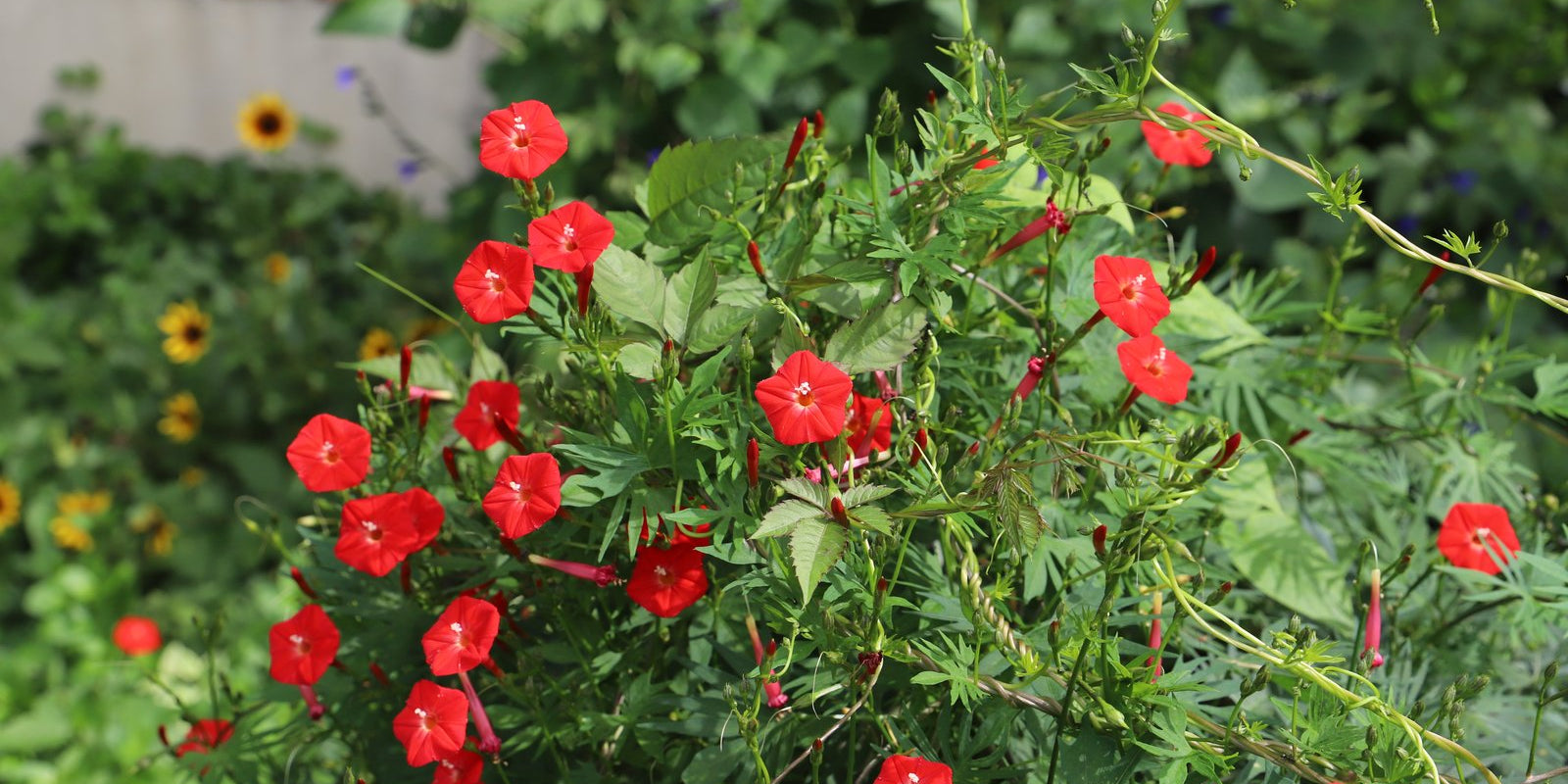
Cardinal climber (Ipomoea × multifida, also sold as Ipomoea × sloteri) is an annual vine grown for scarlet flowers, in the morning glory family, Convolvulaceae. This garden-made cross of cypress vine and red morning glory grows fast and can clothe a trellis in one warm season. The usual stumble comes first: hard seed sown straight from the packet into cool soil can sit for weeks without sprouting.
Three mistakes that matter
- Sowing untreated seed into cold soil. The hard seed coat keeps water out. Soak or nick it as set out in Sowing Seeds, and wait for the soil warmth in When to plant.
- Planting into rich, heavily fed soil. Manure-rich beds and generous feeding grow a tangle of leafy vine with few flowers. Choose average, free-draining soil, and keep to the light feeding in Care by growth stage.
- Letting ripe pods drop in warm zones. The vine reseeds readily where winters are mild, and its parent cypress vine already smothers bushland in northern Australia. Pick pods before they split, as described in Pruning and Training.
When to plant
Cardinal climber is frost tender, so sow once frosts are over and the soil holds at least 20°C. Seed germinates best in soil of 20 to 30°C. One sowing is enough, because a vine keeps flowering until cold weather or frost stops it.
| Zone | Example cities | Sow | Flowering | Notes |
|---|---|---|---|---|
| Tropical | Darwin NT; Cairns, Townsville QLD; Broome WA | May-Oct | Jul-Mar | Sow through the dry season, keeping seed out of wet-season downpours; pick pods before they drop. |
| Subtropical | Brisbane, Gold Coast, Bundaberg QLD; Coffs Harbour, Lismore NSW | Sep-Jan | Dec-May | Sow once spring soil warms; pick pods near creeks and bushland, where cypress vine already escapes. |
| Arid and semi-arid | Alice Springs NT; Broken Hill, Dubbo NSW; Mildura VIC; Kalgoorlie WA | Oct-Dec | Jan-Apr | Sow after the inland frosts; mulch deeply and water steadily through the dry heat. |
| Temperate | Sydney, Newcastle, Wollongong NSW; Melbourne, Geelong VIC | Oct-Dec | Jan-Apr | Sydney can sow from October; Melbourne, the cool end, waits until the soil warms in November. |
| Mediterranean | Perth, Bunbury WA; Adelaide SA | Oct-Dec | Jan-Apr | Sow into warm spring soil; summer heat arrives dry, so mulch well and water deeply. |
| Cool and alpine | Canberra ACT; Hobart TAS; Ballarat VIC; Armidale NSW | Oct-Dec | Feb-Apr | Start in pots under cover in October; plant out after the last frost, often Melbourne Cup weekend. |
Where spring is slow to warm, start seed in pots under cover 4 to 6 weeks before the last frost. Late sowings still flower, but for a shorter run before autumn cold ends them.
Site, soil and setup
Give the vine at least six hours of direct sun a day; it grows in part shade but flowers less there. It needs free-draining soil of average fertility, at a pH of about 6.0 to 8.0.
| Where | What to do |
|---|---|
| Every bed | Dig in a 5 cm layer of compost before sowing. Skip manure, which pushes leaves at the expense of flowers. |
| Acid soil, below pH 6.0 | Spread garden lime at 100 to 200 g per square metre and dig it in 4 weeks ahead of sowing. |
| Heavy clay that stays wet | Grow in a raised bed or a large pot, as the vine needs good drainage. |
| Sandy or inland soil that sheds water | Water in a wetting agent at the label rate before sowing. |
| The support | Fix a trellis, wire mesh, netting or strings against a fence or post. Vines reach about 2.5 to 4.5 m. |
Avoid a bed where sweet potato grew last season, because the two share leaf-mining and hawk moth caterpillars. Cypress vine (Ipomoea quamoclit), one parent, is an environmental weed in the Top End, the Kimberley and coastal Queensland. Neither plant is a declared weed anywhere in Australia, as the table shows, but ask your council before growing either near bushland.
| State or territory | Status of cardinal climber and cypress vine |
|---|---|
| Queensland | Neither is a prohibited or restricted invasive plant. Cypress vine is an environmental weed on the coast and a problem along south-east Queensland creeks. |
| New South Wales | No listing beyond the general biosecurity duty that covers every plant. Cypress vine has escaped north from the Richmond River. |
| Victoria | Not a declared noxious weed. |
| Tasmania | Not a declared weed. |
| South Australia | Not a declared plant. |
| Western Australia | Both are Permitted on the Western Australian Organism List. Cypress vine is naturalised in the Kimberley. |
| Northern Territory | Not a declared weed. Cypress vine grows wild around settlements across the Top End. |
| Australian Capital Territory | Not a declared pest plant. |
Container growing
Cardinal climber grows well in a large pot with an obelisk or frame to climb, or trailing from a hanging basket. Use a pot at least 30 cm deep and wide, about 20 L, filled with fresh potting mix. Grow it alone, because the vine overwhelms anything planted with it.
- Watering: push a finger into the mix and water deeply when the top few centimetres feel dry; in hot weather that is often daily.
- Feeding: water in seaweed solution at 30 mL per 9 L fortnightly. From the first flowers, switch to liquid potash at the label rate, fortnightly.
- Position: full sun against a wall, railing or post the vine can reach.
Sowing Seeds
Start cardinal climber from soaked or nicked seed, sown direct at the foot of its support, or in pots under cover where spring is cool.
Preparing the seed
Soak the seed overnight in warm water, never longer than 24 hours, and sow the swollen seeds straight away. Any seed that stays hard and small needs scarifying (breaking the hard coat so water can enter). Rub one spot with a nail file or fine sandpaper, on the side away from the eye, until the paler inner layer just shows.
Sowing direct
- Sow two or three seeds 6 to 8 mm deep at each spot, with the spots 15 to 30 cm apart along the support.
- Keep the soil evenly damp but never soggy; seedlings usually appear in 7 to 21 days.
- Thin to the strongest seedling at each spot once true leaves show.
Starting under cover
- Sow one or two seeds in each small pot or deep cell of seed raising mix, 6 mm deep.
- Keep the pots at about 21°C; a seedling heat mat holds that warmth steady.
- Harden off seedlings over one to two weeks (moving them outside for longer each day so they adjust to sun and wind).
- Plant out after the last frost, setting the whole root ball in without breaking it up, as the roots resent disturbance.
Care by growth stage
Warm weather, regular water and a light hand with feeding keep cardinal climber flowering. Weeks count from sowing.
| Stage | Water | Feed | Watch for |
|---|---|---|---|
| Seedlings (weeks 1 to 4) | Keep the soil evenly damp, watering gently at the base | Nothing until the first true leaves, then seaweed solution at half strength (15 mL per 9 L) fortnightly | Seedlings collapsing at soil level (see Common problems) |
| Climbing (weeks 4 to 10) | Water deeply when the top few centimetres dry out | Seaweed solution at 30 mL per 9 L fortnightly; no high-nitrogen feeds | Stems wandering off the support; aphids on shoot tips |
| First flowers (weeks 10 to 14) | Keep the soil evenly moist under mulch | Sulphate of potash at 30 g per square metre, scattered once around the base and watered in | Large caterpillars and winding leaf mines (see Pests and diseases) |
| Full flower to frost (week 14 onward) | Keep watering steadily right through flowering | Liquid potash at the label rate fortnightly, only if flowering slows | Pods turning brown (see Pruning and Training) |
If growth stalls in very poor soil, a light dose of all-purpose controlled release granular (NPK around 14-5-10) scratched into the soil can help.
Pruning and Training
Cardinal climber needs training more than pruning, and its flowers need no deadheading. Fix the support before sowing, then guide stems onto it as they grow.
- Tie in early: loop young stems loosely to the support with soft twine until they start to twine by themselves.
- Tuck in strays: weave wandering stems back through the trellis or netting before they tangle together.
- Trim as needed: cut back stems that reach gutters, shrubs or other plants; no regular pruning is needed.
- Pick unwanted pods: in warm zones, pull off browning pods you will not save, so fewer seeds drop.
- End of season: once frost kills the vine, pull it out and put any pods in the bin, not the compost. Where there is no frost, pull it out once flowering fades, before the last pods ripen.
Companion planting
The red flowers draw bees and butterflies, so the best partners gain from those visitors or finish before the vine takes over.
Grows well with
- Poppy: spring poppies finish as the heat arrives, and the vine can scramble over the gap they leave.
- Cucumber and zucchini: both need bees to move their pollen, and the vine keeps bees busy nearby.

Keep apart
- Sweet potato: both host the same leaf miner and hawk moth caterpillars, and Ipomoea species can carry viruses that infect sweet potato.
- Shrubs and small trees: a vine that escapes its support can smother them.
Harvesting Blooms
Flowers usually start 10 to 14 weeks after sowing and keep coming until cold weather, each bloom closing up at night.
- If you plan to save seed, leave a few flowers on the healthiest vine to set pods.
- Let pods dry on the vine until papery and brown; each holds 2 to 4 hard seeds.
- Pick the pods before they split, and shell the seed onto a tray indoors.

Store dry seed in a labelled paper envelope in a cool, dry place. This hybrid comes true from seed, so saved seed grows the same vine next season.
Common problems
Seedlings collapse at soil level. Damping off (Pythium species and Rhizoctonia solani) rots young stems, most often in wet, cold seed raising mix or soil. Read more
Transplants sit still. Seedlings planted out with a broken root ball often stall, because the vine resents root disturbance.
The vine crawls in spring. Growth is slow in cool weather and races away once hot, humid days arrive, so patience usually fixes it.
Stems sprawl instead of climbing. Without a support in reach and a first tie, the slender stems twist around each other and across the ground.
Plenty of leaves, few flowers. Part shade thins the display, and so does soil made rich with manure (see Three mistakes that matter).
Pests and diseases
Cardinal climber has no major pests or diseases in most gardens, though insects that feed on sweet potato and morning glories sometimes visit.
Aphids (family Aphididae). Small sap-suckers, including cotton aphid (Aphis gossypii), cluster on shoot tips, curling young leaves and leaving sticky honeydew. Read more
Convolvulus hawk moth (Agrius convolvuli). Its caterpillars, green at first and later dark brown or black, carry a horn on the tail and grow to 9 to 12 cm long. They strip leaves from vines in this family.
Sweet potato leaf miner (Bedellia somnulentella). Tiny caterpillars tunnel winding mines inside the leaves, sometimes through much of each leaf.
Prevention first
- Hose shoot tips and leaf undersides with a firm jet to knock aphids off.
- If aphids return, spray insecticidal soap on the colonies in the cool of the morning.
- Check leaves early or late in the day and pick caterpillars off by hand.
- Pick off and bin mined leaves before the caterpillars inside finish feeding.
Tips
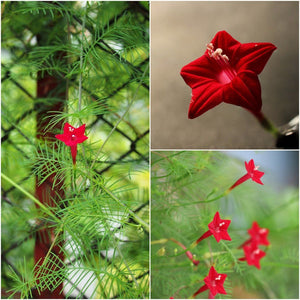
- Tell your seedlings from cypress vine by the leaves. Cardinal climber has 3 to 7 pairs of narrow lobes, like a small palm leaf; cypress vine splits into thread-fine segments.
- Run strings up a sunny veranda post or bare fence for a quick summer screen that comes down with the frost.
- Try it as a groundcover over a sunny bank, where the stems knit into a low, flowering mat.
Questions
When do I plant cardinal climber seeds in Australia?
Sow once frost is over and the soil holds at least 20°C. That is Oct to Dec in temperate, Mediterranean, arid and cool areas, Sep to Jan in the subtropics, and May to Oct in the tropics. In cool areas, start seed in pots under cover in October.
Should I soak cardinal climber seeds before planting?
Yes. Soak the seed overnight in warm water, no longer than 24 hours, and sow the swollen seeds straight away. Nick any that stay small with a nail file, on the side away from the eye, so water can get in.
Is cardinal climber the same as cypress vine?
No. Cardinal climber is a hybrid of cypress vine and red morning glory. Its leaves have a few pairs of narrow lobes, like a small palm leaf. Cypress vine leaves split into many thread-fine segments.
Why is my cardinal climber all leaves and no flowers?
Usually the soil is too rich or the spot too shady. Manure and high-nitrogen feeds push leafy growth at the expense of flowers. Grow it in full sun in average soil, and feed lightly with seaweed solution and a little potash from the first flowers.
Are cardinal climber seeds poisonous?
Yes. The seeds contain indole alkaloids, including lysergic acid compounds. Eating them can cause vomiting, and larger amounts can cause hallucinations. Keep seed and pods away from children and pets, and call the Poisons Information Centre on 13 11 26 if any is swallowed.
Is cardinal climber a weed in Australia?
It is not a declared weed in any state or territory. Its parent, cypress vine, is an environmental weed in northern Australia, and cardinal climber reseeds in warm areas. Pick pods before they split, and ask your council before growing it near bushland.
Grow it
More flower guides
All flowers
Ageratum
Grow ageratum from seed in Australia: surface sowing, months for six climate zones, spacing, pots, deadheading, weed and livestock cautions and pests to watch.
| Position | Full sun, 6 hours or more |
|---|---|
| Depth | Surface, 1 mm at most |
| Spacing | 30 cm; Red Flint 40 cm |
| First pick | 12 to 14 weeks from sowing |

Alyssum
Grow alyssum from seed in Australia: sowing months for six climate zones, surface sowing, spacing, pots, shearing for more flowers, and the pests to watch.
| Position | Full sun or part shade |
|---|---|
| Depth | Surface sow, press in |
| Spacing | 15 to 20 cm |
| First pick | 8 to 9 weeks from sowing |

Aquilegia
Grow aquilegia from seed in Australia: chilling the seed, when to sow in six climate zones, part shade, pots, deadheading, cut flowers and common pests.
| Position | Part shade or morning sun |
|---|---|
| Depth | Surface, 3 mm cover at most |
| Spacing | 30 to 50 cm |
| First pick | From about 28 weeks |

Aster
Grow China asters in Australia: sowing months for six climate zones, spacing, pots, watering, Fusarium wilt and thrips, and cutting blooms for the vase.
| Position | Full sun, 6 hours minimum |
|---|---|
| Depth | 6 mm |
| Spacing | 30 to 40 cm |
| First pick | 13 to 16 weeks |