
How to Grow Larkspur in Australia
Sow larkspur seed 3 to 6 mm deep, covered, in cool autumn soil of about 10 to 18°C; seedlings appear in 14 to 21 days. Sow where it is to flower, because the taproot resents moving, and thin to 20 to 30 cm. Plants need cold nights to flower, usually 11 to 21 weeks from sowing. Every part is poisonous, so wear gloves.
| Sun | Full sun, light afternoon shade |
|---|---|
| Water | Evenly moist, never waterlogged |
| Soil | Free-draining, neutral to slightly alkaline, with compost |
| Feed | Light; compost at sowing, seaweed solution for seedlings |
| Spacing | 20 to 30 cm |
| Depth | 3 to 6 mm, covered |
| Germination | 14 to 21 days at 10 to 18°C |
| Harvest | 11 to 21 weeks |
| Container | Pot 30 cm or wider, heavy base |
| Frost | Hardy; autumn seedlings overwinter outdoors |
| Use | Cut and dried flowers; poisonous, not edible |
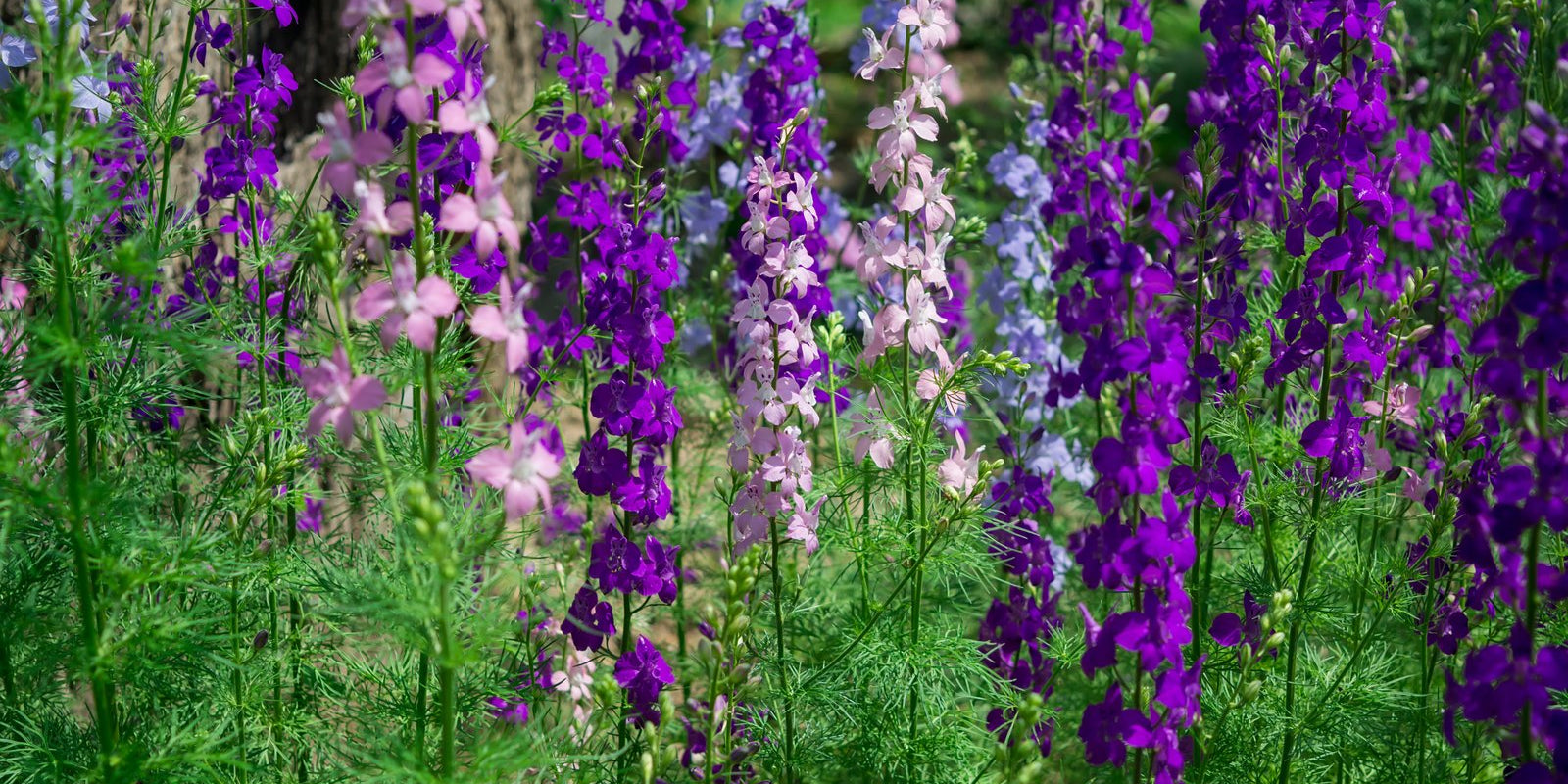
Larkspur (Consolida ajacis, also listed as Delphinium ajacis) is a hardy annual of the buttercup family, Ranunculaceae, grown for tall spikes of colourful flowers. Sown in autumn, it sits through winter as a feathery clump, then flowers from late winter to early summer for the vase or for drying. Where most sowings go wrong is timing: seed put in during spring warmth sulks, and the plants flower short.
Three mistakes that matter
- Waiting for spring. Warm soil gives patchy germination, and plants that miss a run of cold nights flower short. Sow in autumn, or at the times your zone's row gives in the table under When to plant.
- Raising seedlings in a shared punnet. Larkspur sends down a taproot early, and seedlings pulled apart for planting out often stall or die. Sow in the bed itself, or one plant to a cell.
- Scattering seed on top. Light stops the seed germinating, so seed left lying on the surface often fails. Bury it 3 to 6 mm deep in fine soil and keep that covering damp until the seedlings break through.
When to plant
Larkspur germinates in cool soil of about 10 to 18°C. The young plants then need several weeks of nights between about 0 and 10°C to flower well (vernalisation, a chilling period that triggers flowering). That is why autumn is the main sowing season in the south, with Anzac Day a handy marker.
| Zone | Example cities | Sow | Flowering | Notes |
|---|---|---|---|---|
| Tropical | Darwin NT; Cairns, Townsville QLD; Kununurra WA | Apr-Jun | Aug-Oct | Marginal: warm nights limit flowering. Sow in the coolest dry-season months and expect shorter spikes. |
| Subtropical | Brisbane, Sunshine Coast, Bundaberg QLD; Coffs Harbour NSW | Apr-Jun | Aug-Nov | Sow once autumn cools; plants flower through late winter and spring, well before the humid summer. |
| Arid and semi-arid | Alice Springs NT; Dubbo NSW; Mildura VIC; Kalgoorlie WA | Apr-May | Sep-Nov | Marginal: sow in autumn so spikes open before spring heat and hot winds; shelter and mulch well. |
| Temperate | Sydney, Newcastle, Wollongong NSW; Melbourne VIC | Mar-May and Aug-Sep | Sep-Jan | Autumn sowings flower best; August sowings still flower, on shorter spikes as the weather warms. |
| Mediterranean | Perth, Bunbury WA; Adelaide SA | Mar-Jun | Sep-Dec | Sow with the autumn rains; spring sowings run into the early dry heat and flower poorly. |
| Cool and alpine | Hobart TAS; Canberra ACT; Ballarat VIC; Orange NSW | Mar-Apr and Sep-Oct | Nov-Feb | Autumn seedlings overwinter outdoors. On the coldest tablelands, sow in spring once the soil can be worked. |
Give seedlings about 6 weeks of growth before the cold arrives, so each forms a small rosette first. Missed autumn? In temperate gardens, a sowing in early August still flowers, usually 11 to 13 weeks later.
Site, soil and setup
The strongest stems come from full sun, with light afternoon shade a help where spring turns hot early. Strong wind bends and snaps tall spikes, so pick a sheltered bed. Larkspur likes free-draining, neutral to slightly alkaline soil with plenty of organic matter, and its roots rot where water lies.
| Soil | Preparation |
|---|---|
| Any bed | Weed thoroughly, loosen the soil with a fork and dig through a 5 cm layer of compost. |
| Acid (check with a pH kit) | A month ahead of sowing, dig in garden lime at 100 to 200 g per square metre. |
| Clay that holds water | Build the bed up or sow on mounds. Gypsum, at 500 g to 1 kg per square metre, helps only dispersive clay: a dry crumb dropped in rainwater turns it milky within 20 hours. |
| Sand that repels water | Treat with a wetting agent at the rate on its label, and mulch lightly after emergence. |
Rhizoctonia, one cause of damping off, lives on in plant scraps between crops. Give larkspur a fresh patch if seedlings rotted there the previous year.
Container growing
A pot stops larkspur seeding itself around. Use a pot 30 cm or more across, such as a standard 300 mm pot holding about 13.5 L. Drainage holes matter, and so does a broad, weighty base under such tall spikes. Potting mix can harbour Legionella bacteria, so moisten it before opening, wear gloves and a mask, then scrub your hands.
- Watering: water when the top of the mix dries; cold, soggy roots rot.
- Feeding: once buds form, a fish and seaweed blend at 25 mL per 9 L each fortnight.
- Position: a sunny, sheltered corner, with one slim stake set in at sowing.
Sowing Seeds
Larkspur is started from seed sown in its flowering spot, since young plants take badly to moving.
Preparation
A spell in the fridge (cold stratification) brings seed up faster and more evenly. Two weeks ahead of sowing, tip the seed into a small airtight container and mist it until every seed is damp, leaving no pooled water. Mark the container as poisonous seed and store it well away from food. Handle the seed in gloves and sow it cold. More on cold stratification.
Sowing direct
- Rake to a fine tilth, drop a few seeds every 10 cm and bury them 3 to 6 mm deep.
- Keep the surface damp, never soggy or dry. Seedlings usually appear in 14 to 21 days.
- When true leaves show, reduce to one plant every 20 to 30 cm, or every 15 cm in a row kept for cutting.
- Snip extras at ground level rather than pulling them, sparing the taproots left behind.
Starting in cells
- Fill cells with seed raising mix and put two or three seeds in each, 3 to 6 mm deep.
- Keep the tray unheated, at about 13°C, under newspaper until shoots appear.
- Thin each cell to its best seedling with scissors.
- Harden off the young plants (a week of longer and longer spells outdoors) and set them out 5 to 7 weeks after sowing.
- Slide each plug out intact and settle it in with half-strength seaweed solution, 15 mL per 9 L.
The Imperial Mix grows 90 to 120 cm tall, in deep and pale blue, pink, lilac and white. Perennial delphiniums look alike but live for years; they have their own guide at Delphiniums.
Care by growth stage
A bed prepared with compost gives larkspur nearly all the food it needs. Even moisture and cool roots count for more than fertiliser, and autumn sowings usually take 18 to 21 weeks to flower.
| Stage | Water | Feed | Watch for |
|---|---|---|---|
| Seedlings (weeks 1 to 6) | Light, frequent watering; damp, not soggy | None before true leaves; after that, seaweed solution at half strength (15 mL per 9 L) every second week | Stems rotting at ground level; snail and slug damage overnight |
| Winter rosette (weeks 6 to 12) | Morning watering at the base, once the soil is dry 5 cm down | Nothing in a compost-rich bed; in poor soil, worm casting liquid the colour of weak tea every second week | Waterlogged soil around the crown after heavy rain |
| Stems and buds (about weeks 12 to 18) | Deep soaks through dry spells, with mulch to keep the roots cool | One dressing of sulphate of potash, 30 g per square metre, watered in as spikes appear | Aphids on soft tips; stems starting to lean |
| Flowering (about weeks 14 to 21) | Hold the soil evenly moist until the last spikes are cut | Only if leaves pale, fish and seaweed blend at 25 mL per 9 L every second week; seaweed solution at 30 mL per 9 L after heat | White powder on the leaves; plants yellowing as the heat builds |
Spikes this tall need support to grow straight. Set stakes or a layer of flower netting in place at sowing, before the roots spread. If growth stalls in poor soil, a light dose of all-purpose controlled release granular (NPK around 14-5-10) scratched in can help.

Deadheading
Cutting each spike as it fades brings on side spikes and stops seed scattering.
- Main spike: when most of its flowers have dropped, cut back to the leaves just below, and side spikes follow.
- Weekly in flower: take off spent side spikes the same way.
- End of the season: leave a few spikes to ripen for seed, then pull the plants as they yellow in the heat.
Companion planting
Larkspur suits a cottage bed of other cool-season annuals sown in the same autumn weeks.
Grows well with
- Cornflowers: sown in the same months, with a similar cutting season.
- Calendula: autumn-sown and lower, so it fills the space in front of the spikes.
- Violas: a low edging sown in the same months.
Keep apart
- Perennial delphiniums: the same powdery mildew infects both, so one can spread it to the other.
- Sunflowers on the northern side: their height robs larkspur of the sun it flowers best in.
Harvesting Blooms
A spike is ready for the vase once its bottom two or three flowers are open.
- Take each stem as long as it comes, cutting to just above a pair of leaves.
- Pull off the leaves below the water line and plunge the stems into clean water at once.
- For drying, wait until most flowers are open, before any petals drop.
- Hang small bunches head down, stripped of leaves, somewhere cool and dry.
Fresh stems usually last 5 to 7 days. Change the water often and keep the vase away from fruit, which can make the petals drop. Dried spikes hold their colour for wreaths and winter jars. For seed, let a few pods turn papery and split, then shake the black seed into a paper bag outdoors.
Common problems
Bare rows after three weeks. Warm soil and seed left in the light, the first and third of Three mistakes that matter, account for most failures. Read more
Seedlings keel over. Damping off (a stem rot at soil level, mostly from Pythium species and Rhizoctonia solani) thrives in soggy soil or mix. Read more
Short spikes and few flowers. Plants sown late into warm weather miss their cold spell, and hot, dry conditions stunt them further.
Plants yellow and rot at the base. Soil that stays sodden rots the roots. Raise the bed, as in Site, soil and setup, or grow larkspur in a pot.
Pests and diseases
Snails take seedlings, aphids cluster on soft tips, and mildew arrives late as plants age.
Garden snail (Cornu aspersum) and grey field slug (Deroceras reticulatum). Both graze seedlings down to stumps overnight, leaving slime behind. Collect them after dark with a torch, sink beer traps, and ring pots with copper strips. Read more
Green peach aphid (Myzus persicae). These small sap-suckers, yellow, green or pink, crowd onto new shoots, and the leaves can wilt or discolour. Hose them off, then spray insecticidal soap if they return. Read more
Powdery mildew (Erysiphe aquilegiae). A white, dusty coating starts on the older, lower leaves and creeps upward. Pick off badly coated leaves, then spray a mix of 1 part full-cream milk and 10 parts water. Read more
Prevention first
- Thin to the distances in Sowing Seeds, so breezes can dry the foliage.
- Aim the hose at the ground in the morning and keep the leaves dry.
- Start every tray with new seed raising mix and scrubbed cells.
- Check seedlings by torchlight in the evenings, and tips weekly for aphids.
Tips
- Sow along a fence, where the tall spikes shade nothing.
- Larkspur has naturalised in several states, so cut spent spikes before seed drops anywhere near bushland.
- Label any seed you save as poisonous and store it out of reach, away from vegetable seed and food.
Questions
When do you plant larkspur seeds in Australia?
Mostly in autumn. Sydney and Melbourne sow Mar to May, Perth and Adelaide Mar to Jun, and Brisbane Apr to Jun. Canberra and Hobart sow Mar to Apr, or Sep to Oct on the coldest ground. Plants need weeks of cold nights to flower well, so spring sowings in warm areas often flower short.
Is larkspur poisonous to children, dogs and cats?
Yes. Every part of larkspur is poisonous if eaten, and the seed most of all. The sap can also irritate skin and eyes. Keep plants, cut stems and saved seed away from children, pets and livestock. If any part is swallowed, call the Poisons Information Centre on 13 11 26, or a vet for an animal.
Do larkspur seeds need to be chilled before sowing?
It is not essential, but it helps. Two weeks before sowing, mist the seed lightly, seal it in a labelled airtight container and keep it in the fridge, away from food. Chilled seed usually comes up faster and more evenly. Sow it 3 to 6 mm deep and cover it, because it needs darkness.
Can you transplant larkspur seedlings?
Only with care. Larkspur puts down a taproot early and dislikes disturbance, so sow it in the bed or one seed pair to a cell. Harden cell seedlings off and plant them out 5 to 7 weeks after sowing, sliding each plug out intact. Seedlings pulled apart from a shared punnet often stall.
What is the difference between larkspur and delphinium?
Larkspur is an annual that flowers once from seed and then dies. The garden delphinium is a perennial that lives for several years. They are close relatives with similar spikes of flowers, and both are poisonous. Larkspur is usually sown direct in autumn, while perennial delphiniums are grown and cared for differently.
How do you dry larkspur flowers?
Cut the spikes when most flowers are open, before any petals drop. Strip the leaves, tie the stems in small bunches and hang them upside down in a cool, dry place. The colours dry quickly and hold well. Wear gloves while handling the stems, as the sap can irritate skin.
Grow it
More flowers to sow in September
All flowers
Ageratum
Grow ageratum from seed in Australia: surface sowing, months for six climate zones, spacing, pots, deadheading, weed and livestock cautions and pests to watch.
| Position | Full sun, 6 hours or more |
|---|---|
| Depth | Surface, 1 mm at most |
| Spacing | 30 cm; Red Flint 40 cm |
| First pick | 12 to 14 weeks from sowing |

Alyssum
Grow alyssum from seed in Australia: sowing months for six climate zones, surface sowing, spacing, pots, shearing for more flowers, and the pests to watch.
| Position | Full sun or part shade |
|---|---|
| Depth | Surface sow, press in |
| Spacing | 15 to 20 cm |
| First pick | 8 to 9 weeks from sowing |

Aster
Grow China asters in Australia: sowing months for six climate zones, spacing, pots, watering, Fusarium wilt and thrips, and cutting blooms for the vase.
| Position | Full sun, 6 hours minimum |
|---|---|
| Depth | 6 mm |
| Spacing | 30 to 40 cm |
| First pick | 13 to 16 weeks |

Aubretia
Growing aubretia as a hardy groundcover in Australian gardens: sowing, position, trimming after flowering, companion plants and common pests.
| Position | Full sun, 6 hours or more |
|---|---|
| Depth | On the surface, barely covered |
| Spacing | 25 to 30 cm |
| First pick | Spring, after a winter chill |