
How to Grow Stock in Australia
Sow stock seed from late summer into autumn, 3 mm deep in trays at about 18 to 24°C. Seedlings usually appear in 1 to 2 weeks. Plant out at 5 to 10 cm tall, 20 to 30 cm apart, in full sun and rich, limed soil. Flowers usually open 10 to 20 weeks from sowing, depending on the variety.

| Sun | Full sun, 6 hours plus |
|---|---|
| Water | Evenly moist; water the soil, not leaves |
| Soil | Rich, free-draining, limed, pH 7.0 to 7.5 |
| Feed | Potassium-rich feed fortnightly from bud stage |
| Spacing | 15 to 30 cm by variety |
| Depth | 2 to 3 mm |
| Germination | 1 to 2 weeks at 18 to 24°C |
| Harvest | 10 to 20 weeks from sowing |
| Container | 5 L pot each; 10 L for groups |
| Frost | Tolerates light frost |
| Use | Scented beds, pots and cut flowers |
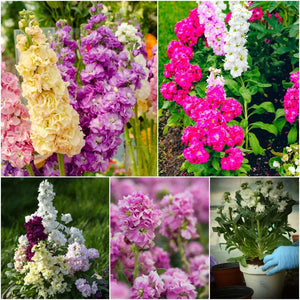
Stock (Matthiola incana) belongs to the cabbage family, Brassicaceae. It is grown for its spikes of sweetly scented flowers, in the bed and the vase. Across most of Australia it flowers from autumn through winter into spring, and a few stems can scent a whole room. The usual failure is timing: plants sown into warming weather make leaves, then fade before they flower well.
Three mistakes that matter
- Sowing into warming weather. Stock flowers best in cool conditions, and plants that meet hot days and warm nights before they bloom decline and flower poorly. Sow from late summer into autumn, within the months for your zone in When to plant.
- Planting into acid soil. Like the rest of the cabbage family, stock does not thrive in acid ground. Check the pH and dig in lime four weeks before planting, as Site, soil and setup describes.
- Crowding plants and wetting the leaves. Tight, damp foliage invites downy mildew and grey mould, which both thrive in cool, wet weather. Give each variety its full spacing from Sowing Seeds, and water the soil rather than the plant.
When to plant
Stock seed germinates at about 18 to 24°C, yet the plants grow and flower best in cool weather. Sow as the summer heat breaks, so seedlings establish in warm soil and flower through the cool months. For a longer run of stems, sow a few seeds every few weeks through your window.
| Zone | Example cities | Sow | Flowering | Notes |
|---|---|---|---|---|
| Tropical | Darwin NT; Cairns, Townsville QLD; Kununurra WA | Apr-May | Jul-Sep | Sow early in the dry season; 'Dwarf Ten Week Mixed' flowers soonest, before build-up heat ends the display. |
| Subtropical | Brisbane, Sunshine Coast, Bundaberg QLD; Coffs Harbour NSW | Mar-Jun | Jun-Oct | Sow once the humid summer heat eases; flowers run through winter until spring warmth builds. |
| Arid and semi-arid | Alice Springs NT; Broken Hill NSW; Mildura VIC; Kalgoorlie WA | Mar-May | Jun-Oct | Plants take light inland frost; mulch and water steadily as dry spring heat returns. |
| Temperate | Sydney, Newcastle, Wollongong NSW; Melbourne VIC | Feb-Apr and Aug | May-Nov | Plant seedlings out around Anzac Day; keep August sowings to 'Dwarf Ten Week Mixed', which flowers before summer. |
| Mediterranean | Perth, Bunbury WA; Adelaide SA | Feb-May | May-Oct | Sow as the summer heat eases; plants flower through the wet winter and fade in dry late-spring heat. |
| Cool and alpine | Hobart TAS; Canberra ACT; Ballarat VIC; Orange NSW | Jan-Apr and Aug | Apr-Dec | Frost can pause flowering in midwinter; raise August trays under cover and plant out after heavy frosts. |
Near the end of a window, choose 'Dwarf Ten Week Mixed', which flowers sooner than the giant types. Evening scented stock (Matthiola longipetala, sold as Matthiola bicornis) germinates cooler, at about 14 to 20°C, so it can go in later.
Site, soil and setup
Give stock full sun, at least 6 hours of direct sun a day, in a bed sheltered from strong wind. It wants deep, rich soil that drains freely and sits neutral to slightly alkaline, about pH 7.0 to 7.5.
| Where | What to do |
|---|---|
| Every bed | Weed and dig deeply, then mix in compost 5 cm deep and pelletised chicken manure at 100 g per square metre. Well-rotted cow or horse manure, 5 to 10 cm deep, does the same job if dug in 4 to 6 weeks ahead. |
| Soil below pH 7.0 | Dig in garden lime or dolomite lime at 100 to 200 g per square metre, 4 weeks before planting. |
| Clay, or ground that stays wet | Build the bed up. Gypsum at 500 g to 1 kg per square metre helps only dispersive clay, which clouds rainwater within 20 hours when an air-dried crumb is dropped in. |
| Sand that sheds water | Water in a wetting agent at the label rate before planting, then mulch. |
Downy mildew spores survive in old leaves in the soil. Move stock to a fresh bed each year, returning after 2 to 3 years.
Container growing
'Dwarf Ten Week Mixed', 'Evening Scented' and 'Virginian Mixed' are the compact choices for pots. One plant needs a pot at least 20 cm wide and deep, which holds about 5 L. A group needs 10 L or more, such as a 30 cm pot of about 13.5 L.
Fill it with fresh potting mix. Bagged mix can carry Legionella bacteria, so wet it before you handle it, wear a mask and gloves, and wash your hands afterwards.
- Watering: water at the base once the top 5 cm of mix is dry, soaking it through.
- Feeding: fish and seaweed blend at 25 mL per 9 L, fortnightly, then liquid potash at the label rate once buds show.
- Position: full sun, though a few hours of shade suits pots in warmer spots.
Sowing Seeds
Garden stock is usually raised in trays and planted out. Evening scented stock and Virginian stock (Malcolmia maritima, a separate genus) grow in much the same way, but are sown where they will flower.
Starting under cover
- Sow thinly over fresh seed raising mix in a clean tray or punnet, and cover with 3 mm of fine mix.
- Keep the mix moist but never wet or dry.
- Hold the tray at the germination temperature in When to plant, and expect seedlings in 1 to 2 weeks.
- When the first true leaves open, prick out the seedlings (move each into its own cell or small pot).
Sowing direct
- Rake the soil fine, scatter the seed thinly and cover it with 2 to 3 mm of soil.
- Keep the surface damp until seedlings show, usually within 1 to 3 weeks.
- Thin Virginian stock to 15 cm apart and evening scented stock to 20 to 30 cm.
- Leave evening scented stock where it comes up, because it does not take kindly to being moved.
Due to quarantine restrictions and our shipping policy, we cannot send 'Evening Scented' stock seed to South Australia or Western Australia.
Transplanting
- Plant out when seedlings are 5 to 10 cm tall, usually 5 to 10 weeks after sowing.
- Harden off the young plants first (get them used to outdoor sun and wind by leaving them out a little longer each day).
- Space them as the variety table below gives, with the lowest leaves sitting level with the soil.
- Water in with seaweed solution at half strength, 15 mL per 9 L, then mulch lightly.
| Variety | Height | Spacing | Flowers from sowing | Best use |
|---|---|---|---|---|
| 'Dwarf Ten Week Mixed' | 35 cm | 20 cm | 70 to 80 days | Front of beds, pots and short posies; the latest sowings |
| 'Giant Imperial Mixed' | 60 cm | 30 cm | About 140 days | Bushy, branched plants with single flowers in purple shades, for beds and cutting |
| 'Giant Column Pacific Blue' | 75 cm | 30 cm | About 140 days | Tall spikes for the vase and the back of a bed |
| 'Evening Scented' (Matthiola longipetala) | 50 cm | 20 to 30 cm | 95 to 115 days | Sown direct near seating, for scent after dark |
| 'Virginian Mixed' (Malcolmia maritima) | 30 cm | 15 cm | About 100 days | Sown direct in pinks, lilacs and whites, for edges and pots |
Care by growth stage
Cool nights, steady moisture and a potassium-rich feed from bud stage decide how well stock flowers.
| Stage | Water | Feed | Watch for |
|---|---|---|---|
| Seedlings in trays (weeks 1 to 6) | Keep the mix damp, never soggy | None before the first true leaves; then seaweed solution at half strength, 15 mL per 9 L, fortnightly. No synthetic feed in trays | Seedlings collapsing at soil level |
| Planted out (weeks 6 to 12) | Water deeply at the base when the top 5 cm is dry; mulch | Organic: fish and seaweed blend, 25 mL per 9 L, fortnightly. Synthetic: all-purpose controlled release granular (NPK around 14-5-10) mixed in at planting | Aphids, caterpillars, and snails at night |
| Buds and flowering (weeks 10 to 20) | Evenly moist soil, dry leaves | Organic: sulphate of potash, 30 to 50 g per square metre as buds show, or liquid potash at the label rate, fortnightly. Synthetic: fruiting and flowering soluble (NPK 15-4-26 to 15-5-20), fortnightly | Downy mildew under the leaves; brown leaf tips and margins |
| Cutting and late season | Keep watering steadily until the last stems are cut | Organic: fish and seaweed blend, 25 mL per 9 L, fortnightly while dwarf plants rebloom. Synthetic: fruiting and flowering soluble, fortnightly | Grey mould on old flowers; flowering slowing as nights warm |

Deadheading
Take off spent spikes as they fade, which on the dwarf types can bring more flowers.
- How to cut: cut each faded spike back to just above a set of leaves, using sharp snips or secateurs.
- Giant types: the main spike is the crop, and once it is cut the plant is usually finished.
- No pinching: leave the growing tips of garden stock alone.
- Virginian stock: let a few seed pods ripen, and seedlings may come up by themselves.
- End of the season: pull plants out once warm weather stops the flowers, and add them to the compost heap.
Companion planting
Good neighbours share its cool season and its need for sun, without shading it.
Grows well with
- Violas and sweet William: low cool-season flowers sown in the same months, set in front of taller stock.
- Calendula: another annual of the same sowing window, adding orange and yellow.
- Cornflowers: sown in the same months, and a blue partner for stock in the vase.
Keep apart
- Cabbages, broccoli and kale: they share cabbage aphid and cabbage white caterpillars with stock.
- Peas on a trellis to the north: their winter shade falls across plants that need 6 hours of sun.
Harvesting Blooms
Cut stems for the vase when one-third to one-half of the flowers on the spike are open.
- Cut the longest stem you can with sharp snips, and strip the lower leaves.
- Stand each stem in a clean bucket of water straight away.
- Cut off any thick, white, fibrous base, which stops the stem taking up water.
- Change the vase water and recut the stem ends often.

Cut stock usually lasts 7 to 10 days in a vase. Stems keep for a short time at 2 to 5°C, though long chilling costs some of their scent. Use them in vases, posies and table arrangements.
Common problems
Plants fade before they flower. Warm weather is the cause; see the first point in Three mistakes that matter.
No seedlings appear. Mix that dried out, or seed buried deeper than 3 mm, is a common cause. Read more
Seedlings topple over. Damping off (a seedling rot at the soil line, mostly from Pythium species and Rhizoctonia solani) is favoured by wet mix. Read more
Stems flop. Too much nitrogen gives weak stems, so ease off leafy feeds and switch to potassium at bud stage.
Leaf tips and edges turn brown at flowering. A shortage of potassium is a common cause; feed as the flowering row in Care by growth stage sets out.
Mostly single flowers. Many mixed packets give both single and double flowers; see Tips for sorting seedlings.
Pests and diseases
Aphids and caterpillars are the usual pests, and cool, damp weather brings the moulds.
Cabbage aphid (Brevicoryne brassicae). Grey-green aphids gather in colonies coated with a whitish powder, mostly under the leaves. Check leaf undersides often and spray insecticidal soap. Read more
Cabbage white butterfly (Pieris rapae) and diamondback moth (Plutella xylostella). Their caterpillars chew holes in the leaves, worst in autumn and spring. Check the leaves often, and net young plants with fine insect mesh at planting. Read more
Garden snail (Cornu aspersum) and grey field slug (Deroceras reticulatum). They eat tender leaves and seedlings at night, leaving slime trails. Collect them by torchlight, set traps and clear their hiding places. Read more
Downy mildew (Hyaloperonospora parasitica). A white, fluffy growth forms under the leaves, which yellow and drop, mostly at 8 to 16°C. The strain on stock does not cross to broccoli or cabbage. Remove affected leaves and thin crowded plants. Read more
Grey mould (Botrytis cinerea). Ageing flowers go soft and grey, mostly in cool weather with heavy dew. Cut off affected spikes.
Prevention first
- Keep to the spacing and watering in Three mistakes that matter.
- Pull cabbage-family weeds such as wild radish, which harbour cabbage aphid.
- Clear away spent flowers and dead leaves, where mould and mildew spores survive.
- Start every sowing in fresh mix and clean trays.
Tips
- To favour double flowers, chill the tray at 4 to 7°C for 3 to 4 days at the seed-leaf stage. Keep the paler, lighter green seedlings and discard the darkest, which usually flower single.
- Plant a few stock by a bedroom window or a back door, since the scent is strongest in the evening.
- Scatter evening scented stock seed among sturdier annuals, whose stems help hold up its slender ones.
Questions
When do you plant stock seeds in Australia?
From late summer into autumn in most areas. Sydney and Melbourne sow Feb to Apr, plus Aug for dwarf types, Perth and Adelaide Feb to May, and Brisbane Mar to Jun. Darwin and the tropics sow Apr to May. Canberra, Hobart and other cool areas sow Jan to Apr, or under cover in Aug.
Why are my stocks not flowering?
Warm weather is the usual cause. Stock flowers best in cool conditions, and plants that meet hot days and warm nights before they bloom decline. Sow earlier in your window next time, and choose 'Dwarf Ten Week Mixed' for late sowings, as it flowers in about 70 to 80 days.
How do you get double stock flowers?
Many mixed packets give some single and some double flowers. At the seed-leaf stage, chill the tray at 4 to 7°C for 3 to 4 days. Keep the paler, lighter green seedlings, which usually flower double, and discard the darkest ones.
How long do cut stocks last in a vase?
Usually 7 to 10 days. Cut when one-third to one-half of the flowers on the spike are open, strip the lower leaves and stand the stems in water straight away. Cut off any thick, fibrous base, and change the water and recut the stems often.
Can you grow stock in pots?
Yes. 'Dwarf Ten Week Mixed', 'Virginian Mixed' and 'Evening Scented' are the compact choices. Give one plant a pot at least 20 cm wide and deep, about 5 L, or a group 10 L or more. Use fresh potting mix and full sun.
What is the difference between stock and evening scented stock?
Garden stock is Matthiola incana, with dense spikes of flowers for beds and vases. Evening scented stock is Matthiola longipetala, a slender plant whose flowers give their strongest scent in the evening. Sow it direct, because it dislikes being moved.
Grow it


More flower guides
All flowers
Ageratum
Grow ageratum from seed in Australia: surface sowing, months for six climate zones, spacing, pots, deadheading, weed and livestock cautions and pests to watch.
| Position | Full sun, 6 hours or more |
|---|---|
| Depth | Surface, 1 mm at most |
| Spacing | 30 cm; Red Flint 40 cm |
| First pick | 12 to 14 weeks from sowing |

Alyssum
Grow alyssum from seed in Australia: sowing months for six climate zones, surface sowing, spacing, pots, shearing for more flowers, and the pests to watch.
| Position | Full sun or part shade |
|---|---|
| Depth | Surface sow, press in |
| Spacing | 15 to 20 cm |
| First pick | 8 to 9 weeks from sowing |

Aquilegia
Grow aquilegia from seed in Australia: chilling the seed, when to sow in six climate zones, part shade, pots, deadheading, cut flowers and common pests.
| Position | Part shade or morning sun |
|---|---|
| Depth | Surface, 3 mm cover at most |
| Spacing | 30 to 50 cm |
| First pick | From about 28 weeks |

Aster
Grow China asters in Australia: sowing months for six climate zones, spacing, pots, watering, Fusarium wilt and thrips, and cutting blooms for the vase.
| Position | Full sun, 6 hours minimum |
|---|---|
| Depth | 6 mm |
| Spacing | 30 to 40 cm |
| First pick | 13 to 16 weeks |