
How to Grow Sweet William in Australia
Sow sweet william from late summer to autumn in most Australian gardens, 5 mm deep, for flowers the next spring. Seedlings appear in 7 to 14 days. Plant out 20 to 30 cm apart in full sun and free-draining, neutral to slightly alkaline soil. Traditional types need a winter before flowering, while first-year strains such as 'Wee Willie' can flower about 20 weeks from sowing.

| Sun | Full sun |
|---|---|
| Water | When the top 5 cm is dry |
| Soil | Free-draining, neutral to slightly alkaline, pH 6 to 7.5 |
| Feed | Light; compost at planting, seaweed solution fortnightly |
| Spacing | 20 to 30 cm |
| Depth | 5 mm |
| Germination | 7 to 14 days at 18 to 25°C |
| Harvest | Next spring, or 20 weeks |
| Container | Pots of 10 L or more; 'Wee Willie' best |
| Frost | Frost hardy; winter cold brings on flowers |
| Use | Beds, borders, pots, cut flowers, butterflies |
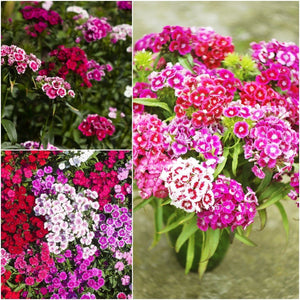
Sweet william (Dianthus barbatus) is a cottage flower in the pink family, Caryophyllaceae, grown for its dense, flat heads of fragrant flowers. They come in red, pink, white and bicolours. Those crowded heads of many small flowers set it apart from carnations and pinks, its relatives in the same genus. It flowers across most of Australia, and timing is what most gardeners get wrong. Sown in the wrong month, the traditional types give a year of leaves first.
Three mistakes that matter
- Expecting flowers in the first summer. Traditional sweet william is a biennial (a plant that grows leaves in its first year and flowers in its second). A spring sowing often gives only a leafy clump. Sow from late summer to autumn for spring flowers, as set out in When to plant.
- Wet, heavy soil. Plants rot at the crown in ground that stays wet, and rust is worse in poorly drained beds. Choose free-draining soil or a raised bed, as set out in Site, soil and setup, and water the soil rather than the leaves.
- Crowding the plants. Clumps packed tightly stay damp in the middle, which suits rust and grey mould. Space plants 20 to 30 cm apart, as set out in Sowing Seeds, so air moves between them.
When to plant
Seed germinates in 7 to 14 days in soil of about 18 to 25°C. What decides the flowers is the cold that comes after: most sweet william needs a spell of winter cold (vernalisation) before it flowers. Seed sown from late summer to autumn grows into a clump that flowers in spring. Strains bred to flower in their first year, such as 'Wee Willie', can flower about 20 weeks after a spring sowing.
| Zone | Example cities | Sow | Flowering | Notes |
|---|---|---|---|---|
| Tropical | Darwin NT; Cairns, Townsville QLD; Broome WA | Apr-Jun | Aug-Oct | Sow early in the dry season and grow as an annual; 'Wee Willie' flowers without winter cold. |
| Subtropical | Brisbane, Gold Coast, Bundaberg QLD; Coffs Harbour NSW | Feb-May | Aug-Nov | Autumn sowings flower through the dry spring; plants often fail in humid summers, when rust and rot take hold. |
| Arid and semi-arid | Alice Springs NT; Dubbo NSW; Mildura VIC; Kalgoorlie WA | Mar-May and Aug-Sep | Sep-Dec | Autumn sowings flower in spring; give spring sowings afternoon shade, mulch and shelter from hot winds. |
| Temperate | Sydney, Newcastle, Wollongong NSW; Melbourne VIC | Feb-May and Sep-Nov | Sep-Feb | Autumn sowings flower from spring; spring sowings of the taller mixes often wait until the following spring. |
| Mediterranean | Perth, Bunbury WA; Adelaide SA | Feb-May and Sep-Oct | Sep-Jan | Autumn sowings grow on winter rain and flower in spring; spring sowings need mulch before the dry heat. |
| Cool and alpine | Hobart TAS; Canberra ACT; Ballarat VIC; Orange NSW | Jan-Mar and Sep-Nov | Oct-Feb | Plant late summer sowings out before hard frost; established clumps take frost, and winter cold sets their flowers. |
At the hot end of a window, raise seedlings in trays in part shade and plant them out as the weather cools. In cool gardens, have autumn sowings planted out by Anzac Day so their roots settle before the hardest frosts.
Site, soil and setup
Give sweet william full sun, at least six hours a day; in hot inland gardens it welcomes light afternoon shade. It grows best in light, free-draining soil enriched with compost, neutral to slightly alkaline, at about pH 6 to 7.5.
| Where | What to do |
|---|---|
| Every bed | Weed, loosen the soil with a fork and dig in a 5 cm layer of compost before planting. |
| Acid soil, below pH 6 | Dig in dolomite lime at 100 to 200 g per square metre, 4 weeks before planting. A light dressing each year suits established clumps. |
| Heavy clay or ground that stays wet | Build a raised bed or mound. Gypsum at 500 g to 1 kg per square metre helps only dispersive clay: an air-dried crumb in rainwater that clouds within 20 hours confirms it. |
| Sandy soil that sheds water | Water in a wetting agent at the label rate before planting. |
Do not replant sweet william where earlier plants rotted or wilted. The fungi behind wilt persist in the soil, so give new plants fresh ground.
Container growing
The dwarf 'Wee Willie' is the pick for pots and window boxes, and 'Single Standard Mixed' suits larger containers. Use a pot of at least 10 L with drainage holes; a 30 cm pot holds about 13.5 L. Potting mix can carry Legionella bacteria, so wet it first, wear gloves and a mask, and wash your hands afterwards.
- Watering: water at the base whenever the top 5 cm of mix is dry.
- Feeding: potted plants need more than beds. Water in fish and seaweed blend at 25 mL per 9 L fortnightly from the first flower buds.
- Position: full sun, moved into light afternoon shade during hot spells.
Sowing Seeds
Seedlings raised in trays and planted out give the most even stand, but seed can also go straight into the bed.
Starting in trays
- Fill trays or punnets with seed raising mix and sow the seed 5 mm deep.
- Keep the mix moist but never wet; seedlings usually appear in 7 to 14 days.
- Plant out once seedlings have true leaves and stand 5 to 10 cm tall, usually 6 to 8 weeks after sowing.
- Harden off the seedlings first (set them outside for a little longer each day so they adjust to sun and wind).
- Water them in with seaweed solution at half strength, 15 mL per 9 L.
Sowing direct
- Rake the soil fine, sow the seed 5 mm deep in short rows and firm the soil over it.
- Thin seedlings to 20 to 30 cm apart, or 15 to 20 cm for 'Wee Willie'.
- Check the row for snails at dusk until the seedlings are growing strongly.
All four mixes are sown the same way; they differ in height and in how soon they flower.
| Variety | Flowers and habit | Good to know |
|---|---|---|
| 'Single Standard Mixed' | Dense single heads on sturdy stems, about 60 cm tall | Borders, mass plantings, large pots and cutting |
| 'Tall Single Herald of Spring' | Bold reds and pinks | An early-season type; sun or part shade |
| 'Dianthus Summertime Mix' | Bright, fragrant mixed colours | Flowers from late spring for months; mass plantings draw butterflies |
| 'Wee Willie Dwarf Mixed' | Red, pink, white and bicolour, dwarf, up to about 20 cm | Pots and edging; bred to flower in its first year |
Care by growth stage
Sweet william is a light feeder, and compost dug in at planting carries it most of the way. Moist roots and dry leaves matter more than fertiliser.
| Stage | Water | Feed | Watch for |
|---|---|---|---|
| Seedlings (weeks 1 to 8) | Water gently so the mix stays moist but never wet | Nothing until the first true leaves, then worm casting liquid diluted to weak tea colour fortnightly | Seedlings collapsing at soil level; snails |
| Leafy clump (planting out to winter) | Water deeply at the base when the top 5 cm of soil is dry | Seaweed solution at 30 mL per 9 L fortnightly | Snails and slugs; aphids on soft shoots |
| Winter (biennial types) | Water only when the soil is dry; established clumps take frost | None while growth is slow | Water lying around the crowns |
| Buds and flowering (spring) | Keep watering at the base so the leaves stay dry | Fish and seaweed blend at 25 mL per 9 L fortnightly from the first buds, only if leaves look pale | Orange spots on leaves (rust); grey fuzz on old heads (grey mould) |
| After the first flush | Keep watering steadily right through | Seaweed solution at 30 mL per 9 L after cutting back | Faded heads to cut; seed heads to keep or remove |
If growth stalls in poor soil, scratch in a light dose of all-purpose controlled release granular (NPK around 14-5-10) at the label rate.

Deadheading
Cutting off spent heads keeps plants tidy and often brings a second, lighter flush. Prompt deadheading also helps plants carry on for another year.
- Young plants: pinch out the growing tip once, just above a pair of leaves, for bushier plants with more stems.
- Single heads: cut each faded head off just above a pair of leaves.
- Mass plantings: shear the whole planting back once the main flush fades.
- For seed: leave a few heads to ripen and dry on the plant.
- After flowering: cut stems back to the leafy base to neaten plants you keep for another year.
Companion planting
A sunny, well-drained cottage bed sown in autumn suits sweet william and several other spring cut flowers.
Grows well with
- Cornflowers: another autumn-sown cut flower that flowers in spring, for mixed bunches.
- Calendula: shares the autumn sowing window and a sunny, free-draining bed.
- Violas: low cool-season flowers to edge the front of a bed of taller sweet william.
- Foxgloves and bellflowers: tall partners for the long-stemmed cutting types.

Keep apart
- Sunflowers and corn on the north side: their summer shade leaves sweet william thin and short of flowers.
- Leafy crops watered daily by sprinkler: constantly wet leaves invite rust and grey mould.
Harvesting Blooms
Cut stems for the vase when only one in ten to one in five flowers in each head has opened.
- Cut in the cool of early morning, when stems are full of water.
- Take the longest stems you can, cutting just above a pair of leaves.
- Strip the lower leaves and stand the stems straight away in a clean bucket of water.
- Wear gloves for big bunches, as the plant can irritate sensitive skin.
- For seed, cut heads once the capsules are dry and starting to split.
Shake the black seed from the dry capsules and store it in a labelled paper envelope somewhere cool, dry and dark. Seed from a mix comes up in mixed colours. Keep cut stems away from cats and dogs, which can be upset by chewing them.
Common problems
No flowers in the first year. See the first point in Three mistakes that matter.
Seed does not come up. Seed sown too deep, a surface left to dry, or soil far outside the temperature in When to plant are the usual causes. Read more
Seedlings collapse at soil level. Damping off (seedlings killed by soil-borne organisms, mainly Pythium species and Rhizoctonia solani) strikes most often in wet seed raising mix. Read more
Plants rot at the base. Crown rot follows wet, poorly drained soil, the second point in Three mistakes that matter; lift the bed or move plants to pots.
Clumps die out in the centre. Older plants thin from the middle; an occasional feed can delay it, but it is usually the sign to sow again.
Pests and diseases
Snails and a few leaf diseases cause most of the trouble, and the diseases are worst in crowded, damp plantings.
Garden snail (Cornu aspersum) and grey field slug (Deroceras reticulatum). They feed at night on seedlings and soft leaves, leaving holes and slime trails. Collect them by torchlight, set shallow beer traps, or run copper tape around wooden or plastic pots and beds. Read more
Aphids (family Aphididae). These small sap-suckers cluster on new shoots and under leaves, leaving sticky honeydew. Hose them off first; if they persist, spray insecticidal soap late in the day, away from open flowers. Read more
Rust (Puccinia species). Raised brown to orange spots form on the leaves, spreading fastest in humid weather. Pick off affected leaves and pull out badly affected plants.
Grey mould (Botrytis species). Flowers and old heads turn brown and mouldy in cool, damp weather. Cut off affected heads and put them in the bin, not the compost.
Prevention first
- Space plants as set out in Sowing Seeds so air moves between them.
- Water at soil level, as set out in Care by growth stage.
- Clear spent heads and fallen leaves promptly.
- Check seedlings for snails at dusk for the first few weeks.
Tips
- Let a few plants self-sow at the edge of a bed, then lift the seedlings while small and move them where you want them.
- Near bushland on the NSW tablelands and in the alps, deadhead before seed sets. Sweet william has naturalised in the Orange district and near Perisher.
- Plant a block near the vegie patch: bees and butterflies visit the flowers.
Questions
When should I plant sweet william seeds in Australia?
Late summer to autumn suits most gardens, for flowers the next spring. Temperate gardens sow Feb to May, Perth and Adelaide Feb to May, and cool gardens Jan to Mar. Subtropical gardens sow Feb to May, and tropical gardens Apr to Jun as the dry season starts. Spring sowings also work in the south.
Does sweet william flower in the first year?
Usually not from a spring sowing. Traditional sweet william is a biennial that needs a spell of winter cold before it flowers. Sow it in late summer or autumn for spring flowers. Strains bred for first-year flowers, such as 'Wee Willie', can flower about 20 weeks after sowing.
Does sweet william come back every year?
It is a biennial or short-lived perennial. Deadheading promptly after flowering can keep plants going for another year or two, but older clumps often die out in the centre. Sweet william also self-sows, so seedlings often come up nearby. Sow a fresh tray every year or two to keep a bed flowering.
Is sweet william the same as a carnation?
No, although they are relatives in the same genus, Dianthus. Sweet william carries dense, flat heads of many small flowers on each stem. Carnations and pinks carry one or a few larger flowers on each stem. Sweet william is sown and grown as a biennial for spring flowers.
Can you grow sweet william in pots?
Yes. Use a pot of at least 10 L with drainage holes, such as a 30 cm pot, and fresh potting mix. The dwarf 'Wee Willie' suits pots best. Water at the base when the top 5 cm is dry. From the first buds, feed fish and seaweed blend at 25 mL per 9 L fortnightly.
When do you cut sweet william for the vase?
Cut when only one in ten to one in five flowers in a head has opened, early in the morning. Take long stems, strip the lower leaves and stand them straight away in clean water. Wear gloves for big bunches, as the plant can irritate sensitive skin.
Grow it



More flower guides
All flowers
Ageratum
Grow ageratum from seed in Australia: surface sowing, months for six climate zones, spacing, pots, deadheading, weed and livestock cautions and pests to watch.
| Position | Full sun, 6 hours or more |
|---|---|
| Depth | Surface, 1 mm at most |
| Spacing | 30 cm; Red Flint 40 cm |
| First pick | 12 to 14 weeks from sowing |

Alyssum
Grow alyssum from seed in Australia: sowing months for six climate zones, surface sowing, spacing, pots, shearing for more flowers, and the pests to watch.
| Position | Full sun or part shade |
|---|---|
| Depth | Surface sow, press in |
| Spacing | 15 to 20 cm |
| First pick | 8 to 9 weeks from sowing |

Aquilegia
Grow aquilegia from seed in Australia: chilling the seed, when to sow in six climate zones, part shade, pots, deadheading, cut flowers and common pests.
| Position | Part shade or morning sun |
|---|---|
| Depth | Surface, 3 mm cover at most |
| Spacing | 30 to 50 cm |
| First pick | From about 28 weeks |

Aster
Grow China asters in Australia: sowing months for six climate zones, spacing, pots, watering, Fusarium wilt and thrips, and cutting blooms for the vase.
| Position | Full sun, 6 hours minimum |
|---|---|
| Depth | 6 mm |
| Spacing | 30 to 40 cm |
| First pick | 13 to 16 weeks |