
How to Grow Salvias in Australia
Salvia seed needs light, so press it onto damp mix and leave it uncovered. Keep it at 22 to 26°C and seedlings appear in 5 to 15 days. Start trays 4 to 8 weeks before the last frost, then plant out 20 to 40 cm apart in full sun and free-draining soil. Flowers usually begin 11 to 16 weeks from sowing and run until frost.
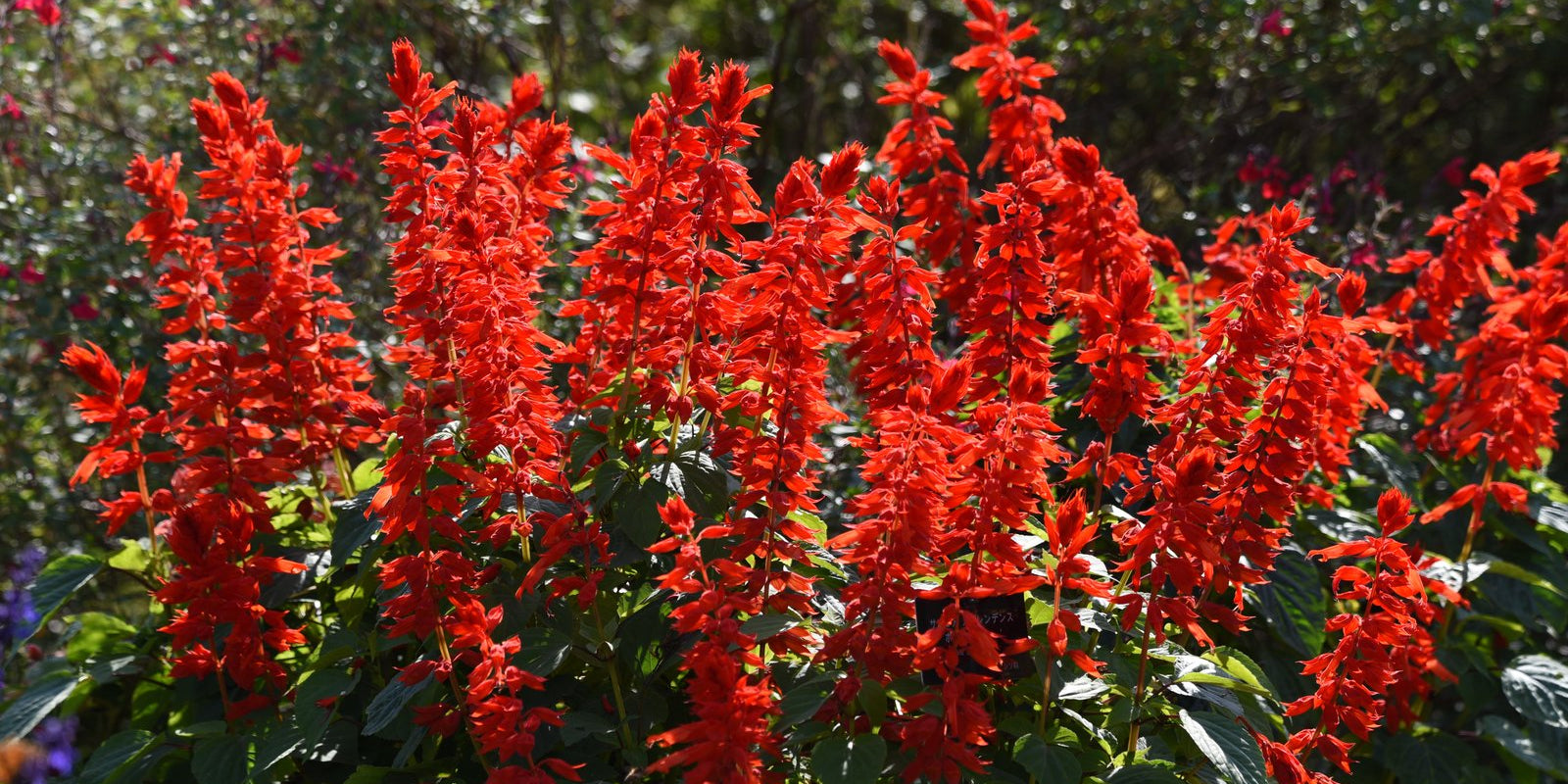
| Sun | Full sun, 6 hours minimum |
|---|---|
| Water | Even moisture; scarlet sage least drought tolerant |
| Soil | Free-draining with compost, pH 6.0 up |
| Feed | Light; compost, then seaweed solution fortnightly |
| Spacing | 20 to 40 cm |
| Depth | Surface sown, light needed |
| Germination | 5 to 15 days at 22 to 26°C |
| Harvest | About 11 to 16 weeks |
| Container | Pots of 10 L or more |
| Frost | Tender, except painted sage, a hardy annual |
| Use | Bedding, borders, pots, cut and dried flowers, bees |
Scarlet sage (Salvia splendens), mealycup sage (Salvia farinacea) and painted sage (Salvia viridis) are salvias of the mint family, Lamiaceae. All three are grown from seed for spikes of colour from late spring until frost, and the blue and painted kinds keep bees busy. The usual mistake happens on sowing day: burying seed that needs light.
Three mistakes that matter
- Burying the seed. All three germinate best with light reaching the seed, so seed sown deep often never comes up. Press it onto the surface of damp mix and leave it uncovered, or barely covered for painted sage.
- Planting out into cold ground. Scarlet and mealycup sage are frost tender and sit still in cold soil, and a late frost can kill them. Keep seedlings under cover until the last frost has passed in your zone.
- Soggy soil. Salvias rot at the roots and base where water lies, and mealycup sage is prone to root disease in wet ground. Plant into free-draining soil or a raised bed, as set out in Site, soil and setup.
When to plant
Warmth decides the start: salvia seed comes up in about 5 to 15 days once the mix holds 22 to 26°C. Spring garden soil is rarely that warm, so outside the tropics start seed in trays indoors or on a seedling heat mat. One sowing usually carries a bed through the season.
| Zone | Example cities | Sow | Flowering | Notes |
|---|---|---|---|---|
| Tropical | Darwin NT; Cairns, Townsville QLD; Broome WA | Apr-Jul | Jul-Nov | Sow early in the dry season so plants flower before the heat, rain and humidity of the build-up. |
| Subtropical | Brisbane, Gold Coast, Bundaberg QLD; Coffs Harbour NSW | Aug-Nov and Mar-Apr | Nov-Aug | Spring is the main window; autumn sowings flower through the mild, mostly frost-free winter. |
| Arid and semi-arid | Alice Springs NT; Broken Hill, Dubbo NSW; Mildura VIC; Kalgoorlie WA | Sep-Nov | Dec-Apr | Raise seedlings under cover and plant out after the last frost; mulch well before summer heat. |
| Temperate | Sydney, Newcastle, Wollongong NSW; Melbourne VIC | Aug-Dec | Nov-May | August sowings stay in trays under cover; Melbourne plants out after the last frost, often early November. |
| Mediterranean | Perth, Bunbury WA; Adelaide SA | Aug-Nov | Nov-May | Plant out as spring warms, then mulch and water steadily once the dry summer heat arrives. |
| Cool and alpine | Hobart TAS; Canberra ACT; Ballarat VIC; Armidale NSW | Sep-Dec | Jan-Apr | Start seed in trays indoors; plant out after the last frost, later at altitude. Autumn frost ends flowering. |
In Melbourne and the cool zone, Melbourne Cup weekend in early November is the traditional signal to plant out frost-tender seedlings.
Site, soil and setup
Give salvias full sun, at least 6 hours a day. Scarlet sage also flowers in part shade and does best in a sheltered spot. All three want free-draining soil with some organic matter, and scarlet sage prefers it close to neutral, around pH 6.0 or above.
| Where | What to do |
|---|---|
| Every bed | Pull the weeds, loosen the soil with a fork and dig in a 5 cm layer of compost before planting. |
| Soil below pH 6.0 | Dig in garden lime at 100 to 200 g per square metre, 4 weeks before planting. |
| Clay or ground that stays wet | Plant on a raised bed or mounded rows. Gypsum at 500 g to 1 kg per square metre helps only dispersive clay: an air-dried crumb dropped in rainwater turns it milky within 20 hours. |
Damping off fungi survive between crops on old plant debris. Clear spent plants away, and use a fresh spot if seedlings collapsed there the year before.
Container growing
All three suit pots, and compact 'Blaze of Fire' also fits window boxes. Give each plant at least 10 L of potting mix; a 30 cm pot holds about 13.5 L. Bagged mix can carry Legionella bacteria, so wet it before opening, wear a mask and gloves, and wash your hands afterwards.
- Watering: soak the pot once the mix is dry a finger's depth down; summer pots can need it daily.
- Feeding: from the first buds, water on fish and seaweed blend at 25 mL per 9 L every fortnight.
- Position: the sunniest spot you have, with a heavy pot for the 90 cm stems of 'Blue Bedder'.
Sowing Seeds
Start salvias in trays for the longest season, or sow direct once the soil is warm and frost is over.
Starting in trays
- Sow 4 to 8 weeks before your last frost, into fresh seed raising mix.
- Press the seed onto the damp surface and leave it uncovered; give painted sage only enough mix to hold it in place.
- Water from below or with a fine mister, so the seed is not washed under.
- Keep trays at 22 to 26°C in bright light, and expect seedlings in 5 to 15 days.
- Move each seedling into its own cell or small pot once its first true leaves open.
- Harden off the seedlings (more time outdoors each day for a week), then plant out at 5 to 10 cm tall.
Water each transplant in with half-strength seaweed solution, 15 mL per 9 L. Space plants 20 to 40 cm apart, closer for compact scarlet sage and wider for the taller two.
Sowing direct
- Rake a fine, level seedbed after the last frost.
- Press 2 to 4 seeds onto the surface every 30 cm.
- Keep the surface damp with a fine spray until seedlings show.
- Thin to the strongest seedling at each spot once true leaves open.
The three share one method but differ in size and thirst.
| Variety | Plant | Height | Grown for | Good to know |
|---|---|---|---|---|
| 'Blaze of Fire' | Scarlet sage | About 30 cm, compact | Plumes of scarlet flowers for bedding, borders and window boxes | Least drought tolerant of the three; keep the soil evenly moist |
| 'Blue Bedder' | Mealycup sage | About 90 cm, bushy | Blue flower spikes over grey-green leaves; cut and dried flowers | Copes with heat and drier soil; flowers until the first frost |
| Tricolour Mix | Painted sage | 30 to 60 cm | White, violet-blue and rose-pink bracts (coloured leaf-like parts below the small flowers) | A hardy annual that self-sows; once sold as Salvia horminum |
Care by growth stage
Salvias are light feeders, and a bed dug with compost carries them most of the way. Water matters more: scarlet sage needs it steadily, while the other two cope with the soil drying between drinks.
| Stage | Water | Feed | Watch for |
|---|---|---|---|
| Seedlings in trays (weeks 1 to 6) | Bottom water or mist; damp, never soggy | None before true leaves; then half-strength seaweed solution, 15 mL per 9 L, every fortnight | Stems pinching at the base and falling over; pale, stretched stems |
| Planted out (weeks 6 to 10) | Deep soak at the base when the top few centimetres dry, morning or evening | Only if leaves look pale: worm casting liquid, weak tea colour, every fortnight | Snails overnight; aphids on soft tips |
| Flowering (from about week 11) | Scarlet sage evenly moist; the others when the soil is dry about 10 cm down | In poor soil only: sulphate of potash at 30 g per square metre once as buds form, or fish and seaweed blend, 25 mL per 9 L, every fortnight | Fine yellow stippling on leaves in hot, dry spells |
| Late summer to first frost | Keep watering steadily while you are still cutting stems | Full-strength seaweed solution, 30 mL per 9 L, after a heatwave | White powdery patches on leaves as nights turn humid |
If growth stalls in thin, poor soil, scratch a light dose of all-purpose controlled release granules (NPK around 14-5-10) into the soil around the plants.

Deadheading
Faded spikes left on a plant turn to seed and slow the next flush, so a weekly trim keeps salvias flowering until frost.
- Young plants: pinch out the tips of scarlet and mealycup sage in spring for bushier plants; flowering starts a little later.
- Scarlet sage: snip each faded spike back to the next pair of leaves.
- Mealycup sage: cut spent spikes to a leaf pair, and after a long flush trim the whole plant lightly to keep it compact.
- Painted sage: cut back faded stems to bring on fresh spikes.
- Seed for next year: leave a few painted sage stems to ripen, as the Tips explain.
- End of the season: pull out spent plants and compost them.
Companion planting
Salvias sit well beside other warm-season flowers that go out after the last frost and want the same sun.
Grows well with
- Marigolds: frost tender too, they go in at the same time in the same full sun.
- Zinnias: another after-frost annual for a cutting bed, in full sun and free-draining soil.
- Petunias: sown on the surface in warmth like salvias, they share pots and window boxes.
- Vegetable beds: 'Blue Bedder' and painted sage bring bees and beneficial insects into the patch.
Keep apart
- Mint: its runners take over a bed and crowd low salvias.
- Tall sunflowers on the sunny side: a row of them shades salvias for much of the day.
Harvesting Blooms
Cut mealycup sage once the bottom three or four flowers on a spike have opened, and painted sage when its bracts are fully coloured.
- Cut in the cool of the morning with clean secateurs.
- Take each stem at full length, just above a pair of leaves.
- Strip leaves that would sit under water, and stand stems in a bucket of water as you go.
- For drying, wait until painted sage bracts have stiffened a little.

To dry mealycup or painted sage, hang small bunches upside down in a dry, dark, airy room for about two weeks. Keep them away from the damp air of a kitchen, laundry or bathroom. Use fresh stems in small vases and the dried spikes in winter arrangements.
Common problems
No seedlings. Seed covered too deeply, or mix far below 22°C, is the usual cause; the first of the Three mistakes that matter covers the fix. Read more
Seedlings topple over. Damping off (a stem rot of young seedlings, mostly from Pythium species and Rhizoctonia solani) strikes seedlings in wet mix. Read more
Tall, pale, floppy seedlings. They are stretching for light, usually on a dim windowsill, and need the brightest spot you have. Read more
Scarlet sage wilts and browns. It is not drought tolerant, and dry soil in hot weather scorches it; water as set out in Care by growth stage.
Flowering slows. Old spikes setting seed hold back new ones; trim them as set out in Deadheading.
Pests and diseases
Salvias are seldom troubled for long: snails take seedlings, and sap-suckers build up in hot, dry weather.
Garden snail (Cornu aspersum) and grey field slug (Deroceras reticulatum). They chew seedlings and soft shoots at night, most of all after rain, and leave silvery trails. Collect them by torch about two hours after sunset, and set beer traps nearby. Read more
Aphids (family Aphididae). Small sap-suckers cluster on new shoots and under leaves and leave sticky honeydew. Hose them off with a strong jet, or spray insecticidal soap onto the leaf undersides. Read more
Two-spotted mite (Tetranychus urticae). Leaves turn yellow and finely stippled, and numbers climb fast in hot, dry weather. Hose the undersides of the leaves and keep plants watered. Read more
Powdery mildew (Golovinomyces biocellatus). White powdery patches spread over the leaves, mostly in summer and autumn; it has been recorded on salvia in Queensland. Remove the worst leaves and spray 1 part full-cream milk to 10 parts water. Read more
Prevention first
- Give plants the full spacing from Sowing Seeds, so air moves between them.
- Water the soil, not the leaves, early in the day.
- Raise seedlings in new mix and scrubbed trays.
- Check shoots and leaf undersides once a week through summer.
Tips
- Save painted sage seed at the end of autumn, once most bracts have fallen. Seed from a mixed planting may give mixed colours.
- Painted sage self-sows where it is happy, so pull unwanted seedlings while they are small.
- In frost-free gardens, scarlet and mealycup sage can live on as short-lived perennials; trim them back after flowering for another flush.
- Plant a clump of 'Blue Bedder' where you can watch it: in south-east Queensland gardens, blue-banded bees are regular visitors to salvias.
Questions
When should I plant salvia seeds in Australia?
Spring in most zones. Sydney and Melbourne sow Aug to Dec, Perth and Adelaide Aug to Nov, and Canberra and Hobart Sep to Dec. Brisbane sows Aug to Nov and again Mar to Apr. The tropics sow Apr to Jul, early in the dry season. Outside the tropics, plant seedlings out after the last frost.
Do salvia seeds need light to germinate?
Yes. Press the seed onto the surface of damp seed raising mix and leave it uncovered, or barely covered for painted sage. Keep the tray at 22 to 26°C in bright light. Seedlings usually appear in 5 to 15 days.
Is salvia an annual or a perennial?
Scarlet sage and mealycup sage are tender perennials grown as annuals, because frost kills them. Painted sage is a true annual that often self-sows. In frost-free gardens, the first two can live on for more than one season.
Do salvias attract bees?
Mealycup sage and painted sage draw bees well, and blue-banded bees visit salvias in south-east Queensland gardens. Many scarlet sage bedding types are bred for colour and may carry little nectar, so they offer bees less.
Can salvias be grown in pots?
Yes. Give each plant at least 10 L of potting mix, for example a 30 cm pot with drainage holes, in full sun. From the first buds, feed with fish and seaweed blend at 25 mL per 9 L every fortnight. Compact 'Blaze of Fire' also suits window boxes.
Is ornamental salvia the same as culinary sage?
No. Culinary sage (Salvia officinalis) and chia (Salvia hispanica) are separate species grown for leaves and seed. Scarlet sage, mealycup sage and painted sage are grown for their flowers in beds, pots and vases.
Grow it
More flowers to sow in September
All flowers
Ageratum
Grow ageratum from seed in Australia: surface sowing, months for six climate zones, spacing, pots, deadheading, weed and livestock cautions and pests to watch.
| Position | Full sun, 6 hours or more |
|---|---|
| Depth | Surface, 1 mm at most |
| Spacing | 30 cm; Red Flint 40 cm |
| First pick | 12 to 14 weeks from sowing |

Alyssum
Grow alyssum from seed in Australia: sowing months for six climate zones, surface sowing, spacing, pots, shearing for more flowers, and the pests to watch.
| Position | Full sun or part shade |
|---|---|
| Depth | Surface sow, press in |
| Spacing | 15 to 20 cm |
| First pick | 8 to 9 weeks from sowing |

Aster
Grow China asters in Australia: sowing months for six climate zones, spacing, pots, watering, Fusarium wilt and thrips, and cutting blooms for the vase.
| Position | Full sun, 6 hours minimum |
|---|---|
| Depth | 6 mm |
| Spacing | 30 to 40 cm |
| First pick | 13 to 16 weeks |

Aubretia
Growing aubretia as a hardy groundcover in Australian gardens: sowing, position, trimming after flowering, companion plants and common pests.
| Position | Full sun, 6 hours or more |
|---|---|
| Depth | On the surface, barely covered |
| Spacing | 25 to 30 cm |
| First pick | Spring, after a winter chill |