
How to Grow Queen Anne's Thimbles in Australia
Sow Queen Anne's thimbles seed barely covered, about 1 mm deep, when the soil sits near 18 to 21°C. That means autumn in most zones, and spring in cool and alpine gardens. Seedlings usually appear in 14 to 21 days. Thin to 20 cm in full sun and light, fast-draining soil. Water only in dry spells, feed lightly, and deadhead for more flowers.
| Sun | Full sun, six hours plus |
|---|---|
| Water | Low; water deeply in dry spells only |
| Soil | Light, fast-draining, moderately fertile; any pH |
| Feed | Light; compost at sowing, weak seaweed after |
| Spacing | 20 cm |
| Depth | 1 mm, barely covered |
| Germination | 14 to 21 days at 18 to 21°C |
| Harvest | About 10 to 16 weeks |
| Container | Two plants per 25 cm, 8 L pot |
| Frost | Hardy; cover young seedlings on frosty nights |
| Use | Borders, wildflower patches, bee gardens, small posies |
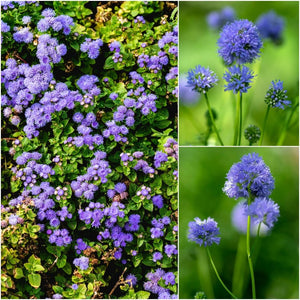
The seed sold here as Queen Anne's thimbles is fineflower gilia (Gilia leptantha), a hardy annual in the phlox family, Polemoniaceae. This Californian mountain wildflower carries small, loose clusters of lavender to violet-blue flowers, and bees visit them. The name Queen Anne's thimbles belongs to Gilia capitata, a different species with round pincushion heads. Neither is related to Queen Anne's lace (Daucus carota, Ammi majus). The usual mistake is treating it as a rich-soil summer annual, when it wants cool-season sowing and lean, fast-draining ground.
Three mistakes that matter
- Sowing into warm weather. This mountain annual flowers in the cool of spring. Sown late, plants often meet summer heat and flower only briefly. Sow at the times in When to plant.
- Rich, wet soil. In the wild it grows in open, rocky or sandy places with fast drainage and little water. Manure, heavy feeding and daily watering give soft growth that flops or rots. Keep the bed lean, as set out in Site, soil and setup.
- Tearing the roots. Seedlings resent root disturbance, so bare-root transplants often stall and sulk. Sow where the plants are to flower, or in single cells planted out whole, as described in Sowing Seeds.
When to plant
Seed germinates fastest when the soil sits around 18 to 21°C; cooler soil slows it rather than stopping it. That points to autumn in most of Australia, with a second window from late winter into spring. In most southern gardens, have the autumn sowing in by Anzac Day. The plant is frost hardy, but young seedlings are less tolerant. On frosty nights, cover autumn sowings with a cardboard box or an old sheet until plants are established. Cool and alpine gardens, where frost is regular from about April to October, sow in spring.
| Zone | Example cities | Sow | Flowering | Notes |
|---|---|---|---|---|
| Tropical | Darwin, Katherine NT; Cairns, Townsville QLD | Apr-Jun | Jul-Sep | Sow in the dry season; plants fade as heat and humidity build before the wet. |
| Subtropical | Brisbane, Sunshine Coast, Bundaberg QLD; Coffs Harbour NSW | Apr-Jun and Aug | Jul-Nov | Autumn sowings flower through the mild winter and spring, finishing before humid summer heat. |
| Arid and semi-arid | Alice Springs NT; Mildura VIC; Dubbo NSW; Kalgoorlie WA | Mar-Apr and Aug-Sep | Jul-Nov | Cover young seedlings on frosty nights from May; mulch and water in dry spells as spring heat builds. |
| Temperate | Sydney, Newcastle, Wollongong NSW; Melbourne VIC | Mar-Apr and Aug-Oct | Aug-Jan | Sow the autumn batch by Anzac Day for spring flowers; late-winter sowings flower from late spring into early summer. |
| Mediterranean | Perth, Bunbury WA; Adelaide SA | Mar-May and Aug-Sep | Aug-Dec | Autumn sowings ride the winter rain; spring sowings need water once the dry heat arrives. |
| Cool and alpine | Hobart TAS; Canberra ACT; Ballarat VIC; Armidale NSW | Sep-Nov | Dec-Mar | Sow once hard frosts ease, since frost is regular from about April to October. |
Autumn sowings grow slowly through winter and flower in spring, while spring sowings flower faster but for a shorter time before the heat.
Site, soil and setup
Give it full sun, six hours or more a day, and a light soil that drains quickly after rain. It grows in acid, neutral or alkaline soil and in sand, loam or chalk, so pH rarely needs correcting. Moderately fertile ground is plenty.
| Where | What to do |
|---|---|
| Every bed | Fork in a 5 cm layer of compost before sowing, and add no manure or fertiliser. |
| Heavy clay or ground that stays wet | Sow on a raised bed or a mound. Gypsum at 500 g to 1 kg per square metre helps only dispersive clay: an air-dried crumb set in rainwater that clouds within 20 hours confirms it. |
| Sandy or inland soil that sheds water | Water in a wetting agent at the label rate before sowing. |
| Part shade | Plants tolerate part sun, but choose the sunniest spot available for the most flowers. |
Container growing
The low rosette and fine stems suit a wide pot or trough on a sunny step. A 25 cm pot holds about 8 L of mix and two plants; a 33 cm pot holds about 18 L and three or four. Fill it with a free-draining potting mix. Potting mix can carry Legionella bacteria, so wet it before handling, wear gloves and a mask, and wash your hands afterwards.
- Watering: pots dry out faster than beds, so water when the top of the mix feels dry, then let it drain.
- Feeding: seaweed solution at half strength (15 mL per 9 L) fortnightly from the first true leaves. Once the rosette forms, use 30 mL per 9 L until buds show.
- Position: the same full sun as a bed, somewhere open where air moves freely.
Sowing Seeds
Sow Queen Anne's thimbles seed where it is to flower, or into single cells where snails or a short season make that hard. The seed is tiny, around 11,500 to the gram, so the sand trick helps spread it thinly.
Sowing direct
- Rake the soil to a fine, crumbly surface and water it the day before.
- Mix the seed with four to ten parts of dry sand and scatter it thinly in small patches.
- Cover it with no more than about 1 mm of fine soil, then firm it gently.
- Keep the surface damp with a fine spray; seedlings usually appear in 14 to 21 days.
- Thin to 20 cm apart once seedlings have a few true leaves, snipping extras at soil level.
Starting in cells
- Fill single cells or small pots with seed raising mix and sow two or three seeds on each.
- Barely cover the seed, keep the mix moist, then snip off all but the strongest seedling.
- Harden off the young plants for about a week (stand them outdoors a little longer each day so they adjust to sun and wind).
- Plant out when seedlings are 5 to 10 cm tall, sliding each root ball in whole at the depth it grew.
- Water in with seaweed solution at half strength (15 mL per 9 L).
Telling it apart
If the flowers open as round heads packed with dozens of florets, the plants are Gilia capitata rather than Gilia leptantha. Seed catalogues often mix up the two names.
| Feature | Gilia leptantha | Gilia capitata |
|---|---|---|
| Flowers per cluster | 2 to 6, in small clusters, open or not, on spreading stalks of unequal length | 25 to 100, packed into one round head |
| Flower | A slender tube with a yellow or white throat; lobes lavender in the wild, sold as violet-blue | Small florets that together read as a powder blue pincushion |
| Stamens | The longest usually reach past the petal lobes | Protrude from each floret |
| Leaves | A basal rosette of lobed, toothed, woolly leaves | Finely divided, fern-like leaves up the stems |
| Height | About 15 to 45 cm in the wild; sold as 40 to 50 cm | 10 to 90 cm |
Care by growth stage
Sun, drainage and restraint decide how well it flowers. It is a light feeder that needs water mainly in dry spells. Weeks count from a spring sowing; autumn sowings take longer.
| Stage | Water | Feed | Watch for |
|---|---|---|---|
| Germination and seedlings (weeks 0 to 4) | Mist the surface so it stays damp but never soggy | Nothing until the first true leaves, then seaweed solution at half strength (15 mL per 9 L) fortnightly | Damping off (seedlings collapsing at soil level); snails and slugs grazing at night |
| Rosette (weeks 4 to 10) | Water deeply only when the top few centimetres are dry | Seaweed solution at 30 mL per 9 L fortnightly; beds with compost need nothing more | Aphids on new growth; crowding, so finish thinning to 20 cm |
| Budding and flowering (weeks 10 to 16) | Water at the base in dry weather, keeping the leaves dry | In poor sand or pots only, fish and seaweed blend at 25 mL per 9 L fortnightly | Aphids on buds; stems leaning in shade or rich soil |
| Late flowering and seed (week 16 on) | Keep watering in dry spells right to the end of flowering | None | Yellowing leaves as plants finish; capsules browning for seed |
If plants stay small and pale in very poor sand, scratch in a light dose of all-purpose controlled release granular (NPK around 14-5-10).
Deadheading
Removing faded clusters keeps new buds coming and limits the seed that falls.
- Spent clusters: snip each one back to the next bud or leaf once the petals wither.
- End of season: pull plants out once they yellow and stop budding, and compost them if they are healthy.
Companion planting
Good partners share its sun, its lean, free-draining soil and its cool-season timing.
Grows well with
- Californian poppies: another Californian annual for full sun and lean soil that also resents transplanting.
- Baby blue eyes: sown in autumn in free-draining soil, it fills the front of the bed.
- Phacelia: an autumn or spring sown bee plant that flowers alongside it.
Keep apart
- Thirsty vegetables on daily irrigation: the constantly wet soil invites root rot.
- Tall, leafy plants on the north side: their shade stretches the stems and cuts flowering.
Harvesting Blooms
Cut stems for small vases when the first flowers in a cluster have opened and more buds show colour.
- Pick in the early morning or the cool of the evening, never in midday heat.
- Use clean, sharp snips, and cut stems as long as possible.
- Strip the leaves from the lower half of each stem.
- Stand stems in a bucket of water in the shade as you go.
- Keep picking, because every cut also works as a deadhead.
For seed, leave a few late clusters unpicked. Collect the capsules as they turn brown and before they split open, then dry them on paper indoors. Store the cleaned seed in a labelled paper envelope somewhere cool and dry. The fine stems suit posies and small jars, and a few plants left standing keep feeding bees.
Common problems
No seedlings. Seed buried too deep, or sown into cold or baking soil, often fails; sow it barely covered, at the times in When to plant. Read more
Seedlings stall after planting out. Roots torn during transplanting set plants back, as described in Three mistakes. Read more
Tall, floppy plants with few flowers. Shade, rich soil or too much water give soft stems; move the next sowing to full sun and lean soil.
Flowering stops early. Heat and ripening seed end the display, so deadhead often and sow earlier next time.
Seedlings appear the following year. It self-seeds freely; pull unwanted seedlings while small, or deadhead to prevent it.
Pests and diseases
Few pests single it out; most trouble is common to any bed of young annuals.
Garden snail (Cornu aspersum) and slugs. Common in gardens throughout Australia, they feed after dark and can graze a patch of seedlings to the ground, leaving shiny trails. Hunt them by torchlight after rain and set beer traps. Read more
Aphids (family Aphididae). These small sap-suckers form colonies on soft growth, causing yellowing, stunting and sticky honeydew, and they can carry viruses. Hose them off, or spray insecticidal soap at the label rate. Read more
Damping off (Pythium species and Rhizoctonia solani). Seedlings rot and topple at soil level, most often in wet soil or seed raising mix. Sow thinly, water lightly and clear out collapsed seedlings. Read more
Root rot (Pythium species). In waterlogged soil the fine roots rot, and older plants wilt and collapse even though the soil is wet. Pull affected plants and sow the next batch on a raised bed.
Prevention first
- Thin to 20 cm, as set out in Sowing Seeds, so air moves between plants.
- Water as set out in Care by growth stage, never on a schedule.
- Check seedlings for snails and aphids on each visit, including under the leaves.
- Wash seed trays and cells before reuse, since damping off fungi carry over on them.
Tips
- Sow in small patches rather than rows: the airy clusters read better as a drift of colour.
- Try a patch in a rockery or gravel garden, which copies the fast drainage of its wild rocky slopes.
- Plant a patch beside the vegie garden or in a bee border, where the flowers draw bees and butterflies.
Questions
Is Queen Anne's thimbles the same as Gilia leptantha?
Not quite. The common name Queen Anne's thimbles belongs to Gilia capitata, which carries round pincushion heads of 25 to 100 flowers. The seed sold here under that name is Gilia leptantha, fineflower gilia, which carries two to six flowers in small, loose clusters. Both are Californian annuals grown the same way.
When do I sow Queen Anne's thimbles in Australia?
Sow in autumn in most zones, with a second window in late winter or spring. Tropical gardens sow Apr to Jun for dry-season flowers. Cool and alpine gardens sow Sep to Nov, once hard frosts ease. Seed comes up fastest in soil at 18 to 21°C.
Is Queen Anne's thimbles related to Queen Anne's lace?
No. Queen Anne's lace is wild carrot (Daucus carota), and Ammi majus shares the name. Both belong to the carrot family, Apiaceae, and carry flat white umbrellas of flowers. Gilia belongs to the phlox family, Polemoniaceae.
How long do gilia seeds take to germinate?
Seedlings usually appear in 14 to 21 days with the soil at 18 to 21°C. Cooler soil slows germination rather than stopping it. Sow barely covered, about 1 mm deep, and keep the surface damp with a fine spray until they show.
Does gilia come back every year?
The plant is an annual and dies after flowering, but it self-seeds freely. Leave a few clusters to ripen and seedlings often appear the following season. Deadhead instead if you do not want them.
Can I grow Queen Anne's thimbles in pots?
Yes. A 25 cm pot holding about 8 L of free-draining potting mix suits two plants, and a 33 cm pot three or four. Give it full sun, water when the top of the mix is dry, and feed weak seaweed solution fortnightly until buds show.
Grow it
More flower guides
All flowers
Ageratum
Grow ageratum from seed in Australia: surface sowing, months for six climate zones, spacing, pots, deadheading, weed and livestock cautions and pests to watch.
| Position | Full sun, 6 hours or more |
|---|---|
| Depth | Surface, 1 mm at most |
| Spacing | 30 cm; Red Flint 40 cm |
| First pick | 12 to 14 weeks from sowing |

Alyssum
Grow alyssum from seed in Australia: sowing months for six climate zones, surface sowing, spacing, pots, shearing for more flowers, and the pests to watch.
| Position | Full sun or part shade |
|---|---|
| Depth | Surface sow, press in |
| Spacing | 15 to 20 cm |
| First pick | 8 to 9 weeks from sowing |

Aquilegia
Grow aquilegia from seed in Australia: chilling the seed, when to sow in six climate zones, part shade, pots, deadheading, cut flowers and common pests.
| Position | Part shade or morning sun |
|---|---|
| Depth | Surface, 3 mm cover at most |
| Spacing | 30 to 50 cm |
| First pick | From about 28 weeks |

Aster
Grow China asters in Australia: sowing months for six climate zones, spacing, pots, watering, Fusarium wilt and thrips, and cutting blooms for the vase.
| Position | Full sun, 6 hours minimum |
|---|---|
| Depth | 6 mm |
| Spacing | 30 to 40 cm |
| First pick | 13 to 16 weeks |