
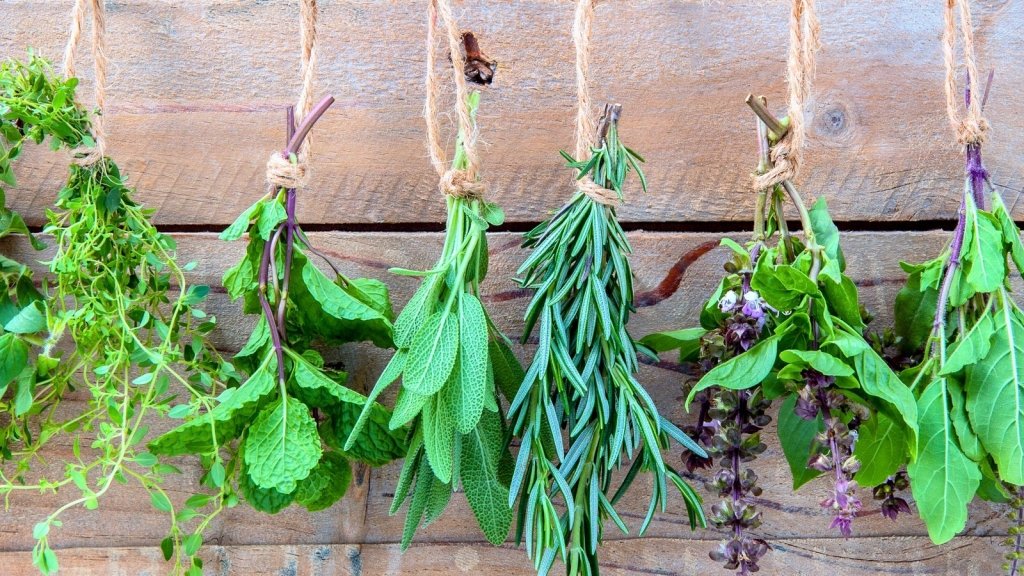

The short version: Cut herbs in the morning once the dew has dried and just before the flower buds open, when the leaves hold the most aromatic oil. Take about a third of a perennial at a time, cutting above a leaf pair. Woody herbs such as rosemary, thyme and sage dry well; soft ones such as basil, coriander and chives keep more flavour frozen. Dry until the leaves crumble and the stems snap, then store them whole in labelled jars in a dark cupboard.
By late summer the herb bed makes more than the kitchen can absorb. The oregano has doubled, the mint is heading for the path, and the basil is about to flower.
It comes down to two decisions: when you cut, and whether the herb dries or freezes.
Cut in the morning, just before the flowers open
The strongest flavour sits in the leaves as the buds form but before they open, and in the morning once the dew has dried. Herbs hold flavour in volatile oils, which build towards flowering and fade once the plant sets seed. ABC Organic Gardener agrees: pick once any moisture has evaporated.
Treat that as a general rule with exceptions, not a law. Coriander grown for seed is meant to flower, and timing matters for a batch, not for five leaves.
Take about a third, and cut above a leaf pair
Cut above a leaf pair, and take no more than about a third of a perennial at once. The node holds dormant side shoots, so a cut above one returns two stems for one, which is how basil, mint, oregano and thyme stay bushy. Parsley, coriander, dill and chives have no leaf pairs, so cut their outer stems at the base.
Soft annuals take a harder cut, back to roughly 10 to 15 cm. Woody perennials do not: rosemary, thyme, sage and lavender build bare grey wood that often will not reshoot, so keep cuts in the green. Botanic Gardens of Sydney gives the same advice: tip prune from early on, and never pick all the leaves off a plant. Use sharp secateurs, cutting away from your hand.

Which herbs dry well, and which freeze better
- Dry well: rosemary, thyme, oregano, marjoram, sage, bay, mint and lemon balm.
- Better frozen, or made into a paste, salt or oil cube: basil, coriander, parsley, chives, dill and tarragon.
The split runs on moisture, and dried chives lose almost all flavour. Coriander is the odd one out: the seed dries well though the leaf does not, and no picking stops it bolting, so see why coriander bolts.
Wash first, dry the surface, then hang the bunches
Wash only the herbs that are gritty or soil-splashed, shake them hard and spread them out until the surface is dry. Wet leaves bundled tight hold moisture in the middle, where mould starts.
Bundle five to eight stems, band the cut ends and hang them upside down somewhere dry, shaded and airy: a spare room, a garage, a verandah eave. Keep them out of sunlight and cooking steam. Ten days is common in dry weather, longer in damper air. For seed heads, slip a paper bag over the bundle.
Air drying only works when the air is drier than the herb, and on much of the Australian coast in summer it is not. A bunch can take on moisture overnight faster than it dries by day, then go musty inside. If it is limp after a week, move it indoors.

The dehydrator, the oven and the microwave
A dehydrator is the most reliable method and kindest to the flavour. Lay leaves in a single layer, not touching, at roughly 35 to 40 degrees. Soft herbs are often done in two to four hours, sage and bay take longer.
The oven is the compromise. Prop the door ajar so moisture escapes, and ABC Organic Gardener suggests not exceeding 40 degrees. Most ovens will not go that low, so check with a thermometer. Herbs dried hot taste of hay, because the aromatic oils leave with the steam, so temperature matters more than time. Do not leave a propped-open oven unattended.
The microwave suits a small handful. Spread one layer between two sheets of paper towel and run 30 second bursts for one to three minutes. Stay with it, because dry leaves and the towel can catch alight.
Freezing, herb salt, herb vinegar and herb butter
Freezing suits everything that dries badly. Whole mint leaves freeze flat on a tray, then bag up. Raw basil blackens, so use oil instead: a third to half a cup through two cups of chopped leaves. Other chopped herbs go into ice cube trays with water. Pesto and herb pastes freeze the same way. Frozen herbs thaw limp, so cook with them rather than garnish.
Herb salt is chopped leaves through salt, one part herb to four, dried on a tray. Herb vinegar is soft leaves steeped for a fortnight. Herb butter is herbs beaten through soft butter and frozen.
The oil warning matters. Herbs in oil are not shelf stable, fresh or dried. Oil excludes air, and CSIRO explains that this creates the airless conditions favouring Clostridium botulinum, the bacterium behind botulism. Its guidance is acidification, or refrigeration at or below 5 degrees. Keep them in the fridge and use within four days, or freeze.
Testing for dryness, and storing it
A herb is dry when the leaves crumble and the stems snap. Anything leathery is holding water, and water in a sealed jar is how a batch goes mouldy.
The step most people skip is conditioning. Put the dried leaves in a glass jar two thirds full, seal it, and leave it a week, shaking daily. Condensation on the glass, or leaves clumping, sends it back to the dehydrator. Throw out any mould.
Store whole leaves rather than crushed, crumbling them as you cook. Use airtight glass in a cool dark cupboard and label every jar with the date. Expect six to twelve months of flavour: dried herbs do not turn dangerous with age, they turn flat.

Herb seed, herb tea and flowers for bees
Coriander and dill are grown for seed as much as leaf. Wait until the heads brown and dry on the plant, then hang the stems upside down in a paper bag until the seed falls. Dry it another week before jarring. Our seed saving guide covers keeping a variety true.
Herbs for tea dry the same way. Mint, lemon balm, lemon verbena and chamomile flowers all dry well for a hot drink, and whole leaves brew better than crushed. Leave a few plants to flower for the bees.
Drying and storing in Australia's climate zones
These are broad groupings. The humidity in the week you cut matters more than the zone, and in damp climates check stored jars for condensation.
- Tropical (Darwin in the Northern Territory, Cairns and Townsville in Queensland): air drying works in the dry season and fails in the wet, so dehydrate from November to April.
- Subtropical (Brisbane and the Sunshine Coast in Queensland, Coffs Harbour and Lismore in New South Wales): summer humidity beats most bunches, so dehydrate in summer and air dry in winter.
- Arid and semi-arid (Alice Springs in the Northern Territory, Broken Hill in New South Wales, Mildura in Victoria, Kalgoorlie in Western Australia, inland Queensland): the easiest drying in the country.
- Temperate (Sydney and Newcastle in New South Wales, Melbourne and Geelong in Victoria at the cold end of the zone): air drying works in spring and autumn. Coastal summer humidity calls for the dehydrator; inland gardens can hang bunches.
- Mediterranean (Perth and Geraldton in Western Australia, Adelaide and the Barossa in South Australia): dry summers make this ideal air drying country.
- Cool and alpine (Tasmania, Canberra and the ACT, Ballarat in Victoria, Orange and Armidale in New South Wales, Stanthorpe in Queensland): cut the main crop in late summer, because damp autumn air slows drying.
Frequently asked questions
Can I dry herbs in the sun?
Not for culinary herbs. Direct sun bleaches the colour and drives off the aromatic oils. Shade with good airflow beats sun.
My bunch went mouldy in the middle. Why?
The leaves went in wet, the bunch was too thick, or the air was too humid. Make smaller bundles and dry the surface before tying. Throw mouldy batches out.
Should I strip the leaves off the stems first?
Not for hanging bunches: the stems make it easy to tie. Strip them once everything is crisp. In a dehydrator, loose leaves dry evenly.
Can I dry herbs on a rack instead of hanging them?
Yes, and small-leaved herbs such as thyme often do better that way. Spread them one layer deep on a mesh rack in a dry, shaded, airy spot.
Can I keep herbs in olive oil in the pantry?
No. Herbs in oil are not shelf stable, fresh or dried, because oil creates the airless conditions Clostridium botulinum needs. Refrigerate and use within four days, or freeze.
Can I cut my rosemary right back?
No. Rosemary, thyme, sage and lavender often will not reshoot from bare wood. Take a third at a time and keep every cut in the green.
Cut in the morning, dry it properly, and check the jar for condensation before you trust it.
Related growing guides
- Pinch basil above a leaf pair
- Why coriander bolts, and how to keep picking it
- Herbs to sow in September
Our herb seeds and culinary herb seeds can fill any gaps the drying racks have shown up.