
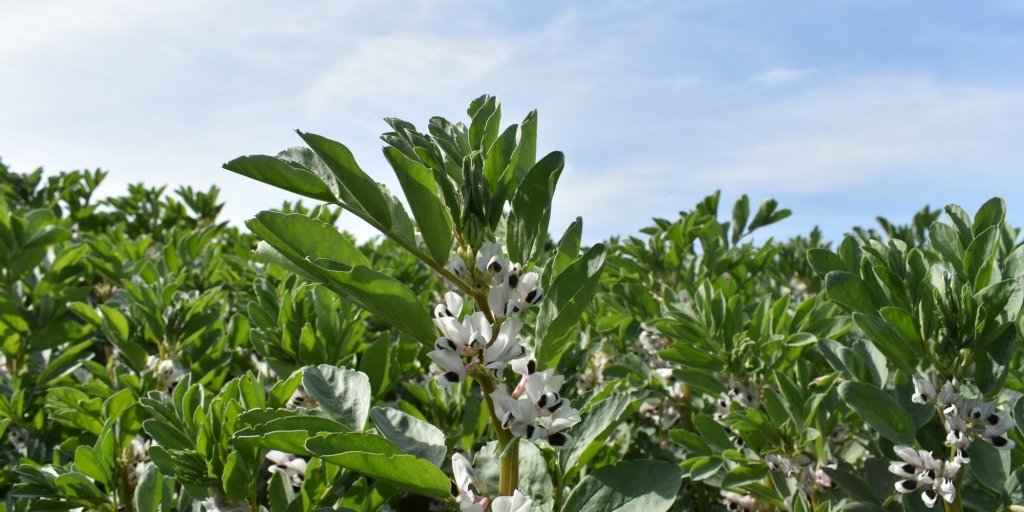
A hardy cool season bean
Vicia faba, the broad bean, is a vetch, and its closest garden relatives are peas and lentils. Despite the shared name it is only distantly related to French and runner beans, which belong to the genus Phaseolus. It has been grown around the Mediterranean for thousands of years.
It is also one of the most forgiving crops in the winter garden. Broad beans stand frost, keep growing through cold, wet weeks that stop most other vegetables, and leave nitrogen in the soil for whatever follows. A dwarf such as Coles Dwarf crops in a large pot, and a tall one such as Aquadulce fills a double row. More are in our bean seeds collection.

When to sow broad beans
Broad beans are an autumn sowing in most of Australia, picked from late winter into spring. A late sowing that flowers into the heat sets poorly.
- Tropical (Darwin, Cairns, Townsville and the Top End): rarely worth the bed. Grow snake beans or okra instead.
- Subtropical (Brisbane, the Gold and Sunshine coasts, Bundaberg and the NSW north coast): May-Jun.
- Arid and semi-arid (Alice Springs, Broken Hill, Kalgoorlie, Mildura and most of the inland): Apr-Jul.
- Temperate (Sydney, Melbourne, Newcastle, Geelong and coastal southern Australia): late Mar to Aug.
- Mediterranean (Perth, Adelaide, the south west of Western Australia and the South Australian gulf country): the same months as temperate, sown at the early end so the pods fill before the dry summer.
- Cool and alpine (Hobart, Canberra, Ballarat, Armidale, the tablelands and alpine districts): late Mar to Jun, and Jul-Aug in milder pockets.
These are broad groupings, so gardeners between two zones should lean on their own local frost dates. South of Brisbane, May or June is a safe default.
Soil, sowing and spacing
Broad beans are not fussy, but they crop best in free draining soil improved with compost or aged manure and close to neutral, so lime an acid bed before sowing. Choose a sheltered spot, because a tall variety in flower is top heavy in wind.
Water the bed well before sowing, then sow 5cm deep and hold off watering until the shoots appear, because the large, soft seed rots quickly in cold, wet soil. Double rows are easiest, since the two rows lean on each other: set the seed 10 to 15cm apart along each row, keep the pair of rows about 25cm apart, and allow about 70cm between one double row and the next. Stagger the seed so plants are not directly opposite. Only dwarf varieties suit pots, in a container at least 40cm across and 30cm deep.
Support, water and weeds
Stake the corners of each double row and run string around the outside at knee height, then again at hip height as the plants grow. Water at the base, and mulch once the shoots are up, because moisture matters most from flowering through to pod fill. Hand weed while the plants are small and let the mulch do the rest. Broad beans fix their own nitrogen, so skip high nitrogen feeds: compost at sowing and a little sulphate of potash at flowering is plenty.
Aphids and other pests
Aphids are the main pest, and in Australia they are cowpea aphid, which is black, and green peach aphid. Older British books blame blackfly, Aphis fabae, which is not present in Australia. Aphids gather on the soft growing tip, so once the lowest flowers have set pods, pinch out the top 10cm of every stem: that removes most of the colony and pushes the plant into filling what it has. Knock the rest off with a jet of water and leave ladybirds, hoverflies and parasitic wasps to it. If an infestation is genuinely beyond that, use an APVMA-registered product for that pest, exactly as the label says, sprayed at dusk when bees are not flying. Planting summer savoury alongside is old garden tradition rather than proven control.
Mice and rats dig up newly sown seed, so start the seed in pots and plant out, or cover the row with frost cloth until the shoots are up.
Chocolate spot
Chocolate spot (Botrytis fabae) shows as small reddish brown spots on the leaves in damp, still weather, and it can spread into dark blotches on stems and pods. Air is the control: keep to the spacing above, water at the base rather than over the leaves, and pick off affected leaves early. Bin badly affected material rather than composting it, and keep broad beans out of that bed for three years.
Harvesting, and the bed afterwards
Pick the first pods young, at 7 to 10cm, and cook them whole like a flat bean. After that, pick when the pods feel full but the beans are still soft and the scar on each bean is pale. Once that scar darkens they turn starchy, although shelled beans dropped into boiling water for a minute slip out of their grey skins, which is called double podding, and are tender again. Pods left to dry on the plant can be stored as a dry bean or saved for next season.

Only about 30 per cent of the nitrogen in a broad bean plant is in the roots and nodules, and the rest is in the stems, leaves, pods and beans. Cut the finished plants off at ground level, leave the roots in the soil and compost the tops, so the nitrogen in both goes back into the garden. Sown thickly and dug in before flowering they also make a useful winter cover crop, as do the mixes in our cover crop and soil builder seeds. Quarantine rules stop those mixes going to Western Australia or Tasmania, so gardeners there can use broad beans alone as the cover crop.
One note for the kitchen
Broad beans do not suit everyone. People with the inherited condition glucose-6-phosphate dehydrogenase (G6PD) deficiency can have a serious reaction to broad beans, called favism, so they must avoid broad beans in any form, raw or cooked. If you are unsure whether that applies in your household, ask your doctor first.
Related growing guides
- Cover Crops: How to Feed Your Soil Over Winter
- Aphids: How to Spot, Control and Prevent Them in an Australian Garden
- What to grow in winter: cool-season vegetables across Australia
Ready to plant? Browse our bean seeds.