
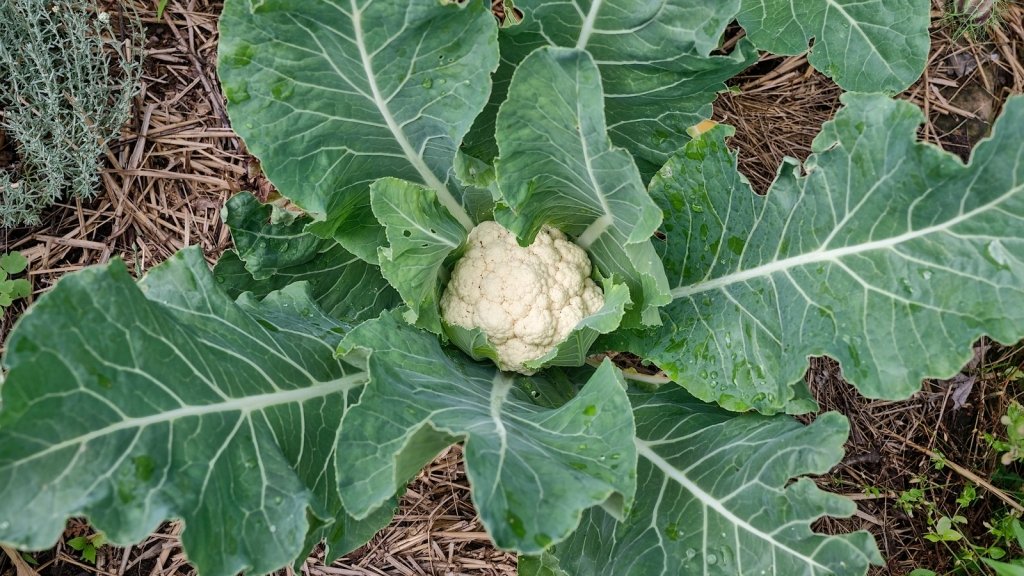
The short version: Cauliflower is the fussiest of the brassicas because its curd is a stalled flower head, and anything that shocks the plant while it is forming shows up in the curd. A tiny early head (buttoning), a grainy or fuzzy curd (ricing), a curd that never forms, brown patches, hollow stems, a purple blush, bolting and heads that loosen into leaves all trace back to a short list of causes: a check to growth from cold, heat, dry soil or hunger, too much nitrogen, damaged growing tips, boron or molybdenum shortage, or simply leaving the head too long. Grow it in the cool months, keep water and feed steady, give each plant 30 to 45 cm, and cut the curd the week it firms up.
Cabbage forgives. Cauliflower keeps score. Every cold snap, dry week and missed feed is written into the curd, and by the time you can see the problem the decision has usually been made weeks earlier. The upside is that each fault has a distinct look, so a quick diagnosis tells you exactly what to change next season.

How a cauliflower makes a curd
Cauliflower (Brassica oleracea, Botrytis Group) builds a big leaf frame first, then its growing point switches to producing a dense dome of arrested flower buds, the curd. Australian guides put the run from sowing to harvest at roughly 14 to 18 weeks for common varieties, and anywhere from about 12 to 26 weeks across quick mini types and slow winter ones. The plant wants steady, cool conditions for the whole of that time. The curd forms in a matter of days once triggered, and it is at its best for only about a week before it starts to loosen.
Seven curd problems and what causes each
1. No head at all
A plant that grows big and leafy and never forms a curd is called blind. A common cause is damage to the growing tip, from a caterpillar, a snail, a hailstone or rough handling at planting. Wide temperature swings while the plant is young can do the same, and some seed lots simply carry a few plants that never head. Rarely, a shortage of molybdenum is involved; the tell-tale sign is whiptail, where the leaves grow narrow, strappy and puckered. Protect the growing point with netting, plant at the right time for your zone, and if you see whiptail, test the soil pH and lime if it is acidic, because molybdenum is locked up in acid soils.
2. Buttoning
A curd the size of a coin, formed on a plant far too small to support it, is buttoning. It is a stress response: the plant was checked while young by cold, heat, dry soil, hunger or a root-bound punnet, and it panicked into flowering early. The button never grows. Plant out sturdy, well-hardened seedlings, never let them sit dry, feed them from the first week, and in frosty districts avoid planting into a forecast cold snap.

3. Ricing
Ricing is a curd that looks grainy or fuzzy instead of smooth, because the arrested flower buds started to grow on. Overfeeding with nitrogen, high humidity and a sudden warm spell are the usual triggers. Space plants properly for airflow, ease off the nitrogen once the curd starts to show, and harvest promptly. A riced head is still edible, just less pretty.
4. Brown patches and hollow stems
Browning on the curd has three possible causes with different fixes. Sunburn gives tan or brown patches on the exposed top; the fix is blanching, which means folding two or three outer leaves over the developing curd and holding them with a peg, or growing a self-blanching variety whose leaves wrap naturally. Pest damage from caterpillars or slugs leaves grazed, discoloured patches with the culprit nearby. Boron deficiency gives a small, brown, retarded curd along with a hollow stem whose internal tissue turns watery and then brown or black, and stiff, pale young leaves. Boron shortage is worst in sandy, alkaline, low-organic-matter soils, after drought or heavy rain, and where nitrogen or lime has been overdone. It is also easy to overdo: boron is toxic to plants in small excess, so do not guess a dose from commercial rates. Confirm it with a soil test and use a home garden product at the label rate, or feed the bed with compost and a seaweed solution and see whether the next crop improves.
5. Purple or pink tinge
A white curd that blushes purple or pink after a cold night or a day of strong sun is showing the same pigments that colour purple cauliflower, and it is harmless. Blanching prevents the sun-triggered version. Choose a purple or orange variety if you would rather embrace it.

6. Loose, leafy or split heads
A curd that opens up, sprouts small leaves through it or splits into segments has usually been left too long, hit a warm spell during maturation, or swelled too fast after heavy rain or overwatering. Once the curd is firm, tight and about the size the variety promises, cut it. Waiting for it to get bigger is how most heads are lost. In warm weather check every second day.
7. Bolting
Bolting is the curd going straight on to flower, usually after a sudden temperature change or a dry spell while the head was forming. Mulch to keep the roots cool and moist, throw shade cloth over the bed on hot days, and time sowings so the curd forms in the coolest part of your season.
Getting the basics right
Most curd faults come back to a check in growth, so the whole method is about avoiding checks. Sow into good seed-raising mix and hold seedlings in the punnet until the worst heat has passed. Plant out 30 to 45 cm apart into a bed enriched with compost and well-rotted manure, with a pH near neutral. Water deeply and evenly, mulch, and feed with a liquid vegetable fertiliser every one to two weeks while the frame is growing, then ease off the nitrogen once the curd shows. Net the bed against cabbage white and diamondback caterpillars from day one, and do not plant cauliflower where any brassica grew in the previous two years for the sake of soil nutrition, and rest a bed for at least three years where clubroot has ever appeared. Our guide to protecting brassicas from caterpillars covers the netting.

Harvesting well
Cut the curd with a few wrapper leaves attached while it is firm and the florets are still tightly packed, typically about 20 cm across for a standard variety and smaller for minis. Morning harvest keeps it crisp. A plant will not produce a second head, so pull it and compost it unless clubroot was present, in which case it goes in the bin. Sow smaller batches a few weeks apart through your cool season rather than a whole bed at once, and you get a steady supply instead of ten heads in one week.
Cauliflower seasons across Australia's climate zones
- Tropical (Cairns and far north Queensland, Darwin and the Top End of the Northern Territory, the Kimberley in Western Australia): a marginal crop. Sow quick, heat-tolerant varieties in the early dry season, about April to June, and expect small heads.
- Subtropical (Brisbane and coastal Queensland, Coffs Harbour and northern New South Wales): sow from about March to June so curds form in the dry, mild winter. Choose early varieties.
- Arid and semi-arid (inland Queensland, Broken Hill and Dubbo in New South Wales, Mildura in Victoria, inland South Australia and Western Australia, Alice Springs in the Northern Territory): sow in autumn, roughly March to May, for winter heads, and water steadily through dry spells.
- Temperate (Sydney and New South Wales, Melbourne and Victoria): sow from about January to April, early varieties first and slow winter types last. Spring sowings are risky because the curd tends to form in early summer heat.
- Mediterranean (Perth and southern Western Australia, Adelaide and the Adelaide Plains in South Australia): sow February to April for heads from late autumn through winter on the winter rains.
- Cool and alpine (Hobart and Tasmania, Canberra and the ACT, Ballarat in Victoria, Orange and Armidale on the New South Wales tablelands, and the alpine country of the Snowy Mountains and the Victorian high country): the best cauliflower country. Sow in spring, about September to November, for autumn heads, and in January for plants that mature through winter.
Whatever the zone, the aim is the same: the curd forms in cool, settled weather, not during a heatwave or a hard frost.
Frequently asked questions
Can I eat a cauliflower that has buttoned, riced or turned purple?
Yes to all three. They are cosmetic faults, not safety problems. Cut away brown patches and use the rest, but if any part of the curd is slimy, soft or smells off, that is rot rather than a cosmetic fault, and the head should go in the compost.
How do I know when to cut a cauliflower?
When the curd is firm, white and tight and has stopped growing noticeably from one day to the next. If the florets start to separate or leaves poke through, it is already past its best.
Why are my cauliflower leaves narrow and strappy?
That is whiptail, a molybdenum deficiency most often seen in acidic soil. Test the pH and lime the bed before the next brassica crop.
Should I add boron to my cauliflower bed?
Only if a soil test or clear symptoms point to a shortage, and then only at the rate on a home garden product. Excess boron harms plants and lingers in the soil.
Cauliflower asks for more attention than cabbage, but the rules are simple: cool weather, steady water and feed, room to grow, protected leaves, and a prompt harvest. ABC Gardening Australia's guide to growing cauliflower is a good companion to this one.
Related growing guides
- Cabbage White and Diamondback Caterpillars: Protecting Your Brassicas
- Soil pH explained: why it matters and how to nudge it
- What to grow in winter: cool-season vegetables across Australia
Choose an early, mid or late variety to spread the harvest: browse our cauliflower seeds, broccoli seeds and the full range of vegetable seeds.