
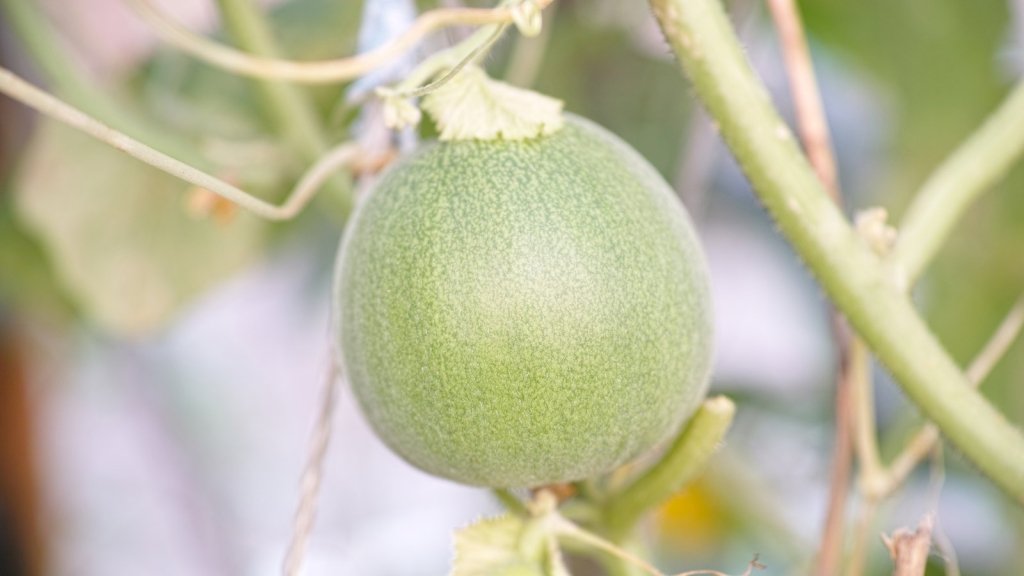
The short version: Rockmelon and honeydew are both Cucumis melo, and both want heat, room and a long run of warm weather. Sow into soil of at least 18°C and allow each vine about a square metre. Water steadily while the fruit swells, then ease back at the end, because the sugar is made on the vine. A ripe rockmelon slips off the vine. A honeydew does not, so you cut it.
The giveaway is the smell. On a warm summer morning you can tell which rockmelons are ready without bending down.
The two usual causes of a disappointing homegrown melon are picking early and drowning it in the last fortnight. A melon builds sugar on the vine, and never catches up once cut.
Two melons, one species, and why watermelon differs
Rockmelon and honeydew are two groups of one plant, Cucumis melo. The netted, orange-fleshed melon Australians call rockmelon, and Americans call cantaloupe, is the reticulatus group. Honeydew is the inodorus group, the winter melons, with casaba and Piel de Sapo types. Watermelon is a different genus, Citrullus lanatus, and like honeydew it never releases from the stem. Rockmelons do, which governs how you pick them; our sweeter watermelons guide covers that crop.
Melons need heat and a long season
Allow 10 to 16 weeks from planting to the first pick, and five to seven weeks from flower to ready fruit. The Queensland Department of Primary Industries rockmelon and honeydew information kit, a 1997 growers' guide that is still the fullest Australian treatment, gives that range and notes cold-season crops are slower and colour poorly. Where the season is short:
- Choose an early, short-season variety with smaller fruit.
- Lay black plastic on the bed a fortnight ahead: black film warms soil.
- Plant against a north-facing wall, which holds evening warmth.
- Cloche young plants, uncovering them once the vines run.
Sow into warm soil, on a mound
Soil temperature decides this, not the calendar. The kit sets a floor of 15°C, but seed strikes in three days at 28 to 30°C and takes 14 days at 15°C, losing many seeds to disease. Aim for 18°C minimum, 22 to 27°C for a clean strike.
Sow 2 cm deep, two or three seeds per station, and thin to the strongest. Melons resent root disturbance, so start early seed in deep cells three to four weeks before you expect soil of 18°C, and plant out after the last frost. Space plants 50 to 60 cm apart in rows 1.5 to 2 m apart, on a low, broad mound 15 to 20 cm high, wide enough not to dry out.
They trellis well where space is short: tie the stems up and sling each fruit in an old stocking at cricket ball size. Watermelon is too heavy.
Pollination: why the first small fruit yellows and drops
A melon vine carries male flowers and fruit-bearing flowers, and only the latter become melons; in most varieties that flower carries both male and female parts. Bees do the work, and flowers last a day, so pollination ends by midday.
Cold, wet or windy weather keeps bees home, and small fruit then set, yellow and drop. Plant flowers nearby, shelter the patch from wind, and spray only late in the day, away from open flowers. To hand pollinate, pick a male flower, the one on a thin stalk with no swelling behind it, and brush its pollen into an open fruit-bearing flower, as our hand pollination guide shows.

Water steadily while the fruit swells, then ease back
The Queensland kit splits this into two stages.
- Vine growth and early fruit fill. From fruit set until netting appears, or on a honeydew until it nears full size, our rule of thumb, keep the soil evenly moist. In hot weather, two or three waterings a week.
- Fruit filling to maturity. Once netting shows, reduce the water gradually so the sugars concentrate. The kit is blunt: watering right before harvest lowers sugar content, and keeping water up gives a heavier crop with less sugar.
Ease back, do not cut the water off: a vine that dries hard then gets a drenching splits its fruit. Water at ground level, because wet leaves overnight favour downy mildew, while crowded, humid foliage favours powdery mildew.
Feed the same way. Dig compost in before planting, aim for slightly acid soil, pH 6 to 6.5, and stop feeding by early fruit set. Later feeding gives soft fruit that splits, and excess nitrogen runs a vine to leaf.
Thin the fruit. A vine carrying everything it set ripens small, thin-tasting melons, so let four to six through on a strong vine, fewer on a large-fruited one. Slide a tile or straw under each melon once it has size.
How to tell a ripe rockmelon from a ripe honeydew
Rockmelon tells you plainly. As it matures the stem cracks where it joins the fruit, which growers call slip: at half slip it pulls away under pressure, at full slip it comes off cleanly. Wait for full slip. The netting coarsens, the skin beneath turns yellow-green, and the blossom end smells sweet.
Honeydew never slips, so cut it with clean secateurs, fingers clear of the blade. Read the rind: the waxy bloom goes, the surface turns tacky, the colour shifts from greenish white to creamy white on white types and brightens on yellow-skinned ones, and the blossom end gives under firm pressure.
Rockmelons soften after picking, honeydew and watermelon barely change, and none make more sugar off the vine. The kit puts it plainly: melons gain no sugar once picked, and close to half of it is reputed to be laid down in the last week on the vine.
Before you cut it, wash the rind
Scrub the whole melon under running water and dry it before cutting, because the knife carries whatever is on the skin into the flesh, and a homegrown melon has lain on soil. CSIRO notes that the netted rind of a rockmelon is particularly hard to clean, and that listeria keeps growing slowly at fridge temperature. The Food Safety Information Council advises refrigerating cut produce within two hours and discarding anything left out longer, and says vulnerable people should avoid rockmelon: pregnant women, older people and anyone with a weakened immune system.

What goes wrong
- Powdery and downy mildew are the most serious cucurbit diseases. Space plants for airflow and see our powdery mildew guide.
- Fusarium wilt yellows leaves, wilts runners and browns the inside of the stem, often one runner at a time. The Soil Wealth fact sheet notes it travels on seed, seedlings and soil, and that spores survive more than 10 years. Bin affected plants, never compost them, clean your tools, and keep cucurbits off that ground for years.
- Fruit fly can sting melons as they ripen: Queensland fruit fly (Bactrocera tryoni) in the eastern states, Mediterranean fruit fly (Ceratitis capitata) in Western Australia. Net the patch and never leave fallen fruit lying. Which crops count as hosts, and what you must do about them, differs by state, so check your state agriculture department and our fruit fly guide.
- Split fruit follows a dry spell broken by heavy water. Hollow heart, a cavity in the flesh, is better known in watermelon and its cause is debated.
- Bland fruit means picked early, watered too hard at the end, or given too little sun.
Sowing windows across Australia's climate zones
These are broad groupings: local frost dates and soil temperature overrule the month, and no authority publishes a national melon calendar.
- Tropical (Darwin in the Northern Territory, Cairns and Townsville in Queensland): the dry season is the growing season, March to August.
- Subtropical (Brisbane, the Sunshine Coast and Bundaberg in Queensland, Coffs Harbour and Lismore in New South Wales): sow August to December.
- Arid and semi-arid (Alice Springs in the Northern Territory, Broken Hill in New South Wales, Mildura in Victoria, Kalgoorlie in Western Australia, inland and central-west Queensland): sow from September and mulch heavily.
- Temperate (Sydney, Newcastle and Wollongong in New South Wales, Melbourne and Geelong in Victoria at the cold end of the zone): sow October to December, once soil holds 18°C.
- Mediterranean (Perth, Bunbury and Geraldton in Western Australia, Adelaide and the Barossa in South Australia): sow September to December.
- Cool and alpine (Tasmania, Canberra and the ACT, Ballarat in Victoria, Orange, Bathurst and Armidale in New South Wales, Stanthorpe in Queensland): raise indoors in October, plant out in November after frost.
Frequently asked questions
Can I grow rockmelon in a pot?
Yes, in a large one: at least 40 litres, good drainage, one plant and a trellis. Water daily in hot weather, then ease back once the fruit nets, since a pot dries faster than a bed.
Plenty of flowers but no fruit. What is wrong?
Usually the early male flowers arriving first, which is normal, or poor bee weather. Plant flowers nearby and hand pollinate.
Will a rockmelon ripen on the kitchen bench?
It will soften and smell stronger, but not sweeter. Picked before full slip, it stays flat tasting.
Do melons cross with cucumbers or pumpkins?
No, they are different species. Rockmelon and honeydew cross with each other, which matters only if you save seed, and never changes this year's fruit.
How long does a picked melon keep?
A whole ripe rockmelon keeps about two weeks in the fridge. Honeydew keeps four weeks, but takes chilling injury stored too cold.
Do I need to wash the outside before cutting?
Yes. The knife drags whatever is on the rind into the flesh, and a homegrown melon has lain on soil. Refrigerate cut melon within two hours. Pregnant women, older people and anyone with a weakened immune system are advised to avoid rockmelon altogether.
Warm soil, steady water while the fruit swells, then a drier finish, and the melon earns its row.
Related growing guides
If you have the room and the heat, our rockmelon and honeydew seeds cover the netted types and the winter melons, with watermelon seeds beside them.