
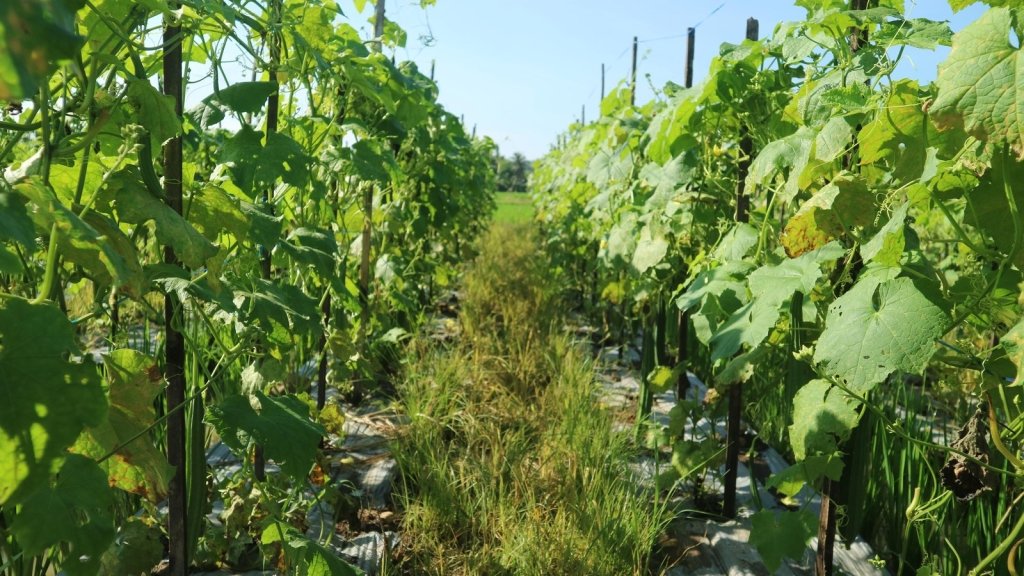
The short version: Cucumbers want warm soil, even water and something to climb. Sow two or three seeds per station, 1 to 2 cm deep, once the bed holds above 16°C, and trellis the vine. Most garden types need bees to set fruit. Keep moisture steady, mulch and pick every day or two. Bitterness is mostly variety plus stress, and a bitter cucumber is not food.
A cucumber vine is one of the fastest things in a summer garden.
The fruit is mostly water and grows at the speed the water allows, so any interruption shows as a bend, a swollen end, a bitter mouthful.
Lebanese, telegraph, apple and gherkin each suit a different job
- Lebanese and slicing. Short to medium fruit, 10 to 20 cm, thin skinned, best for a small garden.
- Telegraph, continental or burpless. Long fruit, 30 to 45 cm, needing a trellis to stay straight.
- Apple and crystal. Round, pale and mild, picked at tennis ball size.
- Gherkin and pickling. Small and firm fleshed for brine, picked at 5 to 10 cm.
Garden cucumbers are monoecious: male and female flowers on one plant, with insects moving pollen. Gynoecious varieties are almost all female, so their seed comes blended with a pollen bearing variety. Parthenocarpic varieties fruit without pollination, as greenhouse cucumbers do; Western Australia's Department of Primary Industries and Regional Development warns in its greenhouse cucumber bulletin that pollinating them gives bulbed, bitter fruit.
Sow into warm soil, and sow where the plant will stay
Soil temperature decides this crop, not the calendar: seed wants the bed above about 16°C and germinates fastest around 27°C, while cold wet soil gives patchy germination and rot.
Sow two or three seeds per station, 1 to 2 cm deep, and thin to the strongest. Direct sowing wins where the season allows: cucurbit roots resent disturbance, and a checked seedling sulks while a direct sown one races past. In cool districts raise in cells or coir pots and plant out at the two to four leaf stage, root ball whole. Sow again every three or four weeks.
A trellis gives straighter fruit, cleaner skin and better airflow
Fruit hangs free and grows straight, skin stays unmarked, and air moves through the canopy. A mesh panel, star picket and wire frame, or netting between posts all work, at 1.8 to 2 m.
Space trellised plants 40 to 60 cm apart, a sprawling plant about a square metre. Tie the stem loosely every 30 cm with soft twine, or twist the tip around a vertical string twice a week, and keep fruit clear of wires and stems: anything pressing on a young cucumber leaves a bend.

Male flowers come first, and the female ones carry the fruit
A young plant opens a run of male flowers before any female ones appear. Male flowers sit on a thin plain stalk; female flowers carry a miniature cucumber behind the petals.
Cucumber pollen is large and sticky, so insects must move it. A female flower holds many ovules and needs repeated bee visits, at least nine by the usual estimate; partial pollination gives the classic bad cucumber, normal at the flower end and pinched at the stem end.
Hand pollination takes a minute. In the morning, pick a freshly open male flower, strip the petals back and brush its pollen onto each open female flower, as with zucchini flowers that will not set. Longer term, nearby flowers bring bees.
Even moisture is the single biggest factor in fruit quality
A cucumber that dries out and is then flooded answers with bitterness and curled, pinched fruit, and a loaded plant aborts fruit if it runs dry or sits through days above 35°C. Water deeply at the base, never lightly and often: two or three times a week, or daily in sand, pots and heatwaves. See our guide to watering vegetables deeply.
Water in the morning and at soil level: foliage left wet overnight invites downy mildew and angular leaf spot, while a damp, still canopy suits powdery mildew. Lay 5 to 7 cm of straw or lucerne mulch once the soil is warm, then liquid feed from first fruit set, fortnightly.
Bitterness is mostly genetics plus stress, not bad luck
All cucurbits make cucurbitacins, the plant's defence against being eaten. In cucumber it is mainly cucurbitacin C, and breeders have used a bitter free mutation, the bi gene, since the 1950s, so many modern varieties stay sweet.
In a variety that can still make it, mild bitterness is a stress response: heat, big day to night swings, too little water, or a wet then dry watering pattern. Our guide to sweeter, less bitter cucumbers has the detail.
Taste before you serve. Most cucumbers carry a faint bitterness at the stem end; trimming that end and peeling deals with it. Anything beyond that faint note, or any unpleasant smell, means the bin: cooking does not destroy cucurbitacins. The Australian Food Safety Information Council records vomiting, stomach cramps, diarrhoea and collapse in people who ate bitter zucchini, and the same compounds make a cucumber bitter.

Powdery mildew, downy mildew and the summer pests
Powdery mildew (Podosphaera xanthii) shows as white powdery patches on either leaf surface, older shaded leaves first. Unlike most leaf fungi it needs no wet leaf, only humid, still air, so airflow matters more than dry foliage. Downy mildew (Pseudoperonospora cubensis) is angular yellow patches on the upper leaf, bounded by veins, with greyish fuzz beneath; it needs only a few hours of leaf wetness, prefers roughly 15°C to 20°C, and can cycle in four days.
Management is structural: space plants, trellis them, water at the base in the morning, bin bad leaves and pick tolerant varieties. Milk at one part in ten, or potassium bicarbonate at 5 g per litre with a little horticultural oil, have trial evidence behind them but suppress rather than cure: start early and repeat weekly. Both scorch in hot sun, so spray on a mild morning, never above 30°C.
Cucumber mosaic virus has no spray: plants are stunted, with mottled curled leaves and distorted fruit. An Australian industry factsheet lists more than 80 aphid vectors, led by melon aphid (Aphis gossypii) on cucumbers and green peach aphid (Myzus persicae), and notes an aphid picks it up in under a minute, so pull affected plants and manage aphids early. Pumpkin beetle (Aulacophora hilaris), orange with four black spots and 6 to 7 mm, chews leaves and flowers, so seedlings want a cover or morning patrol. In warm districts cucumber fly (Zeugodacus cucumis) stings fruit, so net the crop from first fruit set.
Pick young, pick often, and never let one mature
Cucumbers are ready roughly 55 to 80 days from sowing, or two weeks after flowering for long types and 7 to 10 days for Lebanese ones. Pick them smaller than the supermarket has taught you: firm, evenly green, no yellowing at either end.
In peak summer, check daily for short fruited types and every second day for long ones: one fruit left to mature tells the plant its job is done and flowering slows. Cut fruit with clean, sharp secateurs, keeping your spare hand clear of the blade.

Sowing windows for Australia's six climate zones
- Tropical (Darwin in the Northern Territory, Broome in Western Australia, Cairns in Queensland): the dry season, April to August.
- Subtropical (Brisbane and the Gold Coast in Queensland, Coffs Harbour in northern New South Wales): September to March, avoiding the wettest weeks.
- Arid and semi-arid (Alice Springs in the Northern Territory, Broken Hill in New South Wales, Mildura in Victoria, Kalgoorlie in Western Australia, inland Queensland): spring and early autumn, with midsummer shade.
- Temperate (Sydney and Newcastle in New South Wales, Melbourne and Geelong in Victoria at the cold end of the zone): September to January, once soil holds above 16°C.
- Mediterranean (Perth and Bunbury in Western Australia, Adelaide and Mount Gambier in South Australia): September to December, plus a late February sowing.
- Cool and alpine (Tasmania, Canberra and the ACT, Ballarat in Victoria, Orange and Armidale in New South Wales, Stanthorpe in Queensland): October to December once frost has passed.
These are broad groupings: local frost dates and soil temperature overrule the month, so treat them as starting points.
Frequently asked questions
Why are my cucumbers fat at one end and skinny at the other?
Incomplete pollination. Each seed comes from its own ovule, so a flower with too few bee visits swells only where ovules were fertilised, leaving the stem end pinched.
Do I have to build a trellis, or can they run on the ground?
A trellis is optional. It keeps fruit straight and unmarked, moves air through the leaves and puts the harvest at eye level.
My plant has flowers everywhere and no cucumbers. What is wrong?
Young plants open male flowers only for a week or two. If female flowers open then yellow, suspect pollination, heat or uneven water.
Why do my cucumbers taste bitter?
Usually stress in a variety that can still make cucurbitacins: heat, dry spells, or watering that swings from flooded to bone dry.
Can I eat a cucumber that tastes bitter?
If it is only the usual faint note at the stem end, trim that end and peel it. Anything more, or an unpleasant smell, means the bin: cooking does not remove cucurbitacins.
How often should I really be picking?
Daily for Lebanese and gherkin types in high summer, every second day for telegraph types. Frequent picking keeps it flowering.
Warm soil, a trellis, a steady hose and a daily basket is nearly the whole method.
Related growing guides
Our cucumber seeds cover all four types, and the climbing vegetable seeds range is worth a look.