
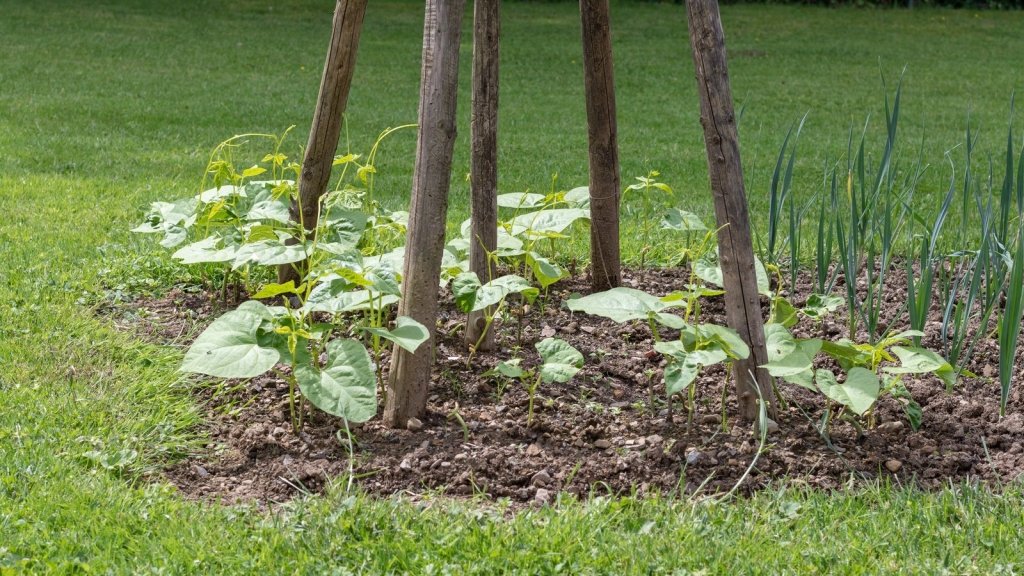
The short version: Sow beans into warm soil, about 16°C and rising, 2 to 5 centimetres deep depending on the soil. Bush beans give one flush in eight to ten weeks; climbing beans start slower and crop for months. Runner beans are a different species with perennial roots that need cool nights to set pods, so they disappoint in a hot humid summer. Water well at flowering, pick often, and cook beans before eating them.
A packet of bean seed is the cheapest bet in the vegetable garden and one of the easiest to lose. The seed is large and starchy, and in cold wet ground it swells, splits and rots.
Sow the same packet into warm soil and the row is up in a week to ten days. The gap is a few weeks of patience.
Bush, climbing and runner beans are three different jobs
Bush and climbing beans are the same species, Phaseolus vulgaris. Runner beans are Phaseolus coccineus, a different plant.
- Bush or dwarf beans grow knee high, need no support, and ripen most of the crop in eight to ten weeks. That flush suits the freezer, so sow a short row every three weeks.
- Climbing or pole beans start slower, crop for two or three months, and give more from the same square metre because they grow upwards.
- Runner beans have scarlet or white flowers and tuberous roots that persist for years in mild districts. They need cool nights to set, and in a hot humid summer they flower hard and set almost nothing.
Butter or wax beans are yellow podded and easier to spot, and purple pods turn green when cooked.

Sow into warm soil, and do not soak the seed first
Beans germinate on soil temperature, not the date. About 16°C is the working minimum, 18°C to 20°C is quick and even, and 30°C is the top of the band. Average a few thermometer readings, as our guide to the kitchen thermometer test explains.
Cold wet soil is what kills bean seed: a big starchy seed drinks fast, and while it sits swollen and cold it leaks sugars that invite seed rot. Skip the overnight soak too. Sustainable Gardening Australia calls it unnecessary in their notes on growing beans, and there is a second reason: water rushing into a dry seed can split the coat and crack the cotyledons. Sow direct, because beans resent root disturbance.
Depth, spacing and supports that will actually hold
- Sow 2 to 3 centimetres deep in heavy soil, 4 to 5 in light sand.
- Space bush beans 10 to 20 centimetres apart, in two rows 25 centimetres apart so they lean together and keep pods off the soil.
- Space climbing beans 15 to 20 centimetres along the support, which goes up first.
- Sow into damp soil and leave it alone: overwatering now does more harm than underwatering.
Climbing beans reach 2 metres and runner beans go higher, so a frame that looks generous in October is a wind-loaded sail by January. A tripod of hardwood stakes survives a storm. Our guide to supports for climbing vegetables compares the options.
Nitrogen fixing is real, but it does not fertilise the bed for free
Beans form nodules on their roots where rhizobia bacteria turn air nitrogen into a form the plant can use, which is why they need little added nitrogen. Compost and a little blood and bone at sowing is enough, and excess gives leaves rather than beans.
What gets overstated is the leftover. Much of the fixed nitrogen goes into the pods and seed: in grain legumes roughly 30 to 40 per cent leaves in the seed at harvest, as the Soil Quality fact sheet for South Australia explains. Pull the plants out by the roots and the nodules go too, so cut the tops at ground level and leave the roots.
Inoculant is not worth buying. Beans and peas use different rhizobia, so an old pea bed carries nothing useful, and the groups sold to Australian gardeners cover peas, faba beans, mungbeans and cowpeas, not French or runner beans.

Water at flowering, and expect losses in a heatwave
Beans are relaxed about water until they flower, then they are not. A dry week at flowering or pod fill costs you pods, so water deeply two or three times a week and mulch to hold it. Water at the base in the morning: wet foliage overnight is what rust and halo blight wait for.
When a hot run strips every flower off the plant, that is not your fault. Bean pollen works best near 20°C, falls away above about 28°C, and by the mid thirties much of it is sterile. Warm nights from the low twenties up cut pod set as well. Shade cloth through the worst days helps, and plants flower again afterwards.
Pick young, pick often, and cook what you pick
Pick while the pods snap instead of bending, before the seeds swell and the pod turns lumpy: every two or three days in warm weather. The plant wants seed, not dinner, and once a few pods harden it slows or stops flowering.
Beans are a cooked vegetable. They contain lectins that cooking breaks down, and dry seed holds far more than a green pod. The Food Safety Information Council advises soaking dried beans for at least five hours then boiling them briskly in fresh water for at least 10 minutes, and warns that slow cooking may not destroy the toxin. As few as four or five raw beans can cause severe stomach upset, seed saved from your own row included. Keep children from grazing raw beans off the plant.

The pests and problems worth knowing about here
Bean fly (Ophiomyia phaseoli) belongs to tropical and subtropical coastal districts, so Queensland, northern New South Wales and the Top End see it and southern gardens rarely do. The maggot mines from a leaf into the stem, so the first sign is a stunted seedling with yellowing leaves and a swollen, cracked stem at soil level. Seedlings are at greatest risk for three or four weeks after emergence, as Business Queensland sets out. Mounding soil around the stems encourages roots above the damage.
Halo blight shows as water-soaked leaf spots ringed with a pale yellow halo, spread by rain splash and wet hands. It is seed-borne and there is no cure: pull infected plants, bin them, save no seed from that row, and sow elsewhere next season.
Bean rust (Uromyces appendiculatus) makes pustules 1 to 2 millimetres across with yellow haloes that burst into reddish-brown powder, and it likes mild, humid weather with long dews. Space plants for airflow.
The 28-spotted ladybird (Henosepilachna vigintioctopunctata) eats leaves rather than aphids, leaving a skeletonised window, and is best picked off by hand. Snails can take a row of seedlings overnight, and our guide to slugs and snails covers the options.
When to sow beans across Australia's climate zones
These are broad groupings, and published sowing calendars disagree about the edges. Local frost dates and your own soil temperature decide it.
- Tropical (Darwin and Katherine in the Northern Territory, Cairns and Townsville in Queensland): the dry season, April to August. Wet season sowings struggle with bean fly.
- Subtropical (Brisbane, the Sunshine Coast and Bundaberg in Queensland, Coffs Harbour and Lismore in northern New South Wales): August to March, best either side of midsummer.
- Arid and semi-arid (Alice Springs in the Northern Territory, Broken Hill in New South Wales, Mildura in Victoria, Kalgoorlie in Western Australia, Emerald in central Queensland): August to October, then late February into March, skipping the heat between.
- Temperate (Sydney and Newcastle on the New South Wales coast, Melbourne and Geelong in Victoria at the cold end of the zone): October to February, once the soil holds 16°C.
- Mediterranean (Perth, Bunbury and Margaret River in Western Australia, Adelaide and the Barossa in South Australia): September to January, with mulch on sandy soil.
- Cool and alpine (Tasmania, Canberra and the ACT, Ballarat in Victoria, Orange and Armidale in New South Wales, Stanthorpe in Queensland): November to January, after frost. Runner beans thrive here.
Frequently asked questions
Should I soak bean seed before sowing?
No. A long soak can split the coat and damage the seed inside. Sow it dry into damp soil and leave the bed alone.
My beans flowered beautifully and set nothing. Why?
Heat, almost always. Pollen loses viability as the days climb through the thirties, and warm nights add to it. The plants usually set after the weather breaks.
Do beans really put nitrogen back into the soil?
Only partly. The nodules fix nitrogen, but a large share walks off on your dinner plate. Leave the roots in and the next crop gets what is left.
Do I need to buy an inoculant?
No. Beans and peas use different rhizobia, so an old pea bed does not help, and no group sold to Australian gardeners covers French or runner beans.
Why are my runner beans all flower and no pods?
Cool nights are what they set on, and a humid northern summer does not supply them. Grow climbing beans for the crop and the runner for its flowers.
Can I eat beans raw off the plant?
No. Soak dried beans for at least five hours, then boil them briskly in fresh water for at least 10 minutes. A slow cooker on low may not destroy the toxin.
Warm soil, a support that will hold, water at flowering and a basket every second day will do the rest.
Related growing guides
- Supports for climbing beans, peas and cucumbers
- The kitchen thermometer test: when your soil is ready
- Growing broad beans
Ready to sow a row? Our bean seeds cover bush, climbing, butter and runner types, and the climbing vegetable seeds share that trellis.