
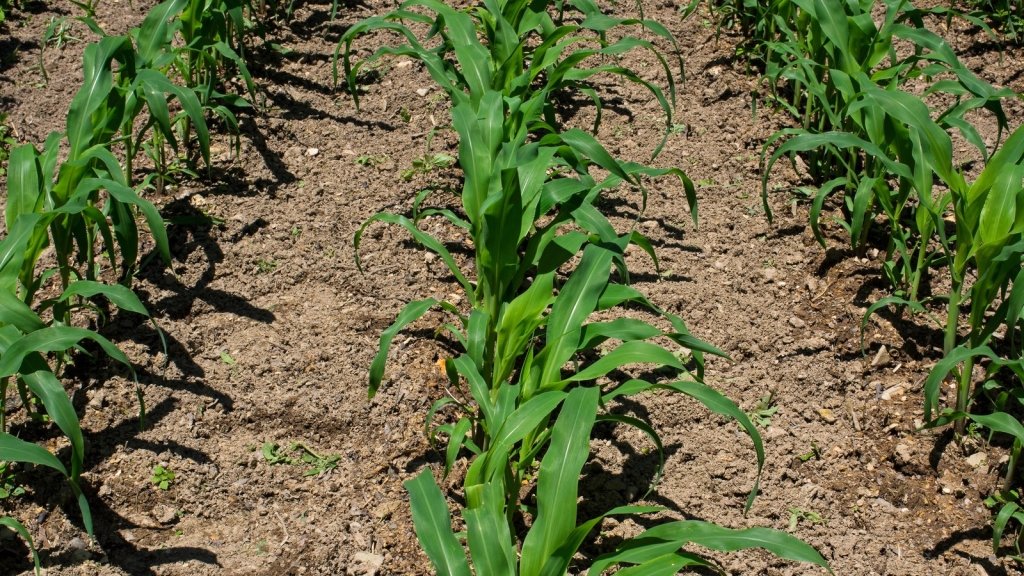
The short version: Sweet corn is wind pollinated, so plant it as a block of three or four short rows, never one long row. Sow 3 to 5 cm deep once the soil holds about 16°C, space plants 25 to 35 cm apart, and sow a fresh block every two to three weeks. Feed it hard and water from three weeks before the silks appear until two weeks after. Pick when the silks are brown and a squeezed kernel runs milky.
A cob with half its kernels missing is the commonest disappointment in a home corn patch, and rarely the seed's fault.
Corn does not need bees. Pollen falls from the tassel and must land on a silk lower down, which decides the spacing and the block size.
Plant a block, not a row, because every silk is one kernel
Each silk is attached to one ovule inside the husk, and that ovule becomes a kernel only if pollen lands on it. A cob of 500 kernels needed 500 landings.
A long single row sheds pollen sideways onto the lawn; three or four short rows shed onto each other. Base silks emerge first and tip silks last, so gaps show at the pointy end. Tap each stem on a still morning while the tassels shed.

Sowing: soil temperature, depth, spacing and a block every two to three weeks
Sweet corn sulks in cold ground. The NSW Department of Primary Industries and Regional Development (NSW DPI) advises soil at least 12°C and rising when read at 9 am, with 14 to 16°C the minimum for supersweet. At home, 16°C is the target, read 4 to 5 cm down.
Sow 3 to 5 cm deep into moist soil, or 2.5 cm if the ground is cool or the seed is supersweet, which carries less starch. Corn transplants poorly once the roots circle, so direct sowing is the default; deep cells suit cold gardens.
- Mark out a block, not a strip: three rows of five is the minimum, and 25 in a five by five is better.
- Sow two or three seeds per station at 25 to 35 cm each way, then thin to the strongest: see our vegetable spacing guide.
- Sow the next block two to three weeks later and repeat, which turns one glut into a run of dinners: see succession planting.
Keep supersweet corn away from the rest
Standard sugary (su) loses sweetness fast. Sugary enhanced (se) is sweeter and holds longer. Supersweet, marked shrunken-2 or sh2, carries up to twice the sugar of a standard variety and keeps it far longer.
The genes that make corn sweet are recessive, so pollen from field maize, popcorn or a standard variety turns those kernels tough and starchy, in the cob you eat this season.
NSW DPI puts the commercial answer at 400 m of separation, or 14 to 21 days between pollination times. No home block has 400 m, so use time.
- Grow one type a season. The simplest fix of all.
- Or separate the flowering. Sow the second type three weeks later, or pick varieties whose days to maturity differ by at least three weeks.
- Keep popcorn out. Popcorn, ornamental corn and field maize all need separating; se and su do not.
Feed it hard, and water it at the two moments that count
Corn is a heavy nitrogen feeder. NSW DPI cites American research showing it takes up under 15 per cent of its nitrogen in the first four weeks and about 60 per cent in the two weeks either side of tasselling, so feeding only at sowing misses the window. Dig compost and pelletised manure through the bed, side dress with blood and bone at knee height, then feed fortnightly with fish and seaweed: see our guide to feeding the vegetable garden.
The critical stretch covers tasselling, silking and early cob fill, from three weeks before the silks appear to two weeks after. Wilting at early tasselling alone can cut yield by up to 20 per cent. Soak deeply two or three times a week rather than sprinkling daily, and never let the bed dry while the cobs fill. See our guide to watering deeply.

What goes wrong: lodging, tillers, earworm, birds and smut
Lodging. Tall plants blow flat in a storm as the cobs fill. Hill 10 to 15 cm of soil around the stems at knee height, giving the brace roots something to grip.
Tillers. Leave the side shoots at the base alone. Pioneer Seeds Australia reports that trials more than 80 years ago found removing tillers never raised yields and usually lowered them, and later tracer work showed those leaves feed the main cob.
Corn earworm. The caterpillar in a cob tip is corn earworm (Helicoverpa armigera). Its close relative, native budworm (Helicoverpa punctigera), does not attack corn. Business Queensland advises checking twice weekly from first flowering. Squash the ribbed eggs, about half the size of a pinhead, and any small caterpillars on the silks, then cut the damaged tip off at picking. A Bacillus thuringiensis spray is gentlest around bees and works only on small larvae, so use it late in the day at the label rate.
Birds. Cockatoos and corellas strip a block in a morning. They are native birds, protected in most states, so exclude rather than harm them. Use white netting with a mesh of 5 mm by 5 mm or smaller at full stretch, pulled taut over a frame: coarser mesh tangles birds, bats and reptiles, and 5 mm has been the legal maximum in Victoria for household netting since September 2021. See deterring birds.
Maize weevil. Sitophilus zeamais ignores green cobs and matters only if you dry corn for popcorn or seed. Dry the kernels hard, freeze them, then store airtight.
Smut. Boil smut (Ustilago maydis) makes pale grey swellings that blacken into sooty spores. In the eastern states, cut the galls out while pale and firm and bin them, never compost them. It has never been recorded in South Australia or Western Australia, so gardeners there should photograph it and call the Exotic Plant Pest Hotline on 1800 084 881 rather than cut or move it.
Corn leaves have sharp edges, so wear a long-sleeved shirt and a hat inside a tall block.
How to tell a cob is ready, and how fast the sugar goes
Start checking about three weeks after the silks appear: NSW DPI puts harvest at three to four weeks from first silk. Three signs line up: tip silks brown and dry, husk gone dull, the cob full and rounded. Then peel back a strip of husk and press a kernel. Clear and watery is too early, milky is right, thick and pasty means the sugars have turned to starch.
The clock keeps running after picking. A standard sugary variety is at its best for two to five days on the plant and two to four afterwards; supersweet types allow five to twelve and four to ten. Pick in the cool of the morning and refrigerate the cobs in their husks, because warmth speeds sugar into starch.

Sweet corn sowing windows across Australia's climate zones
These windows are broad groupings drawn from state guides rather than one national calendar: local frost dates and soil temperature overrule the month.
- Tropical (Darwin in the Northern Territory, Cairns and Townsville in Queensland): most of the year, with the dry season, April to August, easiest if you can water.
- Subtropical (Brisbane, the Sunshine Coast and Gold Coast in Queensland, Coffs Harbour and Lismore in northern New South Wales): August to February, skipping sowings that would flower in the stormiest weeks.
- Arid and semi-arid (Alice Springs in the Northern Territory, Broken Hill in New South Wales, Mildura in Victoria, Kalgoorlie in Western Australia, inland and central-west Queensland): September to February, skipping sowings that would silk in peak heat.
- Temperate (Sydney, Newcastle and Wollongong on the New South Wales coast, Geelong and Melbourne in Victoria at the cold end of the zone): September to early January, once the soil holds 16°C, with Melbourne starting later.
- Mediterranean (Perth, Bunbury and Busselton in Western Australia, Adelaide, the Adelaide Hills and the Barossa in South Australia): September to December, with the dry summer suiting corn if you water.
- Cool and alpine (Tasmania, Canberra and the ACT, Ballarat in Victoria, Orange, Bathurst and Armidale in New South Wales, Stanthorpe in Queensland): late October to December, after the last frost, with a short-season variety.
Frequently asked questions
How many corn plants do I actually need?
At least 15, in a block of three rows of five, and 25 or more if you have room. Fewer, and pollination turns patchy.
Can I grow corn in a pot on a balcony?
You can grow it, but pollinating it is the hard part. Tap the tassels over the silks each morning; one large trough beats scattered pots.
Why are my cobs only half filled with kernels?
Poor pollination, nearly every time. Too few plants, a single row, a hot windy spell at flowering or dry soil at silking will all leave gaps.
Should I pull off the side shoots at the base?
No. Those are tillers. Early trials found that removing them never raised yields and usually lowered them.
Can I grow popcorn and sweet corn in the same garden?
Not at the same time. Popcorn pollen turns sweet corn kernels starchy in the season you pick.
My corn is 2 m tall and has blown over. Can I save it?
Often yes. Stand them up gently before the stems set a bend, and mound soil firmly around the bases.
Get the block right, sow into warm soil and water through silking, and the cobs fill to the tip.
Related growing guides
- Direct sowing straight into the garden
- The kitchen thermometer test for soil readiness
- Succession planting for a continuous harvest
Planning a block? Browse our corn seeds, one type at a time, or the wider vegetable seeds range.