
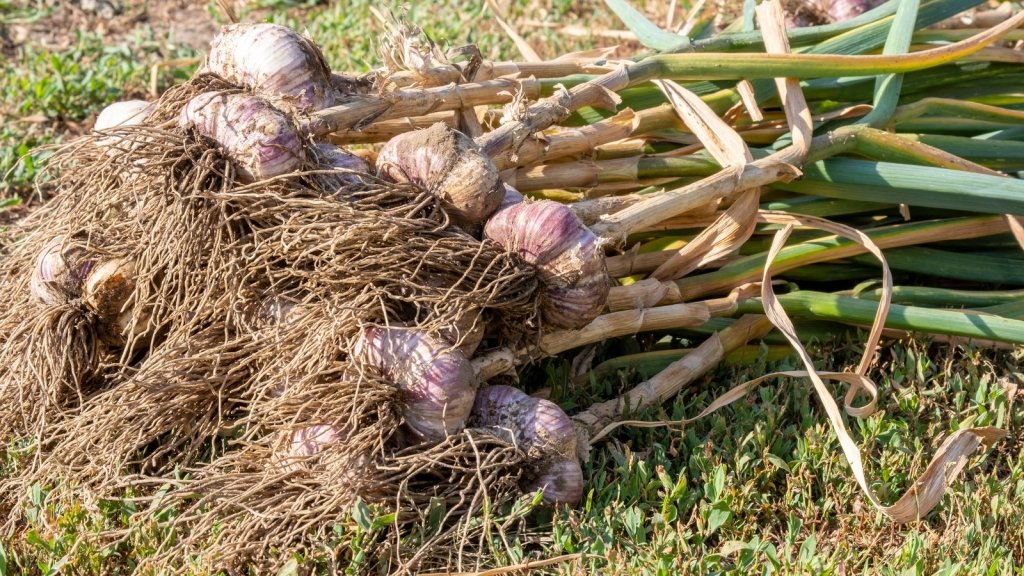
The short version: Garlic is ready when the plant says so, not the calendar. In most of Australia that is late spring to midsummer, earlier in the north. Lift when the lower three or four leaves have browned and five or six are still green, after a test dig. Stop watering one to two weeks before, lift with a fork, and do not wash the bulbs. Cure in airy shade for three to six weeks, then store dark, dry and airy.
Garlic spends most of a year doing very little, then gives you about a fortnight to get one decision right.
Lift early and the bulbs are small. Lift late and the cloves have already shouldered apart.
Garlic is ready in late spring to midsummer, but the plant sets the date
Bulbs are generally ready seven to eight months after planting, and the harvest rolls north to south: Queensland and northern New South Wales first, then Western Australia, South Australia and Victoria, then Tasmania.
Timing shifts by a few weeks from season to season, following warmth rather than dates, and the garlic groups mature early, mid and late.
Count the leaves, then dig one bulb to be sure
Every green leaf is roughly a wrapper layer, which is why growers count leaves, not days. Dig when a third to a half of the leaves have browned: the lower three or four dead, five or six still green. Penny Woodward's ABC Organic Gardener guide puts it as four to six green leaves left.
Then dig one bulb. A ready one is plump, with cloves clearly divided under the skin. If it is still a smooth round, cover it and wait a week.

Cut the scapes off hardneck garlic, then cook them
Hardneck garlic sends up a scape, a stiff flower stalk topped with bulbils. Cut it off: trials at the University of Guelph on the cultivar Music reported yield gains of 20 to 30 per cent when scapes were removed by hand as soon as they appeared, and found that taking one leaf with the scape cut bulb size by about 13 per cent. Snip cleanly above the top leaf. Scapes are good in a stir fry. Softnecks rarely make them, as our hardneck and softneck guide explains.
Stop the water, then lift with a fork and never by the stem
Ease off watering one to two weeks before you lift, so the skins dry into a firm covering.
Push a garden fork in about 15 cm from the row, lever up from underneath and lift by hand, keeping your boots clear of the tines. Never pull by the stem: a torn neck is an open door for rot.
Brush loose soil off with your fingers. Do not wash or scrub the bulbs, do not knock them together, and leave the roots and leaves on. Keep them out of the sun.
Curing seals the neck, dries the wrappers and sets dormancy
Put the plants somewhere shaded, dry and airy, such as a carport or open shed. Full sun scalds bulbs, and a shed that bakes all afternoon cooks them.
Allow three to six weeks, longer in humid air. Penny Woodward suggests four to six, Sustainable Gardening Australia a minimum of two to three, noting that bulbs left two months store longer. Hang plants in bunches of five to ten, or lay them in a single layer on racks.
Curing is done when the neck is dry and tight, the wrappers rustle and the roots are brittle.

Trim, grade and plait the cured crop
Trim the dried leaves to about 2 cm above the neck and the roots to about 1 cm. Do not break bulbs into cloves, because a loose clove dries out fast. Grade into three: best for planting, bruised or soft for the kitchen, the rest into store.
Softneck plaits while the stems still bend. Hardneck snaps, so tie it in bunches.
Store garlic dark, dry and airy, and keep it out of the fridge
Garlic keeps best either properly cold or at steady room temperature, and worst in between. Commercial stores hold it near 0°C in dry air, which no kitchen can manage, so use a dark, airy cupboard or pantry, in shallow boxes or net slings that let air move. Turban types run out at roughly four months, Artichoke around eight, Creole and Silverskin beyond twelve.
The fridge is the wrong place for culinary garlic. Cloves break dormancy fastest between about 4°C and 18°C, and a fridge sits at the cold end of that band, so they sprout and go rubbery. A sealed jar or plastic bag is wrong for the opposite reason: trapped moisture brings mould. Check the store monthly and throw out any bulb that has gone soft or shows blue green mould.
One safety note. Garlic in oil is low in acid and holds no oxygen, the combination that lets Clostridium botulinum, the botulism bacterium, grow. Never leave home made garlic in oil at room temperature. The Food Safety Information Council says home made vegetables in oil and flavoured oils keep in the fridge for up to 10 days. Freeze small portions to keep it longer, and do not bottle it unless the garlic is acidified first.
Save your own planting stock, unless the patch has had disease
Set aside roughly 10 to 15 per cent for replanting, choosing the biggest bulbs from your healthiest plants, and store it separately and cooler than the kitchen crop, at around 10°C, the figure Sustainable Gardening Australia gives for home storage. The cool spell that spoils eating garlic is part of what readies a clove to bulb, and our guide to storing seed garlic covers the months until planting.
The catch is disease. White rot moves in infected soil, on boots, tools and the roots of planting stock, and rust survives on infected planting material, so stock from an affected bed replants the problem. Buy fresh when disease has appeared, or when bulbs have shrunk for a couple of seasons.
White rot, rust and bulb mites are the three to watch
White rot (Sclerotium cepivorum, now Stromatinia cepivora) is the serious one. Plants yellow and wilt, and lifted bulbs show rotted roots and white fluffy growth studded with black survival bodies. The AUSVEG white rot factsheet says those bodies can stay dormant in soil for as long as twenty years, and that the fungus attacks only alliums, chiefly onions, leeks and garlic. Bin affected plants, clean boots and tools, and keep alliums out of that bed, chives and spring onions included.
Rust (Puccinia allii) shows as bright orange or dark brown bumps along the leaf veins, and favours cool, wet weather. A light late infection still gives a usable bulb, but lift early. Onion rust is not known to occur in Western Australia, where it is a declared pest and any find or suspected find must be reported.
Bulb mites are barely visible and feed on cloves in the ground and in store, leaving sunken tan patches. Bin them and never plant them.
Harvest and curing across Australia's climate zones
These are broad groupings: your frost dates and the season you had overrule any month named here. No single authority publishes a harvest calendar for the whole country.
- Tropical (Darwin in the Northern Territory, Cairns and Townsville in Queensland): the earliest harvests, the hardest curing. Spread bulbs in a single layer under cover with a fan.
- Subtropical (Brisbane and the Sunshine Coast in Queensland, Lismore and Coffs Harbour in New South Wales): lifting runs through spring. Cure under a ventilated roof.
- Arid and semi-arid (Alice Springs in the Northern Territory, Broken Hill in New South Wales, Mildura in Victoria, Kalgoorlie in Western Australia, inland Queensland): dry air cures easily, but keep bulbs in deep shade.
- Temperate (Sydney, Newcastle and Wollongong on the New South Wales coast, Melbourne and Geelong in Victoria at the cold end of the zone): late spring on the coast, into summer further south. Sea air slows curing.
- Mediterranean (Perth, Bunbury and Albany in Western Australia, Adelaide and the Barossa in South Australia): dry summers make curing easy. Lift from late spring.
- Cool and alpine (Tasmania, Canberra and the ACT, Ballarat in Victoria, Orange, Bathurst and Armidale in New South Wales, Stanthorpe in Queensland): the last to harvest, often late December into January.
Frequently asked questions
My garlic has flopped over. Does that mean it is ready?
Not on its own. Flopping varies between varieties and can follow wind or heavy watering. Use the leaf count and a test dig.
Can I wash the soil off? The bulbs look filthy.
Do not wash them. Water sits under the outer wrappers and invites rot. Brush it off, then peel a dirty wrapper away when you trim.
How long will my garlic actually keep?
It depends on the type: see the storage section above. Silverskins are the ones to grow if you want garlic in the cupboard all year.
Why can I not keep garlic in the fridge?
Fridge temperatures sit in the band where garlic loses dormancy fastest, so cloves sprout and soften. A dark, airy cupboard is better, though peeled or chopped garlic does belong there.
My bulbs came up small. What went wrong?
Usually planting too late, crowded spacing, weeds, too little water in spring, or scapes left on a hardneck. Small bulbs eat well, but do not plant them.
Can I replant cloves from a supermarket bulb?
It is not a good bet. Much of it is imported and treated to stop it sprouting, so it grows poorly, and garlic brought in for eating can carry onion rust into districts free of it.
Read the leaves rather than the calendar, lift gently, and give the crop its weeks of shade and airflow. That is the difference between garlic that lasts a fortnight and garlic that keeps.
Related growing guides
- How to grow garlic in Australia
- Hardneck or softneck: which garlic should you grow?
- How to store seed garlic before planting
For the next crop, our garlic bulbs are Australian grown planting stock, and our onion seeds suit the same beds.