
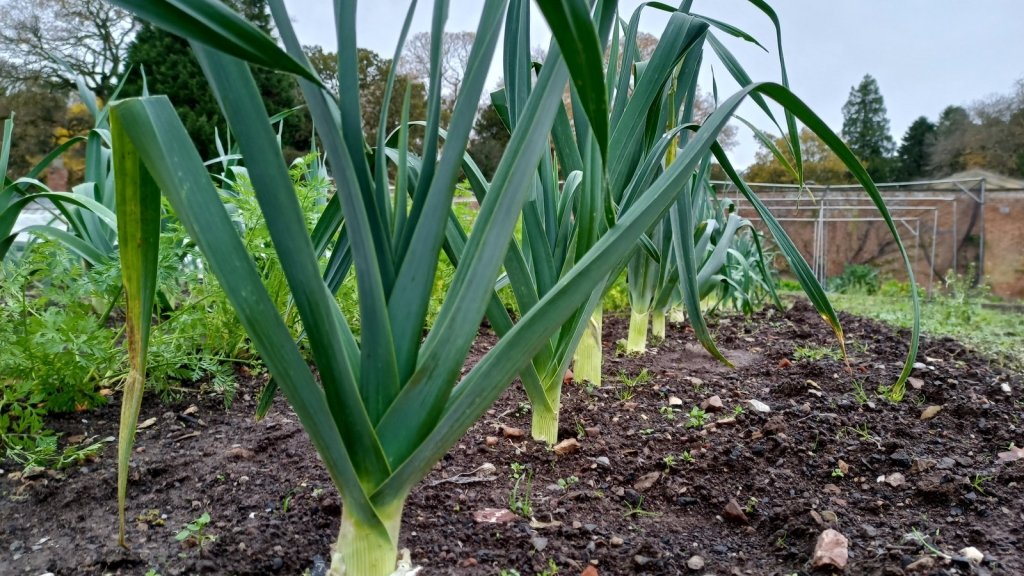

Leeks are a long crop rather than a difficult one. Sow in autumn in most of the country, or in spring in the coldest districts, raise the seedlings somewhere you can watch them, plant them deep into a hole rather than a furrow, then water and feed steadily for months. Most leeks that disappoint were not beaten by a pest. They were planted too shallow, or crowded, or allowed to dry out halfway through.
Pick a variety, then pick your season
For an autumn sowing headed into winter, an old open pollinated type does everything you need, but none of them are bolt proof, so the choice matters most in cold districts.
Giant Musselburgh (sold here as Giant Musselburg) and American Flag are the long-standing names, and the New South Wales Department of Primary Industries leek growing guide lists Musselburgh and London Flag as the most popular varieties in that state. Bulgarian Giant is an earlier, long-stemmed type and Elephant the heavier one, and the Western Australian Department of Agriculture and Food is blunt about Elephant: its farmnote on growing leeks in Western Australia says open pollinated varieties such as Elephant have been industry mainstays for years, but that they are prone to bolting. Carentan is a shorter, thicker French heirloom, listed by Happy Valley Seeds as an organic line as well. Compare them in the leek seeds collection.
When to sow leeks across Australia
In most of the country the autumn sowing is the one that matters: seed down from about February to May, plants out by late autumn, full-sized shanks pulled from late winter through spring, with the earliest sowings and any leeks you pull young coming in during winter itself. The coldest districts sow in spring instead.
- Tropical (the Top End around Darwin and Katherine, far north Queensland around Cairns and Townsville, the Kimberley in Western Australia). A dry season crop. Sow once the wet has finished and clear the bed before the humidity returns, because the NSW guide puts the best growing range at 13°C to 24°C and the WA farmnote notes good quality is harder to get in hot climates.
- Subtropical (south east Queensland from Brisbane to the Sunshine Coast, the Northern Rivers of New South Wales). The NSW guide gives February to May for coastal and inland districts, and the cooler end of that window, April to May, suits the subtropics. Aim to finish before the heat returns.
- Arid and semi-arid (Alice Springs in the Northern Territory, Broken Hill in New South Wales, Mildura in Victoria, Kalgoorlie in Western Australia, central west Queensland, the South Australian pastoral country). The cool months are the growing season, and water is the limiting factor rather than frost. Sow from late summer into autumn, mulch heavily, and water deeply.
- Temperate (Sydney, Newcastle and the Central Coast, the New South Wales coast and inland slopes, coastal Victoria, and Melbourne and Geelong at the cold end of the zone). February to May is the NSW window. Sow at the February to March end for full-sized leeks by late winter, and later in the window for a spring harvest.
- Mediterranean (Perth and the south west of Western Australia, Adelaide, the Fleurieu Peninsula and the South Australian gulf districts). A mild wet winter suits leeks better than almost anywhere. The WA farmnote gives April to November as the main production season, says seed may be planted from May to February, and notes the crop is grown all year round in the Perth metropolitan area.
- Cool and alpine (Tasmania including Hobart and the highlands, the Victorian high country and Ballarat, the New South Wales tablelands including Orange, Bathurst and Armidale, Canberra and the Australian Capital Territory, and Stanthorpe on the Queensland Granite Belt). The NSW guide puts tableland planting at September to December. An autumn sowing here leaves a half-grown plant sitting through a cold winter, which is the situation most likely to end in a flower stalk.
These zones are broad groupings. If you garden between two of them, or high up in an otherwise warm district, lean on your own first and last frost dates rather than the label, and check your state department of primary industries guide for local timing.
Seedlings in a tray, or sown where they will grow
Raising seedlings gives you accurate spacing and a much deeper plant. Sowing in place saves the work but gives a shorter white shank unless you leave room between rows to earth up.
For the tray or nursery bed, the NSW guide says to sow 1 cm deep in rows 10 to 15 cm apart, and to transplant when the plants are almost pencil thick and about 20 cm high. The WA farmnote gives 15 cm high, and notes that cell grown seedlings establish more quickly, with fewer losses in hot weather, than bare root seedlings lifted from a seedbed. Either way the nursery stage is long, at 8 to 16 weeks before planting out.
For direct sowing, the NSW guide describes two systems: close rows about 30 cm apart, where earthing up is not possible and the shanks come out shorter, or rows 45 to 50 cm apart so the shanks can be blanched by earthing up. Plants need to be at least 10 cm apart to make a shank of reasonable size.
Planting out: the dibber hole, and whether to trim anything

The dibber hole is the whole trick. Make a hole 10 to 15 cm deep with a thick stick or a trowel handle, drop the seedling in so the leaves sit just above ground level, and do not fill the hole with soil.
The WA farmnote says transplants should be planted 10 to 15 cm deep in holes made by hand or machine, and that this deep planting gives increased length of white stem. It also records that in Perth the holes are often not filled in immediately, because that can choke the plants, and that normal frequent irrigation replaces soil gradually around the stems. At home you do the same with a watering can: water into the hole so a little soil washes down around the roots, then leave the rest to fill itself over the following weeks. That is puddling in. The buried stem is what stays white and tender, and anything above the soil turns green and tough. Our guide to planting out seedlings covers the rest of the transplanting routine, with its punnet-depth rule swapped for the deep hole described here.
Do you need to trim the roots and tops? Shortening the leaves helps a bare root seedling stand up and settle, and the WA farmnote says bare root transplants are normally topped to ensure better establishment. It says nothing about cutting the roots, and we could not find Australian trial work showing that root trimming improves the crop. A cell raised seedling that lifts with its root ball intact needs neither treatment. Treat trimming as a handling convenience, not a yield decision.
Hilling and trench planting do the same job of keeping light off the lower stem. The NSW guide describes trenches about 23 cm deep and 60 cm apart, seedlings 15 to 18 cm apart along the row, filled in gradually as the plants grow, and notes that this banking up can suppress weeds on its own. The simpler version is to plant at normal depth and draw soil up every few weeks, against the stem rather than into the fan of leaves, because grit between the leaf bases is hard to wash out later.
Spacing is how you choose the shank you get

Closer spacing gives more leeks and thinner ones. Wider spacing gives fewer and thicker. The NSW guide sets the floor at 10 cm between plants, and the WA farmnote describes the commercial layout as rows 40 cm apart with about 20 cm between plants, producing a leek with a white shank of 10 to 20 cm, a diameter of 2 to 5 cm and a weight of 200 to 300 g. In a home bed, 15 cm is a fair compromise. You can also plant tight and pull every second one young: on Gardening Australia, Sophie Thomson notes leeks can be harvested fat and large, or young and about the size of a spring onion.
Water and feeding
Leeks want the soil moist the whole way through and a steady trickle of nitrogen rather than one big feed at planting.
The NSW guide explains the watering habit. Leeks have a fibrous root system and the roots develop from the base of the plant, so periodic wetting of the base is needed to encourage a large number of roots, and by four months those roots reach 45 to 60 cm deep. Its rule is short: water often enough to keep the soil moist and so avoid any check to growth. That means a long soak rather than a daily splash, and our guide to watering vegetables deeply is worth a read if your bed dries out fast.
For feeding, the NSW guide says to side dress with nitrogen if growth lacks vigour and is not bright green, while the WA farmnote describes weekly top dressings of nitrogen and potassium for a commercial crop. The home version is compost worked in before planting, then a fortnightly liquid feed such as a fish and seaweed blend once the plants are away. One caution at the point of action: the NSW guide warns against applying manure and blood and bone immediately before planting, because they attract the corn seed fly, whose larvae attack germinating seeds. Get the manure in with the previous crop instead. Both guides want a deep, friable, well drained soil that is not acid, with NSW putting the target at pH 6 or higher.
How long it really takes
Allow five to six months from planting out, and longer again from seed for a full-sized shank. The NSW guide says leeks are harvested mostly 5 to 6 months after planting, and the WA farmnote is longer at 21 to 30 weeks from transplanting on top of the nursery stage. The Gardening Australia plant finder gives 16 to 22 weeks, closer to the size most home gardeners actually pull. Nothing goes wrong if you harvest early, but the bed is tied up for a long time, which is why both guides treat weeding as a serious job for this crop.
Bolting, and what actually causes it
Cold is the trigger, not a dry week. Leeks are biennial, and cold acting on a plant that has more than a handful of leaves sets it up to flower the following spring. The NSW guide says leeks, like onions, are induced to bolt by low winter temperatures, and the WA farmnote says they are quite frost tolerant but may flower in spring following low winter temperatures.
Controlled-environment research fills in the mechanism. In growth chamber experiments on three leek cultivars, published in Scientia Horticulturae in 1994, the juvenile phase ended at about 2 g or five visible leaves, below which cold did not induce flowering. The inductive range ran from 0°C to 18°C with an optimum near 5°C, and temperatures above 18°C reversed the effect. That work was done in the northern hemisphere, so treat it as the mechanism rather than as Australian timing.
Three things follow. A plant already well grown going into a cold winter is the one at risk, which is the argument for spring sowing in the tablelands and alpine districts. A check to growth is not the trigger in itself: a dry spell gives you a thinner, tougher leek, which is why the NSW guide tells you to avoid one, but the flower stem comes from cold acting on a plant big enough to respond. And variety matters, which is where the note about Elephant earns its place. If a stem does run up the middle, the core turns woody, so pull that plant and use what is still tender around it. This is a different problem from an onion that refuses to bulb, which is driven by day length: leeks do not form bulbs at all, as our article on onions not forming bulbs explains.
Rust, and the diseases you will actually meet here
Rust is worth knowing about, but the specific leek rust that plagues British gardens has not been found in Australia, and the allium rust that is here was recorded in that work on shallots, garlic, Welsh onion and chives rather than on leeks. A Hort Innovation project, Classification of the onion rust complex, assembled rust specimens from South Australia, Tasmania, Victoria, New South Wales and Queensland on hosts including shallots, garlic and Welsh onion, and confirmed two genetic lineages within the Puccinia allii complex as present here. It concluded that Puccinia porri, the species responsible for leek rust in Europe, was absent from Australia, describing it as one of the few common allium rusts in the world that is genuinely not here.
That changes the label more than the practice. The project summarises control as clean seed plus reducing the amount of spore around, by removing diseased crop residue, infected volunteer plants, older diseased plantings and weedy onion relatives, and notes that infection is favoured by cool, wet conditions. In a garden that means room for air to move between plants, watering at the base rather than over the leaves where you can, and not following leeks with garlic or onions in the same bed season after season.
The diseases the WA farmnote actually names for leeks are different again: downy mildew (Peronospora destructor) as the most common, bacterial soft rot in autumn and the cooler months, and Fusarium basal rot occasionally, which is the one that calls for a rotation out of alliums.
Pests worth watching
The risks sit on young seedlings rather than the mature crop. The WA farmnote says few problems are experienced with pests in leeks, but that thrips and snails can cause significant damage to young seedlings in large numbers, with onion seedling maggot, two spotted mite and grubs turning up occasionally. The Gardening Australia plant finder also calls leeks generally pest free apart from the odd snail. So put the effort into the nursery stage. Thrips damage shows as silvery-white patches on leaves, which is how Business Queensland describes thrips feeding in crops more broadly.
Onion maggot needs a moment, because the name covers two flies. The true onion fly (Delia antiqua), which bores into allium bulbs and roots overseas, is exotic to Australia according to the AUSVEG exotic pest profile, which notes the fly established here is Delia platura, called seed corn maggot or onion maggot, with a much wider host range. It is the same group of insect behind the manure warning above, so the control is a timing decision rather than a spray.
Harvesting through winter, and using the bed as storage

Leave them in the ground and pull them as you need them. That is the leek's best trick. The NSW guide explains why it works: unlike onions, leeks do not form bulbs and have no rest period, so they can be harvested over a long time, and the WA farmnote adds that they are quite frost tolerant.
- Loosen before you pull. Commercial harvest, in the WA guide, is hand pulling after a blade has passed under the bed to cut the roots, and the NSW guide explains why: leeks sit deeper than onions and their roots are more active and matted at harvest. A fork under the row does the same job.
- Trim and wash properly. That guide trims the roots, strips the excess outer sheaths, cuts the tops back to leave about 10 to 15 cm of leaf, then washes thoroughly.
- Watch the calendar in spring. Leeks left standing after a cold winter will eventually run to flower, so clear the bed before that rather than be caught out. If you do lift a batch, the NSW guide gives up to three months at 0°C and 90 to 95 per cent relative humidity, and a home fridge is warmer and drier than that.
A second year, and saving seed
A leek carries into a second year, because it is biennial, but you are choosing seed over dinner. The WA farmnote describes leeks as biennial though grown as a short-lived annual in commercial cropping, and the same winter cold that causes an unwanted bolt is what a seed saver wants, so a plant left standing usually throws a flower stem in spring. The shank is finished as food once that stem runs up the centre. Different leek varieties flowering together can also cross, so if you want one to come true, let a single variety flower and pull the rest before they get there. Leek is Allium ampeloprasum var. porrum, and saved seed is worth labelling carefully.
Where to start
If you are planning an autumn bed, the leeks go in first, because they are the slowest thing in it to finish. Pick a variety from the leek seeds collection, start the seedlings while the soil is still warm, and fill the rest of the bed from the autumn and winter seeds collection. Our guide to winter vegetables by climate zone covers what can share the space while the leeks take their time.