
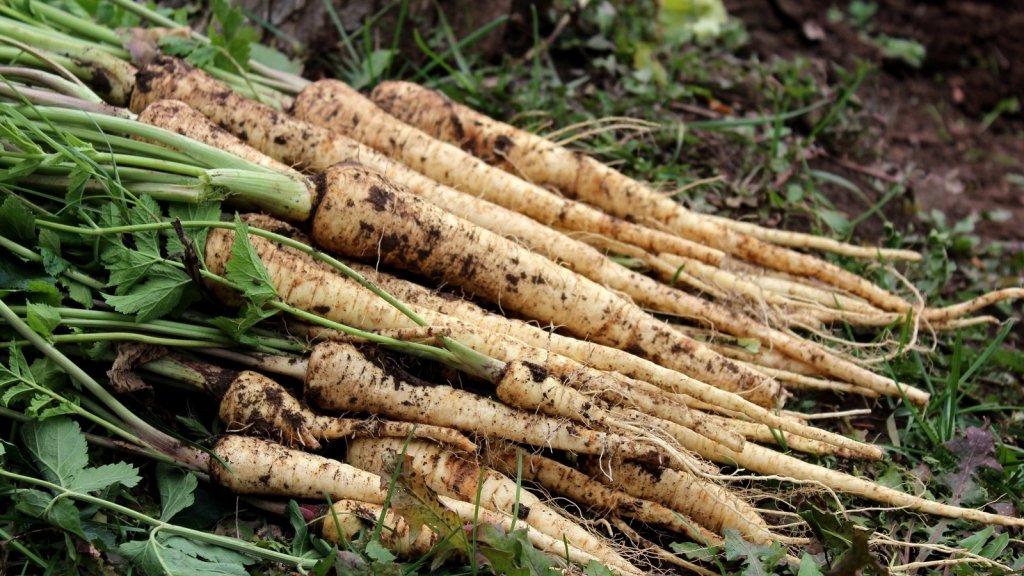

Parsnips have the worst germination reputation of any common vegetable, and most of it is earned. Nearly every failure traces back to one of three things: seed that was too old, a seedbed that dried out during the weeks the seed needed, or ground that was too shallow, too stony or fed too recently. Sort those out and parsnips ask almost nothing of you until you dig them.
The five things that decide a parsnip crop
- Fresh seed, and the whole packet used this season.
- Sown straight into the bed, never raised in punnets.
- Deep, stone-free soil that was improved last season rather than last week.
- A damp surface held for the full two to four weeks the seed takes to come up.
- Early thinning, then patience until the cold arrives.
Start with fresh seed, and use all of it
Parsnip seed is among the shortest lived of any vegetable seed, and that is the single biggest reason a row never appears. The University of Saskatchewan puts its life expectancy at about one year in good storage, Utah State University Extension says vigour drops away rapidly after one year, and the Royal Horticultural Society tells growers to buy only enough for the current year.
So do not ration a packet across two seasons. Sow the lot, and treat that generosity as part of the method. If you do have older seed, our guide to how long seeds last and how to test them shows you how to check before you commit a bed to it.
Sow direct, never into punnets
The parsnip you eat is the taproot itself, so anything that checks that root turns up on the plate as a fork, a stump or a twist. The RHS states plainly that sowing indoors is not recommended, because parsnips form a taproot that does not transplant well. Trays, peat pots and shuffling a spare seedling into a gap all give the same shapes, and you cannot patch a gappy row either, so resow the gap instead. Our direct sowing guide covers the general technique.
Prepare the bed before you sow

Straight roots come from soil with nothing in the way. Pick an open, sunny spot with deep, free-draining ground, fork it to at least 30 cm, break up the clods and pick out the stones. A stone, a clay lump, a compaction pan or a piece of half-rotted material will each divert the tip of the root, so the fork you find in winter was decided on the day you sowed.
The manure warning is usually stated too loosely. The RHS advice is to avoid digging in any organic matter immediately before sowing, because fresh compost can branch a root just as fresh manure does. Ground improved the previous season is the ideal. The University of Saskatchewan puts crooked and forked roots down mainly to hard, compacted soil, or to sowing thickly and never thinning. The honest ranking is compaction and stones first, recently dug lumpy material second, a heavy nitrogen feed third.
In shallow, stony or heavy ground, match the variety to the soil. Among parsnip varieties, White Gem is described as short rooted and broad shouldered and suited to most soils, while Hollow Crown is a long heirloom reaching around 30 cm that wants the depth. A raised bed of lighter soil is the other answer.
Sowing, and the weeks that decide everything
Depth and spacing
Sow about 1 cm deep, and never more than 2 cm. The RHS recommends a 1 cm drill with rows 30 cm apart, and Utah State University Extension goes shallower at about 6 mm, thinning to 8 cm to 15 cm apart. Sowing too deep is a common and entirely avoidable cause of an empty row.
Station sowing makes the rest easier. Drop three seeds at each final spacing, about 15 cm apart, then thin each station to the strongest seedling. You get the right spacing without thinning a whole row, and a failed station is easy to resow.
How long germination really takes
The soil temperature tables compiled by J. F. Harrington and published by Oregon State University Extension give parsnip a minimum of about 2°C, an optimum range of about 10°C to 21°C and a maximum of about 29°C. Days to emergence from seed sown 12 mm deep: about 27 days at 10°C, 19 at 15°C, 14 at 20°C, 15 at 25°C, 32 at 30°C, and little or no germination at 35°C.
That table holds the whole strategy. A fortnight is the best you will ever do, three to four weeks is normal, and sowing into hot summer soil is futile rather than slow.
Keeping the surface damp the whole time
This is where most crops are lost. The seed must not dry out at any point in those three weeks, and a crusted surface will stop seedlings that have already germinated.
- Water the drill before sowing, then cover the seed with sieved compost or seed raising mix, so the surface cannot cap.
- Lay a plank, hessian or shade cloth flat along the row and lift it every day or two, then take it off the moment the first seedlings show.
- Mulch thickly either side of the row and only dust the row itself, which is how the grower in this Sustainable Gardening Australia account from the New South Wales Southern Highlands cuts down the watering.
- Sow a few radish seeds along the drill. They are up in days and mark the row, so you know where to water and what not to hoe.
- In warm weather, water lightly once or twice a day. A hard blast from the hose washes seed out of the drill.
Thinning
Thin once the seedlings have their first true leaves, to 8 cm to 15 cm apart. Crowded parsnips stay slender and wind around one another, and spacing is your main lever over final size. It is the step most often skipped, which our guide to thinning carrots, beetroot and radish goes into properly.
When to sow, zone by zone
Parsnip wants cool soil at sowing and cool weather at harvest, with roughly 17 to 20 weeks in between. The Australian months below come from the Gardenate parsnip planting calendar unless noted otherwise.
- Tropical (Darwin and the Top End of the Northern Territory, Cairns and Townsville in far north Queensland, the Kimberley in Western Australia): Gardenate lists no sowing month at all here, and the temperature table explains why, since there is little or no germination near 35°C. Parsnips are not worth the bed space. The coolest dry season weeks in a shaded, mulched bed are the only realistic try, and a fast root crop such as radish will reward you far better.
- Subtropical (Brisbane, the Sunshine Coast and the Gold Coast, Coffs Harbour and the northern rivers of New South Wales, and Toowoomba on the Darling Downs where nights are colder): sow June to October, starting early in that window so the roots have size before spring heat. Expect less sweetening than southern gardeners get, because subtropical winters rarely hold below 5°C for long.
- Arid and semi-arid (Alice Springs in the Northern Territory, Broken Hill and Dubbo in New South Wales, Mildura in Victoria, Kalgoorlie in Western Australia, and inland South Australia and Queensland): sow April to November. The window is generous, the seedbed is the hard part, because these soils can dry out in a morning and some sands turn water repellent. A cover over the row, afternoon shade and a wetting agent on hydrophobic sand decide whether you get a row at all.
- Temperate (Sydney, Newcastle and the New South Wales coast, Melbourne, Geelong and coastal Victoria): sow August to December. Spring sowings size up through summer and autumn, then sit in the ground through winter, which is the easiest way to run the crop.
- Mediterranean (Perth and the south west of Western Australia, Adelaide and the Adelaide plains in South Australia): Green Adelaide lists parsnip for September through to March, and not April to August, which fits a crop that wants soil at 10°C or more to come up in reasonable time and cool weather to finish. The deep sands around Perth grow beautifully straight roots but drain within a day, so the damp seedbed matters more here than anywhere.
- Cool and alpine (Hobart and Tasmania, Canberra and the ACT, Ballarat and the Victorian high country, Orange, Bathurst and Armidale on the New South Wales tablelands, and Stanthorpe in southern Queensland): sow September to December. This zone gets the full benefit of cold sweetening, and the Southern Highlands grower above sows in September and harvests from March through autumn and winter.
These zones are broad groupings. If you garden between two of them, or high up in a warm region, lean on local cues rather than the calendar: your own first and last frost dates, and the temperature in the top few centimetres of the bed.
Harvest, and why the cold makes them sweet

Roots are usually ready roughly 17 to 20 weeks from sowing. Utah State University Extension puts maturity at 100 to 120 days, the University of Saskatchewan at about 120 days or more. You can pull once the shoulders are a few centimetres across, but flavour runs on a different clock from size.
The frost story is mostly true, with one correction worth having: what sweetens a parsnip is sustained cold, not the frost event. Working on the variety White King, Bufler and Horneburg measured both halves of it. In the season when air temperature fell below 5°C for 12 days in the last eight weeks before harvest, starch in the root dropped significantly and total sugar rose significantly. In the season when it never fell below 5°C, neither changed. In cold storage at 1°C, starch was almost completely depleted over 24 weeks while sucrose at least doubled, with the starch-digesting enzyme alpha-amylase doubling in activity over the first eight weeks. A separate long-term storage study by Ilic and Sunic tracked starch falling from about 5 per cent at harvest to 0.04 per cent, with sucrose the dominant sugar at 8.5 to 10 per cent.
So a light frost in a mild week does very little, while a fortnight of genuinely cold nights does a great deal. Mild-winter gardeners are not locked out either, since several weeks in the coldest part of the fridge works on the same conversion.
Leaving the roots in the ground
Parsnips keep well in the soil, and Australian ground almost never freezes hard enough to stop you digging. Leave them there and lift as you need them, but mark the row with canes before the tops die down, because a bare winter bed hides its own crop. Two limits apply. Roots can rot around the shoulders late in winter, with slugs and snails part of it, so keep water from pooling around the crowns. And a parsnip is a biennial, so once it throws a flower stalk in spring the core turns woody. Clear the bed before then, and if a root does go woody the flesh around the core is still good.
The problems worth knowing about
Canker
Canker is the main disease of parsnip. The Pacific Northwest Pest Management Handbooks describe reddish-brown to blackish cankers on the shoulders and crowns, caused by the fungus Itersonilia perplexans and favoured by cool, moist conditions. The controls are all cultural: long rotations, well-drained ground without a compaction pan, hilling soil over the shoulders through the season, and preventing anything that wounds the roots. The RHS adds a useful detail, which is to hand weed rather than hoe near the crowns, because a nick in the top of a root opens the way in.
Almost all the published work on parsnip canker comes from Britain, Europe and North America, where parsnip is a major field crop. We did not find an Australian survey of it in home gardens, so treat those measures as sound general practice rather than a local diagnosis. If roots rot from the shoulders down in a wet winter, drainage and covered shoulders are the first things to change. Of the varieties we sell, White Gem is described as having good canker resistance.
Carrot fly, which Australia does not have
Overseas parsnip guides give a lot of space to carrot fly, and the advice does not transfer. Carrot rust fly (Chamaepsila rosae, formerly Psila rosae) does attack parsnip along with carrot, celery, celeriac, dill, fennel and parsley, but AUSVEG states that Australia is free of it and treats it as a High Priority Plant Pest, so there is nothing here to spray for. If you ever did see classic rusty tunnelling, photograph it and call the Plant Health Australia Exotic Plant Pest Hotline on 1800 084 881 rather than reach for a chemical. Slugs and snails will take young parsnip seedlings, and our guide to carrot fly and what really damages Australian carrots covers the pests that actually do the damage in Australian root beds, vegetable weevil, cutworm, wireworm and root-knot nematode, and answers the parsnip question directly.
Wear gloves and long sleeves around the tops
Parsnip foliage is worth respecting. The leaves and stems contain furanocoumarins, and DermNet lists Pastinaca sativa among the common causes of phytophotodermatitis, a phototoxic reaction that follows plant sap on the skin and then sunlight. Redness and blistering appear roughly 24 to 48 hours later, and the pigmentation left behind can last for years. DermNet names gardeners and vegetable pickers among those at risk, and notes that the occupational form is avoided by wearing suitable gloves.
The University of Saskatchewan gives the same advice for harvest: long sleeves, long trousers and gloves. Apply it whenever you are cutting tops, weeding among mature plants or clearing the bed, and take more care rather than less on a bright day, because sunlight is the second half of the reaction. If sap does reach your skin, keep the area covered and out of the sun, and see a doctor if blistering or a widespread rash develops.
Common questions
Nothing came up at all. What went wrong?
Work through four causes in order: seed older than a season, a surface that dried out at some point in those three weeks, seed buried deeper than 2 cm, or soil too hot at sowing. The first two account for most empty rows.
Can I save my own parsnip seed?
Yes, and freshness is exactly the reason to. Parsnip is a biennial, so leave three or four roots in the ground to flower in their second spring and collect the seed once the heads are dry. Keep them well away from any other parsnip variety flowering nearby, since different varieties of the same species will cross.
Where to start
If parsnips have beaten you before, change one thing first: buy a fresh packet for this season and sow the lot, in stations, under a plank. That single change fixes more failed rows than anything else. Our parsnip seeds include a long heirloom for deep beds and a short, broad-shouldered type for the stony or shallow ground most of us are actually working with.