
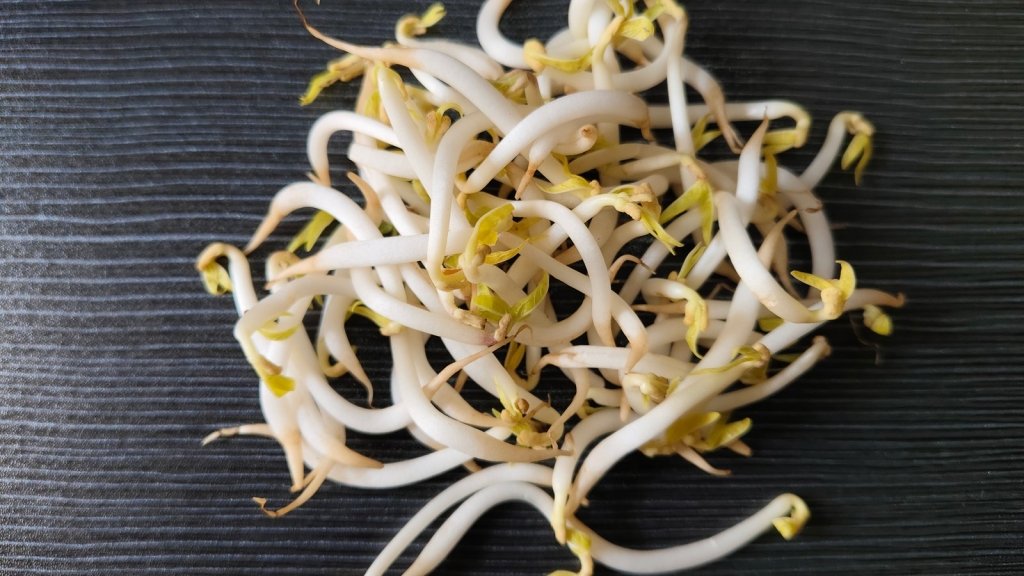
The short version: Shop style bean sprouts are fat and white because they are grown in complete darkness, under a steady weight, and picked young. Soak two to four hours in warm water, or overnight, drain hard, hold them at 21°C to 27°C, keep light off them, press the bean mass with a plate, rinse every four to six hours while you are awake, and harvest around day four or five. Light turns them green and bitter, no weight leaves them thin, and extra days make them stringy.
Most people who already sprout have the same complaint about mung beans: the jar produces something pale green and wispy, nothing like the plump, squeaky bean shoots from the greengrocer. The seed is fine. The conditions are not.

Why the shop sprout is fat and white
Commercial bean sprouts are thick and pale because of three settings rather than a special seed: total darkness, constant pressure on the bean mass, and an early cut.
Miss the dark and the seedling makes chlorophyll, opens its leaves and builds a shorter, tougher stem. Miss the weight and it has nothing to push against, so it stays thin. Leave it past about five days and the root runs away, which graders count as a fault.
Mung bean, and what counts as a bean sprout
The sprout in a stir fry is the germinated seed of mung bean (Vigna radiata), a small green summer legume grown commercially in Queensland and northern New South Wales.

Food Standards Australia New Zealand sorts seed sprouts into three groups: green sprouts such as alfalfa, onion and radish, bean sprouts, also sold as bean shoots, which are mostly mung bean, and shoots such as snow pea shoots.
Two names cause trouble. Bean shoots on an Australian punnet are mung bean sprouts under another name. Pea shoots and sunflower shoots are not: they are the third group, grown in light and cut with their leaves on. Soy bean sprouts are a different species again, with a big yellow head, and they are normally cooked, never eaten raw.
The method, start to finish
Soak, drain hard, rinse often and keep the beans warm: that is the whole method, and it runs about five days. Use Mung Bean Seeds (Sprout) from the sprouting seeds range, and only enough dry beans to cover the base of the container.
Soak for two to four hours in warm water at around 32°C to 35°C, or overnight at room temperature, around 20°C to 22°C. Then drain and pick a container:
- A wide mouth jar with mesh: easiest for one meal, hardest to weight.
- A colander inside a bowl: the best home compromise, easy to rinse and press.
- A food grade bucket with holes in the base: worth it for a tray a week.
Whatever you use must drain completely, because a centimetre of standing water sours a batch faster than anything else. Rinse with cool water every four to six hours and hold the beans between 21°C and 27°C.
The frequent rinsing is not fussiness. Germinating beans respire hard and give off real heat, and mung bean respiration climbs sharply as temperature rises, so a warm mass gets warmer on its own. Rinsing carries that heat away.

Growing in the dark, and why it matters more here
Darkness matters more for mung beans than for alfalfa, because here the swollen stem is the food and the leaf is the problem. Alfalfa growers often finish with a deliberate day of light to green the tops. Do that to a mung bean and you have undone the work.
Studies disagree on whether light raises or lowers the polyphenols in a mung bean sprout. What is not in dispute is that light greens the tips, opens the seed leaves and shortens the stem, and that a green tipped bean sprout tastes grassy where a white one tastes sweet.
A closed cupboard is the easiest answer, and a cardboard box over the colander works as well. A glass jar on a windowsill under a thin tea towel still catches enough light to green the tips.
The weight trick, explained honestly
Pressing the bean mass with a weight is what thickens the sprouts, and the mechanism is a plant hormone rather than squashing. A dark grown seedling that meets resistance, whether a crust of soil or a saucer on top, releases ethylene.
Ethylene causes a well documented change in dark grown seedlings: the stem slows its stretch and thickens instead, root growth slows, and the seedling ends up stronger rather than taller. It is the same reaction that shoulders a real seedling up through hard ground, and commercial growers use it deliberately, adding weights a day or two after growth starts.
At home, sit a small plate flat on the beans and stand a jar of water on it. Published figures for commercial beds range from about half a gram to a few grams per square centimetre, so 2 grams is a fair middle: roughly 100 g across a large jar mouth, or several hundred grams across a 20 centimetre colander. Add it on day two, and lift the plate and the weight off for every rinse, then put them back once the beans have drained.
A few hundred grams of beans cannot press on itself the way a commercial bed does, so expect sprouts noticeably fatter than an unweighted jar rather than an exact match for the shop.
Harvest, hulling and keeping them crisp
Harvest at about four to five days, while the stem is still smooth and the root short. The sprouts should snap rather than bend.
Then deal with the hulls. Tip the lot into a big bowl of cold water and swirl it. The green seed coats lift off and spin on the surface, where you can pour them away while the sprouts sink. Nobody enjoys picking hulls off one at a time.
Drain hard, then dry on a tea towel or in a salad spinner, because wet sprouts sealed in a container go slimy fast. Store at 5°C or below. Commercial sprouts held near 0°C keep about a week, so a home fridge gives you a few days.
Cooking them, and the raw sprout question
Bean sprouts suit a very short cook or none at all, because heat collapses their cell walls quickly and a minute too long turns squeak into sog. Add them to a hot wok at the very end and toss twice, or dress them raw with lime, chilli and torn coriander.
Raw sprouts of every kind carry a genuine food safety history. The warm, moist conditions that suit a germinating bean suit Salmonella, E. coli and Listeria just as well, and the NSW Food Authority names alfalfa, mung bean and clover as the sprouts most often linked to food poisoning. Most sprout outbreaks trace back to the seed rather than the kitchen, which is why commercial growers have to decontaminate seed before sprouting it. One of Australia's largest outbreaks from a single food was traced to commercially grown mung bean sprouts in South Australia in 2016, with more than 400 people ill. Clean hands, clean containers, honest rinsing and cold storage all lower the risk, but rinsing keeps a batch fresh rather than washing out bacteria that entered during germination, and no home setup makes sprouts bacteria free. Note the tension with that quick toss: if you are pregnant, under five, over 70 or immunocompromised, the NSW Food Authority says not to eat raw or lightly cooked, still crunchy sprouts at all, and the quick toss above does not count. Cooked right through, until steaming hot and soft, they are safe to eat.

Across Australia's climate zones
Your zone changes how often you rinse and how fast a batch goes wrong, not what you sow or when. Food poisoning bacteria grow between 5°C and 60°C and multiply fastest near 37°C, so a warm kitchen speeds the beans and everything else in the jar. Cold slows most of them, although Listeria keeps growing slowly in the fridge, which is why home sprouts are a use within days food rather than a keep for a week one.
- Tropical (northern WA, the NT Top End and far north QLD): a Darwin bench in the wet sits far closer to that 37°C peak. Rinse at the short end, use cool water, and pick on day three or four.
- Subtropical (south east QLD and northern NSW): a humid Brisbane or Coffs Harbour summer behaves much the same way, so rinse three times on the hot days and do not let the beans sit wet.
- Arid and semi-arid (inland NSW, SA, WA and central QLD): hot afternoons, cool nights. Use the coolest interior cupboard you have.
- Temperate (coastal and eastern NSW, VIC): comfortable most of the year, although Melbourne sits at the cold end of this zone and may want a warmer corner in winter.
- Mediterranean (Perth and southern WA, Adelaide and southern SA): tropical advice through summer, temperate advice through the mild wet winter.
- Cool and alpine (TAS, the southern tablelands, the Victorian high country, and Canberra and the ACT): a Hobart or Canberra kitchen in winter often sits below the 21°C the beans prefer, so batches take an extra day. Slow, not sour, is the limit here.
The payoff is a snap the supermarket punnet has usually lost by the time you open it, for the price of a handful of dry beans. Mung Bean Seeds (Sprout) sit in the sprouting seeds collection, with larger sprouting packs for a weekly colander.
Frequently asked questions
Why are my mung bean sprouts green and thin?
Light and no weight. Light tells the seedling it has reached the surface, so it stops stretching and greens up, and an unweighted pile has nothing to push against, so it never thickens.
How long do mung bean sprouts take to grow?
About four to five days from the end of the soak, held between 21°C and 27°C. A tropical kitchen in summer can be ready on day three, a cool or alpine one in winter on day six.
Do I really need to put a weight on them?
Not for edible sprouts, but yes for the thick shop style stem. Resistance triggers ethylene, which makes the stem swell sideways instead of stretching. A weighted saucer is enough.
Why does the jar smell sour, and can I save it?
A sour or musty smell means the batch warmed up, drainage failed, or both. Official advice is to avoid any sprout that smells musty or has darkened, so tip it out and start again.
Are bean shoots the same as bean sprouts?
Yes. Bean shoots on an Australian punnet are mung bean sprouts under another name. Pea shoots and sunflower shoots are different, grown in light and eaten with their leaves. Soy bean sprouts are a separate species.
How long do home grown bean sprouts keep in the fridge?
A few days, provided they are drained and dried well and stored at 5°C or below. Commercial sprouts held near 0°C last about a week, and a home fridge runs warmer.
Related growing guides
- Broccoli sprouts versus alfalfa sprouts, the green sprouts that suit a salad.
- How to grow microgreens at home, for soil grown crops cut with scissors.
- Asian greens for the stir fry pan, for the rest of the wok.